


Are you ready for the new crypto tax rules in 2025? Many traders lose money by not knowing the tax laws. The IRS has changed how they track digital coins, and you could face big fines if you mess up.
Tax time doesn’t have to be scary if you know what to do.
A recent study shows that 7 out of 10 crypto owners don’t know they can save money on taxes with their crypto losses. This lack of knowledge costs traders thousands of dollars each year.
The IRS is now watching crypto trades more closely than ever before.
This guide will walk you through all the new 2025 crypto tax rules in plain talk. You’ll learn what counts as a taxable event, how to track your cost basis, and ways to pay less tax legally.
Get ready to trade smarter.
Key Takeaways
- Starting January 1, 2025, the IRS will track crypto trades with a new 1099-DA form, making all transactions visible to tax authorities.
- You must pay taxes when you sell crypto for cash, trade one crypto for another, or buy goods with digital coins.
- Long-term capital gains (assets held over one year) are taxed at 0-20%, while short-term gains face higher rates of 10-37%.
- Moving crypto between your own wallets is tax-free, and you can gift up to $19,000 in crypto per person each year without tax impact.
- Staking rewards, mining income, and airdrops count as taxable income when received, not when you sell the coins later.
Key Changes to Crypto Tax Laws in 2025
Big changes are coming to crypto taxes in 2025. The Build Back Better Act will make exchanges report your gains and losses on 1099 forms. This means the IRS will know about your crypto profits.
You can’t hide your trades anymore! A new tax form called 1099-DA will track all your digital asset deals. Exchanges must send these forms in 2026 for your 2025 trades.
Your wallet tracking will change too. Right now, you can use one method to count all your crypto. Starting January 1, 2025, you must track each wallet on its own. This wallet-by-wallet rule might raise your tax bill if you’re not ready.
The tax rates on capital gains stay the same, but how you count them will shift. Smart traders are planning now to avoid tax surprises later.
When Do You Owe Taxes on Cryptocurrency?

Crypto tax rules can hit your wallet if you don’t know when you owe money to Uncle Sam. You must pay taxes on crypto when you sell for cash, trade for other coins, or buy stuff with your digital money.
Taxable events for crypto
The IRS treats crypto like property for tax purposes. You need to know which actions trigger taxes so you don’t get caught off guard.
- Selling crypto for cash creates a taxable event. If you sell Bitcoin for dollars, you must report any profit or loss on your tax return.
- Trading one crypto for another counts as a sale. Swapping Ethereum for Solana means you sold Ethereum in the eyes of the tax law.
- Buying goods or services with crypto is taxable. That pizza you bought with Bitcoin? You need to figure out if you gained or lost money from when you first got that Bitcoin.
- Mining rewards count as income when you get them. The market value on the day you mine becomes your cost basis.
- Staking rewards are taxable as income. The IRS views these earnings like interest from a bank account.
- Getting paid in crypto for work is taxable as regular income. The dollar value on payday is what counts for your taxes.
- Airdrops become taxable when you gain control of the tokens. The market value on that day is your starting point for future gains or losses.
- Hard forks that give you new coins create taxable income. You owe taxes based on the value of new coins when they hit your wallet.
- Margin trading gains from crypto are taxable. These often fall under short-term capital gains rates.
- DeFi interest and yields count as taxable income. Earnings from lending platforms must be reported on your tax form.
Non-taxable crypto transactions
Not all crypto moves trigger a tax bill. You can do several things with your digital coins without owing Uncle Sam a penny.
- Buying crypto with cash doesn’t create a tax event. You can purchase Bitcoin or other digital assets using dollars without tax impacts.
- Moving crypto between your own wallets stays tax-free. The IRS doesn’t count transfers from your Coinbase account to your personal wallet as a taxable event.
- Giving crypto as gifts under $17,000 avoids taxes. You can gift digital assets to friends or family without either party paying taxes, as long as the value stays below the annual gift tax limit.
- Donating crypto to charity can be tax-free. Giving your coins to a valid 501(c)(3) group means no capital gains tax, plus you might get a tax break.
- Holding crypto long-term creates no tax bill. Simply owning digital assets without selling or trading them won’t trigger taxes, no matter how much they grow in value.
- Taking out a crypto-backed loan stays tax-free. Using your coins as loan collateral isn’t a sale, so no taxes apply on these loans.
- Staking crypto without claiming rewards avoids taxes. Some networks let you delay claiming staking rewards, which puts off the tax bill until you actually get the coins.
- Receiving crypto from a hard fork might be tax-free. The rules here can be tricky, but some fork events don’t create taxable income right away.
Crypto Capital Gains Tax
Crypto taxes hit your wallet when you make money from your coins. The IRS treats your crypto profits like stock gains – you’ll pay more if you sell quickly and less if you hold for over a year.
Short-term vs. long-term gains
The tax rate you’ll pay on your crypto profits depends on how long you hold your digital assets before selling them. Let’s break down the key differences between short-term and long-term capital gains.
| Feature | Short-Term Capital Gains | Long-Term Capital Gains |
|---|---|---|
| Holding Period | Less than 1 year | More than 1 year |
| Tax Rate | 10% to 37% (same as ordinary income) | 0% to 20% (preferential rates) |
| Tax Brackets | Follows regular income tax brackets | Based on income level (lower rates) |
| Tax Impact | Higher tax burden | Lower tax burden |
| Best For | Day trading, quick flips | Buy-and-hold strategy |
| Tax Forms | Schedule D, Form 8949 | Schedule D, Form 8949 |
| Example | $10,000 profit taxed at 24% = $2,400 tax | $10,000 profit taxed at 15% = $1,500 tax |
Many traders miss this critical detail. The IRS treats coins or tokens held for less than a year as short-term gains. You’ll pay the same rates as your regular income tax bracket, which can reach up to 37% for high earners.
Patient investors benefit from long-term status. Any digital assets kept for more than 365 days qualify for reduced capital gains rates. These max out at 20% for most people.
The math speaks for itself. On a $10,000 profit, you might save $900 or more just by waiting a full year before selling. This simple timing strategy can cut your tax bill by 30-50%.
Some smart traders plan their sales around tax brackets. They spread out large sales across tax years or time their exits to match lower-income periods.
The tax code rewards patience. For folks in lower income brackets, long-term gains might even qualify for 0% taxation in some cases.
How to calculate capital gains
Figuring out your crypto gains isn’t as hard as it seems. You just need to know the basic math and keep good records of all your trades.
- Find your cost basis for each crypto purchase. This is what you paid plus any fees.
- Track the sale price or value when you trade or sell. This is your “proceeds” amount.
- Subtract your cost basis from your proceeds. The formula is: Proceeds – Cost Basis = Gain or Loss.
- Pick a method for tracking multiple buys. FIFO (First In, First Out) uses your oldest purchases first.
- LIFO (Last In, First Out) uses your newest buys first. This can help in falling markets.
- HIFO (Highest In, First Out) uses your most costly buys first. This often gives the best tax results.
- Apply the method to all your crypto trades. For example, Henry bought BTC at $15,000, $50,000, and $40,000, then sold 1 BTC for $15,000.
- With FIFO, Henry has $0 gain/loss (bought at $15K, sold at $15K).
- Using LIFO, Henry has a $25,000 loss (bought at $40K, sold at $15K).
- With HIFO, Henry gets a $35,000 loss (bought at $50K, sold at $15K).
- Keep all records of your trades. Save dates, amounts, and prices from your crypto exchanges.
- Sort your gains into short-term (held less than a year) and long-term (held more than a year).
- Report your crypto gains on Schedule D and Form 8949 for your tax return.
- Use crypto tax software to make this job easier, especially if you have many trades.
- Ask a tax pro for help with complex cases like DeFi or staking rewards.
Crypto Income Tax
Crypto income taxes hit your wallet in ways you might not expect. Mining rewards, staking income, and those surprise airdrops all count as taxable income at the moment you get them – not when you sell.
Staking rewards and mining income
Staking rewards put money in your pocket when you lock up your crypto to help run a network. The IRS taxes these rewards as ordinary income based on their value when you get them. You must report this cash on your tax forms, just like you would report a paycheck.
Mining income works the same way. If you mine Bitcoin or other coins, you pay taxes on the fair market value of each coin at the time you receive it. Many traders forget to track these values, which leads to tax headaches later.
Your mining gear might qualify for tax write-offs too, helping cut your total tax bill.
Airdrops and hard forks
Got free crypto in your wallet out of nowhere? That’s an airdrop! The IRS sees these surprise gifts as taxable income. You must pay taxes based on what those tokens were worth when you got them.
For example, if you wake up to find 100 tokens worth $10 each, you’ll need to report $1,000 as income on your tax forms. This applies even if you didn’t ask for the tokens.
Hard forks split a blockchain and create new coins. When Bitcoin Cash split from Bitcoin in 2017, Bitcoin owners got equal amounts of the new coin. The IRS taxes these new tokens as income too.
You owe taxes on the fair market value of these new tokens on the day you got them. Many traders miss these tax rules and face problems later. Keep good records of all airdrops and forks to avoid tax headaches.
Getting paid in cryptocurrency
Getting your paycheck in Bitcoin or other crypto brings tax duties you can’t ignore. The IRS sees crypto payments as regular income, not special money. You must report the fair market value of the crypto on the day you get it.
For example, if you receive 0.5 Bitcoin worth $20,000 on payday, that $20,000 counts as taxable income right away. Your boss might use Form 1099-MISC to tell the IRS about these payments.
The tax rate for crypto income matches your normal income tax rate. This rate depends on how much total money you make in a year. The tricky part comes later if you sell that crypto.
Let’s say your 0.5 Bitcoin grows to be worth $25,000 and you sell it. You’ll owe capital gains tax on the $5,000 profit. Many crypto payment apps now track the exact value when you get paid, which helps at tax time.
Keep good records of all crypto pay to avoid tax problems down the road.
Tax-Free Cryptocurrency Transactions
Not all crypto moves cost you tax dollars – learn how gifting, donating, and wallet transfers can keep the IRS away from your digital coins. Read on to discover these money-saving tricks!
Gifting crypto
Giving crypto to friends or family comes with tax perks you should know about. The IRS lets you gift up to $19,000 worth of crypto per person each year without paying any taxes on it.
This gift tax limit for 2025 means you can spread your crypto wealth around tax-free to many people. The person who gets your crypto gift won’t owe taxes when they receive it, but they might pay taxes later if they sell it for a profit.
For big spenders, the rules get even better. You can give away up to $13.61 million in crypto gifts during your lifetime before the gift tax kicks in. This huge tax break makes crypto a smart way to pass wealth to your loved ones.
Just keep good records of when you bought the crypto and how much you paid – the person getting your gift will need this info to figure out their taxes if they sell it later.
Donating cryptocurrency
Crypto gifts to charities can save you money on taxes. You won’t pay capital gains tax on donated crypto, which puts more cash in your pocket. The IRS lets you claim tax deductions based on the fair market value of your crypto gift.
This works best with coins that have gone up in value since you bought them.
Many groups now take Bitcoin and other digital assets as gifts. You’ll need proof of your donation for tax time. Ask the charity for a receipt that shows the date and value of your crypto gift.
This small step will make tax filing much easier and help you claim your full tax break.
Moving crypto between wallets
Good news for crypto traders! Moving your coins from one wallet to another is not a taxable event. The IRS doesn’t see this as selling or trading your crypto. You can shift your Bitcoin from Coinbase to a cold storage wallet without tax worries.
Many folks move their digital money to safer spots to guard against hacks or theft.
Your cost basis stays the same when you move crypto between your own wallets. Just keep good records of these moves. Note the date, amount, and wallet addresses for each transfer. This helps if the IRS asks questions later.
Some tax software tools can track these wallet transfers for you, making tax time less stressful.
Understanding Crypto Tax Forms
The IRS has new tax forms just for crypto in 2025. These forms can seem scary at first, but they help track what you owe on your digital money.
Form 1099-B
Form 1099-B is a tax document you’ll get from crypto exchanges that tracks your trading activity. Major exchanges must send these forms to both you and the IRS. This form shows all your crypto sales and trades during the tax year.
It lists important details like dates, cost basis, and sale prices for each transaction. The IRS uses this info to check if you reported your crypto gains correctly.
You need to match what’s on your 1099-B with your tax return. The form helps you fill out Schedule D for capital gains. If numbers don’t match what the IRS has, you might face questions or an audit.
Keep good records of all your crypto moves, even if you don’t get a 1099-B from smaller platforms. Tax software can help you sort through this paperwork and stay on the right side of crypto tax laws.
Form 1099-MISC
Form 1099-MISC plays a key role in crypto tax reporting. The IRS uses this form to track money you earn from crypto staking and airdrops. You’ll get this form if you made $600 or more from these sources in a tax year.
Crypto platforms must send you this form by January 31 each year. Keep it safe for your tax filing.
The form shows all your “other income” from crypto. This includes those free tokens you got from airdrops. It also covers what you earned from staking your coins. If someone paid you in Bitcoin or other crypto for work, it shows up here too.
The amounts on this form count as regular income, not capital gains. This means you might pay higher tax rates on this money than on your crypto sales.
Form 1099-DA
Starting January 2025, crypto traders will face a big change in tax reporting. The IRS has created Form 1099-DA just for digital assets. This new form will track your crypto moves much like stocks are tracked today.
Crypto exchanges must now tell the IRS about your trades. They will send you this form to help you file taxes right. Gone are the days when crypto trades could fly under the radar.
The form will show your cost basis and profits from crypto sales. This makes it harder to miss reporting taxable events on your tax return. Crypto exchanges like Coinbase and Binance must follow these rules.
They will report all your buys, sells, and trades to the tax folks. If you trade crypto, you need to keep good records of all your moves. This will help match what the exchanges report about your digital asset deals.
How to Report Crypto on Your Taxes
Reporting your crypto trades to the IRS doesn’t have to be a headache. You’ll need to list all your crypto sales on Form 8949 and then transfer those totals to Schedule D on your tax return.
Most tax software now includes crypto sections that walk you through each step of the process.
Reporting capital gains
You must report all crypto capital gains on your taxes using IRS Form 8949. This form asks for details about each crypto sale or trade you made. You’ll need to list the date you got the crypto, when you sold it, your cost basis, and final sale price.
The math is simple: take what you sold it for (proceeds) and subtract what you paid for it (cost basis). The answer shows if you made money or lost money on the deal. For example, if you bought Bitcoin for $10,000 and sold it for $15,000, your gain is $5,000.
Your tax rate depends on how long you owned the crypto before selling. The IRS treats crypto like property, not money. Short-term gains (held less than a year) get taxed at your normal income tax rate.
Long-term gains (held more than a year) get lower tax rates. After filling out Form 8949, you’ll move the totals to Schedule D on your tax return. Keep good records of all crypto trades to make tax time easier.
Reporting crypto income
Got crypto income from staking or mining? You must list it on Schedule 1 of your tax forms. The IRS wants to know about all money you make from digital coins. Report your staking rewards, airdrops, and hard forks in this section.
The amount you report is based on the fair market value on the day you got the crypto.
Business owners who mine crypto or run crypto businesses need Schedule C. This form lets you list both your crypto income and any costs tied to making that income. You can subtract things like computer gear, power bills, and software costs from your crypto profits.
Keep good records of all your crypto income with dates and values. Tax software can help track these details so you don’t miss anything at tax time.
Special Tax Scenarios
Crypto trading comes with special tax rules that can trip up even smart investors. Swapping one coin for another, buying coffee with Bitcoin, and playing in DeFi pools all create tax events you must track.
Crypto-to-crypto trades
Trading one crypto for another counts as a taxable event. The IRS treats this just like selling for cash. Let’s say you swap Bitcoin for Ethereum. You must figure out if you made or lost money on that Bitcoin.
Your profit or loss equals the market value of the Ethereum you got minus what you paid for the Bitcoin. Many traders miss this rule and face tax troubles later. The tax forms need details about each trade, including dates and dollar values at the time of the swap.
Tax rates on these trades depend on how long you owned the first crypto. If you held Bitcoin for over a year before trading it for Ethereum, you pay lower long-term capital gains tax.
Trades on decentralized exchanges like Uniswap still count for taxes. No escaping the tax rules just by staying away from regular exchanges! Smart traders keep perfect records of all crypto-to-crypto moves to avoid headaches at tax time.
Spending crypto on goods or services
Buying stuff with your Bitcoin or Ethereum counts as a sale for tax purposes. The IRS treats this as if you sold your crypto for cash and then used that cash to buy the item. You must pay taxes on any profit based on the fair market value of your crypto at the time you spent it.
For example, if you bought Bitcoin at $10,000 and used it to buy a laptop when Bitcoin was worth $15,000, you have a $5,000 gain to report on your tax forms.
Many crypto fans don’t know this rule and skip reporting these small purchases. This is risky! The tax office now tracks digital assets more closely than ever. You need to keep good records of all crypto spending, even for small items like coffee or clothes.
Apps and tax software can help track these transactions so you don’t face penalties later. The basic rule is simple: if your crypto went up in value before you spent it, you owe taxes on that growth.
Margin and futures trading
Margin and futures trading in crypto works differently than regular buying and selling. With margin trading, you borrow money to make bigger trades than your cash allows. Futures let you bet on crypto prices without owning the actual coins.
Both types create capital gains or losses that you must report to the IRS. The tax rules don’t care if you traded with borrowed money or made bets on future prices – you still owe taxes on profits.
The IRS wants to know about all your crypto margin and futures trades on Form 8949. This form tracks your buy price, sell price, and profit or loss for each trade. Many traders miss these reports because they think only direct coin sales count for taxes.
This mistake can lead to big tax bills later. Keep good records of all your trades, even the complex ones with borrowed funds or futures contracts.
DeFi transactions and liquidity pools
DeFi pools hold your crypto while you earn money. These pools work by you putting your coins in with others. The pool uses these coins to make loans or trades. You get rewards for helping out.
These rewards count as income on your taxes. The IRS wants its cut of what you earn! You must track each time you get these rewards and how much they were worth in dollars on that day.
Trading in DeFi also creates tax bills. If you swap one crypto for another, you might owe capital gains tax. For example, if you trade Bitcoin for Ethereum in a DeFi app, the IRS sees this as selling Bitcoin and buying Ethereum.
You need to figure out if you made money on that Bitcoin. Tax software can help track these swaps. Many DeFi users face big tax surprises because they forget these trades count as taxable events.
How to Minimize Your Crypto Tax Liability
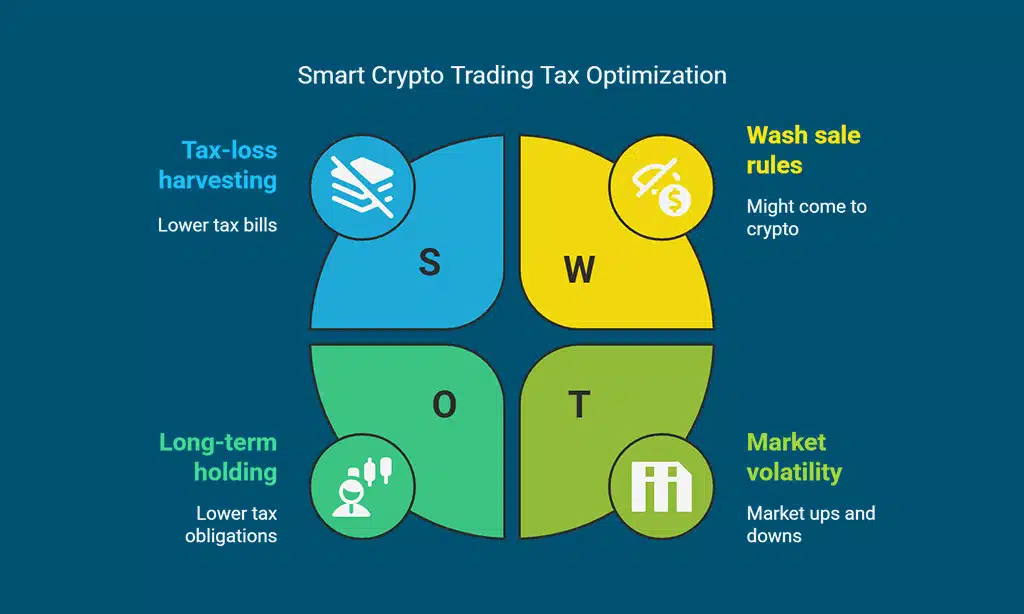
Smart crypto traders cut their tax bills with simple tricks. You can slash what you owe the IRS by timing your sales and using special accounts that shield your gains.
Tax-loss harvesting
Tax-loss harvesting helps smart crypto traders cut their tax bills. You can sell crypto that dropped in value to create losses on paper. These losses then fight against your gains to lower what you owe the IRS.
The tax code lets you offset all your capital gains with losses. You can also use up to $3,000 of extra losses against your regular income each year. Any leftover losses roll to next year.
This move works best in down markets when many coins lose value.
Many crypto fans use this trick near the end of the tax year. You pick coins that fell below what you paid, sell them, and lock in those losses. The key part is timing. You must report all sales on your tax forms.
Some tax software can spot the best coins to sell for this plan. Just watch out for wash sale rules that might come to crypto soon. The right tax-loss plan might save you thousands in taxes while keeping your long-term crypto goals on track.
Holding crypto for the long term
Keeping your crypto for more than a year can save you big money on taxes. The IRS rewards patient investors with lower tax rates. If you hold your Bitcoin, Ethereum, or other digital assets for over 12 months, you’ll pay just 0% to 20% in long-term capital gains taxes.
This rate is much better than the short-term rates that can reach up to 37%. The math is simple: buy, wait a year plus one day, then sell for a lower tax bill.
Smart crypto owners use this tax break as a key part of their plan. You don’t need to jump in and out of the market like a day trader. By sitting tight through market ups and downs, you not only pay less to Uncle Sam but also avoid the stress of timing the market.
Many successful crypto investors follow the “HODL” approach – just hold on and let time work its magic. This patient method works well for people who see potential in the long-term future of crypto assets.
Using retirement accounts for crypto investments
A self-directed IRA offers a smart way to invest in crypto without the tax headaches. You can buy Bitcoin, Ethereum, or other digital assets inside these special accounts. The big plus? You won’t pay taxes on your crypto gains until you take money out at retirement.
This works great for active traders who make lots of swaps that would normally create taxable events. Your crypto can grow tax-free or tax-deferred for years.
The IRS doesn’t touch your crypto profits while they stay in the retirement account. This means no capital gains tax forms to fill out each year. No need to track every trade for tax purposes.
Many investors don’t know about this tax benefit. You simply set up a self-directed IRA with a company that allows crypto holdings. Then you can trade as much as you want without creating a tax bill.
This strategy fits well with long-term crypto investing plans.
How to Handle Crypto Tax Challenges
Crypto tax mistakes can cost you big money and even lead to legal trouble. The IRS has stepped up its game in tracking digital money, so you need a plan for past slip-ups and future reports.
What to do if you forgot to report taxes
Did you miss reporting your crypto on past tax forms? Don’t panic. The IRS offers a way to fix this with Form 1040X. This special form lets you change old tax returns and add crypto trades you left out.
Filing this form shows the tax office you want to play by the rules. Many folks don’t know they need to report all crypto moves, but the IRS is getting better at finding these gaps.
Fix your tax issues fast to avoid big fines. The tax office can track digital coins through the blockchain and crypto platforms. They now get reports from most trading sites. If you wait until they find you first, you might face extra fees or worse trouble.
Smart traders fix their own mistakes early. You can often pay less in fines if you step up before the IRS comes knocking.
IRS tracking of crypto transactions
The IRS doesn’t miss much in the crypto world. They team up with Chainalysis to watch blockchain moves. This partnership lets them see who trades what and when. Major crypto exchanges must send 1099 forms to the IRS about your trades.
These forms show how much money you made or lost. The tax folks can match these forms with what you report on your tax return. If they don’t match, you might get a letter asking why.
Your digital footprints stay on the blockchain forever. The IRS can trace transactions from years ago if they want to check your past tax filings. They look for signs of tax fraud and tax evasion through these records.
Many traders think their crypto stays hidden, but the U.S. tax system has grown smarter about digital assets. The IRS now has tools to find unreported crypto income. They can spot the difference between honest mistakes and people trying to hide taxable income.
Playing it straight with crypto taxes saves headaches later.
Consequences of not reporting crypto taxes
Hiding crypto from the IRS leads to big trouble. The government can charge you with crimes that could land you in prison for up to five years. This isn’t a small risk – it’s real jail time for tax cheats.
On top of that, you might face huge fines up to $250,000. Many traders think they can fly under the radar because crypto feels new and different, but the IRS has clear rules about digital money.
Tax agents now use special tools to track crypto moves across the web. They can spot trades you made years ago that you never told them about. Once they find these hidden deals, they won’t just ask for the tax you owe.
They will add extra fees and interest that grow each day. Your small tax bill can turn into a money pit that drains your savings. Smart crypto fans pay their taxes on time to avoid these harsh results.
International Perspectives on Crypto Taxes
Countries like Portugal, Singapore, and Germany have their own rules for crypto taxes, which might help or hurt your wallet if you trade across borders. Read on to learn how these global tax rules could affect your crypto trades in 2025.
How other countries handle crypto taxes
Many nations tax crypto much like the U.S. does. Australia treats digital coins as assets subject to capital gains tax. The UK makes you pay taxes when you sell or swap crypto. In Germany, if you hold crypto for over a year, you pay zero tax when you sell it.
Canada views crypto as a commodity and taxes your profits. India charges a flat 30% tax on all crypto gains with no loss offsets allowed.
Tax rules will change in many places on January 1, 2025. Japan taxes crypto profits at 20%. Ireland treats crypto sales like stock trades. New Zealand doesn’t tax crypto if you buy it to sell later for profit.
Most countries now ask crypto trading sites to track and report your trades. This makes it hard to hide crypto money from tax folks.
Implications for cross-border crypto traders
Cross-border crypto traders face new tax rules in 2025. The wallet-by-wallet method for cost basis will change how you track your trades across countries. You must handle your own crypto transfers until better systems exist.
Many traders don’t know they can save money with crypto losses on their taxes. Starting January 1, 2025, exchanges will use Form 1099-DA to report your gains and losses. This affects how you pay taxes in different countries.
Wrong tax reports can lead to big fines or audits from tax agencies. The IRS watches crypto trades more closely now. Talk to a tax expert who knows about digital assets in many countries.
They can help you pay less tax and follow the rules. Good records of all your trades will save you stress at tax time. Smart traders plan ahead for these new rules.
How to Stay Compliant with Crypto Tax Laws
Staying on top of crypto tax rules needs both good record-keeping and the right tools, and crypto tax software like CoinTracker or Koinly can save you hours of work by tracking your trades and creating tax forms with just a few clicks.
Using crypto tax software
Crypto tax software makes tax time much easier for traders. Programs like CoinLedger pull all your trades from different places and do the math for you. They track what you bought, sold, and traded across many platforms.
These tools can spot which trades might cost you taxes and which ones don’t. Most will make the forms you need for tax filing too.
You don’t have to guess about your crypto taxes anymore. Good tax software connects to exchanges and wallets to grab your history. It sorts through NFTs, DeFi moves, and regular trades to figure out your tax bill.
CoinLedger creates reports you can give to your tax pro or upload to TurboTax. This saves hours of work and helps stop costly mistakes that might trigger tax audits later.
Tracking your transactions effectively
Good record-keeping saves you major headaches at tax time. You must log every crypto trade, swap, or purchase right when it happens. Many traders connect their exchange accounts directly to tax software for automatic updates.
This method pulls all your data with a few clicks and cuts down on errors. You can also upload CSV files from exchanges that don’t connect directly. These files hold all your trade details in one spot.
Tax software spots missing info and flags odd trades that might catch the IRS’s eye. It also figures out your cost basis using methods like FIFO or LIFO. Keep backup records of all receipts and trade confirmations too.
The IRS might ask for proof years later. Smart traders take screenshots of DeFi moves and save emails about every crypto action they take.
Takeaways
Crypto taxes will change a lot in 2025, so get ready now. Keep track of all your trades, know which ones count as taxable, and save money with smart moves like tax-loss harvesting.
The IRS watches crypto closer than ever, making proper reporting vital to avoid big fines. Tax software can help you stay on the right side of the law while saving cash. With the right planning, you can trade crypto without tax headaches in 2025 and beyond.
FAQs
1. How are cryptocurrencies taxed in 2025?
Crypto taxes work like stock market taxes. You pay capital gains tax when you sell for profit. Mining rewards and staking rewards count as taxable income too. The IRS wants its cut of your digital assets!
2. What’s the difference between short-term and long-term crypto gains?
Short-term gains happen when you sell crypto held less than a year, taxed at your income tax rate. Long-term gains apply to crypto kept over a year, with lower tax rates. This tax benefit can save you money if you hold longer.
3. Do I need to report all my crypto trades?
Yes, all crypto trades are taxable events. You must list them on Schedule D of your tax form. Crypto exchanges now send Form 1099-DA to both you and the IRS. No hiding from Uncle Sam!
4. Can I deduct losses from my crypto trades?
You can use tax loss harvesting to offset gains. If your crypto loses value, sell it to claim the loss against your gains. This can lower your overall tax bill. Just watch out for the wash sale rules.
5. How do I figure out my cost basis for crypto?
Cost basis is what you paid for the crypto plus fees. You can use FIFO (first in, first out) or LIFO (last in, first out) methods to track this. Good records help you avoid paying too much in taxes.
6. Are NFTs and DeFi activities taxed too?
NFTs and DeFi actions count as taxable events. Buying NFTs with crypto means you sold that crypto first. DeFi interest counts as gross income. Even DAOs can trigger tax issues. The tax rules keep growing as crypto grows!






























