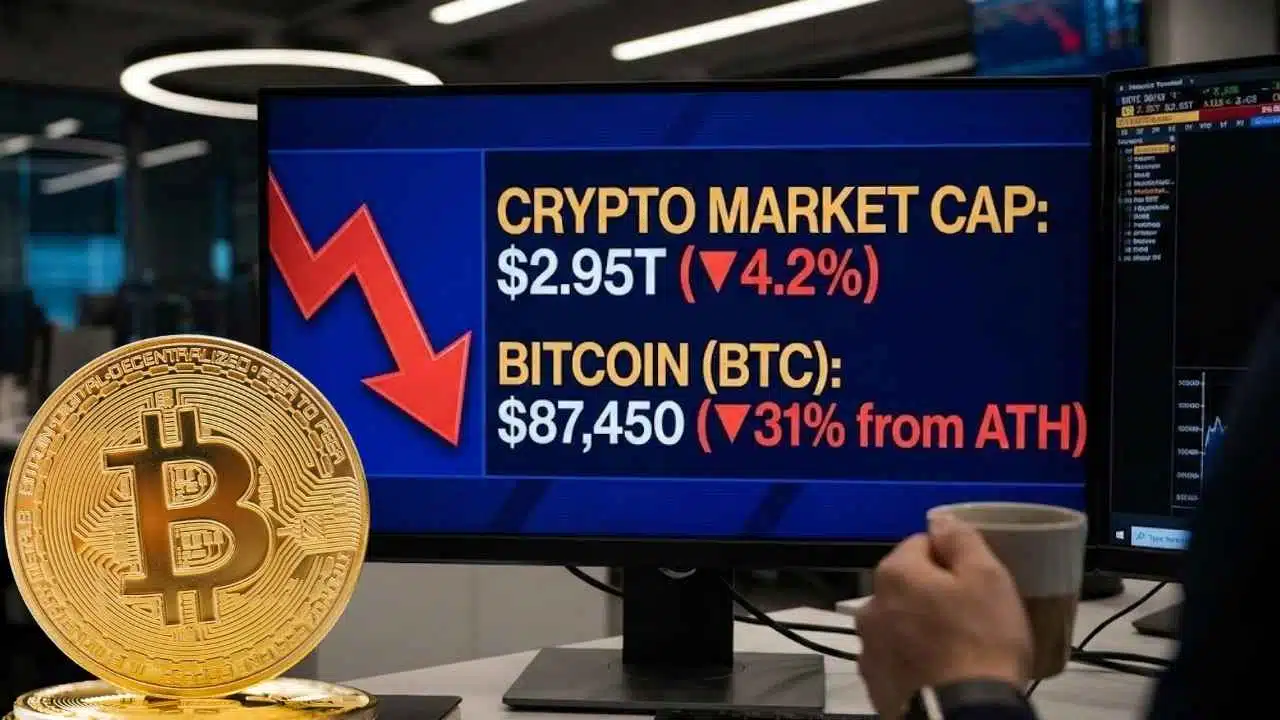
The crypto market cap below $3 trillion on Dec. 23, 2025 as Bitcoin fell near $88,000—about 30% off its Oct. 6 peak—pressuring altcoins and triggering another bout of “extreme fear” sentiment.
Market drops through a key psychological level
The global crypto market slipped under the closely watched $3 trillion mark on December 23, 2025, a level traders often treat as a “line in the sand” for risk appetite. Aggregated market trackers showed total crypto value hovering around $2.97 trillion, as sell pressure persisted into year-end amid weakening momentum across major tokens.
Bitcoin, the largest cryptocurrency, traded around $88,233 in the same period, while the broader market continued to show a defensive posture: capital concentrated in Bitcoin as investors reduced exposure to smaller coins.
Crypto market snapshot (Dec. 23, 2025)
| Metric | Reading | What it suggests |
| Total crypto market cap | ~$2.97T | Market slips below a major psychological threshold |
| Bitcoin (BTC) price | ~$88,233 | Down sharply from October’s peak |
| Bitcoin all-time high (cycle peak) | ~$126,025 (Oct. 6, 2025) | Sets the reference point for the ~30% drawdown |
| Bitcoin dominance | ~59.12% | “Risk-off” behavior: BTC share rising vs altcoins |
Bitcoin’s 30% drawdown reshapes sentiment
Bitcoin’s pullback has been steep by recent-cycle standards. CoinCodex data shows Bitcoin’s all-time high near $126,025 on Oct. 6, 2025, putting late-December prices roughly 30% lower—a drop that often resets leverage, reduces speculative activity, and amplifies caution across the market.
This decline is also reflected in sentiment gauges. The widely followed Crypto Fear & Greed Index (Alternative.me) remained in “Extreme Fear” territory through late December, with recent readings sitting in the mid-20s.
ETF flows flip negative as institutions step back
One of the most closely watched signals this cycle has been U.S. spot Bitcoin ETF demand. Daily flow data from Farside Investors showed continued net redemptions into the December 23 session.
Recent U.S. spot Bitcoin ETF net flows
| Date (2025) | Net flow (US$M) | Notes |
| Dec. 22 | -142.2 | Broad outflows across products |
| Dec. 23 | -157.3 | Outflows continue; pressure remains |
Sustained ETF outflows matter because they can reduce a major source of steady demand that helped lift Bitcoin earlier in the cycle. When that demand weakens, prices can become more sensitive to macro headlines, derivatives positioning, and liquidity conditions.
Analysts question whether the classic four-year cycle is changing
A key storyline in late 2025 is whether Bitcoin’s familiar halving-led rhythm is still reliable. Several market observers have argued that institutional participation—via ETFs and corporate allocation—may be changing how cycles behave.
At the same time, on-chain research commentary has pointed to demand “exhaustion” signals and a possible regime shift toward a prolonged downtrend if new buyers do not replace fading momentum. (CryptoQuant’s recent market commentary has been widely circulated among traders and analysts.)
What’s clear in the data is that Bitcoin’s market share has been rising—often a sign that traders are parking funds in the most liquid asset while trimming altcoin exposure. CoinCodex placed Bitcoin dominance around 59.12% during this period.
Policy optimism meets macro reality
The late-2025 downturn has arrived despite major regulatory and policy developments that many investors expected would support the market—especially around stablecoins.
A White House fact sheet dated July 18, 2025 said the GENIUS Act created a federal regulatory system for stablecoins, including reserve requirements and disclosure expectations designed to strengthen consumer protections and market confidence.
However, regulatory clarity has not insulated crypto from broader macro forces. Risk assets often react to expectations around interest rates, liquidity, and economic growth—factors that can outweigh sector-specific policy wins, especially over short windows.
In the U.S., the Federal Reserve’s Implementation Note issued Dec. 10, 2025 directed policy operations consistent with a federal funds target range of 3.50%–3.75%, underscoring that borrowing costs remain meaningfully restrictive by recent historical standards.
For crypto markets, that backdrop can translate into reduced appetite for high-volatility assets, particularly when year-end positioning turns cautious and traders cut exposure.
Ethereum and the missing “altcoin season”
Ethereum, the second-largest cryptocurrency, has also struggled to spark the kind of broad-based altcoin rally—often called an “altcoin season”—that has defined parts of earlier cycles.
Instead, the market has shown repeated episodes where Bitcoin stabilizes (or rebounds) while many altcoins lag, reinforcing the dominance trend. This dynamic is often explained by liquidity preference: during uncertainty, traders tend to favor assets with deeper order books, tighter spreads, and stronger institutional rails.
That pattern can become self-reinforcing: as Bitcoin dominance rises, fewer incremental dollars chase smaller tokens, and altcoin rebounds become harder to sustain.
What investors are watching next
Market participants are closely tracking several developments into late December and early 2026:
- Whether ETF flows stabilize: Sustained outflows can keep pressure on spot prices, while a return to inflows often improves sentiment quickly.
- Bitcoin’s share of the market: A dominance level near 59% suggests continued defensiveness—if it keeps climbing, altcoins may remain under pressure.
- Sentiment indicators: Extreme fear can persist for weeks in downtrends, but sharp changes sometimes precede volatility spikes.
- Macro signals and policy tone: Higher-for-longer rates or cautious central-bank messaging can limit speculative demand across risk assets.
A market reset heading into 2026
Dropping the crypto market cap below $3 trillion is more than a round-number event—it reflects a broader shift in positioning after Bitcoin’s surge to an October peak and the subsequent 30% drawdown.
Whether this turns into a longer bear phase or a deep correction followed by consolidation will likely depend on two forces that have dominated this cycle: institutional flows (especially ETFs) and macro liquidity. If those improve, risk appetite can return quickly. If they don’t, the market may remain defensive—favoring Bitcoin over altcoins—until a clearer catalyst arrives.