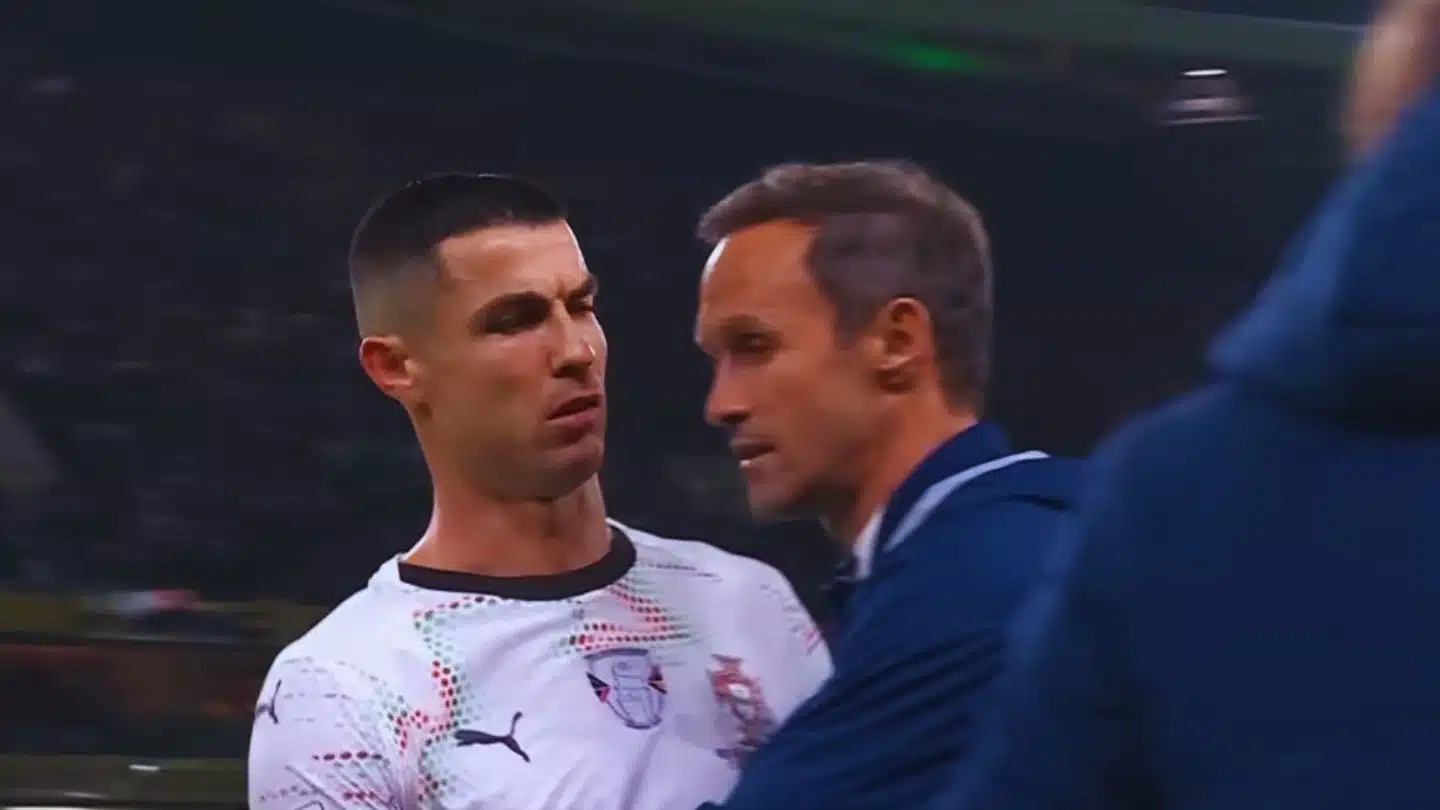
Cristiano Ronaldo, now 40 and still the symbolic heartbeat of Portuguese football, is suddenly at risk of missing the opening phase of what he has already declared will be his final FIFA World Cup. The veteran forward, who has carried Portugal for two decades and remains the world’s top international scorer with 143 goals, received a direct red card during Portugal’s 2026 North America World Cup qualifier against Ireland—a moment that has now turned into a major disciplinary storm.
The incident unfolded in the second half of Portugal’s Group F qualifier. Trailing 0–2 away to Ireland, Ronaldo attempted to contest a loose ball inside the box when he forcefully struck defender Dara O’Shea with his elbow. The referee initially reached for a yellow card, but after a VAR review the decision was upgraded to a direct red. The call stunned both teams: despite Ronaldo’s fiery competitive nature, he had never before been sent off in 226 appearances for the national team. It was a stark contrast to his club career, where he has accumulated 13 red cards across multiple leagues.
This dismissal automatically rules Ronaldo out of Portugal’s final qualifier against Armenia. That is non-negotiable under FIFA rules. But the real concern lies in what comes next: disciplinary committees can add additional suspension matches depending on the severity of the foul. Under FIFA’s guidelines, actions categorized as “violent conduct”—including elbowing an opponent with excessive force—carry a minimum three-match ban, and can extend further if deemed aggressive or dangerous enough to risk injury.
With Portugal currently leading Group F, they are heavily favored to qualify directly for the main tournament. But if the disciplinary panel issues a multi-match ban, Ronaldo could be forced to miss the first, second, or even all three opening group-stage games of the 2026 World Cup. FIFA does not allow players to serve suspensions in friendly matches, meaning Portugal cannot reduce the ban through exhibition games. This increases the likelihood that the punishment—once finalized—will overlap directly with the World Cup.
For a player who has already announced that 2026 will be his last chance at football’s biggest stage, the stakes could not be higher. Ronaldo has competed in five World Cups since his debut in 2006. Despite reaching the semifinals in Germany that year, the trophy has eluded him. This World Cup, held across the United States, Mexico, and Canada, represents his final opportunity to chase the one major title missing from his legendary career.
Should Portugal fail to qualify directly, the consequences deepen. They would be forced into the European playoffs, where every match carries high risk. Competing without their captain—the emotional anchor and strategic centerpiece of the squad—would place enormous pressure on the team. Ronaldo’s absence in knockout-style qualifiers could affect not only Portugal’s tactical shape but also team psychology. His leadership is often described by teammates as irreplaceable, particularly in tense, decisive moments.
Even if Portugal secures early qualification, starting a World Cup campaign without its captain is a major handicap. Teams depend on early momentum in group stages to avoid difficult round-of-16 matchups. Ronaldo’s presence changes defensive behavior—opponents tend to mark tighter, commit more resources to covering his runs, and adjust their structure because of his threat level. Without him, Portugal may need significant tactical adjustments, shifting the responsibility onto younger attackers. While Portugal has depth, replacing a player of Ronaldo’s stature in high-pressure environments is never straightforward.
The disciplinary committee’s decision is expected within the coming weeks. Typically, such cases involve reviewing match footage, referee statements, VAR reports, and the player’s disciplinary history. Ronaldo’s clean international record may play a moderating role, but violent-conduct decisions usually prioritize the nature of the contact over the player’s past.
For now, Portugal must navigate both qualification and preparation under a cloud of uncertainty. Ronaldo’s emotional reaction after the red card showed he understood the magnitude of the moment. At 40, every match matters. Every opportunity is finite. And for a player whose legacy includes rewriting football’s record books, being sidelined at the start of his final World Cup would be a harsh, heartbreaking twist.
The next steps depend entirely on FIFA’s disciplinary ruling. The panel will study whether the elbow was reckless, impulsive, or delivered with intent. While Ronaldo is known for intensity, he is not known for violent behaviour on the international stage—something that his coaching staff and teammates have emphasized since the incident. They point to his exceptional discipline in more than 200 international matches as evidence that the action was not characteristic of him.
Still, FIFA tends to treat elbows harshly because they pose a high risk of head injuries. Under the typical framework, a one-match ban is automatic with the red card. From there, two more matches are added if the act is considered violent, making the minimum punishment three matches. If the panel believes the elbow endangered the opponent or was delivered with excessive force, the ban could extend further. Historically, elbow-related dismissals have rarely received fewer than three competitive matches.
The greater challenge is that these suspensions apply only to competitive fixtures, not friendlies. Portugal cannot use pre-World Cup friendly matches to shorten his ban if it extends beyond the Armenia qualifier. This eliminates any strategic scheduling or match-management options that national teams sometimes rely on.
From a team-building perspective, head coach Roberto Martínez now faces difficult decisions. Preparing for a World Cup without knowing whether your all-time leading scorer is available for the opening matches creates tactical uncertainty. Portugal may need two parallel plans: one built around Ronaldo, and another built without him. It affects lineup choices, formation decisions, pressing structures, and even squad selection—especially for strikers and wide forwards whose roles change depending on whether Ronaldo starts.
There is also a strategic risk if Portugal enters the playoffs without their captain. Playoff rounds leave no room for mistakes, and Ronaldo’s presence traditionally lifts Portugal in high-pressure environments. His experience, penalty-taking reliability, and ability to shift match tempo are not easily replaced. Younger talents like João Félix, Rafael Leão, and Gonçalo Ramos will be expected to shoulder far greater responsibility if Ronaldo is unavailable.
Off the pitch, the story carries emotional weight. Ronaldo has spent two decades building a career defined by longevity, resilience, and relentless ambition. Losing the chance to begin his final World Cup on the pitch—especially for a first-ever red card in his international career—would be one of the most dramatic setbacks of his national-team journey.
As Portugal awaits the ruling, questions hang over both the remainder of the qualifying campaign and next summer’s tournament. Will Ronaldo’s clean international record help reduce the punishment? Or will the nature of the foul—an elbow reviewed by VAR and upgraded to red—leave FIFA with little room for leniency?
Portugal, their captain, and millions of supporters worldwide now wait for a decision that could shape the opening chapter of the 2026 World Cup—and the closing chapter of Cristiano Ronaldo’s extraordinary international legacy.