The notification crisis is real. If you are a brand manager or founder operating in 2026, you have likely noticed a disturbing trend: you post in your Facebook Group of 15,000 members, and only 300 people see it. The era of easy reach on social platforms is over. This is why the most forward-thinking companies are pivoting hard toward a comprehensive Community-Led Growth Strategy.
We are witnessing a massive migration. It is a shift from “rented land”, where algorithms dictate your visibility, to “owned experiences” on platforms like Discord and Slack. In this deep dive, we will unpack why Facebook Groups have failed modern brands, define what Community-Led Growth (CLG) actually looks like in 2026, and provide you with a strategic blueprint to migrate your audience without losing them. This is not just about changing software; it is about changing your entire Go-To-Market (GTM) motion to survive the noise of the modern internet.
The Death of the “Town Square”: Why Facebook Groups Failed Brands
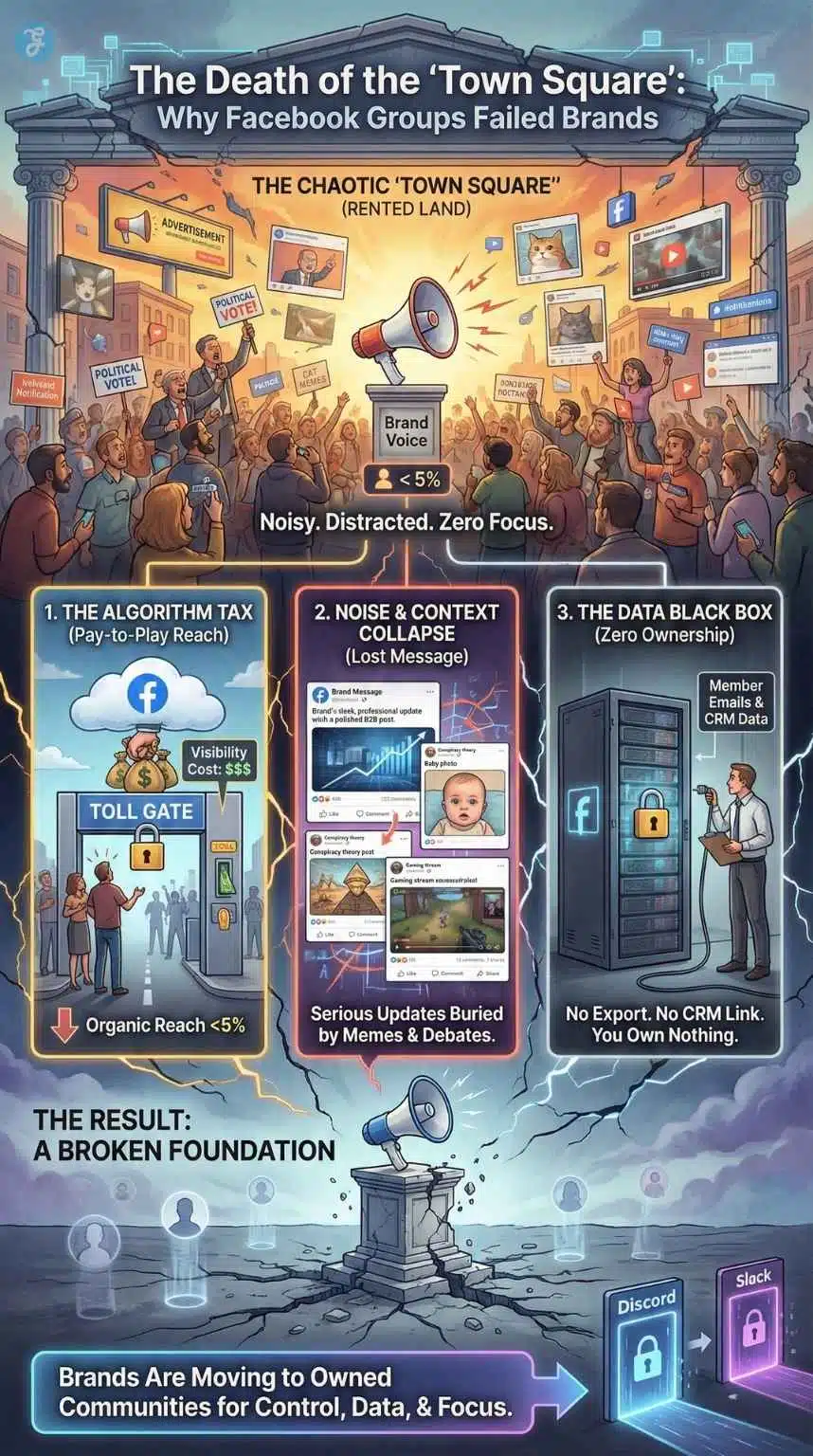
For over a decade, Facebook Groups were the default choice for community building. They were free, accessible, and sat right next to where users were already scrolling. But as we moved into late 2024 and 2025, the utility of Facebook Groups for serious business collapsed.
The “Algorithm Tax” and Reach Suppression
The primary driver for leaving Facebook is the “Algorithm Tax.” Meta’s business model is predicated on keeping users scrolling through the news feed to serve ads. Content that takes users out of the feed or satisfies them too quickly is deprioritized.
In 2026, organic reach in Facebook Groups has plummeted to historic lows. Unless a post triggers an immediate “outrage” or “viral” reaction, it is buried. Brands are finding that they effectively have to pay to boost posts just to reach the community members they already acquired. You are essentially paying rent to talk to your own family.
Context Collapse and The “Cozy Web”
There is a psychological phenomenon known as “Context Collapse.” On Facebook, a user might see a post about a tragic global news event, followed by a photo of their cousin’s baby, followed by your B2B SaaS product update. This jarring mix creates cognitive dissonance.
Users are tired of the noise. They are retreating to what researchers call the “Cozy Web”—private, gated spaces where the context is controlled, and the signal-to-noise ratio is high. When a user opens Discord or Slack, they are entering a specific “room” with a specific purpose. When they open Facebook, they are entering a chaotic public square.
The Data Black Box
Perhaps the most critical failure for an owned audience platform strategy is data. On Facebook, you own nothing.
- You cannot export your member list with email addresses.
- You cannot track how many times a specific user has commented.
- You cannot integrate group activity with your CRM (Customer Relationship Management) tools like HubSpot or Salesforce.
If Facebook decides to ban your group tomorrow, your entire business asset sits at zero.
| Feature | Facebook Groups (Rented Land) | Owned Platforms (Discord/Slack) |
| Reach | < 5% (Algorithmic) | 100% (Notification-based) |
| Data Access | Zero (Locked by Meta) | High (API & CRM Integrations) |
| Content Life | Minutes (Feed-based) | Years (Searchable Knowledge Base) |
| Distractions | High (Ads, Politics, News) | Low (Focused Topic Channels) |
What is Community-Led Growth [CLG]?
To implement a Community-Led Growth Strategy, we first must define it. It is often confused with “community management,” which is reactive. CLG is proactive.
Definition: Community-Led Growth (CLG) is a Go-To-Market strategy where the community acts as the primary engine for user acquisition, retention, and product innovation, rather than just a support channel.
In the traditional “Sales-Led” or “Marketing-Led” models, the funnel is linear: You buy ads, you get leads, you sell them, and then you support them. In CLG, the funnel is circular, a flywheel.
The Economics of CLG in 2026
Why are CFOs suddenly interested in community? Because the math works. The cost of ads (CPM) has risen for five straight years. CLG offers a way to bypass paid acquisition.
- Reducing Customer Acquisition Cost (CAC): When your users answer each other’s questions and create tutorials (UGC), they create organic search traffic and social proof that attracts new users for free.
- Retention and LTV: Data from 2025 shows that customers who are active in a brand community have a 40% higher Lifetime Value (LTV) than those who are not. Belonging is a powerful churn killer.
- Product Feedback Loop: Instead of paying for expensive focus groups, CLG brands have a direct line to their power users for instant beta testing and feedback.
Product-Led Growth (PLG) vs. Community-Led Growth (CLG)
Many tech companies rely on Product-Led Growth (offering a free trial and letting the product sell itself). CLG is the force multiplier for PLG.
| Metric | Product-Led Growth (PLG) | Community-Led Growth (CLG) |
| Primary Driver | The Tool / Software Utility | The People / Network Effect |
| User Goal | “Solve my problem quickly.” | “Connect with others like me.” |
| Retention Mechanism | Feature stickiness | Social stickiness (FOMO) |
| Growth Loop | Viral invite links | Word-of-Mouth & Peer Advocacy |
The Platform Wars: Discord vs. Slack vs. The Rest
Once you decide to adopt a Community-Led Growth Strategy, the immediate question is: Where do we live? In 2026, the market will have bifurcated into two main giants, with a few niche runners-up.
Discord: The Culture Engine
Originally built for gamers, Discord has morphed into the “living room” of the internet. It is best suited for B2C brands, Web3 projects, creators, and products targeting Gen Z or Gen Alpha.
- The Vibe: Discord feels like a club. It is real-time, chaotic, and vibrant. It utilizes voice channels (Stages) and video streaming heavily.
- Customization: You have infinite control over “Roles.” You can gamify the experience by automatically assigning a “VIP” role to someone who has been active for 6 months, unlocking hidden channels. This gamification is pure gold for retention.
- The Downside: It has a steep learning curve. The UI can be overwhelming (“Notification Fatigue”) for older demographics. It is also pseudonymous—users often use handles like “CryptoKing99” rather than real names, making lead qualification harder for B2B sales teams.
Slack: The Professional HQ
Slack is the default operating system for modern business. If you are selling B2B SaaS, developer tools, or running a high-ticket professional network, Slack is likely your best bet.
- The Vibe: It feels like an office or a conference center. It is clean, threaded, and professional.
- The Frictionless Join: This is Slack’s superpower. Your target audience likely already has Slack open 8 hours a day for their job. Joining your community is just adding one more sidebar icon. They don’t need to learn a new tool.
- Identity Resolution: Users on Slack usually use their real names and link their LinkedIn profiles. This allows you to use tools (like Common Room or Orbit) to identify that “Jane Doe” in your community is actually the CTO of a target account you are trying to close.
- The Downside: It is expensive. Slack’s pricing model is per-user, which doesn’t scale well for free communities. The free plan in 2026 still has limitations on message history (the “90-day black hole”), meaning you lose your knowledge base unless you pay up.
Detailed Platform Comparison for 2026
| Feature | Discord | Slack | Circle / Skool (Alternatives) |
| Best Audience | Gen Z, B2C, Gamers, Web3 | B2B, Devs, Professionals | Course Creators, Coaches |
| Content Style | Real-time streams & Voice | Async threads & Text | Forum-style posts |
| SEO Value | None (Private) | None (Private) | High (Can be public) |
| Customization | High (Bots, Roles, embedded apps) | Moderate (Workflow Builder) | Moderate (Branding focus) |
| Cost | Free (Nitro boosts optional) | High (Per user) | Fixed Monthly Fee |
The 2026 CLG Tech Stack: Beyond Just the Platform
Running a community on Slack or Discord without the right “middleware” is like trying to fly a plane with no instrument panel. You are flying blind. In 2026, the best brands use a three-layer stack to turn chaos into data.
1. The Intelligence Layer [The “Brain”]
- Common Room / Orbit: These are the most critical tools in your arsenal. They sit on top of Discord/Slack and perform “Identity Resolution.”
- The Problem: On Discord, a user is just “CryptoKing99.”
- The Solution: Common Room matches “CryptoKing99” to a LinkedIn profile, revealing that he is actually the VP of Engineering at a Fortune 500 company. Suddenly, a random chat message becomes a qualified lead.
2. The Automation Layer [The “Hands”]
- Zapier / Make: Used to glue your community to your product.
- Use Case: When a user hits “Power User” status in your SaaS product, Zapier automatically triggers a bot in Discord to grant them a special “Gold Member” badge and access to a hidden VIP channel.
- Threado: A specialized tool for support automation. It tracks unanswered questions in Slack threads and pings your support team if a community member hasn’t received a reply in 2 hours.
3. The AI Agent Layer [The “Mouth”]
- Custom GPT Wrappers (e.g., Intercom Fin): In 2026, we are seeing the rise of “L1 Support Agents” living inside communities. These bots digest your entire help center and documentation.
- Workflow: A user asks, “How do I reset my API key?” The AI Agent replies instantly with the correct steps and a link. If the user says “That didn’t work,” the Agent automatically tags a human moderator. This reduces human support load by approx 60%.
Strategic Blueprint: How to Execute a CLG Strategy in 2026
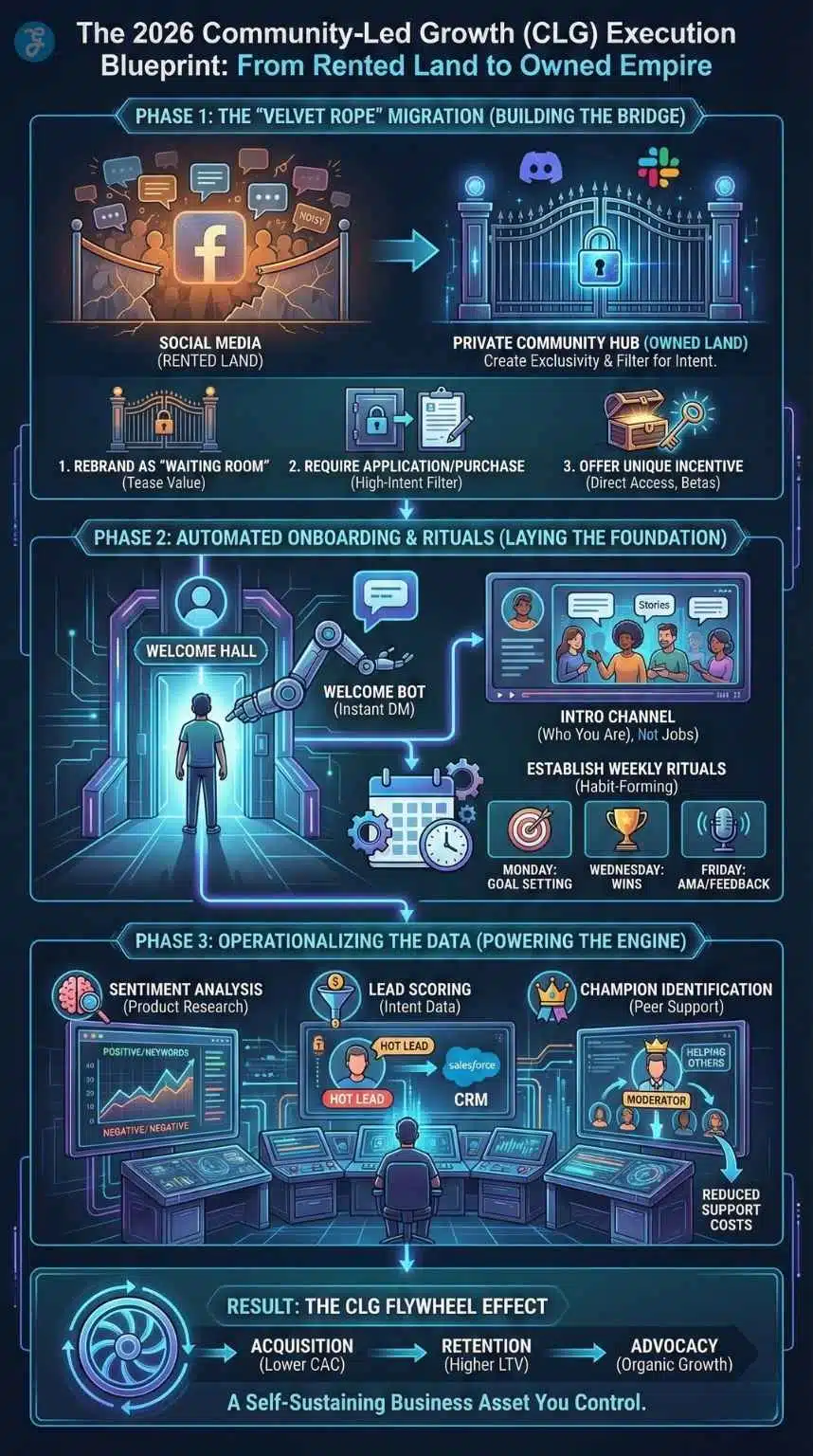
Moving from a Facebook Group to an owned audience platform is not as simple as posting a link. It requires a “Migration Strategy” to avoid leaving 90% of your audience behind. Here is the step-by-step roadmap.
Phase 1: The “Velvet Rope” Migration
Do not shut down your Facebook Group overnight. Instead, rebrand it.
- Top of Funnel (Facebook): Keep the Facebook group open, but treat it as a “waiting room.” Post teasers of the high-value conversations happening in the private community.
- Bottom of Funnel (Discord/Slack): Make the new community exclusive. Require an application or a product purchase to enter. This filters out the noise and ensures that the people joining are high-intent.
- The Incentive: You must offer something on the new platform that doesn’t exist on the old one. Examples: “Direct access to the CEO,” “Weekly live coaching calls,” or “Beta access to new features.”
Phase 2: Onboarding and Rituals
The first 5 minutes a user spends in your new Discord or Slack determines if they stay for 5 years.
- The Welcome Bot: Use automation to send a personalized DM asking them to introduce themselves.
- The Introduction Channel: This is usually the most active channel. Encourage users to share who they are, not just what they do.
- Rituals: Establish weekly habits.
- Monday: Goal setting.
- Wednesday: “Wins” of the week.
- Friday: Feedback or “Ask Me Anything” (AMA).
- NLP Insight: These rituals create “predictable engagement,” forcing users to open the app at specific times.
Phase 3: Operationalizing the Data
This is where the Community-Led Growth Strategy becomes a business engine. You need to bridge the gap between community chatter and revenue.
- Sentiment Analysis: Use AI tools to scan your channels for keywords. If users are constantly complaining about a specific feature, that is free product research.
- Lead Scoring: If a user asks advanced questions about your product in the community, your sales team should be notified. This is “intent data.”
- Champion Identification: Identify the top 1% of contributors. Send them swag, give them special badges, and empower them to become moderators. They reduce your support costs by answering questions for you.
Monetizing the Moat: From Free to Fee
While the primary goal of CLG is often acquisition (growth), a secondary trend in 2026 is the direct monetization of the community itself. “Paid Private Communities” are replacing “Free Public Facebook Groups.”
Model A: The Freemium Club [Hybrid]
- Public (Free): General discussion channels, news updates, and peer support.
- Private (Paid – $10-$50/mo): “The Inner Circle.” Includes monthly group coaching calls with the founders, deep-dive teardowns of member projects, and a “hire-me” channel for job postings.
- Why it works: The free users provide the volume/energy; the paid users provide the revenue to hire a full-time Community Manager.
Model B: The “Productized” Community
- Here, access to Slack/Discord is the product.
- Example: A “Chief of Staff” professional network. You cannot buy the software without the community. The value proposition is 50% tool, 50% access to peers who are solving the same problems.
- SEO Insight: This model reduces churn significantly. A customer might cancel a software subscription because they found a cheaper tool, but they rarely cancel a community subscription where their friends and mentors hang out.
The Risks: Why Communities Fail
While the benefits of brand community trends 2026 are clear, the execution is difficult. Most communities fail due to the “Ghost Town Effect.”
The “Empty Bar” Problem
If you launch a community and there is no activity, new users will leave immediately. Nobody wants to be the first to dance at an empty party.
Solution: The “Seed Group.” Before you launch publicly, invite 50 of your closest friends or super-users. Give them specific topics to discuss. ensure the venue looks “full” before the doors open to the public.
Over-Moderation vs. Anarchy
On Discord specifically, things can get out of hand quickly. If you over-moderate, people feel stifled. If you under-moderate, the culture becomes toxic.
Solution: Clearly defined “Community Guidelines” that are enforced by a mix of AI bots (for spam/hate speech) and human moderators (for nuance).
The ROI Trap
Do not try to sell to your community in the first 6 months. If you treat your community like an email list to blast offers to, they will leave. You must deposit “social capital” before you can make a “withdrawal” (ask for a sale).
The Trust Protocol: Combating Scams and Noise
We are living in the “Deepfake Era.” As AI-generated noise explodes, private communities are becoming the last bastion of trust. However, they are also targets for sophisticated scams (e.g., “Fake Guru” course scams or crypto-drainers).
To protect your brand reputation in 2026, you must implement a “Trust Protocol”:
- The “2-Step Verification” Gate: Never allow instant access via a public link. Use a tool like Guild.xyz or a simple Typeform application. Require users to link a verified social profile (LinkedIn or X) to join. This stops bot swarms dead in their tracks.
- Anti-Scam Bots: On Discord, the “Wick” bot is mandatory. It automatically quarantines users who DM (Direct Message) large numbers of members instantly—a common tactic for scammers trying to sell fake courses or steal wallets.
- The “No-Pitch” Rule: Enforce a strict policy: Zero solicitation in DMs. If a member reports an unsolicited sales pitch, the offender is banned immediately without appeal. This creates a psychological “Safe Zone” where high-status individuals feel comfortable posting without being harassed.
Future Trends: AI Agents in Community Management
Looking ahead to the remainder of 2026, the biggest disruptor in Community-Led Growth is Artificial Intelligence. We are moving beyond simple chatbots.
- AI Co-Pilots: Community managers are using AI agents that sit in Slack/Discord. These agents can digest the last 100 messages in a thread and summarize them for a user who just joined, catching them up instantly.
- Auto-Support: AI agents trained on your documentation can answer 80% of technical questions (L1 Support) inside the community instantly, leaving only the complex problems for humans.
- Connection Engines: AI will soon analyze user profiles and proactively suggest introductions. “Hey, Sarah, you should meet Mike. You both work in Fintech and live in Chicago.” This automates serendipity.
Final Thoughts: The Great Filtering
We are living through a “Great Filtering” of the internet. The massive, open oceans of social media are becoming polluted with bots, ads, and algorithmic trash. In response, human beings are building islands, private, curated, and safe.
For a brand, a Community-Led Growth Strategy is no longer just a “nice to have.” It is your insurance policy against the algorithm. When you own the community, you own your destiny. You are no longer renting attention; you are building a nation. The question is not if you should move to Discord or Slack, but how fast you can execute the migration before your Facebook Group becomes a ghost town.