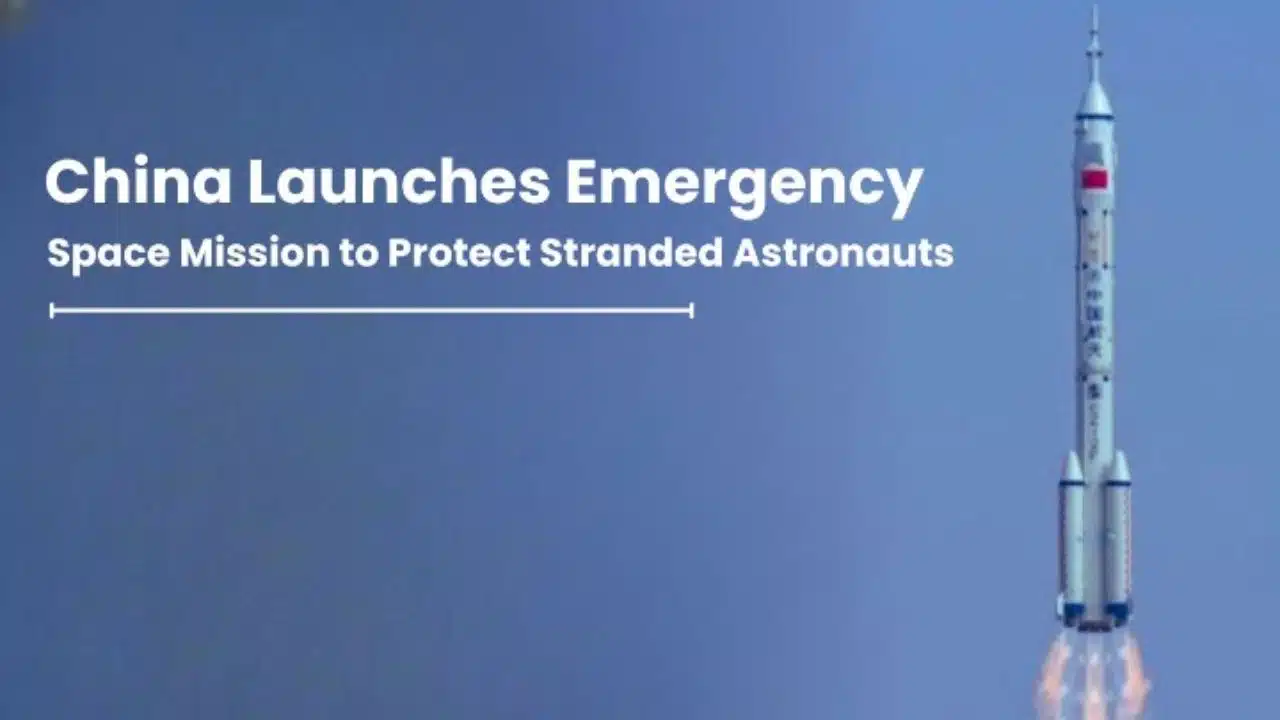
China has carried out the first emergency launch in the history of its crewed space program, sending the unmanned Shenzhou-22 spacecraft into orbit to secure the safety of astronauts aboard the country’s Tiangong space station. The rapid-response mission follows the discovery of debris-related damage to a previously docked spacecraft, which temporarily left three astronauts on the station without a safe return vehicle.
Successful Liftoff from Jiuquan Space Center
The Shenzhou-22 mission lifted off at 12:11 p.m. Beijing time from the Jiuquan Satellite Launch Center in northwest China atop a Long March-2F Y22 rocket. Roughly ten minutes after launch, the spacecraft successfully separated from the rocket and entered its planned orbit. China’s Manned Space Agency confirmed that all flight parameters met mission requirements and declared the flight a full success.
The emergency spacecraft will travel to the Tiangong station for an autonomous docking procedure. Once attached, it will remain docked as a temporary return craft for the current crew.
Emergency Launch Triggered by Damage to Shenzhou-20
This rapid launch was triggered by a concerning safety incident in early November, when China detected small cracks in the viewing-port window of the Shenzhou-20 return capsule. Investigations suggested that the damage was caused by orbiting space debris, a growing hazard faced by all spacecraft operating in low Earth orbit.
The cracks, although small, posed potential risks to the structural integrity of the spacecraft during re-entry. As a result, Chinese officials immediately classified Shenzhou-20 as unsafe for crewed return operations.
Crew Rotation Plans Disrupted
The discovery of the damage forced China to abandon the original return plan for the Shenzhou-20 crew, who had completed a six-month mission and were scheduled to come home on November 5. Their return was postponed by nine days while officials assessed the damage. The crew eventually returned to Earth safely on November 14, using the newer Shenzhou-21 spacecraft as an alternative return vehicle.
Shenzhou-21 Crew Temporarily Left Without an Escape Craft
While the Shenzhou-20 crew could be brought home using the Shenzhou-21 craft, the situation left the Shenzhou-21 crew—Commander Zhang Lu, Wu Fei, and Zhang Hongzhang—without a dedicated return capsule of their own.
This created a temporary but serious concern. A crew aboard a space station must always have access to at least one operational spacecraft that can immediately serve as an emergency escape vehicle. With Shenzhou-20 damaged and Shenzhou-21 already used for an unexpected return mission, the Tiangong crew had no independent means of leaving the station in case of an emergency.
Despite the issue, the astronauts continued normal scientific and maintenance operations, remaining in communication with flight controllers while China prepared an emergency response.
Shenzhou-22 Prepared in Record Time
The Shenzhou-22 spacecraft was initially scheduled for a crewed mission in 2026, but space agency officials fast-tracked the mission into an unmanned deployment following the incident. China conducted an accelerated launch preparation phase, reducing standard procedures that typically take months into only 16 days—a remarkable demonstration of rapid response capability in human spaceflight.
The spacecraft transported approximately 600 kilograms of cargo, including:
-
Food and fresh produce
-
Spare parts and maintenance equipment
-
Specialized tools designed to treat or stabilize the cracked window of the damaged Shenzhou-20 spacecraft
-
Additional monitoring devices for debris-related assessments
This resupply ensures that the Shenzhou-21 crew can continue their mission without resource constraints while having a safe return craft on standby.
Strategic Significance: China Demonstrates a Rapid “Launch-on-Need” Capability
The successful launch of Shenzhou-22 highlights China’s growing ability to respond quickly to unexpected hazards in space. In military and spaceflight terms, the capability is often referred to as “launch-on-need”—meaning the spacecraft and rocket are maintained in a state of readiness so they can be deployed at short notice.
This emergency readiness is crucial for maintaining human operations in orbit, especially as space debris becomes a more severe threat.
Growing Risks from Space Debris
The incident involving Shenzhou-20 illustrates how small pieces of orbital debris—many too small to be tracked by current systems—can pose significant risks to spacecraft. Even tiny fragments travel at extremely high velocities and can puncture protective shields or windows designed for spaceflight conditions.
Space agencies worldwide are dealing with increasing debris density in low Earth orbit due to:
-
Aging satellites
-
Rocket-stage remnants
-
Fragments from past collisions
-
Anti-satellite weapon debris from military tests
China’s emergency mission underscores the need for expanded monitoring systems and improved debris mitigation strategies.
Next Steps for Shenzhou-22 and the Tiangong Station
Once Shenzhou-22 docks with the station, it will act as the primary return vehicle for the Shenzhou-21 crew until they complete their mission, expected sometime in 2026.
Meanwhile, the damaged Shenzhou-20 capsule will not be discarded immediately. Instead, Chinese engineers plan to use it for on-orbit research, examining how debris-related impacts affect spacecraft durability. Later, it will likely be detached and guided back to Earth for detailed inspection and evaluation.
Long-Term Implications for China’s Human Spaceflight Program
This emergency mission represents an important milestone in China’s space program, demonstrating both operational readiness and engineering resilience. It reveals several key developments:
-
Technical maturity in spacecraft design and emergency planning
-
Increasing confidence in autonomous docking and unmanned operations
-
Enhanced capability to protect human life in orbit
-
Growing experience in dealing with space-debris hazards
China has maintained continuous human presence aboard the Tiangong station since 2021 and continues to expand its role as a major participant in global space exploration.