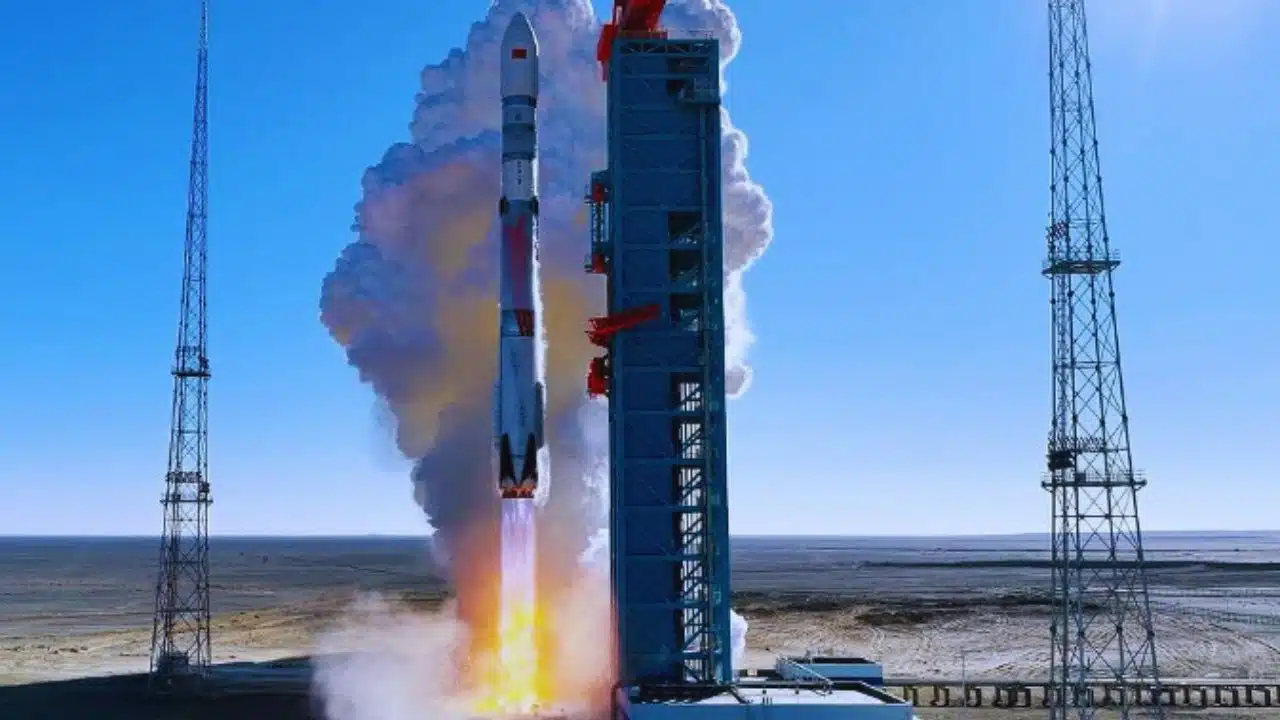
China 89 space launches in 2025 set a national record, reflecting a faster launch cadence and a widening mix of government and commercial missions as Beijing also moves to expand support for the commercial space sector.
Record-setting year
China’s orbital launch total reached 89 in 2025, the highest annual figure recorded by multiple launch trackers and spaceflight logs.
That total exceeds China’s previous yearly high of 68 launches set in 2024, marking a sharp year-over-year increase in launch activity.
During a notable late-year surge, three Long March rockets lifted off in under 19 hours, and China’s running 2025 tally hit 83 at that point—signaling the country was already well past its earlier record before the year ended.
A key theme of the 2025 cadence was repeatable, high-tempo operations across multiple spaceports and mission types rather than a single “flagship” flight driving the headline number.
This launch pace matters because each successful flight expands China’s ability to place satellites for communications, Earth observation, navigation, science, and national-security roles on schedules that match real-world demand.
What drove the surge
China’s record year was powered by a combination of rising satellite demand, maturing launch operations, and growing capacity from both state-linked and commercially oriented programs tied to broadband constellations.
Broadband “megaconstellations”
Two major low-Earth-orbit satellite internet projects—GuoWang and Qianfan—were central to China’s higher launch demand in 2025.
GuoWang is operated by China Satellite Network Group and is described as government-backed, with reporting that it aims for about 400 satellites by 2027 and potentially up to 13,000 satellites in the 2030s.
By early December 2025, GuoWang was reported to have 113 satellites in orbit, while Qianfan was reported at 108, after Qianfan deployments slowed earlier in the year due to reported satellite issues.
Operational tempo and mission mix
China’s late-2025 cadence included clusters of launches within short time windows, reflecting improved readiness across vehicles, range operations, and payload processing.
Launch activity also extended beyond inland sites, with reporting highlighting the growing role of coastal commercial launch infrastructure at Wenchang and a push to relieve pressure on traditional inland bases.
Infrastructure and industry shift
China’s launch system relies on multiple spaceports with distinct roles, including missions to low Earth orbit, polar or sun-synchronous orbits, and geostationary trajectories.
Long March rockets remain the backbone of national launch activity, and long-running infrastructure investment has enabled higher throughput as demand rose in the 2020s.
Key launch sites (context)
| Spaceport | Location (as commonly described) | Typical mission role | Notes |
| Xichang | Sichuan | Geostationary/GTO missions | Identified as a GEO-focused launch site in space security analysis. |
| Jiuquan | Inner Mongolia (area) | LEO missions; crewed missions | Often associated with crewed missions and LEO launches in analysis. |
| Taiyuan | Shanxi | LEO / sun-synchronous | Listed among China’s major launch sites for LEO activity. |
| Wenchang | Hainan | Heavy-lift; coastal access | Highlighted as a heavy-lift/coastal site in analysis. |
Policy signals for commercial growth
Alongside the record launch tally, China also signaled stronger institutional backing for commercial space, including a reported plan to establish a national commercial space development fund and broaden government procurement to integrate commercial capabilities.
If implemented at scale, those measures could reduce financing friction for private launch and satellite firms while also creating more predictable demand through state purchasing.
Global context and risks
Globally, 2025 was a record-setting year for orbital activity, with 301 launches reaching orbit reported by a leading spaceflight statistician’s dataset.
The same dataset reports the United States as the top launcher by country in 2025, with 173 launches reaching orbit.
Other trackers show the United States far ahead in total launches, while China’s 89 still places it among the world’s top launch nations by annual cadence.
Selected 2025 launch counts (as reported by trackers)
| Country/region (tracker labels) | 2025 orbital launches (count) |
| China | 89 |
| United States | 173 launches reaching orbit |
| Europe | 7 |
| India | 4 |
| Japan | 4 |
| Iran | 1 |
| Israel | 1 |
| Australia | 1 |
Higher cadence also increases exposure to operational and supply-chain risks—because tight schedules can magnify the impact of any single delay, anomaly, or payload issue on downstream launch manifests.
And as broadband constellations expand, orbital crowding and debris-management expectations rise, making space traffic coordination and end-of-life disposal practices more consequential for all spacefaring countries.
Final thoughts
China’s record 89-launch year underscores a shift from occasional peaks to sustained cadence—driven largely by large satellite constellation demand and improving launch operations.
The next inflection point to watch is whether commercial support measures translate into faster, lower-cost access to orbit and steadier deployment of GuoWang and Qianfan over 2026.
Just as important will be how China balances speed with mission assurance and how it addresses traffic management as low Earth orbit becomes more congested worldwide.