
Feeling stuck because your tools, reports, and teams all seem to speak different languages? That is where chas6d starts to make sense.
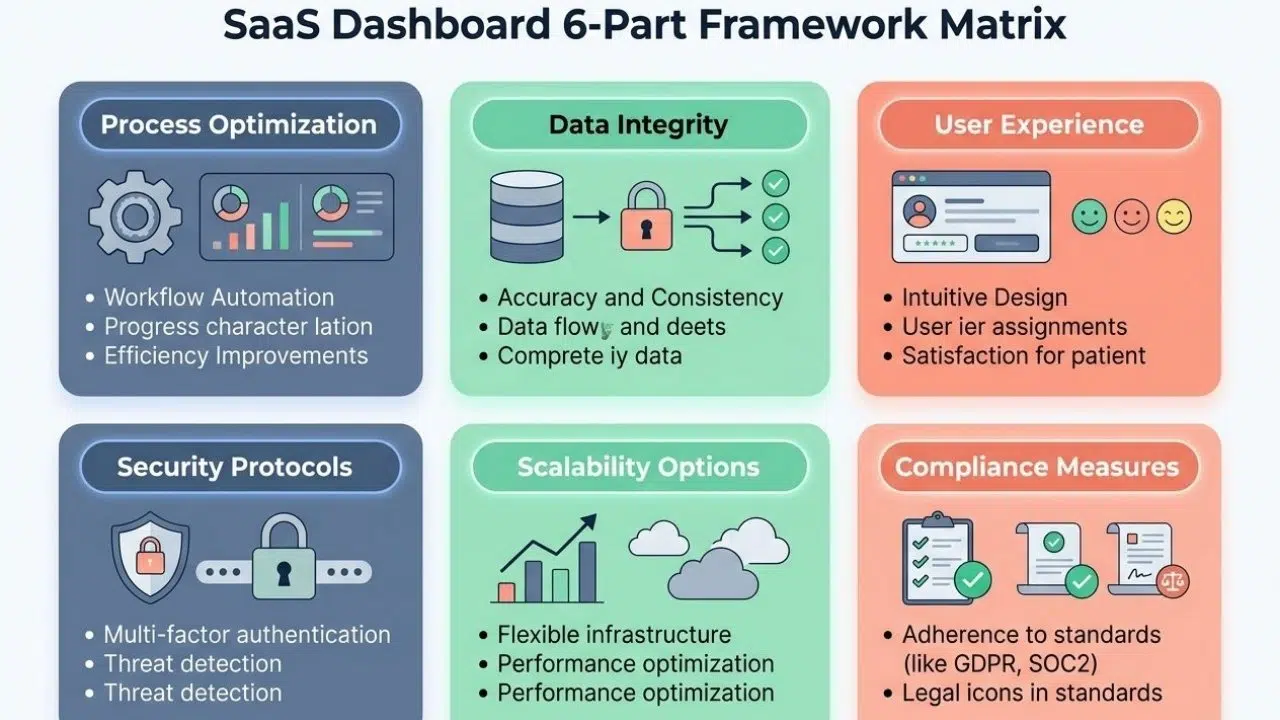
CHAS6D is a framework you can use to clean up messy work across six dimensions: process optimization, data integrity, user experience, security protocols, scalability, and compliance. Instead of chasing one quick fix, you review the whole system and spot where handoffs, bad data, or weak controls are slowing you down.
If you want one guide for beginners, start here.
I will walk you through what CHAS6D is, how to use it, where machine learning fits, and which practical checks matter most in 2026. We will keep it simple, useful, and tied to real decisions you can make right away.
What Is CHAS6D?
If you search for CHAS6D today, you will find it described in more than one way. That is your first clue that chas6d is a framework best treated as a working methodology, not as a rigid U.S. industry standard with one official definition.
For readers who are just understanding chas6d, the easiest way to think about it is this: it is a way to review systems in 6 dimensions so you can align people, software, data, and rules before small issues turn into expensive bottlenecks.
In NIST’s February 2024 update, the Cybersecurity Framework moved to six core functions by adding Govern alongside Identify, Protect, Detect, Respond, and Recover. That is a useful reminder that six-part models work well because they force teams to look at strategy, execution, and risk together, instead of fixing one layer and ignoring the rest.
So if you have seen bold claims behind chas6d, strip the hype away. What matters is whether the framework helps you make better decisions, integrate systems cleanly, and create a repeatable way to improve performance over time.
| CHAS6D dimension | Question to ask first | What good looks like |
|---|---|---|
| Process Optimization | Where does work stall, repeat, or wait for approval? | Cycle time drops and rework becomes easier to spot. |
| Data Integrity | Which system is the source of truth? | Duplicate records and validation errors fall. |
| User Experience | Can a new user finish the task without extra help? | Completion rates rise and support friction drops. |
| Security Protocols | Who can access what, and how do they prove identity? | Access rules are clear, logged, and reviewed. |
| Scalability Options | Will this still work if demand doubles? | Latency, queue depth, and failure rates stay stable. |
| Compliance Measures | Which U.S. rules or contracts apply to this data? | Controls map cleanly to policy, audit, and reporting needs. |
Key Components of CHAS6D
The key components of CHAS6D are not mysterious. They are the repeatable controls, habits, and design choices that keep the six dimensions aligned.
Six Dimensions of CHAS6D
The six dimensions are Process Optimization, Data Integrity, User Experience, Security Protocols, Scalability Options, and Compliance Measures. If one of those dimensions is weak, the rest usually absorb the pain through delays, workarounds, or higher risk.
Teams often connect the model to AI and neural network models, microservices, and automation. That can help, but only when each tool has a narrow job, a clean input, and a clear fallback when the model gets something wrong.
Postman’s 2025 State of the API Report shows why this matters: 82% of organizations now use some level of API-first development, 55% struggle with inconsistent documentation, and 34% still cannot find existing APIs inside their own organizations. In plain terms, scalability and data integrity fail fast when teams build integrations before they agree on contracts, names, and ownership.
- Process Optimization: map the real handoffs first, then remove approval steps, duplicate entry, and manual copy-paste work.
- Data Integrity: define one source of truth and document the schema. OpenAPI is especially useful here because it gives your API a machine-readable contract that developers and tools can both check.
- User Experience: review the path a new user takes from start to finish. A system can be technically correct and still fail if the interface causes hesitation or repeated errors.
- Security Protocols: in NIST’s July 2025 Digital Identity Guidelines, AAL2 requires multifactor authentication and AAL3 requires phishing-resistant public-key authentication. That gives beginners a practical rule: protect sensitive workflows with MFA at a minimum, and raise the bar for privileged access.
- Scalability Options: build reusable services and versioned APIs early, so the system can grow without forcing a rebuild every quarter.
- Compliance Measures: connect policy requirements to actual controls, so operations run with more accuracy and consistency instead of relying on tribal knowledge.
Core Principles of the Framework
The core principles of the chas6d framework are adaptability, clear structure, user-centered design, collaboration, and transparency. These principles of the chas6d framework matter because they turn a loose concept into a system people can actually run.
Adaptability means you keep the framework light enough to evolve. Scalability means you standardize contracts, naming, and monitoring so growth does not wreck operational efficiency.
- Assign an owner per dimension: one person should be accountable for each score, even if several teams contribute.
- Keep one source of truth: specs, examples, and test cases should live together, not across chat threads and private notes.
- Make feedback visible: logs, alerts, and customer friction signals should feed weekly reviews.
- Design for trust: access rules, audit trails, and change history should be easy to inspect, not hidden in one engineer’s memory.
Applications of CHAS6D
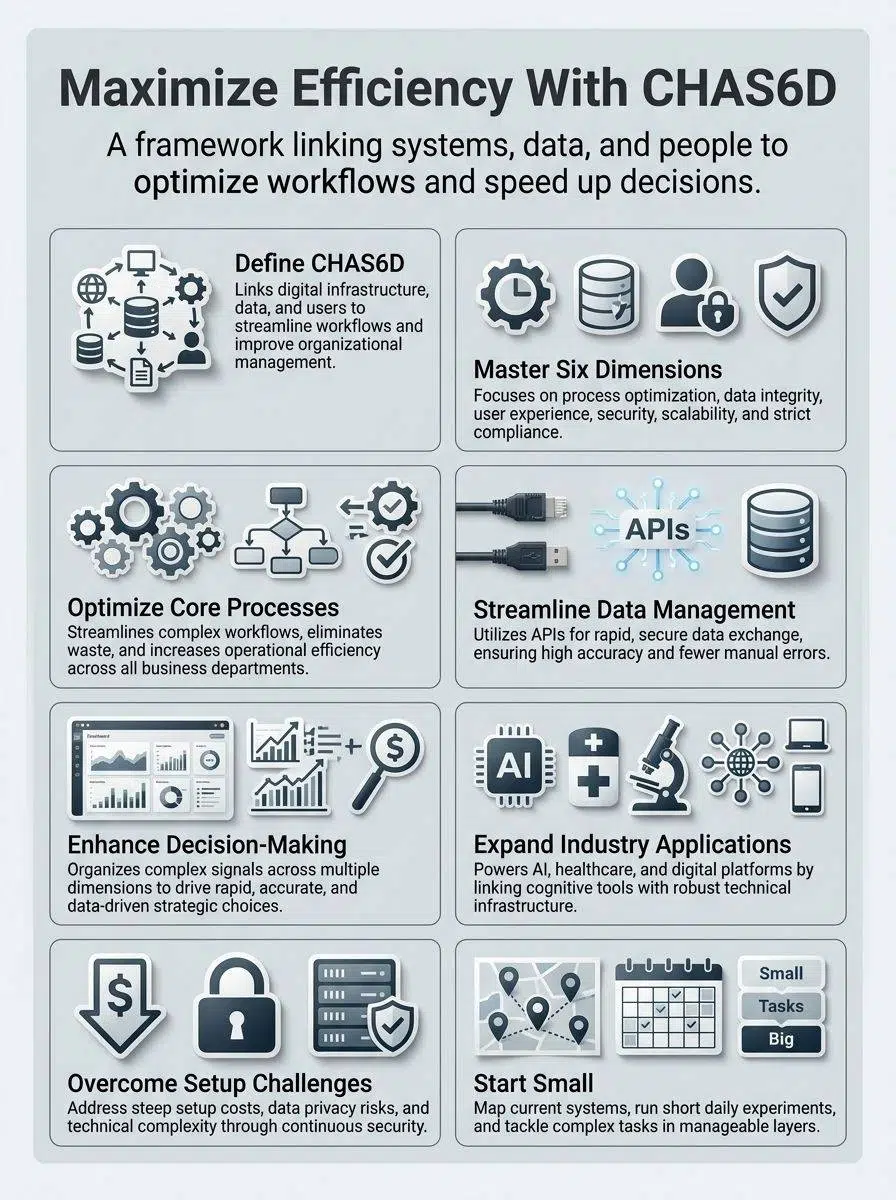
The applications of chas6d are broad because almost every modern business runs on connected software, shared data, and handoffs between teams. You can use the same way to think across sales, operations, support, finance, healthcare, education, and digital systems.
Business and Organizational Efficiency
In day-to-day business work, CHAS6D helps you see where effort leaks out of the system. That makes it useful for onboarding, order processing, approval chains, reporting, and any workflow that crosses more than one tool.
Managers often use the framework to connect task flow with strategic planning. Instead of asking only whether people are busy, they ask whether the system creates clean data, fewer handoff errors, faster decisions, and more reliable outcomes.
A smart first application is your most painful repeat process. Map the workflow, count the handoffs, tag each failure point to one of the six dimensions, and fix the worst bottleneck first.
- Customer onboarding that breaks between CRM, billing, and support
- Finance approvals slowed by spreadsheet version confusion
- Support triage that depends on incomplete account data
- Inventory or fulfillment workflows with too many manual checks
Digital and Cognitive Systems
CHAS6D also fits digital systems that use machine learning, automation, or intelligent agents. This is where the framework becomes especially helpful, because technical systems fail in layers, not in one dramatic moment.
The NIST AI RMF Playbook organizes AI risk work into Govern, Map, Measure, and Manage. If you are applying CHAS6D to AI or intelligent agents, borrow that discipline: define the task, map the risks, measure the output, and keep a human review path for higher-stakes decisions.
This matters even more in 2026 because AI agents are starting to consume APIs directly. If your data fields are inconsistent, your permissions are broad, or your logs are thin, automation will amplify the mess instead of solving it.
Start with one supervised workflow, not a fully autonomous loop. That keeps CHAS6D thinking grounded in evidence instead of hope.
Benefits of Using CHAS6D
CHAS6D helps people simplify complexity. It gives teams one shared structure for better decision-making, cleaner data management, and steadier process improvement.
Enhanced Decision-Making
When teams review work across six dimensions, they stop reacting to the loudest problem and start seeing the real pattern. That leads to better decision-making because each choice gets checked against process, data, user impact, security, growth, and compliance.
Google Cloud’s 2025 DORA research found that 90% of respondents use AI at work and more than 80% say it improves productivity, yet 30% still report little or no trust in AI-generated code. That is exactly why CHAS6D enhances decision-making: it pushes you to treat speed and trust as separate checks, not the same thing.
Streamlined Data Management
CHAS6D offers a practical way to streamline data management across multiple tools. You define the source of truth, document how data moves, and test whether records arrive complete, current, and usable.
The OpenAPI Initiative describes the OpenAPI Specification as a vendor-neutral language for HTTP APIs that defines structure and syntax. For beginners, that means less guessing: you can use an OpenAPI file as a shared contract for fields, requests, responses, and errors before teams write custom glue code.
| Common data problem | How CHAS6D addresses it | What to measure |
|---|---|---|
| Duplicate records | Set one system of record and validate writes | Record-match rate and duplicate count |
| Broken integrations | Use versioned contracts and test environments | Failed calls, 401s, and schema errors |
| Outdated documentation | Keep specs, examples, and tests together | Time to onboard a new contributor |
Process Optimization
Process optimization is where many teams feel the payoff first. Once you see the workflow in layers, wasted steps become easier to remove and handoffs become easier to standardize.
One practical lesson from recent DORA guidance is simple: fast, high-quality feedback beats heroic cleanup later. If reviews, tests, and rollback paths are easy, your system stays reliable while it evolves.
- Turn repeat work into checklists, templates, or automations.
- Move quality checks earlier, before bad data reaches the next team.
- Track handoff delay as closely as you track final output.
- Keep metrics visible enough for weekly review.
Challenges and Limitations
CHAS6D is useful, but it is not magic. It still faces the same limits every framework faces: weak inputs, unclear ownership, rushed implementation, and security gaps.
Common Misconceptions
A common mistake is treating CHAS6D like a futuristic label that fixes everything by itself. It does not. The framework only works if you define the problem clearly and connect each dimension to a real workflow.
Another misconception is that using chas6d means adding artificial intelligence to every process. In practice, many teams get better results by fixing documentation, access control, and testing first, then adding automation where it clearly saves time or reduces error rates.
Technical and Implementation Challenges
Implementing chas6d requires more than a slide deck. You need clean system maps, dependable APIs, testing discipline, and enough coordination to keep changes from breaking downstream teams.
Verizon’s 2025 DBIR reports that human involvement showed up in 60% of breaches, vulnerability exploitation as an initial access step grew by 34% to 20% of breaches, and organizations took a median of 32 days to fully remediate perimeter device vulnerabilities. That is a strong case for shorter patch cycles, tighter access reviews, and more frequent integration testing, especially if your framework spans cloud tools and legacy systems.
Security in chas6d should include regular audits, automated regression tests, and clear rollback plans. Machine learning adds another layer, because model drift, biased outputs, and weak prompt controls can quietly introduce bad decisions into otherwise stable systems.
| U.S. scenario | What to watch | First action inside CHAS6D |
|---|---|---|
| Consumer financial data | FTC Safeguards Rule expectations, written program, incident response, and board-level reporting | Assign a qualified owner, map customer information, and document controls. |
| Electronic health information | HIPAA Security Rule safeguards for access, audit controls, authentication, and transmission security | Map where ePHI moves and confirm who can view, change, or transmit it. |
| General SaaS or internal platforms | Broken auth, object-level access issues, and undocumented integrations | Test APIs against least-privilege rules and keep living docs with the code. |
Tips for Beginners
Start smaller than you think. If you came here after reading a guide for beginners in 2025, update that mindset for March 18, 2026: the fastest path is still one workflow, one team, and one measurable improvement at a time.
Adopting Multi-Dimensional Thinking
Multi-dimensional thinking means you stop asking only, “Did it work?” and start asking, “Did it work fast enough, with clean data, for the right users, under the right controls, at the right scale?” That shift is the real idea behind chas6d.
- Put all six dimensions on one page and score each one from 1 to 5 before you change anything.
- Run one small experiment a day and store the result in a spreadsheet, dashboard, or pattern memory log so your team can spot trends instead of arguing from memory.
- Limit choices to three options when a decision is stuck. That forces a real trade-off across cost, time, and impact.
- Split complex work into layers: interface first, data next, permissions after that, then automation.
- Hold a weekly review and tie the result back to your continual improvement process so the framework becomes a habit, not a one-time workshop.
Practical Steps for Implementation
Keep the first rollout boring on purpose. Boring is good because it is easier to test, easier to explain, and easier to repeat.
OWASP’s API Security Top 10 for 2023 still starts with broken object level authorization and broken authentication, so beginners should test access rules before they spend time polishing dashboards or adding more automation.
- Map the current system: list every tool, data source, approval step, and manual workaround in the workflow you want to improve.
- Define one target per dimension: choose simple goals such as shorter cycle time, fewer duplicate records, or full MFA on admin actions.
- Create a contract for data exchange: use an OpenAPI document or another shared schema so teams agree on fields, required values, and error handling.
- Build a pilot, not a platform: connect only the systems you need for the first workflow and test them in isolation before broad rollout.
- Automate the checks that catch common failure: schema validation, auth tests, smoke tests, and alerting on failed jobs should run by default.
- Review and adjust on a schedule: look at results after 30, 90, and 180 days, then decide whether CHAS6D could scale to the next workflow.
| Time frame | What to complete |
|---|---|
| First 30 days | Workflow map, baseline metrics, access review, and one pilot integration |
| By 90 days | Automated tests, live documentation, alerting, and clear ownership |
| By 180 days | Second workflow rollout, compliance mapping, and trend review across all six dimensions |
Final Words
CHAS6D works best when you treat it as a practical framework, not a mystery acronym. It gives you a clear way to align process optimization, data integrity, user experience, security, scalability, and compliance before weak links spread across the system.
Start with one workflow.
That simple move is usually enough to show why chas6d helps people cut errors, speed decision-making, and build systems that are easier to trust and easier to grow.