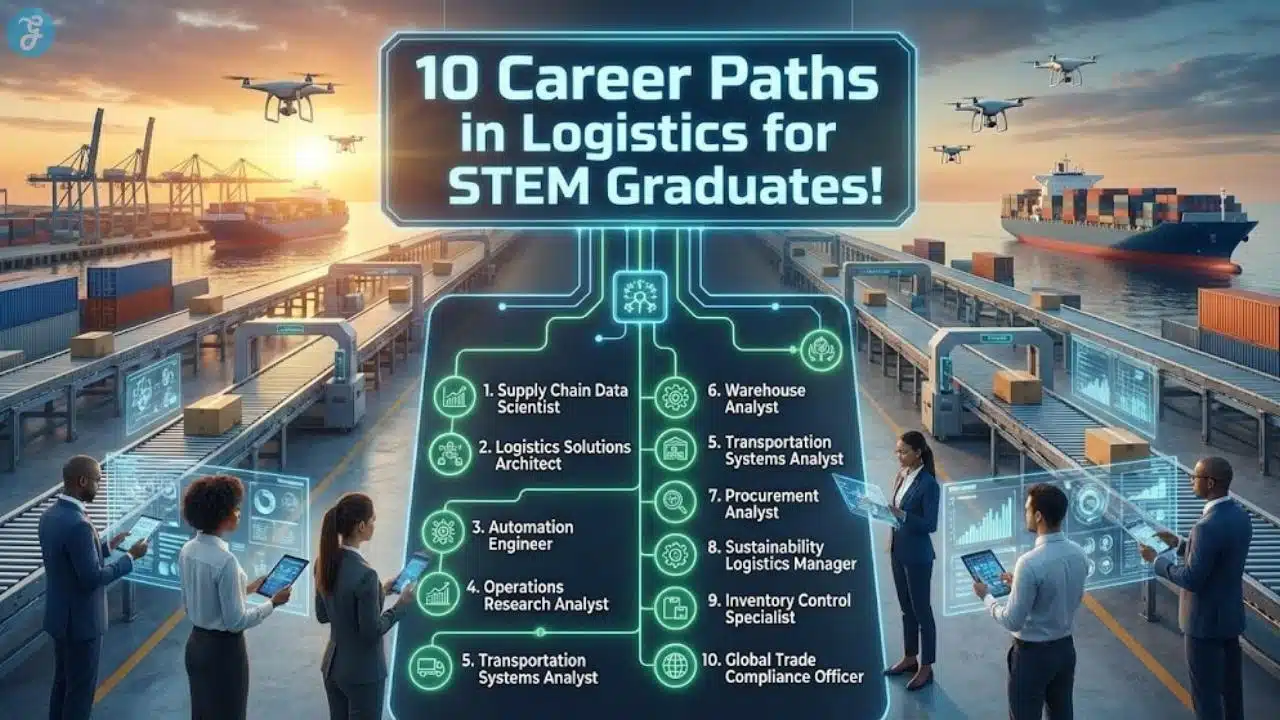
Logistics was once viewed as a low-tech industry dominated by clipboards and forklifts. We know that today, the reality is vastly different. Modern supply chains are powered by complex algorithms, autonomous robotics, and massive datasets. For graduates with degrees in Science, Technology, Engineering, or Mathematics (STEM), this sector offers a playground for problem-solving and innovation.
We selected the top career paths in logistics for STEM graduates, where technical expertise translates directly into operational impact. These roles offer high growth potential and the chance to build the infrastructure of the global economy.
What to Consider When Choosing a Logistics Career for Your STEM Degree?
Transitioning from a STEM degree to a logistics career requires understanding how your specific skills translate to the industry.
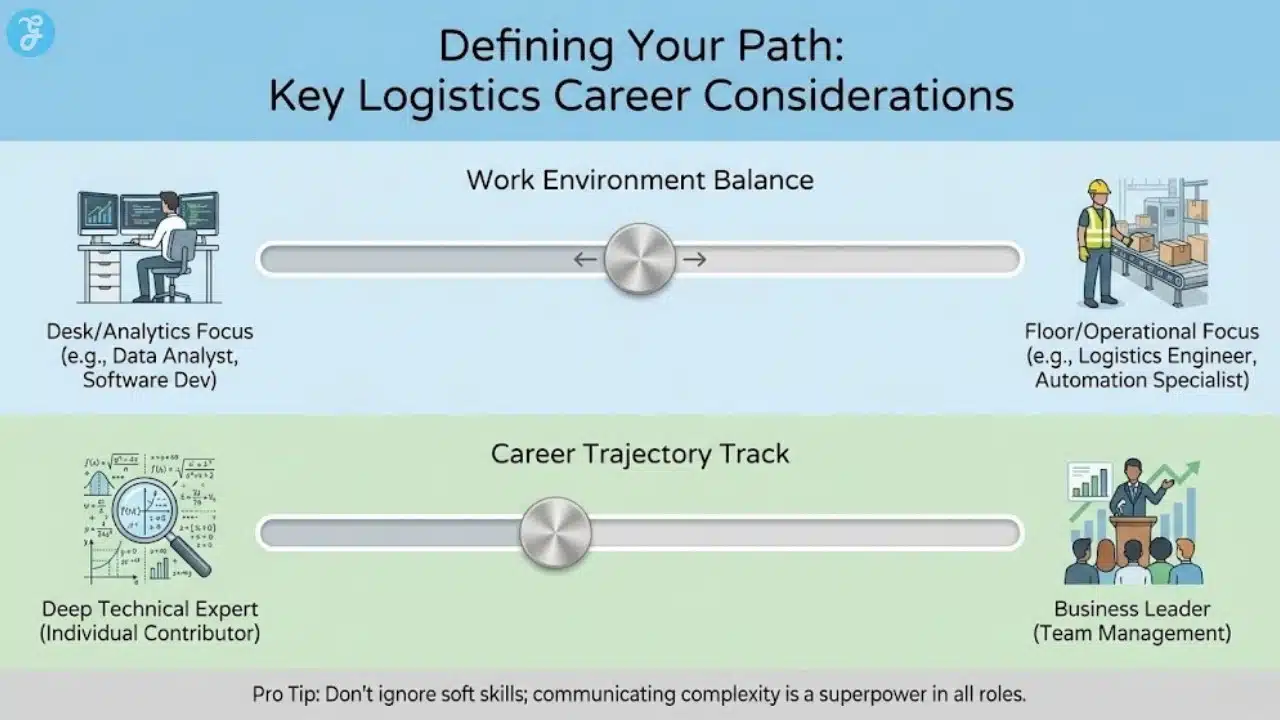
1. The Balance of Desk vs Floor
You must decide if you want to be behind a screen or in the action. Roles like Supply Chain Data Analyst or Software Developer are primarily office-based. In contrast, a Logistics Engineer or Automation Specialist will spend significant time on the warehouse floor wearing safety gear.
We recommend visiting a facility, if possible, to see if you enjoy the industrial environment.
2. Technical vs Managerial Track
Some roles we listed are purely technical, while others are gateways to management. An Operations Research Analyst might stay an individual contributor for years to focus on complex math.
However, a Procurement Engineer or Demand Planner often moves quickly into managing teams. You should consider whether your long-term goal is to become a subject matter expert or a business leader.
3. Industry Sector Matters
Logistics is not the same everywhere. Working as a Packaging Engineer for a consumer electronics company is very different from doing the same job for a chemical manufacturer.
We advise you to look for sectors that align with your personal interests. If you love cars, look for supply chain roles in the automotive industry. If you are passionate about tech, look at e-commerce giants.
Pro Tip: Don’t ignore soft skills. Even in the most technical STEM roles in logistics, you must explain your complex data or engineering concepts to non-technical warehouse managers. The ability to simplify complexity is your superpower.
10 High-Paying Career Paths in Logistics for STEM Graduates in 2026
Here are 10 career paths in logistics for STEM graduates:
1. Supply Chain Data Analyst: Best for Data Science Majors
We selected this role because it serves as the brain of modern logistics operations. A Supply Chain Data Analyst does not just look at spreadsheets. They use programming languages like Python and R to mine massive datasets for patterns. You will predict shipping delays before they happen and optimize inventory levels to save millions of dollars.
This career path is ideal for those who love statistics and pattern recognition. You will spend your days building dashboards in Tableau or Power BI to help leadership visualize complex problems. We found that this role is often the fastest entry point into management for STEM graduates because it provides a holistic view of how the entire business functions.
| Pros | Cons |
| High visibility with upper management | Can involve long hours staring at screens |
| Constant intellectual challenge | Highly dependent on data quality |
| Transferable skills to other industries | Pressure to deliver accurate forecasts is high |
2. Logistics Engineer: Best for Industrial Engineering Grads
We chose Logistics Engineering because it is the purest application of industrial engineering principles. In this role, you design the physical and digital flows of goods. You might determine the optimal layout of a 1 million square foot fulfillment center or design the conveyor systems that sort packages at lightning speed.
Your day-to-day involves using CAD software and simulation tools to model different scenarios. We appreciate this role for its tangible results. You can physically see the improvements you make on the warehouse floor. It bridges the gap between theoretical optimization and real-world execution.
| Pros | Cons |
| Tangible impact on physical operations | Often requires travel to warehouse sites |
| Blend of desk work and floor work | Projects can be disrupted by operational chaos |
| Strong demand in e-commerce sectors | Resistance to change from the floor staff |
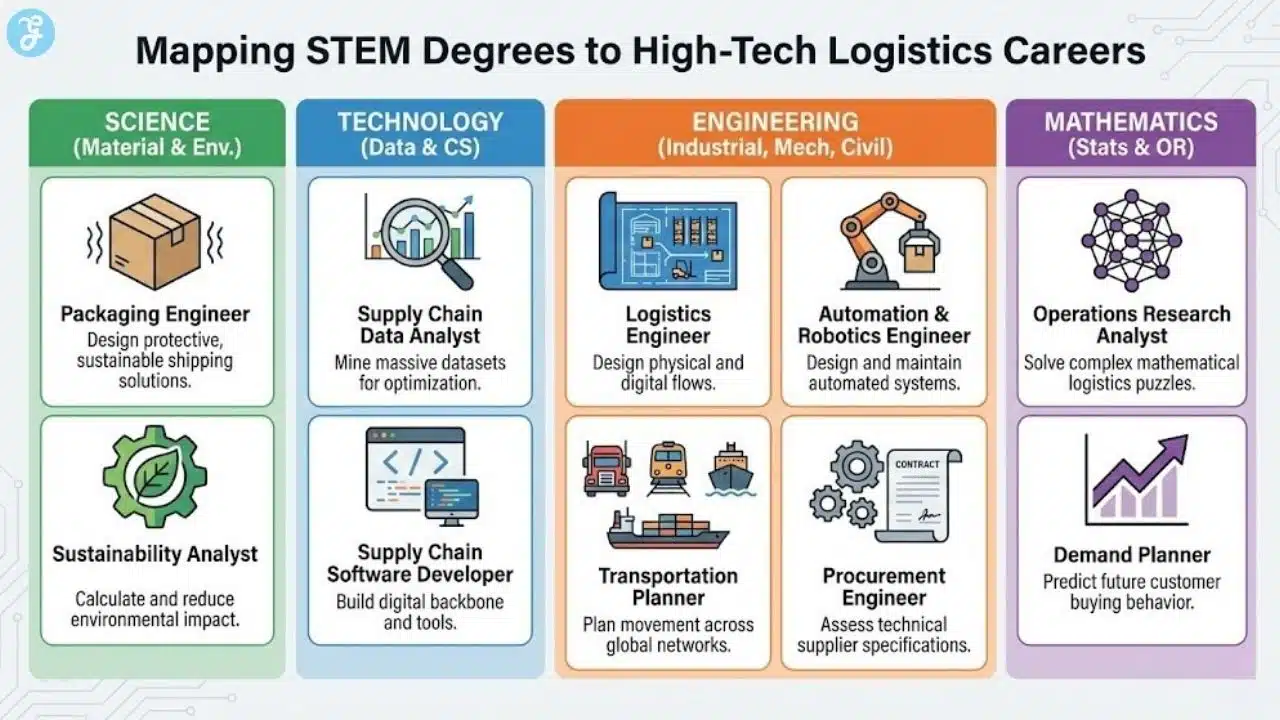
3. Operations Research Analyst: Best for Mathematicians
We selected Operations Research Analyst for those who thrive on abstract problem-solving and advanced mathematics. This role involves building complex mathematical models to solve logistical puzzles. You might calculate the most efficient route for a fleet of 500 trucks or determine the optimal location for a new distribution center based on population shifts.
This path is perfect for graduates with backgrounds in applied mathematics or statistics. We found that these professionals are the secret weapon of major logistics companies. They turn uncertainty into calculated risk using linear programming and simulation methods.
| Pros | Cons |
| Intellectually stimulating and complex | Can feel disconnected from daily operations |
| Very high earning potential | Difficult to explain the value to non-technical staff |
| Focuses on big picture strategy | Models may fail in unpredictable real-world events |
4. Automation & Robotics Engineer: Best for Mechatronics Majors
We included an Automation & Robotics Engineer because the future of warehousing is automated. As companies move toward dark warehouses that run with minimal human intervention, the demand for engineers who can design and maintain these systems is exploding. You will work with Automated Guided Vehicles (AGVs) and robotic arms that pick and pack orders.
This role allows you to get your hands dirty with hardware while also writing the code that controls it. We believe this is one of the most secure career paths in the industry. As labor shortages continue, the reliance on robotics will only increase.
| Pros | Cons |
| Working with cutting-edge technology | High pressure to minimize downtime |
| Rapidly growing job market | Requires on-call availability for repairs |
| Combination of software and hardware skills | Physical safety risks when working with machinery |
5. Packaging Engineer: Best for Material Science Graduates
We chose Packaging Engineering because it combines material science with structural design to solve critical shipping challenges. A Packaging Engineer does not just design boxes. They engineer protection systems that ensure fragile electronics survive a drop from a delivery truck while minimizing waste and weight.
You will test materials for durability and environmental impact. We value this role because it has a massive effect on sustainability. By shaving a fraction of an ounce off a package, you can save a company millions in fuel costs and significantly reduce its carbon footprint.
| Pros | Cons |
| Direct impact on sustainability goals | Often viewed as a cost center by finance teams |
| Creative and design-focused | Finding eco-friendly materials is challenging |
| Diverse range of projects | Strict regulatory compliance requirements |
6. Transportation Planner: Best for Civil Engineering Backgrounds
We selected Transportation Planner because it leverages the same skills used in urban planning and infrastructure design. You will analyze traffic patterns and infrastructure limitations to plan the movement of freight across road, rail, and sea networks. This role is critical for navigating the complexities of global trade lanes.
Your background in civil engineering helps you understand the physical constraints of transportation networks. We found that professionals in this role play a key part in disaster response and supply chain resilience. You figure out how to keep goods moving when a bridge closes or a port gets congested.
| Pros | Cons |
| Critical for global commerce | High stress during weather events or strikes |
| Opportunities to work internationally | Dealing with complex government regulations |
| Strategic importance to the company | Constant fire-fighting and problem-solving |
7. Demand Planner: Best for Statistics Experts
We chose Demand Planner because it requires a deep understanding of statistical modeling and human behavior. Your job is to predict exactly what customers will buy and when they will buy it. You analyze historical sales data and combine it with market trends to tell the factory how much to produce.
This role is the heartbeat of the supply chain. We like it for STEM graduates because it punishes guessing and rewards rigorous analysis. If you enjoy time-series analysis and working with predictive algorithms, this is a natural fit.
| Pros | Cons |
| Central to business profitability | You are blamed for both overstock and stockouts |
| Heavy interaction with sales and marketing | Constant cycle of deadlines |
| Clear metrics for success | Forecasting is never 100 percent accurate |
8. Procurement Engineer: Best for Mechanical Engineering Backgrounds
We included a Procurement Engineer because it bridge the gap between technical requirements and commercial negotiation. When a company needs to buy complex machinery or raw materials, a general buyer often lacks the technical knowledge to evaluate the options. You step in to assess the technical specifications of suppliers.
You will interpret blueprints and technical data sheets to ensure the company is buying the right parts. We selected this path because it offers a unique blend of engineering knowledge and business strategy. It is perfect for engineers who enjoy communication and negotiation.
| Pros | Cons |
| Exposure to external suppliers and tech | Heavy administrative workload |
| Develops strong negotiation skills | Conflict resolution is a daily task |
| Clear path to executive management | Balancing cost vs quality is difficult |
9. Supply Chain Software Developer: Best for Computer Science Professionals
We selected Supply Chain Software Developer because logistics runs on code. From Warehouse Management Systems (WMS) to custom tracking applications, developers build the digital backbone of the industry. You will write code that optimizes routes or integrates e-commerce platforms with inventory databases.
This is not a standard IT job. We found that developers in logistics must understand the physical reality of the goods they are tracking. You solve real-world problems like “how do we scan this barcode faster?” using software solutions.
| Pros | Cons |
| High salary and remote work options | Legacy systems can be frustrating to work with |
| Immediate feedback on your code’s impact | Requires learning complex industry jargon |
| Ability to build new tools from scratch | 24/7 system uptime requirements |
10. Sustainability Analyst: Best for Environmental Science Majors
We chose Sustainability Analyst because environmental responsibility is now a top priority for every major logistics company. You will use scientific methods to calculate carbon footprints and water usage across the supply chain. Your goal is to find ways to reduce waste without sacrificing speed or cost.
This role requires a strong grasp of environmental science and data analysis. We appreciate that this career path allows you to make a genuine difference in the world. You turn “going green” from a marketing slogan into a scientifically measured reality.
| Pros | Cons |
| High moral satisfaction and impact | Often met with resistance due to costs |
| Rapidly growing importance in corporate strategy | Data collection can be difficult and messy |
| Diverse work involving energy and waste | Measuring results takes a long time |
How to Prepare for a Logistics Career as a STEM Graduate?
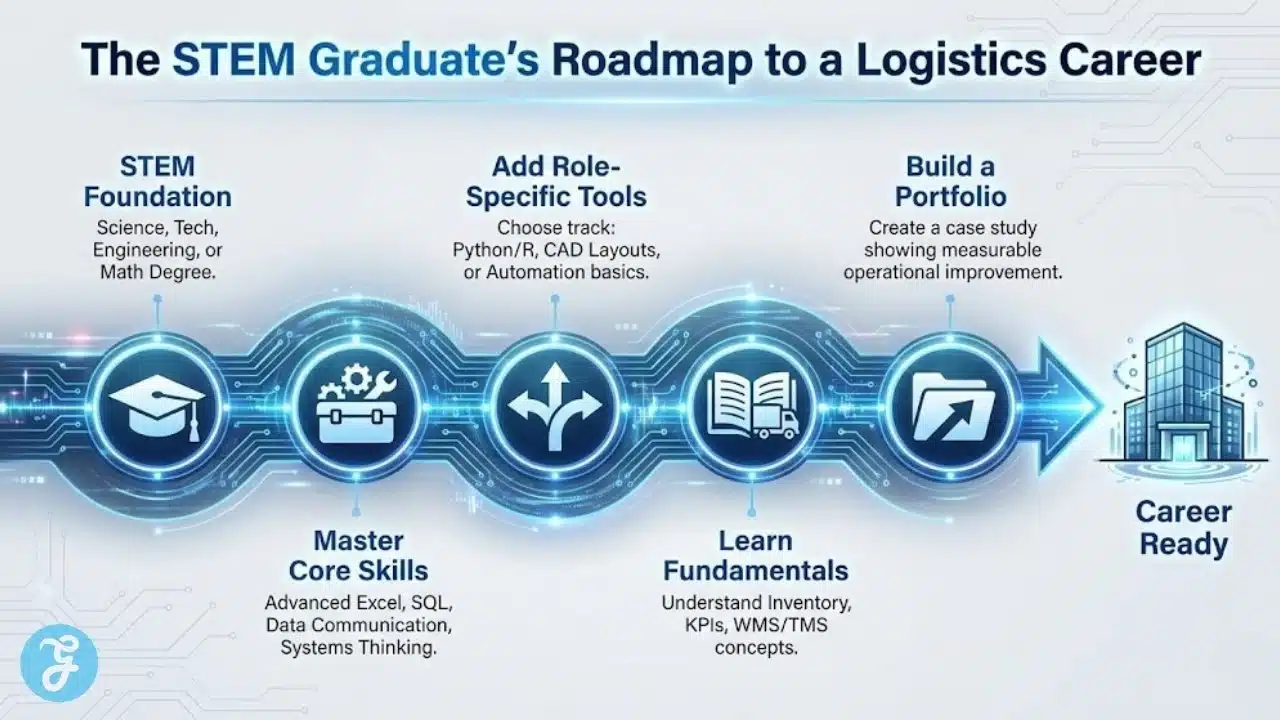
Logistics teams value STEM graduates because they bring structured thinking and problem-solving. But to get hired (and grow fast), you’ll need a mix of technical tools, basic supply chain knowledge, and proof that you can apply your skills to real operational outcomes.
Develop Core skills that help in most logistics roles
These are the foundations that show employers you can handle real datasets, communicate clearly, and make decisions that improve performance.
Must-have skills (for most entry-level paths):
- Advanced Excel: PivotTables, Power Query basics, data cleaning, KPI tracking
- SQL: pulling accurate data from operational systems
- Data communication: summarize insights for non-technical stakeholders
- Systems thinking: understand how one change affects cost, speed, and service levels
Learn Role-specific skill boosters
After you cover the basics, you can choose one track and deepen the skills that matter for that specific path.
Useful add-ons depending on your target career:
- Python/R: forecasting, automation, modeling (analytics, OR, sustainability)
- CAD + layout logic: facility design, conveyor/layout planning (logistics engineering)
- Optimization methods: constraints, trade-offs, scenario planning (OR, transportation)
- Automation basics: sensors, PLC concepts, safety awareness (robotics/automation)
Understanding Logistics Fundamentals
You don’t need to memorize every term. You just need enough vocabulary to connect your STEM skills to supply chain outcomes during interviews and on the job.
High-impact concepts to learn early:
- Inventory basics: lead time, safety stock, reorder point
- Service level & KPIs: on-time delivery, fill rate, cycle time, damage rate
- WMS/TMS awareness: what warehouse and transport systems do and why they matter
- Trade-offs: faster delivery may raise cost; lower inventory can raise stockout risk
Build a Small Portfolio
In logistics, “I can do it” is less convincing than “here’s what I built.” One good project can outperform a long list of certifications.
Portfolio project ideas (pick one and keep it simple):
- Late shipment risk dashboard (Excel/SQL/BI)
- Demand forecast comparison (2–3 models + error metrics)
- Warehouse bottleneck analysis with a redesign proposal
- Route planning prototype with constraints (capacity, time windows)
- Packaging redesign that reduces waste and damage risk
A strong portfolio should include your goal, dataset assumptions, method, and a clear explanation of what was improved.
Quick Overview
This mini reference helps readers match skills to the roles from your article without guessing.
| Skill/Tool | Most Useful For |
| Excel + SQL | Data Analyst, Demand Planner, Sustainability Analyst |
| Python/R | Data Analyst, OR Analyst, Demand Planner |
| CAD + layout thinking | Logistics Engineer, Packaging Engineer |
| Optimization mindset | OR Analyst, Transportation Planner |
| Automation basics | Automation & Robotics Engineer |
Expert Advice for Individuals Seeking Careers in Logistics
Logistics is one of those industries where the “right” move is rarely applicable everywhere. The smartest candidates pick a direction, build proof, and position themselves as a solution to a specific business problem.
1) Pick a track and make your profile look “pre-trained”
Hiring managers respond best when your resume clearly matches the role. Choose one of these tracks and align your skills, projects, and keywords accordingly.
Common tracks for STEM grads:
- Analytics track: Data Analyst, Demand Planner, Sustainability Analyst
- Engineering track: Logistics Engineer, Packaging Engineer
- Optimization track: Operations Research Analyst, Transportation Planner
- Automation track: Automation & Robotics Engineer
- Business-tech bridge track: Procurement Engineer
- Software track: Supply Chain Software Developer
2) Translate your STEM work into logistics outcomes
In logistics, impact is measured in operational results. When describing projects, focus on outcomes that match how the industry thinks.
Outcome language that lands well:
- Reduced delays / improved on-time delivery
- Lowered stockouts / improved fill rate
- Increased throughput / reduced cycle time
- Reduced damage / reduced waste, and cost
- Improved uptime / reduced downtime risk
Even if your project is academic or simulated, tie it to these real-world metrics.
3) Bring a mini case study to interviews
A short, structured story makes you sound experienced—even if you’re early in your career. It also shows you can solve problems the way logistics teams actually work.
Simple case-study format:
- Problem: what was failing (delays, stockouts, congestion, downtime)
- Data: what you used (orders, timestamps, logs, KPIs)
- Approach: how you analyzed or designed a fix
- Result: what improved (measured or estimated)
- Next step: how you’d validate and monitor in real operations
4) Build a hybrid advantage: screen + floor
Many people can analyze data. Fewer can verify assumptions in a warehouse or transport environment. If you can do both, you become extremely valuable.
Ways to build that advantage:
- Visit a facility (or request a tour during interviews)
- Ask operators where errors and bottlenecks happen
- design solutions that respect physical constraints and safety
5) Apply smarter, not wider
Instead of blasting applications, focus on roles where you match most requirements and can show proof. This approach usually produces better interviews and faster offers.
High-signal application strategy:
- Target roles where you match 70%+ of the skills
- Customize your top resume bullets to mirror the job description
- Add a portfolio link or a one-page project summary
- Network with operations + analytics managers (they feel the pain you can solve)
What are You Waiting For?
Logistics is no longer a “behind-the-scenes” industry—it’s a high-impact, tech-driven field where STEM graduates can build fast, rewarding careers. Whether you’re drawn to data analytics, automation, engineering design, or sustainability, the key is to choose a track, build the right skills, and prove your ability with a small portfolio project.
With global supply chains getting more complex every year, companies need STEM talent that can turn problems into measurable improvements—making this one of the most stable and future-proof career paths you can choose.
Frequently Asked Questions (FAQs)
Here are the most frequently asked questions people have about logistics careers for STEM graduates:
Do I need a specific supply chain degree to enter this field?
No, STEM degrees are highly valued. Employers often prefer candidates with hard technical skills in math, engineering, or coding because teaching logistics concepts is easier than teaching someone how to program in Python or calculate structural loads.
Which STEM degree is most in demand in logistics?
Industrial Engineering and Data Science are currently the top contenders. The industry is obsessed with efficiency and data visibility. This makes these two disciplines the most directly applicable to current challenges in the supply chain.
Is logistics a stable career for STEM graduates?
Yes, it is incredibly stable. The global movement of goods is essential for the economy. As supply chains become more high-tech, the reliance on skilled STEM professionals to maintain and optimize these systems will only grow.
Can I work remotely in these roles?
It depends on the specific position. Roles like Data Analyst, Software Developer, and Demand Planner often offer remote flexibility. However, roles like Logistics Engineer or Automation Specialist usually require your physical presence at the facility to monitor operations.
What software skills should I learn to get hired?
Focus on data and visualization tools. We recommend learning Excel (advanced), SQL, and a visualization tool like Tableau or Power BI. For engineering roles, familiarity with CAD software or simulation tools like AnyLogic is a major advantage.