In a significant policy shift, Canada has announced plans to recognize the State of Palestine during the upcoming 80th session of the United Nations General Assembly, scheduled for September 2025. The announcement comes amid intensifying violence in Gaza and growing international calls for justice and accountability.
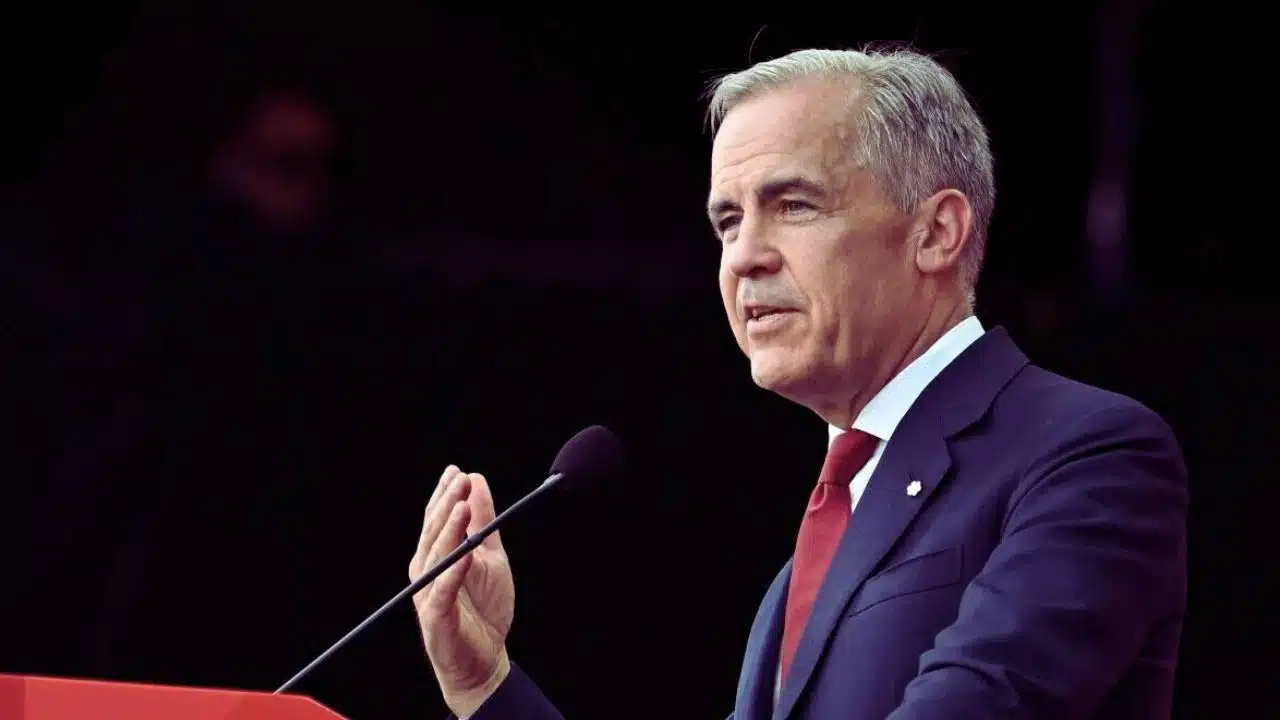
Prime Minister Mark Carney made the declaration, stating that Canada’s previous hopes for a peaceful two-state solution through direct negotiations have been rendered unrealistic due to ongoing Israeli military operations, civilian casualties, and the political deadlock.
This development places Canada alongside a growing list of Western countries, including the United Kingdom and France, that have recently committed to acknowledging Palestinian statehood. These diplomatic shifts reflect increasing frustration with the lack of progress toward a negotiated settlement and widespread global concern over the humanitarian catastrophe in Gaza.
Shift in Canada’s Foreign Policy and Its Reasons
Canada’s position on the Israel-Palestine conflict has traditionally been centered around supporting a peaceful resolution through bilateral negotiations between Israeli and Palestinian leaders. However, the situation on the ground, particularly the immense scale of destruction and loss of life in Gaza since 2023, has forced Ottawa to reconsider its approach.
According to recent humanitarian reports, over 60,000 Palestinians have lost their lives since the conflict intensified, and large parts of Gaza have been reduced to rubble. The international community, including the United Nations and human rights organizations, has condemned the level of violence and accused Israel of carrying out disproportionate military actions that may amount to war crimes.
Carney explained that the path to peace cannot rely solely on waiting for negotiations that have continually failed. He stressed that Canada now sees recognition as a constructive step to preserve the possibility of a two-state solution, which remains widely supported globally as the most viable resolution to the long-standing conflict.
Conditions Tied to Canada’s Recognition of Palestine
Canada’s recognition of Palestine is not unconditional. The Canadian government has clearly indicated that this move depends on several key commitments from the Palestinian leadership.
Among the most important conditions is the expectation that the Palestinian Authority will implement structural reforms aimed at improving governance, transparency, and accountability. In addition, Canada expects President Mahmoud Abbas to ensure that free and fair general elections are held in 2026 to legitimize the political leadership of a future Palestinian state.
Another critical point in Canada’s decision is the exclusion of Hamas from any future Palestinian governance. The Canadian government maintains that Hamas, which it designates as a terrorist organization, must not be allowed to participate in the electoral process or any transitional political arrangements. While this condition aligns with the views of several Western nations, some experts argue that excluding any significant faction could complicate efforts toward building a unified and representative Palestinian government.
UK and France Join Canada in Backing Palestinian Statehood
Canada’s announcement is part of a broader trend among Western powers re-evaluating their stance on the Israeli-Palestinian conflict. Earlier in July, both the United Kingdom and France declared their intentions to recognize Palestine, signaling a shift in European diplomacy and growing disillusionment with Israel’s actions in Gaza and the West Bank.
However, the recognitions so far have been largely symbolic. They are not accompanied by any immediate policy changes that would compel Israel to halt its military operations or settlement expansions. There is still uncertainty over how these diplomatic recognitions will influence the situation on the ground, especially as Israel continues to expand illegal settlements in the West Bank and enforces a devastating military campaign in Gaza.
Despite these challenges, the coordinated recognitions may increase pressure on Israel to reconsider its current policies, especially if more countries join the movement and if international institutions take further action.
U.S. Rejects Recognition Move and Maintains Pro-Israel Stance
While some Western nations move toward supporting Palestinian statehood, the United States continues to oppose such recognition. Washington, which remains Israel’s most powerful and unwavering ally, has dismissed recent declarations by France, the UK, and now Canada as premature and counterproductive.
President Donald Trump, who remains a dominant voice in Republican politics, publicly criticized France’s decision to recognize Palestine and dismissed any suggestions that such moves would change the dynamics of the conflict. He argued that recognizing Palestine at this point effectively rewards Hamas and undermines efforts to combat terrorism.
Trump’s stance reflects the broader U.S. policy, which has continued to back Israel politically, militarily, and diplomatically. This position persists despite widespread international condemnation of Israel’s actions in Gaza and mounting allegations by United Nations experts and humanitarian organizations that Israel is committing acts that may constitute genocide.
The U.S. has blocked or diluted several UN Security Council resolutions aimed at calling for a ceasefire or investigating alleged war crimes committed by Israeli forces. This has further fueled anti-American sentiment across parts of the Middle East and has complicated Washington’s relations with allies who are increasingly uncomfortable with the U.S. position.
Accusations Against Canada Over Weapons Exports to Israel
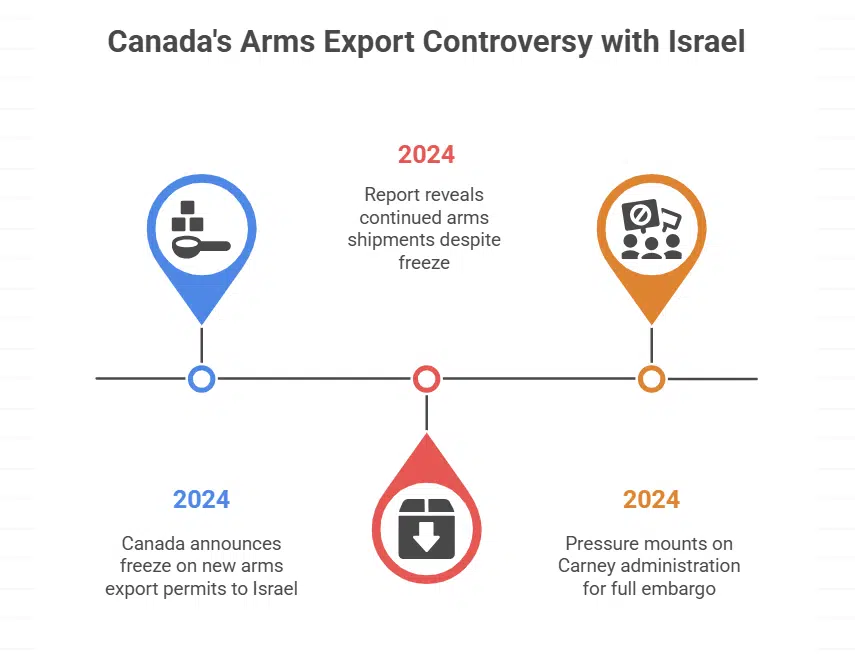
In 2024, Canada had announced a freeze on new permits for arms exports to Israel, citing concerns over human rights violations. However, a recent report by a coalition of Canadian and international advocacy organizations has revealed that arms shipments have continued, possibly through loopholes or existing permits.
Based on Israeli tax documents and customs data, the report highlighted that various Canadian-made defense items have been exported to Israel despite the official freeze. The authors accused the Canadian government of maintaining a policy of secrecy and deception to avoid public scrutiny and evade responsibility.
These revelations have intensified pressure on the Carney administration to not only halt future exports but also cancel all current arms permits and enforce a full two-way arms embargo on the Israeli military. The advocacy groups argue that without genuine enforcement, Canada’s recognition of Palestine risks being seen as a purely symbolic gesture.
Muslim Community Groups React to Canada’s Announcement
The National Council of Canadian Muslims (NCCM) welcomed the recognition of Palestine as a meaningful and overdue step in Canadian foreign policy. However, the organization insisted that recognition alone is not enough.
In their official response, the NCCM urged Canada to adopt a comprehensive and independent foreign policy that goes beyond symbolic gestures. They called for immediate and practical measures, including:
-
A complete arms embargo on Israel
-
Re-evaluation of the Canada-Israel Free Trade Agreement
-
Humanitarian aid and immigration support for Palestinians fleeing Gaza
-
Stronger sanctions on the Israeli government led by Benjamin Netanyahu
The NCCM also criticized the ongoing support of the Trump administration for Israel’s policies, warning that this could threaten Canada’s sovereignty if not resisted. They invoked a comparison between U.S. foreign policy pressure and hypothetical scenarios where Canada is treated as a subordinate state under American control.
What Comes Next: UN General Assembly in September 2025
Canada’s official recognition of Palestine is expected to be announced formally at the United Nations General Assembly in September 2025. This move will mark a historic moment in Canadian diplomacy and could influence other undecided nations to follow suit.
Still, the recognition of a Palestinian state raises numerous questions about implementation, the geopolitical impact, and how it will affect Israeli policy or military strategy in Gaza and the West Bank. Without international enforcement mechanisms, these recognitions may remain largely symbolic.
However, advocates argue that growing international recognition sends a clear message: the global community is increasingly unwilling to tolerate the status quo. For many, it signals a new chapter in the decades-long quest for justice and self-determination for the Palestinian people.