In an era where artificial intelligence seems capable of conquering chess grandmasters, diagnosing diseases, and even creating art, a tantalizing question emerges: could AI crack the ultimate puzzle and predict lottery winning numbers? As millions of players worldwide chase life-changing jackpots, the intersection of cutting-edge technology and games of chance presents a fascinating paradox worth exploring.
The Mathematical Foundation of Lotteries
To understand AI’s potential role in lottery prediction, we must first grasp how these games fundamentally operate. Modern lotteries are built on the bedrock of randomness and probability theory. Take the popular Powerball lottery, where players select five numbers from 1 to 69, plus a Powerball number from 1 to 26. The odds of winning the jackpot stand at approximately 1 in 292 million – a probability so remote it defies intuitive comprehension.
This astronomical improbability isn’t accidental; it’s carefully engineered. Lottery systems employ sophisticated random number generators and physical drawing mechanisms specifically designed to eliminate patterns and ensure genuine randomness. Each draw is statistically independent, meaning previous results have absolutely no bearing on future outcomes – a concept that challenges our pattern-seeking human nature.
What AI Excels At
Artificial intelligence demonstrates remarkable prowess in pattern recognition, data analysis, and predictive modeling. Machine learning algorithms can identify subtle correlations in vast datasets that would escape human notice. They’ve revolutionized fields from financial forecasting to weather prediction by finding meaningful signals within apparent noise.
AI systems excel when historical data contains hidden patterns or when complex variables interact in predictable ways. They can process millions of data points simultaneously, identifying trends that inform accurate predictions about everything from stock market movements to consumer behavior.
The Lottery Paradox
Here lies the fundamental contradiction: AI thrives on patterns, while lotteries are engineered to be patternless. True randomness, by definition, contains no predictable sequences or recurring themes that algorithms could exploit. Each lottery draw represents a fresh start, unconnected to previous results.
Consider this analogy: asking AI to predict lottery numbers is like asking it to forecast which way a perfectly balanced coin will land based on previous flips. No amount of computational power can overcome the absence of underlying patterns in genuinely random events.
Historical Attempts and Their Limitations
Despite mathematical impossibilities, numerous attempts have been made to create lottery prediction systems. Some focus on “hot” and “cold” numbers – those drawn frequently or infrequently over specific periods. Others analyze drawing dates, machine types, or ball sets used in physical drawings.
However, these approaches fundamentally misunderstand randomness. In a truly random system, a number that hasn’t appeared in 100 draws is no more likely to appear in the next draw than any other number. This phenomenon, known as the gambler’s fallacy, illustrates our natural tendency to impose patterns where none exist.
Even sophisticated AI models trained on decades of lottery data consistently fail to outperform random selection. Statistical analysis of such systems invariably shows their predictions perform no better than chance – exactly what probability theory predicts.
Where AI Actually Adds Value
While AI cannot predict lottery winning numbers, it does offer legitimate applications within lottery ecosystems. Gaming commissions use AI for fraud detection, identifying suspicious patterns in ticket purchases or claims that might indicate manipulation or insider knowledge.
AI also enhances security systems, monitoring drawing processes to ensure integrity and randomness. Some lottery organizations employ machine learning to optimize ticket distribution, analyze player behavior for responsible gaming initiatives, and improve customer service through chatbots and automated systems.
Additionally, AI helps researchers study gambling behaviors and develop tools for identifying problem gambling patterns, contributing to player protection efforts.
The Persistence of Prediction Claims
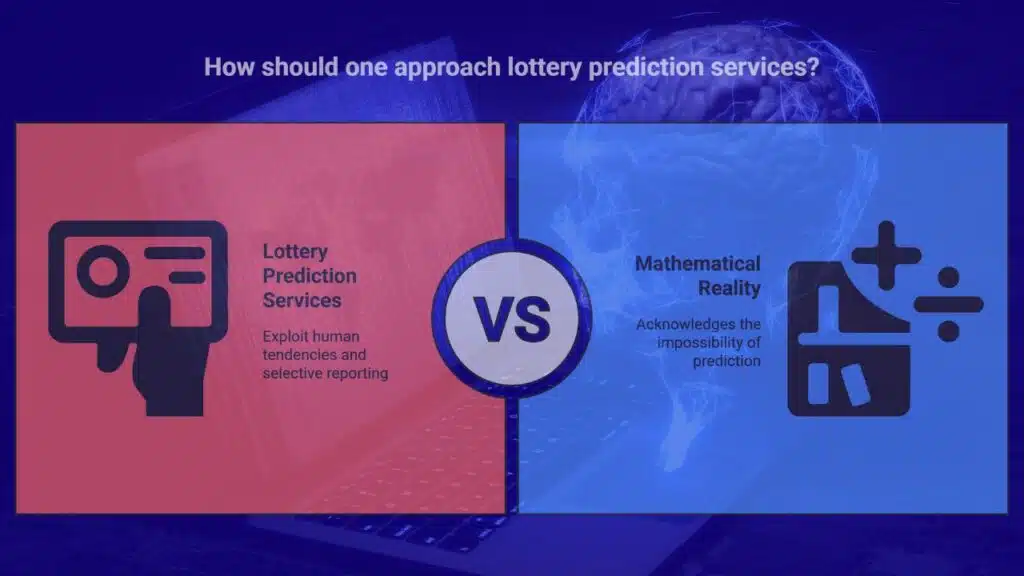
Despite mathematical impossibilities, lottery prediction services continue to proliferate online. These typically employ one of several flawed strategies: analyzing historical frequency data, applying numerological concepts, or using complex-sounding but mathematically meaningless algorithms.
Such services exploit natural human tendencies to seek patterns and control in uncertain situations. They often use selective reporting, highlighting rare instances when their “predictions” align with actual results while ignoring the vast majority of incorrect forecasts.
Understanding True Randomness
The concept of genuine randomness proves challenging for humans to internalize. Our brains evolved to identify patterns for survival, making it difficult to accept that some events truly lack predictable structure. This cognitive bias explains why people continue seeking lottery prediction systems despite overwhelming evidence of their futility.
Modern lottery systems undergo rigorous testing to ensure randomness. Drawing machines are regularly inspected, balls are weighed and measured for uniformity, and random number generators are certified by independent testing laboratories. These measures exist specifically to prevent the kinds of patterns that would make prediction possible.
The Bottom Line
The relationship between AI and lottery games reveals important truths about both technologies and chance. While artificial intelligence represents one of humanity’s most powerful analytical tools, it cannot transcend the fundamental laws of probability and randomness that govern lottery systems.
This limitation isn’t a failure of AI – it’s actually a testament to the robust design of modern lotteries. The inability of even the most sophisticated algorithms to predict lottery numbers provides confidence that these games operate fairly and randomly, as intended.
For lottery players, this means there are no shortcuts or secret systems. Every ticket has the same probability of winning, regardless of how numbers are selected. Whether chosen by birthdays, random quick-picks, or complex algorithms, all combinations stand equal before the impartial mathematics of chance.
The intersection of AI and lotteries ultimately reinforces a fundamental truth: in games of pure chance, the only certainty is uncertainty itself.