The Cambridge Dictionary, one of the world’s most respected English language references, has rolled out its annual update with a striking highlight—over 6,000 new words, phrases, and senses have been added to its online edition. This move demonstrates how rapidly social media culture, especially platforms like TikTok, YouTube, and Twitter (X), is influencing not just conversation but the very structure of the English language.
The dictionary team explained that language is a “living, breathing system” that evolves with social, cultural, and technological shifts. The past year has been a clear example of this, with TikTok trends, online memes, and viral content generating words that have crossed into everyday usage.
Viral Internet Buzzwords Now Officially Recognized
Among the thousands of new entries, three stand out because of their huge online popularity:
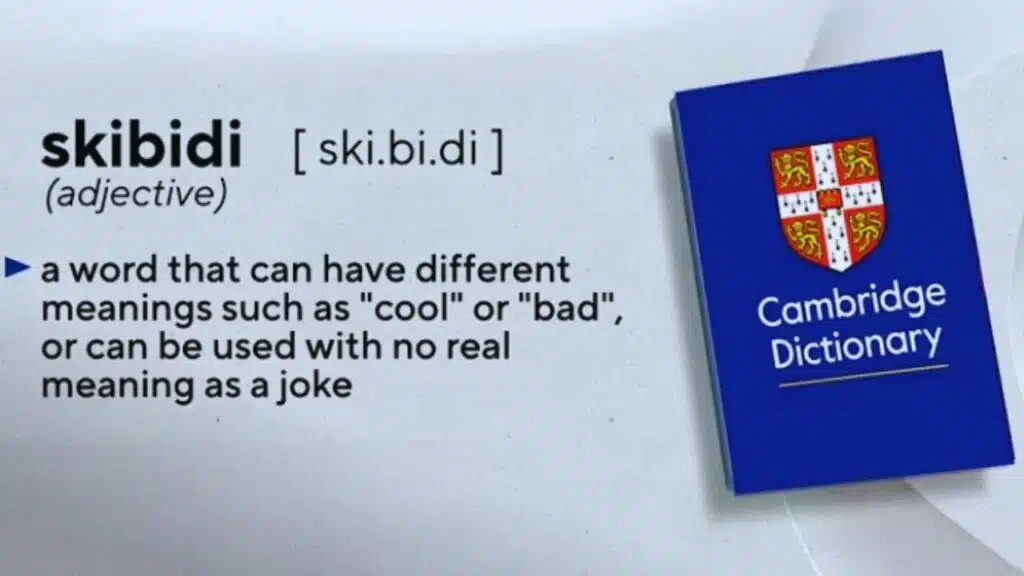
- Skibidi: A word with playful and often nonsensical use, “skibidi” can mean cool, bad, or sometimes nothing at all. It was popularized by the surreal YouTube series “Skibidi Toilet”, which featured bizarre, head-swapping toilet characters and became a viral sensation on TikTok. The term is now widely used by Gen Z as slang in social media comments, jokes, and memes.
- Delulu: Short for delusional, “delulu” started as slang in K-pop fandoms to poke fun at overly obsessive fans who imagined unrealistic scenarios with their idols. Over time, the term spread beyond K-pop circles, and today it is used globally to describe wishful thinking or someone being unrealistic in a funny, lighthearted way. Phrases like “I’m in my delulu era” are common across TikTok and Twitter.
- Tradwife: An abbreviation of traditional wife. The word refers to women who embrace old-fashioned domestic roles, often publicly displaying this lifestyle on social media. The “tradwife” trend has sparked heated debates—supporters praise it as a return to family values, while critics see it as regressive and tied to political or cultural conservatism.
Other New Words Reflect Cultural Trends
The Cambridge Dictionary did not stop with TikTok buzzwords. Its update also captured wider cultural and workplace trends, highlighting how technology, lifestyle, and politics shape modern language:
- Broligarchy – A blend of “bro” and “oligarchy,” used to describe groups of elite, powerful men, especially tech billionaires, who influence politics and the economy.
- Mouse jiggler – Software or gadgets designed to keep a computer active by simulating mouse movement, often used by remote workers who want to appear online while taking a break.
- Work spouse / Work wife – A term describing a close but platonic bond with a colleague, someone who becomes your “office partner” in daily tasks and emotional support.
- Snackable – Once used to describe food, this now refers to short, easily digestible digital content such as TikTok videos or Instagram Reels.
- Red flag / Green flag – Already common online, these terms are now officially recognized to denote warning signs (red) or positive signs (green) in relationships, workplaces, or friendships.
- Forever chemical – Refers to harmful synthetic substances (like PFAS) that remain in the environment indefinitely and pose health risks.
How Cambridge Chooses Words for the Dictionary
Adding new words is not a matter of trend-spotting alone. Cambridge Dictionary relies on its English Corpus, a massive database containing billions of real examples of language use from books, websites, social media, news articles, and spoken English.
Colin McIntosh, Cambridge’s lexical programme manager, explained that words are only added if they show clear signs of widespread, long-term use. In other words, a TikTok meme word must prove it has staying power before making it into the dictionary.
He said: “Internet culture is changing the English language, and the effect is fascinating to observe and capture in the Dictionary.”
Expert Reactions: Language Change or Language Decay?
The update has generated debate among linguists, educators, and the public.
- Supporters argue that dictionaries should reflect real life. If people are using “delulu” or “skibidi” in everyday speech, then these words belong in the dictionary, no matter how silly they may sound.
- Critics, on the other hand, worry that documenting internet slang may normalize “low-quality” language. They fear that future generations might rely too heavily on slang and lose touch with formal English.
Sociolinguist Christian Ilbury, speaking to AP News, pointed out that many of these words are not as new as they seem. Instead, they often originate within niche online groups or fandoms, and platforms like TikTok give them global reach. According to him, dictionaries are not corrupting English but simply documenting its ongoing evolution.
Why This Matters
The inclusion of terms like “skibidi,” “delulu,” and “tradwife” highlights a larger trend: the internet is no longer separate from real life. What begins as a joke in a meme, a K-pop fandom phrase, or a viral YouTube series can quickly spread across cultures and continents, eventually shaping how millions of people communicate.
Cambridge Dictionary’s 2024–2025 update proves that dictionaries are adapting to this reality. They are no longer just static records of “proper” English, but dynamic reflections of how people actually speak and write today.
The Information is Collected from Sky News and ABC News.