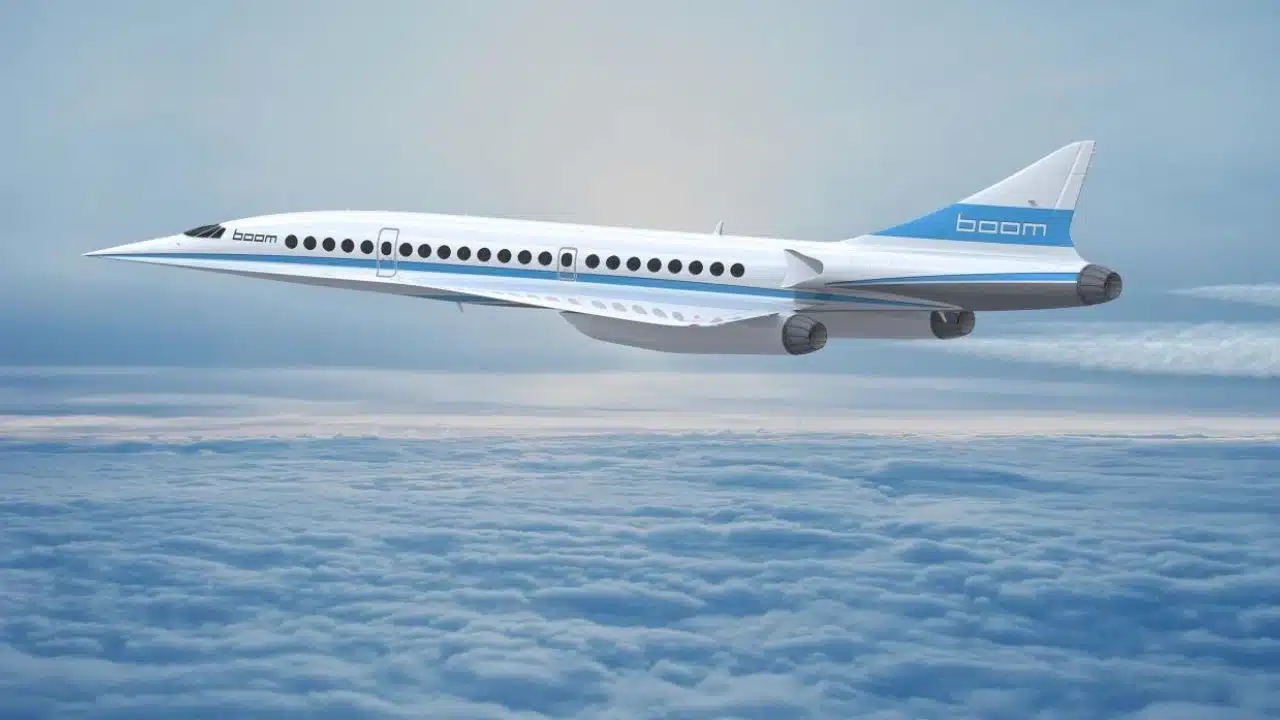
There is no shortage of ambition in commercial aviation — after all, we wouldn’t have heavier-than-air flight without dreamers — but Boom Supersonic is in a class of its own when it comes to raising the bar.
The Colorado-based business intends to restart commercial supersonic flight, which has been dormant since Concorde’s retirement in 2003. However, unlike Concorde, an exclusive engineering marvel that only a few airlines ever operated, Boom hopes that its supersonic aircraft, dubbed Overture, will democratize this sort of travel, making it available to the masses.
“We’ve set out with a really big, audacious goal of creating the first supersonic airliner that tens of millions of people can fly on,” Boom Supersonic founder and CEO Blake Scholl tells CNN. “In my opinion, supersonic travel is about bringing the world closer together.” Our ultimate goal is to provide supersonic travel for every passenger on every route.”
Boom intends to launch Overture into commercial service by 2029, and while that may be difficult, Scholl feels that the business has lately revealed a series of fresh facts about its technology and partners that bring that ambition a little closer to reality.
A difficult procedure
At a speed of Mach 1.7 and an altitude of 60,000 feet, Overture is meant to carry between 64 and 80 passengers. That’s twice the speed and 50% greater altitude than leading widebody aircraft like the Boeing 787 or the Airbus A350, allowing Overture to fly from London to New York in around three and a half hours, cutting travel time in half.
The plane does not yet exist; the first one is due to leave the factory in 2026, but three airlines have already placed orders for it. They include United Airlines, American Airlines, and Japan Airlines, with a total of 130 orders, 35 of which have non-refundable deposits and 95 of which are pre-orders, meaning no money has changed hands yet.
Boom’s current plan calls for a first flight in 2027 and certification of the aircraft in 2029, making it available for service immediately after. Scholl concedes that these goals are “aggressive,” but he’s pleased with the company’s accomplishments so far. “It’s a very complicated process,” he continues, “but unlike electric aircraft or vertical takeoff and landing aircraft, we don’t need an entirely new set of regulations to be certified.” “This is yet another plane. It simply flies at a different rate. But, from a regulatory standpoint, it’s the same safety standards, the same written rules — we just have to obey them and prove that we follow them.”
Boom started work earlier this year on the “Superfactory,” a 62-acre complex in Greensboro, North Carolina, where the jets will be produced and tested before they are ready in mid-2024. In July, the business revealed additional agreements with vendors who will build pieces for the plane at the Paris Air Show: Aernnova for the wings, Leonardo for the fuselage and wing box, and Aciturri for the tail section.
“The general public may not recognize all of those names, but they are the same people who work on large Boeing and Airbus aircraft,” Scholl explains. “We’ve also removed the skin from the plane and shown people the engineering progress on the inside, including the configuration of hydraulics, flight controls, landing gear, avionics, and electrical power systems — all the guts of the plane that make it fly.” To achieve the demanding certification requirements, we are designing everything to the best possible safety standards.”
Sustainable fuel
Engines are among the most important components in a supersonic jet since they must move the aircraft faster than standard airliners, necessitating a different design. Symphony is the name of Boom’s engine, which was developed in partnership with Florida Turbine Technologies, whose experts have worked on supersonic engines for combat jets such as the Lockheed Martin F-22 and the F-35. Boom had previously collaborated on the project with Rolls-Royce, one of the most recognizable names in engine manufacture, but it withdrew last year.
“It’s meant to be efficient in supersonic flight, but also quiet for takeoff and landing,” Scholl says of Symphony, which was developed with noise, one of Concorde’s main faults, in mind. “That is extremely essential. And a significant differentiator from Concorde, which was notoriously antagonistic to airport communities. One of our goals is that when we offer supersonic service to an airport, the community is ecstatic about the new link and has nothing to worry about.”
The engine is also intended to be entirely compatible with SAF, or Sustainable Aviation Fuel, a type of jet fuel whose manufacturing methods promise to reduce carbon emissions by up to 80%, according to the International Air Transport Association. Boom has also pledged to reduce greenhouse gas emissions to zero by 2040.
However, the SAF infrastructure is lagging behind, and selling the idea that supersonic travel can be sustainable will be difficult, because the engines will burn substantially more fuel, and the emissions per passenger will be far greater due to Overture’s restricted capacity.
Another issue is the sonic boom, which is currently prohibited over land, implying that Overture will be permitted to fly supersonic only over the waters. NASA is currently developing a supersonic plane with a substantially less sonic boom in order to update existing requirements. But none of this will occur in time for Boom to benefit: “Sonic boom mitigation is absolutely a part of the future,” says Scholl. “We will look to learn what we can from NASA’s effort, and it’s something we expect not for our first airplane, because that would break our rule about no new regulations, but for our second one in the future.”
Read Also: Jet Plane Crashes in Virginia
Is there going to be some turbulence?
According to Richard Evans, a senior consultant at aviation consultancy firm Cirium, the chances of success for any airline that will operate Overture will be determined by whether it will use it as much as a conventional long-haul aircraft – 4,000 to 5,000 hours of flying time per year. “This is required to amortize the type’s massive ownership cost per seat,” he explains. “Concorde never achieved anything like those levels of utilization, with an average of around 1,000 hours per year.” Boom’s planes will presumably be restricted to a small number of high-yield flights, making such a target extremely difficult.”
Flying passengers as early as 2029 will also be difficult, Evans continues, citing the delayed Boeing 777-9, a variation of an existing aircraft rather than a totally new one, whose development will have taken 12 years once it enters service. “Even if Boom can attract the billions of dollars required,” Evans says, “it will take much more than another six years to certify the type.”
Finally, he believes it is difficult to understand how the supersonic sector would contribute to aviation’s goal of decarbonization. “It takes far more fuel per passenger, whether SAF or conventional, compared to flying the same route in a different aircraft type,” he explains. “Even if 100% SAF can be used, it simply diverts that SAF from being used in a more efficient manner.”
Another cause for concern, according to Richard Aboulafia, managing director at aviation consultancy firm AeroDynamic Advisory, is the fact that no major engine manufacturer, such as General Electric, Rolls-Royce, or Pratt & Whitney, is working with Boom. “I think of Boom as a somewhat amusing experiment to see how much money people would put into fun-looking drawings and models.” Everything about it, from the lack of a serious engine to the strange and unexplainable huge overhaul a few years back, screams “seriously overfunded wishful thinking.”
Scholl said of the overhaul, which reduced cruise speed while increasing passenger capacity: “It’s about listening to customers and about sustainability.” We discovered that by flying at Mach 1.7 rather than Mach 2.2, we could save 40% on fuel. We’d also be able to cruise at lower altitudes, which would be better for emissions. In terms of passenger capacity, airlines told us that they wanted us to design the largest airplane possible since they believe that many people will want it. That is why we increased the number of engines from three to four in order to carry more passengers.”
Overture will still fall short of Concorde’s average of 100 passengers, but Scholl claims the experience will be radically different. “Concorde was a magnificent technical achievement.” “However, when I talk to passengers who flew in it, they say they loved the speed but not the comfort,” he continues.
“We want to build an airplane with an exceptional level of comfort.” Our approach begins the moment passengers get on board: our boarding door is one inch taller than on a narrowbody aircraft and ten inches taller than Concorde. The front cabin boasts cathedral ceilings, which are almost two meters or eight feet tall. There are also two chairs with wide windows on each side of the aisle.”
The fuselage will get narrower towards the back, reducing the cabin to one seat on each side and converting overhead bins into underseat storage. “I think the best seats in the plane are actually in the back,” Scholl claims.
“We put a lot of thought and care into the passenger experience.” We are always bringing in passengers of all sizes and shapes, as well as flight crews, to find out what they enjoy. We strive to provide an experience that is inspiring, comfortable, and functional, whether you want to be productive or rest. It’s going to be an incredible way to fly.”
Read More: Airbus Seeks New Technology for 100% Hydrogen-Powered Aircraft