

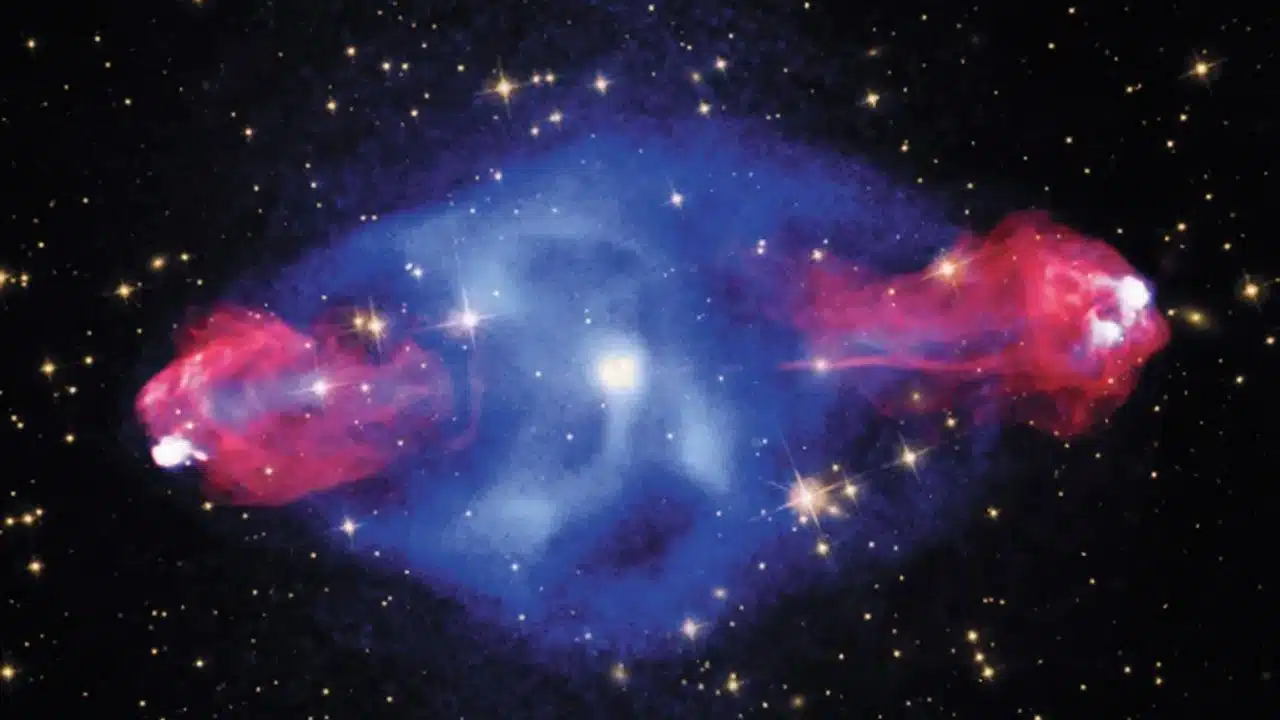
NASA’s Chandra X-ray Observatory has unveiled a revolutionary technique—“X-arithmetic”—that is transforming our understanding of how black holes shape the structure and evolution of galaxy clusters. This breakthrough, announced in December 2025, uses advanced image-processing methods to decode the complex X-ray signals emitted by galaxy clusters, revealing the hidden fingerprints of black hole activity and their cosmic consequences.
The Power of X-Ray Vision
Galaxy clusters, the largest gravitationally bound structures in the universe, contain thousands of galaxies, vast reservoirs of hot gas, and at their centers, supermassive black holes. Chandra’s X-ray vision allows astronomers to peer into the heart of these clusters, detecting the enormous stockpiles of hot gas, which can reach temperatures of up to 100 million degrees. This blazing gas carries crucial information about both the past and present activity within galaxy clusters.
Before the advent of X-arithmetic, interpreting the structures seen in X-ray images—such as hooks, rings, arcs, and wings—was largely descriptive. These features, often the result of powerful outbursts from central black holes, were recognized but not fully understood. With X-arithmetic, researchers can now classify and analyze these structures in unprecedented detail, linking each feature to specific physical processes and quantifying their impact on the surrounding environment.
X-Arithmetic: A New Image-Processing Technique
X-arithmetic is a novel image-processing technique developed specifically for analyzing Chandra’s X-ray data. It enables astronomers to classify structures within galaxy clusters by their X-ray signatures, distinguishing between features caused by black hole feedback, gas sloshing, or other dynamical processes. The technique is versatile, applicable not only to real observations but also to simulations, bridging the gap between theory and data.
The process involves breaking down X-ray images into their constituent parts, assigning mathematical values to different structures, and then using these values to model and predict the physical mechanisms at play. This method has already been applied to several major clusters, including MS0735+7421, the Perseus cluster, and M87, providing new insights into the inner workings of these cosmic giants.
Black Hole Feedback: Sculpting the Cosmic Landscape
At the heart of most galaxy clusters lies a supermassive black hole, millions to billions of times the mass of our Sun. These black holes are not passive occupants; they periodically erupt in powerful outbursts, launching jets of energetic particles that inflate bubbles within the surrounding hot gas. These bubbles carry energy outward, influencing the temperature, density, and dynamics of the cluster gas.
The impact of these outbursts is profound. By injecting energy into the cluster, black holes can regulate the rate at which gas cools and collapses, thereby controlling the formation of new stars. In some clusters, this feedback process is so effective that it prevents the catastrophic cooling of gas, a phenomenon known as the “cooling flow problem.” In others, the black hole’s influence is more subtle, shaping the distribution of galaxies and the overall structure of the cluster.
Case Studies: Chandra’s Discoveries
Perseus Cluster
The Perseus cluster is one of the most studied galaxy clusters, renowned for its intricate X-ray structures and powerful central black hole. Chandra’s images reveal a wealth of features, including giant cavities, ripples, and filaments, all shaped by the black hole’s outbursts. X-arithmetic has allowed researchers to quantify the energy injected by these outbursts, showing that it is sufficient to balance the radiative cooling of the cluster gas and explain the observed mass deposition gap.
MS0735+7421
MS0735+7421 is another cluster where Chandra’s X-ray vision has revealed dramatic evidence of black hole activity. The central black hole here is one of the most powerful known, capable of injecting energy on a scale that rivals the combined output of all the stars in the cluster. X-arithmetic has helped astronomers to map the distribution of this energy, showing how it shapes the cluster’s gas and influences the formation of new galaxies.
M87
M87, home to one of the most famous black holes in the universe, has long been a laboratory for studying black hole feedback. Chandra’s observations have revealed X-ray emitting loops, rings, and filaments around the black hole, indicating the presence of pressure waves, shock waves, and even sound waves. These structures are the result of the black hole’s outbursts, which have dramatically affected the evolution of M87 and its surrounding environment.
The Broader Implications
The ability to decode the X-ray signatures of galaxy clusters has far-reaching implications for our understanding of the universe. By quantifying the impact of black hole feedback, astronomers can better model the formation and evolution of galaxies, clusters, and the large-scale structure of the cosmos.
Moreover, X-arithmetic provides a powerful tool for testing theoretical models and simulations. By comparing the observed structures with those predicted by simulations, researchers can refine their understanding of the physical processes at play, leading to more accurate models of cosmic evolution.
Future Prospects
As Chandra continues its mission, and as new X-ray observatories come online, the potential for further discoveries is immense. X-arithmetic is expected to be applied to an ever-growing number of galaxy clusters, providing a comprehensive picture of black hole feedback and its role in shaping the universe.
In addition, the technique is likely to be extended to other types of astronomical objects, such as galaxy groups and individual galaxies, broadening its impact across astrophysics.
Final Words
The Chandra X-ray Observatory’s new X-arithmetic technique is revolutionizing our understanding of how black holes shape galaxy clusters. By decoding the complex X-ray signals emitted by these cosmic giants, astronomers are uncovering the hidden fingerprints of black hole activity and their profound impact on the universe. This breakthrough not only deepens our knowledge of cosmic evolution but also provides a powerful tool for testing theoretical models and simulations, paving the way for new discoveries in the years to come.






























