

New Satellite to Capture ‘X-Ray Rainbow’ from Massive Celestial Bodies

New Satellite to Capture 'X-Ray Rainbow

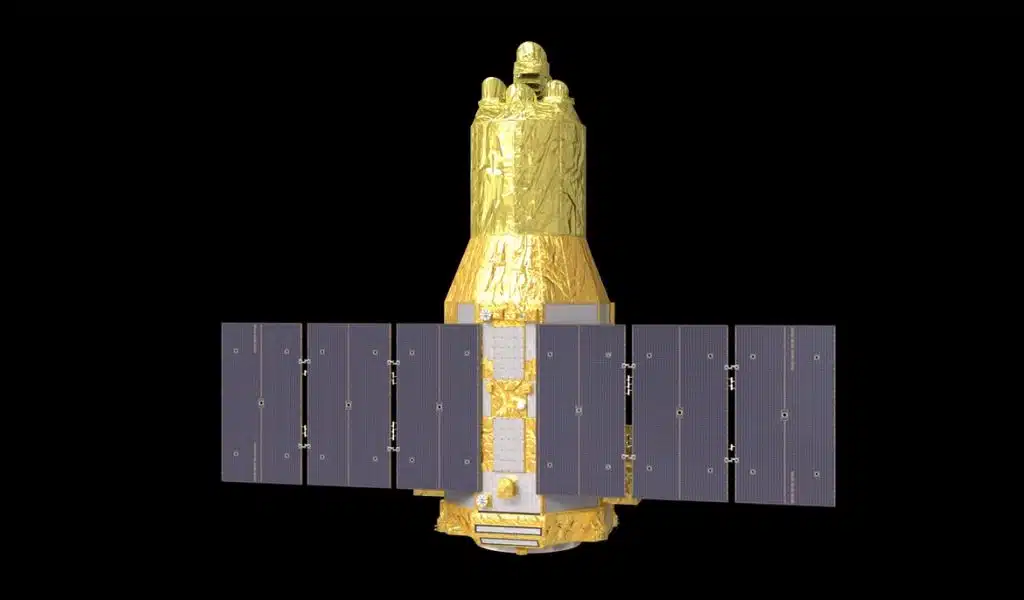
An exciting new space mission is on the horizon! The X-ray Imaging and Spectroscopy Mission (or XRISM, which you pronounce as “crism”) is all set to explore the colossal objects of the universe.

Using state-of-the-art instruments, XRISM can measure the heat of a single X-ray photon. Imagine this as creating an X-ray rainbow from high-energy light, but on a whole new level!

The big day is August 25 (or August 26 if you’re in Japan), when XRISM will take off from Japan’s Tanegashima Space Center. We don’t have the exact time of launch yet, but rest assured you can catch it all live on Space.com when it happens.

Leading this stellar project is JAXA, with NASA chipping in, and support from scientific teams in Canada and Europe.

What’s the mission’s goal, you might ask? Well, according to Brian Williams, XRISM project scientist at NASA’s Goddard Space Flight Center, XRISM is about diving deep into some of the universe’s toughest corners. Think about studying the innards of neutron stars or tracking particle jets zooming near light-speed, powered by black holes in active galaxies. Active galaxies, by the way, are these huge clusters of stars with an unusual energy hub in the center.

XRISM comes equipped with two special tools to investigate these enormous cosmic events. The first of these, Resolve, is an X-ray spectrometer. This instrument is so precise that each pixel in its 6×6-pixel detector can absorb a single X-ray photon. With this level of precision, Resolve can record up to millions of measurements in stunningly high resolution.

To do this kind of work, Resolve needs to operate at super-cold temperatures, close to absolute zero. How do we achieve this? Resolve is kept in a special flask filled with liquid helium, chilling it down to a brisk -460 degrees Fahrenheit (-270 Celsius).

But that’s not all! XRISM also has another instrument, Xtend, to broaden Resolve’s field of view. Thanks to Xtend, Resolve can capture images of the sky about 60% larger than a full moon, which is wider than any previous X-ray imaging satellite!

Both Resolve and Xtend rely on twin X-ray mirror assemblies, developed at Goddard, near Baltimore.

So, buckle up space fans! XRISM is about to take us on an incredible journey into the heart of the cosmos like never before.



Subscribe to Our Newsletter

Related Articles

Top Trending

How to Teach Letters to Kids
8 Ways to Teach Letters to Kids Who Hate Sitting Still
Alphabet Magic vs 123 Magic Number Fun
Alphabet Magic vs 123 Magic Number Fun: Which Skill Does Each App Actually Target?
How to Promote a Blog Post After Publish
10 Best Ways to Promote a Blog Post After Hitting Publish
How to Help a Child Who Refuses to Count Aloud
Articleify 7th anniversary
Happy 7th Anniversary of ArticleIFY: The Journey from a Small Room to Global Horizons

Technology & AI

SEO Agency vs In-House SEO vs Freelancer
SEO Agency vs In-House SEO vs Freelancer: A Decision Framework for Small Teams
ImagineLab Voice Lab vs Murf AI
ImagineLab Voice Lab vs Murf AI: I Tried Multilingual Narration from the Same Script
Best Document Collaboration Tools
10 Best Online Document Collaboration Tools for Teams
Important Signs When Should Raise Prices on Your SaaS
10 Signs It's Time to Raise Prices on Your SaaS
Nostalgia economy
The Nostalgia Economy Is Selling Us a Past We Never Lived

GAMING

Intentional Screen Time
How to Spend Your Screen Time More Intentionally
Complete Guide on Game Programgeeks
Game Programgeeks: A Complete Guide on PC, Game Dev, and Tech
Online Color Game Philippines
Online Color Game Philippines: What Every Beginner Should Know Before Playing
Ways to Reduce Game Development Costs
12 Ways Studios Cut Game Development Costs
NFT game development cost
How Much Does NFT Game Development Cost? A Realistic Budget Breakdown

Business & Marketing

Email Marketing Agency vs DIY Platform
Email Marketing Agency vs DIY Platform: When Outside Help Adds Value
Critical Path Method
The Critical Path Method Explained in Plain English
Time to Value: How SaaS Teams Can Reach Results Faster
How to Onboard New Team Members With a Self-Serve Wiki
How to Document Team Processes for Better Teamwork

EdTech & E-Learning

How to Teach Letters to Kids
8 Ways to Teach Letters to Kids Who Hate Sitting Still
Alphabet Magic vs 123 Magic Number Fun
Alphabet Magic vs 123 Magic Number Fun: Which Skill Does Each App Actually Target?
Alphabet Magic vs ABC Kids: Which Offers Clearer Letter Practice
Alphabet Magic vs ABC Kids: Which Gives Clearer Uppercase and Lowercase Practice?
Alphabet Magic vs LetterSchool comparison review
Alphabet Magic vs LetterSchool: Letter-Tracing Accuracy on the Same Letters [A Hands-on Review]
Alphabet Magic Trace and Phonics vs Teach Your Monster to Read
Alphabet Magic Trace and Phonics vs Teach Your Monster to Read: Which Is Best?

Software & Apps

Best Document Collaboration Tools
10 Best Online Document Collaboration Tools for Teams
Important Signs When Should Raise Prices on Your SaaS
10 Signs It's Time to Raise Prices on Your SaaS
Best CRM Tools for Small Marketing Teams
10 CRM Tools for Small Marketing Teams Worth Using
SaaS partnership tools
10 Best Tools for Managing SaaS Partnerships and Integrations
White-Label SaaS Platform to Resell
8 Best White-Label SaaS Platforms to Resell


















