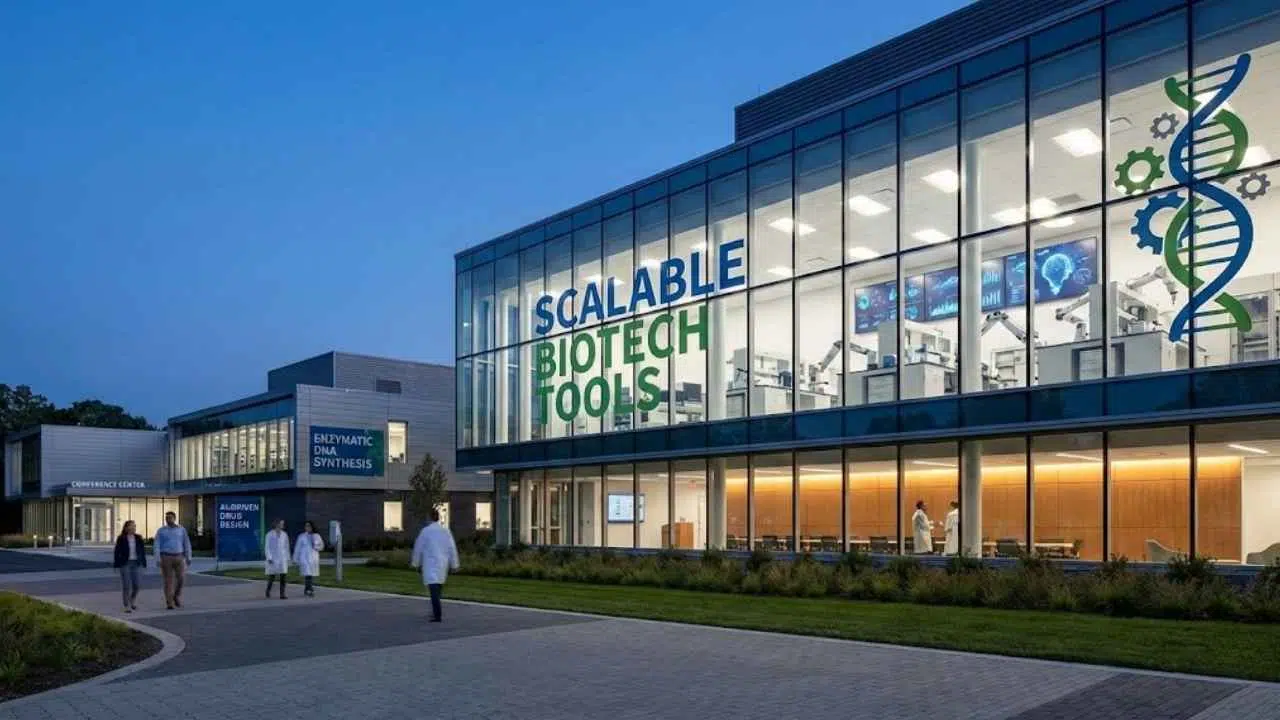
Biotech innovation often gets framed around discovery moments. A promising molecule. A novel target. A breakthrough result happens in early trials. Those moments matter, but they are not what determine whether a company can scale. Many biotech ventures fail not because the science was wrong, but because the systems supporting that science could not grow without breaking.
For investors, scalability is less about hype and more about infrastructure. The real question is whether a company can move from elegant experiments to repeatable outcomes without exploding costs, timelines, or risk. That transition depends on a set of tools that rarely make headlines but quietly shape long-term value. Understanding these tools helps investors separate exciting science from investable platforms.
Why Enzymatic DNA Synthesis Technology Signals Long-Term Scalability
At the foundation of many biotech platforms is the ability to create consistent, high-quality genetic material at scale. Traditional chemical DNA synthesis has served the industry well, but it comes with limitations around length, error rates, and environmental impact. As programs grow more complex, those limitations start to matter.
Enzymatic DNA synthesis technology is designed to produce DNA more accurately and sustainably, which is especially important when working with clonal genes in advanced research and development workflows. For companies building platforms rather than one-off products, this matters. Enzymatic DNA synthesis technology supports genetic consistency, which reduces variability across experiments, development stages, and eventually manufacturing. That consistency lowers downstream risk and makes scale more predictable.
From an investor perspective, the presence of robust synthesis capabilities is often a sign that leadership is thinking beyond discovery. It suggests an understanding that reproducibility and control are prerequisites for commercial viability.
AI-Driven Drug Design Raises the Bar for Underlying Infrastructure
Artificial intelligence has changed how early-stage drug discovery works. Algorithms can now screen vast chemical spaces, predict binding affinities, and suggest candidates far faster than traditional methods. This acceleration has captured investor attention, especially as AI-designed compounds move closer to clinical reality.
What often gets overlooked, however, is that AI only delivers value when paired with reliable execution. AI can suggest thousands of candidates, but biotech teams still need to synthesize, test, validate, and iterate on those suggestions. If genetic constructs vary or synthesis workflows introduce errors, the advantage of AI quickly erodes. Speed without consistency simply creates noise faster.
For investors, AI capability should be evaluated alongside the company’s ability to operationalize insights. Scalable biotech firms pair advanced analytics with dependable wet-lab and synthesis systems that can keep pace.
Consistency Is the Hidden Currency of Biotech Scale
Scalability in biotech is ultimately about trust. Trust that results will hold up across teams, sites, and stages of development. Trust that what worked in one setting will work again under regulatory scrutiny.
Genetic consistency plays a central role here. When companies rely on clonal genes and precise synthesis methods, they reduce ambiguity in their data. That clarity makes it easier to make go or no-go decisions, attract partners, and move confidently into later-stage investment rounds.
Investors often see this show up indirectly. Fewer unexplained delays. Cleaner datasets. More disciplined development plans. These signals tend to correlate with teams that have invested early in the right tools.
Manufacturing Readiness Starts Long Before Manufacturing
One common investor blind spot is assuming that manufacturing challenges can be solved later. In reality, manufacturability is shaped by early technical choices.
Tools that support consistency and repeatability in R&D also smooth the transition to production. When genetic materials behave predictably, scaling processes becomes an engineering problem rather than a research gamble.
Companies that think this way tend to hit fewer surprises when moving toward clinical supply or commercial manufacturing. For investors, that translates into lower capital risk and more reliable timelines.
Evaluating Platforms, Not Just Products
Savvy biotech investors increasingly focus on platforms rather than individual assets. Platforms suggest optionality. They allow companies to apply the same core tools and processes across multiple indications or products.
When evaluating platforms, investors should ask how easily the underlying systems can support expansion. Are synthesis and validation workflows built for iteration. Can data generated today be compared meaningfully with data generated next year.
Tools like enzymatic DNA synthesis and AI-driven design are powerful, but only when integrated into a coherent operating model. Fragmented toolsets often lead to bottlenecks as companies grow.
What Scalable Biotech Companies Get Right Early
The most scalable biotech companies tend to share a mindset. They treat foundational tools as strategic assets rather than background utilities. They invest in consistency before variability becomes expensive. They design processes that anticipate regulatory and manufacturing demands instead of reacting to them.
This does not mean overbuilding infrastructure prematurely. It means choosing tools that grow with the company rather than needing replacement at each stage. For investors, these choices often show up as quieter execution and fewer dramatic pivots. While less flashy, that steadiness is often what preserves value over time.