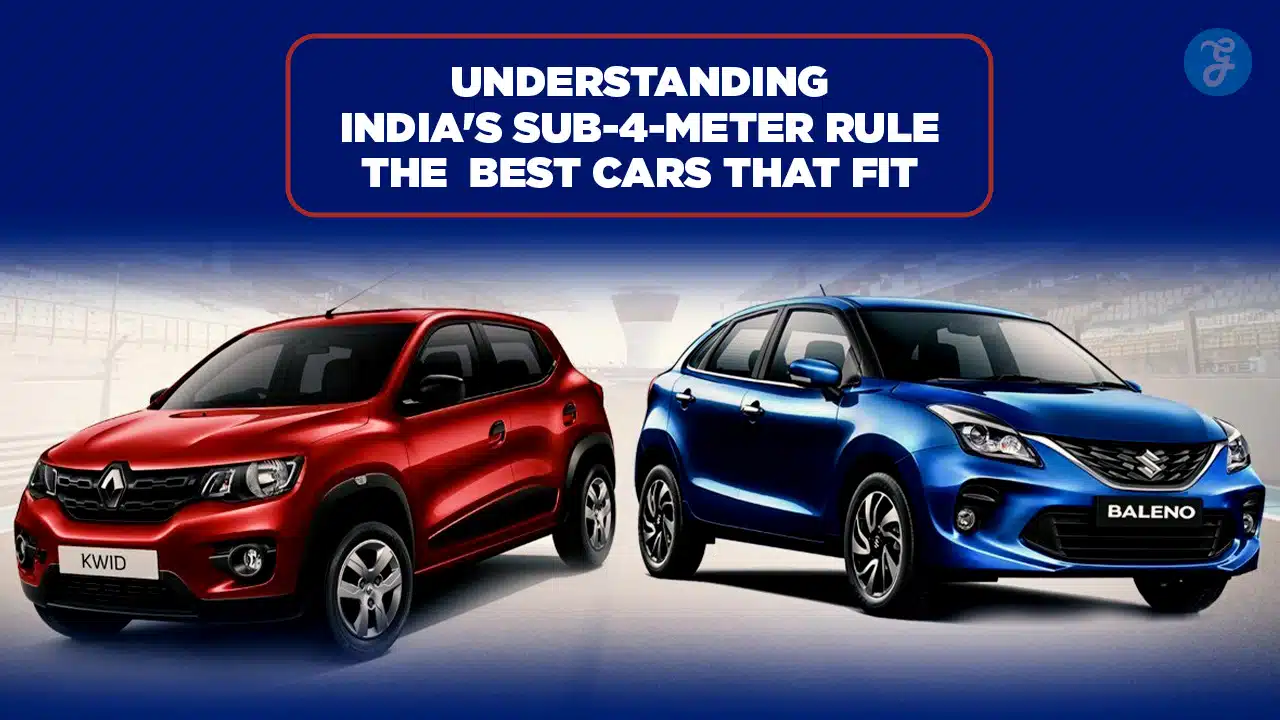
Car shopping in India has one extra layer that many buyers in other countries never think about: a length line on a measuring tape. The moment a car stays under 4,000 mm, it enters a sweet spot that has shaped pricing, model design, and even what body styles dominate showrooms. Brands talk about it. Salespeople mention it. And buyers feel it in the options they see.
This article explains India’s “sub-4-meter” rule in a clear and practical way. You will learn what the rule is, why it matters, and how it influences the market. Then you will see seven popular and well-rounded choices that fit the length limit, across hatchbacks, compact sedans, and compact SUVs. The goal is simple: help you understand the rule and shortlist confidently.
If you are searching for the best sub 4 meter cars in India, this guide is meant to save you time and reduce confusion.
Why This Rule Matters To Car Buyers In India
This rule matters because it changes the kind of cars manufacturers build for India. It also changes how buyers compare value in the same price band. When a market becomes highly competitive around one threshold, brands try hard to offer “more car” while staying under that limit.
It also affects everyday ownership in subtle ways. Many under-4m cars are easier to park and easier to drive in tight city lanes. They often suit Indian traffic patterns and common parking constraints. At the same time, keeping a car under 4 meters can lead to design compromises. You might see a shorter rear overhang, a tighter boot opening, or styling choices that try to make the car look larger than it is.
Another reason it matters is buyer psychology. In many cities, people want SUV-like stance, but they also want city-friendly dimensions. The sub-4m compact SUV segment became a direct answer to that demand. That is why this rule keeps coming up when buyers compare hatchbacks, compact sedans, and compact SUVs.
Many buyers also link this rule with taxation and pricing, which is part of why the topic stays important. Even if you never calculate tax yourself, the market responds to tax structures, and your final on-road price reflects that.
| What The Rule Influences | What You Notice As A Buyer | Smart Way To Use It |
| Model availability | Many best-sellers sit under 4m | Shortlist within segments first |
| Design choices | Tight proportions, compact boots | Check rear seat and boot in person |
| Value perception | Feature-packed trims compete hard | Compare trims, not just base prices |
| Urban practicality | Easier parking and turning | Prioritise visibility and turning radius |
What Exactly Is India’s Sub-4-Meter Rule
At a simple level, “sub-4-meter” means the car’s overall length is 4,000 mm or less. That is the buyer-friendly definition, and it is the one used in everyday conversation. It is easy to check and easy to compare across models.
The deeper context is that India’s small-car definitions have often been discussed alongside engine-size thresholds. That combination has influenced how cars are positioned and how manufacturers plan their line-ups. Over time, the exact policy details and tax frameworks have seen changes and discussions, so you should treat tax specifics as something to verify in the current year. But the market impact of the 4,000 mm line remains very real.
The key takeaway is not to get lost in paperwork. For most buyers, the practical meaning is: cars under 4 meters form a massive, competitive category in India, with many options that are tuned for city use and cost-conscious ownership.
The Official Length Cutoff And The “Small Car” Idea
The 4,000 mm cutoff is the headline. It is also the number manufacturers design around. That is why you see so many cars with lengths like 3,995 mm. They aim to sit just under the limit while still looking and feeling substantial.
This cutoff also created a clear product development target. Brands can plan a compact SUV, compact sedan, or premium hatchback while staying under 4 meters. Once many brands follow the same target, competition becomes intense. That usually benefits buyers through better feature lists, improved packaging, and more frequent updates.
The “small car” idea is often explained using both size and engine brackets. Even if you do not track it closely, it helps to understand why some cars use certain engine sizes and why some models are engineered to fit very specific numbers.
| Concept | Simple Meaning | Why It Matters |
| Overall length | End-to-end length in mm | Determines sub-4m fit |
| Wheelbase | Distance between wheels | Better clue for cabin space |
| Rear overhang | Space behind rear wheels | Affects boot shape and look |
| Engine bracket talk | Common in policy discussions | Influences engine choices |
The Tax Angle And Why It Changed The Market
The sub-4m conversation grew because policy and pricing discussions often focused on “small car” definitions. When the market sees a pricing edge or a strong demand pocket, manufacturers respond quickly. That is why India has such a deep under-4m line-up.
For you as a buyer, the main practical impact is that under-4m cars can offer strong value because brands fight hard in this space. You will often see competitive feature sets, multiple trims, and frequent special editions. You will also see body styles designed to look bigger than their length, because customers want road presence without losing urban convenience.
The most important rule for buyers is simple: do not assume anything about price based only on length. Always compare on-road prices in your city, because state taxes, insurance, and registration differences can change the final picture.
| Buyer Belief | Reality | What To Do |
| “Under 4m means cheaper” | Not always | Compare on-road prices |
| “SUV under 4m is best” | Depends on your route | Test drive in your area |
| “Tax rules never change” | Policies evolve | Check current-year pricing |
Common Myths To Ignore
Myths are common because the sub-4m topic is repeated so often. The first myth is that all sub-4m cars are budget cars. In reality, some premium hatchbacks and top-trim compact SUVs can cost a lot. The second myth is that size decides safety. Safety is more about structure, equipment, and testing than about length.
There is also a myth that sub-4m SUVs are automatically better for Indian roads. Many are better on bad patches due to higher ground clearance, but a well-tuned hatchback can be more comfortable and more efficient for daily city life. The best choice depends on your real usage.
| Myth | What’s True Instead | Quick Shortcut |
| “All sub-4m cars are affordable” | Price depends on trim and demand | Compare same-year variants |
| “Sub-4m equals safer” | Safety is design + equipment | Prioritise airbags/ESC/ratings |
| “SUV beats everything” | Hatchbacks can be smarter in cities | Choose for your daily roads |
How To Check If A Car Truly Fits Under 4 Meters
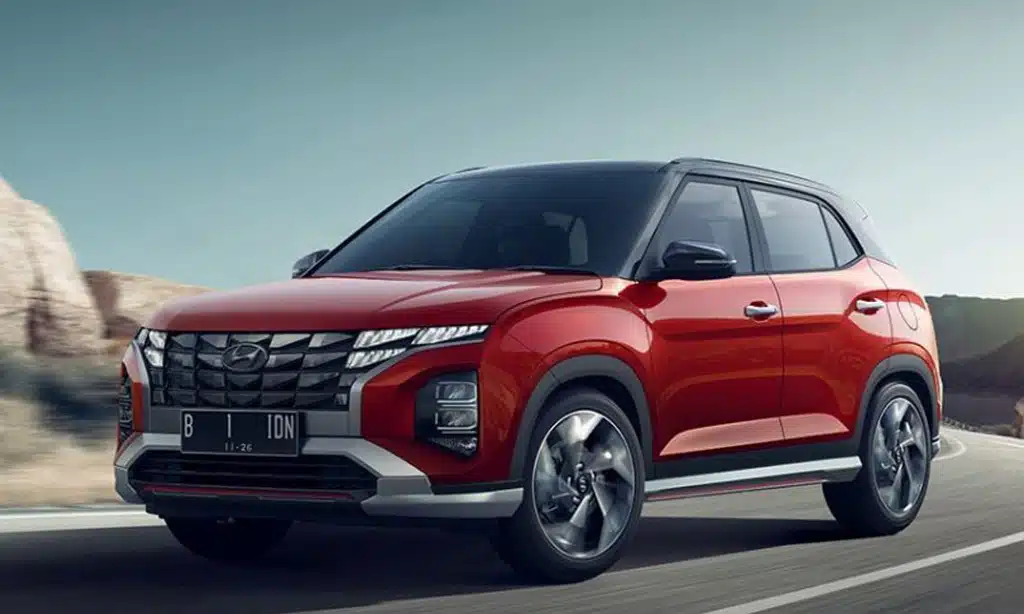
Never rely only on marketing labels. Some cars are called “compact” for styling reasons, but the actual dimension is what counts. Fortunately, checking length is easy. Once you learn where to look, you can confirm it in minutes.
Start by checking the official brochure or the manufacturer’s spec page. Then cross-check with one trusted spec portal or the dealer’s printed spec sheet. The goal is not to doubt everything. The goal is to avoid confusion when you compare rivals that sit very close to 4,000 mm.
Also remember that cabin space does not equal length. A car can be under 4 meters and still feel spacious if the wheelbase and packaging are good. That is why you should also check wheelbase and boot capacity, not just overall length.
| What To Verify | Why It Matters | Best Place To Check |
| Overall length (mm) | Confirms sub-4m fit | Official brochure |
| Wheelbase (mm) | Predicts rear legroom | Brochure + spec portal |
| Boot volume (L) | Trip practicality | Brochure/spec portal |
| Ground clearance (mm) | Speed breaker comfort | Brochure/spec portal |
Where To Find The Official Dimensions
The best source is the official brochure because it lists dimensions clearly. Manufacturer websites also list specs, though some pages vary by year and update cycle. Dealers can provide a printed spec sheet, but you should still cross-check with official material.
A good habit is to save the spec screenshot on your phone. That helps you compare across showrooms. It also helps you avoid confusion when a salesperson talks about “almost 4 meters” without giving you the number.
If you are comparing multiple models, make a small list: length, wheelbase, boot, and ground clearance. These four numbers explain a lot about what the car will feel like in daily use.
| Source | Reliability | Best Use |
| Official brochure | Very high | Final confirmation |
| Manufacturer site | High | Quick check |
| Dealer sheet | Medium | Cross-check only |
| Trusted spec portal | Medium-high | Comparison tool |
Watch-Out Areas That Confuse Buyers
Accessories can change how the car looks, but they usually do not change the official length. Still, a sporty bumper kit can make a car appear longer. Another common confusion is mixing overall length with wheelbase. Wheelbase helps you understand cabin room, but it does not decide whether a car is under 4 meters.
Variant differences can also confuse buyers. A model may have minor changes across facelift versions, and spec tables can differ by year. That is why you should confirm the exact model year and variant you plan to buy.
Finally, remember that numbers do not replace a test drive. A car can look perfect on paper but feel cramped or uncomfortable based on seat design and interior layout.
| Common Confusion | What It Means | Fix |
| Looks longer than it is | Styling tricks | Check spec sheet length |
| Wheelbase vs length | Different measures | Compare both |
| Variant or facelift change | Specs can shift | Confirm model year |
| Boot volume claims | Measurement methods vary | Open the boot yourself |
Best Sub 4 Meter Cars In India At A Glance
The under-4m market is huge, so this list focuses on seven models that are widely considered strong choices across different buyer needs. These are not the only good options. But they represent common, practical shortlists for Indian buyers who want a balance of value, usability, and segment strengths.
To keep this fair and useful, every model below follows the same approach: who it suits, what it does well, what to watch out for, and key specs. Use this as a starting point, then narrow down to two or three cars for back-to-back test drives.
Also remember that ownership experience depends on your city. Service quality can vary by location. Waiting periods can change month to month. That is why shortlisting is step one, and local verification is step two.
| Segment | Why Buyers Like It | Typical Trade-Off |
| Hatchback | Easy to drive, easy to park | Smaller boot |
| Compact sedan | Big boot, family-friendly | Lower stance on bad roads |
| Sub-4m SUV | Higher seating, road presence | Can cost more for similar space |
1. Maruti Suzuki Swift
The Swift is a classic city-friendly hatchback. It stays compact, feels easy in traffic, and suits buyers who want a simple daily driver that does not feel stressful. It is especially popular among first-time buyers and families that want a reliable second car.
The Swift’s strength is balance. It is not trying to be an SUV or a sedan. It is trying to be a practical hatchback with strong everyday usability. If your commute includes narrow lanes, tight parking, and lots of stop-go traffic, this type of car can make life easier.
It also tends to hold value well in many markets. And it is widely supported, which matters for routine maintenance and long-term ownership comfort.
| Swift Summary | What It Offers | Trade-Off |
| City usability | Easy steering and parking | Not a big-boot car |
| Ownership comfort | Wide service coverage | Trim choice matters |
| Daily efficiency focus | Works for commuting | Highway feel varies by driver |
Who It’s Best For
The Swift suits buyers who want a clean, straightforward driving experience. It works well for people who spend most time inside the city. It also works for those who want a car that feels light and simple.
It is a strong match for solo commuters and small families. It also fits buyers who prefer to keep running costs predictable. If your daily route involves heavy traffic, a compact hatchback often feels like the right tool.
| Buyer Type | Fit Level | Why |
| City commuter | Very high | Compact and practical |
| Small family | High | Good daily usability |
| Long highway touring | Medium | Depends on preferences |
Key Strengths
The biggest strength is how effortless it feels in urban driving. The second is the low-stress ownership style many buyers associate with this segment. The third is the strong ecosystem around the model.
If you want a hatchback that feels familiar and easy, this is a common benchmark. And because it sells well, comparisons and parts support are usually straightforward.
| Strength | Real-World Benefit |
| Compact size | Easier parking and U-turns |
| Simple usability | Low learning curve |
| Popularity | Easier resale and support |
What To Consider Before Buying
Hatchbacks do not offer sedan-style boots, so plan around your luggage needs. Also, do not assume every variant has the same safety kit. Check what is standard versus optional across trims.
A good test-drive check is rear-seat comfort for your family. Another check is boot opening and everyday storage.
| Checklist | Why It Matters |
| Variant safety features | Value and peace of mind |
| Rear seat comfort | Family usability |
| Boot access | Daily practicality |
2. Hyundai i20
The i20 is often shortlisted by buyers who want a more premium hatchback feel. It aims to give you a richer cabin experience and a strong feature set. Many buyers like the balance between compact external size and a more “grown-up” feel inside.
This is the kind of hatchback you choose when you want comfort and features without moving to a sedan or SUV. It can feel like a good upgrade choice for people moving up from smaller cars.
It also appeals to buyers who spend a lot of time inside the car. When you care about cabin touchpoints, infotainment, and comfort features, premium hatchbacks become very attractive.
| i20 Summary | What It Offers | Trade-Off |
| Premium hatch feel | Comfort and features | Can get pricey in top trims |
| City + occasional highway | Versatile use | Compare variants carefully |
| Cabin experience | Strong for the segment | Test drive ride quality |
Who It’s Best For
The i20 suits buyers who value features and cabin comfort. It works well for people who want a hatchback but dislike the “basic” feel of entry-level options.
It also fits young families who want a compact car that does not feel too small. And it fits buyers who want a car that feels modern without stepping into compact SUV pricing.
| Buyer Type | Fit Level | Why |
| Feature-focused buyer | Very high | Strong trim offerings |
| City driver | High | Compact length |
| Value-only buyer | Medium | Trim prices can climb |
Key Strengths
Cabin experience is a major selling point in this segment. Many buyers also like the overall refinement feel. The feature list can be a strong deciding factor, especially when you compare similarly priced options.
This is a car where variant selection matters a lot. The right trim can feel like excellent value. The wrong trim can feel overpriced.
| Strength | Real-World Benefit |
| Cabin quality feel | More comfort in daily use |
| Features | Convenience and modern touch |
| Practical hatch format | Easy city life |
What To Consider Before Buying
Always look at the full variant ladder. Premium hatchbacks often have big jumps between trims. It is easy to get tempted by the top trim, so compare it with compact sedans and compact SUVs in the same price band.
Also, test drive on bad roads. Some cars feel great on smooth roads but can feel firm on broken patches.
| Checklist | Why It Matters |
| Variant value | Avoid paying for unused features |
| Ride comfort | Daily satisfaction |
| Rear seat comfort | Family-friendly use |
3. Tata Punch
The Punch is often described as a small car with an SUV-like stance. Many buyers choose it because they want a taller seating position and a sense of road presence, but they still want a compact footprint for city driving.
This is a practical choice for Indian cities where speed breakers and uneven patches are common. Higher ground clearance can reduce stress. The upright seating can also feel more comfortable for many drivers.
It is also popular among buyers who want a “tougher” look without moving into larger SUV sizes. For many people, it feels like a good blend of compact car convenience and crossover style.
| Punch Summary | What It Offers | Trade-Off |
| Tall seating | Better visibility | Check performance expectations |
| Compact footprint | City-friendly | Boot needs verification by variant |
| Crossover style | SUV-like feel | Compare trims carefully |
Who It’s Best For
The Punch suits buyers who want easy entry and exit, better visibility, and compact handling. It works for city users who deal with rough patches. It also suits buyers who want a small car that feels confident.
It can be a good fit for older family members because of the upright seating. And it can be a good fit for new drivers who like a higher driving position.
| Buyer Type | Fit Level | Why |
| Urban driver on rough roads | Very high | Stance and clearance help |
| Small family | High | Practical size |
| High-speed touring | Medium | Depends on preferences |
Key Strengths
The biggest strength is the seating position and city usability. The second is how “compact” it remains in tight spaces. The third is the overall feel of a crossover without the size penalty of larger SUVs.
This type of car can reduce stress in daily driving. That alone is a strong reason many buyers choose it.
| Strength | Real-World Benefit |
| High seating | Better visibility |
| Compact size | Easier parking |
| Crossover stance | Confidence on rough patches |
What To Consider Before Buying
Always check boot practicality with your own bags. Do not rely only on boot volume numbers. Also test drive with passengers if you often travel full.
If you expect fast highway overtakes, set realistic expectations. Many compact crossovers are tuned more for city comfort than for performance feel.
| Checklist | Why It Matters |
| Boot access and shape | Real-world luggage fit |
| Full-load drive feel | Family travel comfort |
| Variant safety kit | Better long-term value |
4. Maruti Suzuki Dzire
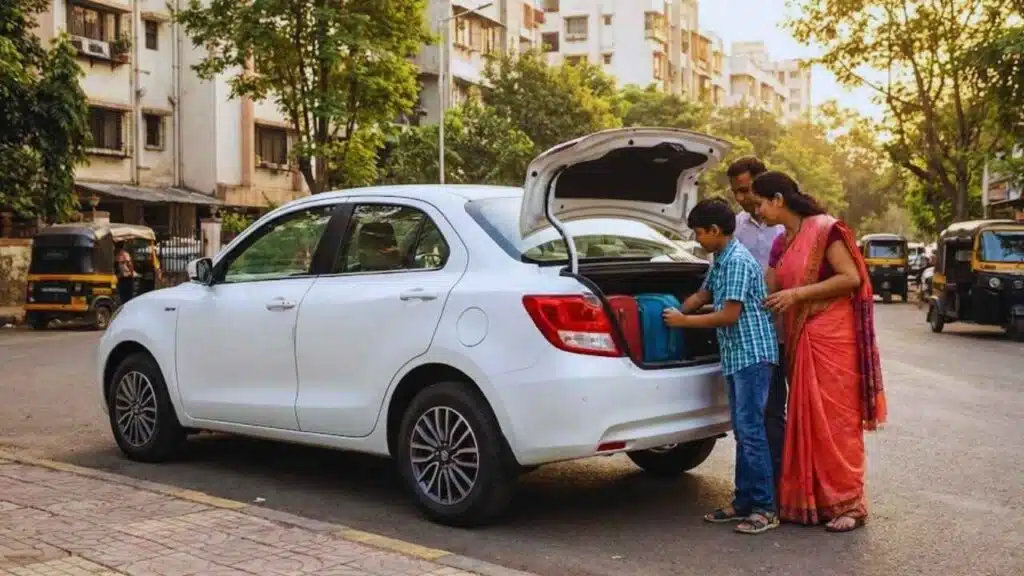
Compact sedans exist because many families want a bigger boot. The Dzire is a popular example of this idea. It stays within the under-4m length but aims to deliver sedan-like practicality.
This body style suits buyers who carry luggage often, travel with family, or simply prefer a separate boot space. It can also feel more “formal” than a hatchback, which some buyers prefer.
In many Indian cities, compact sedans remain a smart choice for practical ownership. They are not as trendy as compact SUVs right now, but the boot advantage stays real and useful.
| Dzire Summary | What It Offers | Trade-Off |
| Big boot | Better travel practicality | Lower stance than SUVs |
| City-friendly length | Easier than big sedans | Watch bad-road scraping |
| Family use | Strong daily fit | Compare trims for safety |
Who It’s Best For
The Dzire suits families who want boot space without a large car footprint. It works for buyers who often travel with bags. It also fits buyers who want a sedan look in a compact size.
If you plan to use the car for airport runs, family trips, or regular luggage hauling, this type of boot can make daily life easier.
| Buyer Type | Fit Level | Why |
| Family with luggage | Very high | Big boot benefit |
| City driver | High | Compact length |
| Rough-road heavy routes | Medium | Lower clearance than SUVs |
Key Strengths
The boot advantage is the headline. The second strength is that you still get a car that is easy in city life. The third is that compact sedans often feel stable and comfortable for family cruising.
This can be a very practical car if you want comfort and luggage flexibility without going big.
| Strength | Real-World Benefit |
| Large boot | Better for trips |
| Compact sedan size | Easier parking than large sedans |
| Family-friendly format | Everyday comfort |
What To Consider Before Buying
Ground clearance and approach angles matter on bad roads. If your route includes deep potholes or steep basement ramps, test carefully.
Also, compare trim features. Compact sedans can vary a lot in what they include as standard. Make sure your chosen trim matches your safety and comfort priorities.
| Checklist | Why It Matters |
| Clearance on your route | Prevents scraping stress |
| Variant equipment | Better value |
| Rear seat comfort | Family satisfaction |
5. Honda Amaze
The Amaze is another compact sedan that focuses on practicality and comfort. It appeals to buyers who like a clean, calm driving feel and want a boot that can handle family travel.
This type of car is often chosen by buyers who want a simple and sensible sedan experience. It can feel comfortable for daily commuting and also more “trip-ready” than many hatchbacks.
A compact sedan can also be a good choice if you carry items that you prefer to keep separate from the cabin. The closed boot helps with that.
| Amaze Summary | What It Offers | Trade-Off |
| Large boot | Family trip comfort | Feature comparison is important |
| Sedan feel | Calm daily driving | Check variant value |
| Compact size | Easy city use | Clearance needs route check |
Who It’s Best For
The Amaze suits families who care about luggage and comfort. It also suits buyers who want a sedan look without a big-car footprint.
It can be a good match for people who drive calmly and want an easy ownership experience. If you want a straightforward sedan with practical strengths, it fits the idea well.
| Buyer Type | Fit Level | Why |
| Family traveller | Very high | Boot advantage |
| Calm commuter | High | Smooth sedan feel |
| Feature-first shopper | Medium | Compare rivals carefully |
Key Strengths
The boot and cabin comfort are key strengths. The sedan format also tends to feel composed on longer drives. Many buyers prefer the driving posture and cabin layout of a sedan for daily use.
This is a “practical first” kind of choice. That can be exactly what many families want.
| Strength | Real-World Benefit |
| Big boot | More travel freedom |
| Sedan layout | Comfortable daily driving |
| Compact outside | City-friendly size |
What To Consider Before Buying
Always compare features and pricing in your city. Depending on the market cycle, some rivals may offer more features for similar money.
Also, check your route for bad-road conditions. Sedans can be fine on normal roads, but clearance matters if your area has rough patches.
| Checklist | Why It Matters |
| Feature-to-price value | Prevents buyer’s remorse |
| Route clearance check | Avoids scraping |
| Test drive with family | Real comfort verification |
6. Maruti Suzuki Brezza
Compact SUVs under 4 meters became one of India’s biggest trends, and the Brezza sits right in that space. Buyers choose it because they want SUV posture without dealing with large-car parking issues.
This is often the “safe” compact SUV choice for families who want a balanced package. It can suit mixed usage: city commuting during the week and highway trips on weekends.
It also appeals to buyers who want a mainstream model with a strong resale ecosystem. In popular segments, resale confidence and service access can matter as much as features.
| Brezza Summary | What It Offers | Trade-Off |
| SUV stance under 4m | City-friendly SUV feel | Can cost more than hatches |
| Mixed-use comfort | City + highway balance | Boot not as big as sedans |
| Mainstream ownership | Resale and support | Variant choice matters |
Who It’s Best For
The Brezza suits buyers who want a compact SUV feel but do not want a large SUV footprint. It fits families that need a higher seating position. It also fits buyers who like a simple and dependable ownership story.
If you want one car to cover most needs without feeling extreme in any direction, a balanced compact SUV often makes sense.
| Buyer Type | Fit Level | Why |
| Mixed city-highway family | Very high | Balanced package |
| SUV stance lover | High | High seating feel |
| Budget-only buyer | Medium | Compare hatch and sedan value |
Key Strengths
The biggest strength is its all-round nature. It does not rely only on one big selling point. Instead, it tries to deliver a complete daily experience: visibility, comfort, and practicality.
It is also a segment where buyers often feel confident because many people already own similar models. That social proof can matter in large markets.
| Strength | Real-World Benefit |
| High seating | Easier visibility |
| Compact SUV size | Urban-friendly |
| Balanced feel | Works for most needs |
What To Consider Before Buying
Do not assume the SUV body automatically means more cabin space. Some hatchbacks can feel as roomy. The difference is seating posture and stance, not always interior width.
Also compare trims carefully. Compact SUVs can have many variants with big price jumps. Choose the trim that matches your must-haves, not the trim that looks best in ads.
| Checklist | Why It Matters |
| Compare cabin space | Avoids false assumptions |
| Trim value | Controls budget |
| Test drive on your roads | Real comfort check |
7. Tata Nexon
The Nexon is one of the most talked-about compact SUVs in India. Many buyers shortlist it because they want a feature-rich compact SUV with strong road presence. It is designed to fit under 4 meters while offering the feel of a larger SUV.
It is also popular among buyers who care about safety discussions and modern features. In the compact SUV segment, buyers often compare not just size and mileage, but also safety kit and tech offerings.
This is a model where variant selection is critical. Compact SUVs often offer multiple engines and transmissions depending on the year and updates, so you should shortlist based on your driving style and needs.
| Nexon Summary | What It Offers | Trade-Off |
| SUV road presence | Confident driving feel | Variant complexity |
| Features and tech | Modern cabin experience | Compare trims carefully |
| Family-ready format | Practical boot and stance | Verify exact configuration |
Who It’s Best For
The Nexon suits buyers who want a compact SUV that feels substantial. It fits families who want higher seating and a more secure road feel. It also fits buyers who want a modern-looking cabin and a strong feature set.
If you care about a “complete” SUV-like experience in a city-friendly size, this model often appears on shortlists.
| Buyer Type | Fit Level | Why |
| Compact SUV fan | Very high | Strong stance |
| Feature-focused buyer | High | Rich trim options |
| Simplicity-first buyer | Medium | Many variants to compare |
Key Strengths
Its strengths include road presence, a strong compact SUV identity, and a wide range of trims that can suit different budgets. This also means you can pick a variant that matches your needs closely.
It is also a model people often compare in safety discussions, which can influence family buyers who want reassurance.
| Strength | Real-World Benefit |
| SUV stance | Confidence in mixed roads |
| Feature-rich variants | Choice across budgets |
| Modern feel | Strong daily comfort |
What To Consider Before Buying
Because variants can be many, decide your must-haves first. For example: automatic or manual, sunroof or no sunroof, and your safety feature priorities. Then find the trim that matches, rather than starting from the top trim.
Also verify dealer support in your city. A great car feels less great if service experience is weak.
| Checklist | Why It Matters |
| Must-have list | Faster shortlist |
| Dealer and service check | Better long-term ownership |
| Back-to-back test drive | Clear comparison |
Best Sub 4 Meter Cars In India: Quick Comparison Table
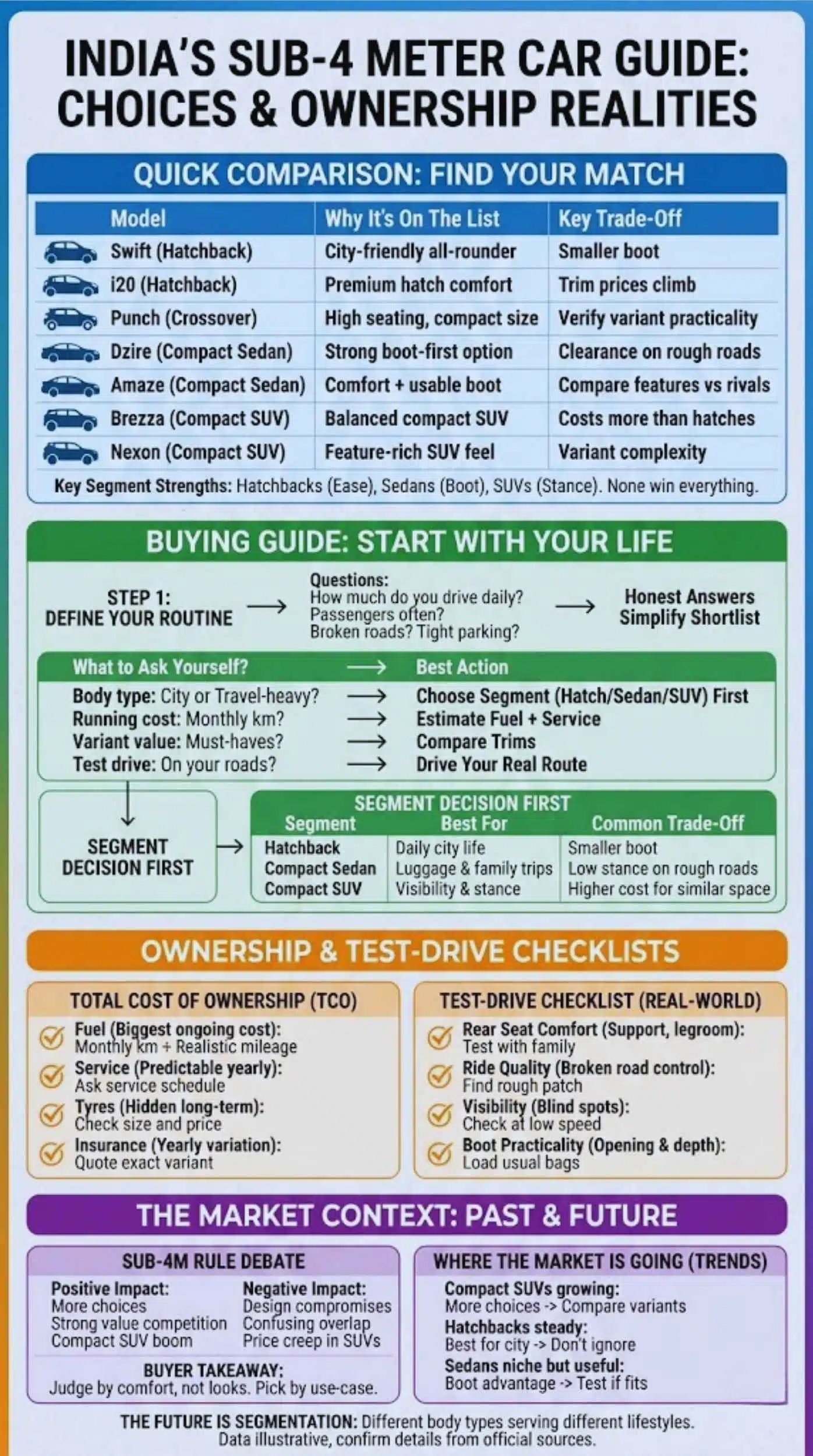
This section is here to make decisions easier. Specs can vary slightly by model year and variant. Use it as a fast shortlist tool, then confirm details from official brochures during purchase.
If you are comparing across segments, remember this: hatchbacks win on ease, sedans win on boot, and compact SUVs win on stance. None of them wins everything.
| Model | Type | Why It’s On The List | Key Trade-Off |
| Swift | Hatchback | City-friendly all-rounder | Smaller boot |
| i20 | Hatchback | Premium hatch comfort | Trim prices climb |
| Punch | Crossover | High seating in compact size | Verify variant practicality |
| Dzire | Compact sedan | Strong boot-first option | Clearance on rough roads |
| Amaze | Compact sedan | Comfort + very usable boot | Compare features vs rivals |
| Brezza | Compact SUV | Balanced compact SUV | Costs more than hatches |
| Nexon | Compact SUV | Feature-rich SUV feel | Variant complexity |
Buying Guide: How To Choose The Right Sub-4m Car
Choosing well is not about picking the most famous model. It is about matching the car to your daily life. A car that feels perfect on a showroom floor can feel wrong after two months if it does not fit your parking situation, family needs, and road conditions.
Start with your routine. How much do you drive daily? Do you carry passengers often? Do you deal with broken roads? Do you park in tight spaces? The more honest you are here, the easier your shortlist becomes.
Also think about ownership timeline. If you keep cars for seven years, comfort and maintenance matter more. If you switch every three years, resale and popularity matter more.
| Decision Step | What To Ask Yourself | Best Action |
| Body type | City-heavy or travel-heavy? | Choose hatch/sedan/SUV first |
| Running cost | How many km per month? | Estimate fuel + service |
| Variant value | What are your must-haves? | Trim comparison sheet |
| Test drive | How does it feel on your roads? | Drive your real route |
Segment Decision First
Decide the segment before you fall in love with a model. If parking is tight, a hatchback may beat an SUV. If your family travels often with bags, a compact sedan may be a better life choice than a hatch.
If you want high seating because of visibility and comfort, compact SUVs exist for a reason. But they do not automatically give more cabin space. Often, they give a different posture and stance.
When you pick the right segment first, half your decision is already done.
| Segment | Best For | Common Trade-Off |
| Hatchback | Daily city life | Smaller boot |
| Compact sedan | Luggage and family trips | Low stance on rough roads |
| Compact SUV | Visibility and stance | Higher cost for similar space |
Total Cost Of Ownership Checklist
Many buyers focus on ex-showroom price and forget running costs. Over five years, tyres, service, and fuel add up. Also, insurance costs can differ based on variant and city.
Do not guess mileage based on ads. Ask owners or look for real-world driving reports, then assume a realistic number based on your driving style. If you drive in heavy traffic, your mileage will drop.
Resale also matters. Popular models tend to sell faster and hold value better, but market cycles and updates can change things.
| Cost Item | Why It Matters | How To Estimate |
| Fuel | Biggest ongoing cost | Monthly km ÷ realistic mileage |
| Service | Predictable yearly expense | Ask service schedule |
| Tyres | Hidden long-term cost | Check tyre size and price |
| Insurance | Yearly cost variation | Quote for your exact variant |
Test-Drive Checklist
A short test drive around a smooth showroom route is not enough. Try to drive on the roads you actually use. If that is not possible, at least find a rough patch near the dealership.
Test rear seat comfort with your family. Check headroom, knee room, and seat angle. Test boot loading with your usual bags if possible. These small checks prevent big regrets.
Also test basics: visibility, steering feel at low speed, braking confidence, and ride comfort at city speeds.
| Test Item | What To Look For | Why It Matters |
| Rear seat comfort | Support and legroom | Family happiness |
| Ride quality | Broken road control | Daily comfort |
| Visibility | Blind spots | Safer driving |
| Boot practicality | Opening and depth | Real usability |
The Bigger Debate: Has The Sub-4m Rule Helped Or Hurt India
This topic creates strong opinions. On one side, people argue it made cars more affordable and pushed manufacturers to design clever compact products for India. On the other side, people argue it encouraged awkward proportions and tax-driven engineering.
Both views have some truth. The market clearly benefited from intense competition in this space. Buyers got more choices, more features, and more frequent updates. At the same time, some cars look “stretched” or “compressed” because designers tried to fit a certain length while still adding style.
For buyers, the debate matters mainly because it explains why so many options look similar in length. It also explains why the compact SUV segment became so dominant. People want road presence, and this segment delivers it without crossing the urban-friendly size line.
| Positive Impact | Negative Impact | Buyer Takeaway |
| More choices under 4m | Some design compromises | Judge by comfort, not looks |
| Strong value competition | Confusing overlap of segments | Pick by use-case |
| Compact SUV boom | Price creep in SUVs | Compare total ownership cost |
Where The Market Seems To Be Going
The market trend has been clear: compact SUVs keep growing in popularity. Many buyers like the seating posture, road presence, and the feeling of being “above traffic.” This is especially appealing in congested cities.
At the same time, hatchbacks still make sense for many people. They are efficient, easy to park, and usually cheaper to run. Compact sedans remain relevant for families who travel with luggage.
So the real future is not one winner. It is a segmentation where different body types serve different lifestyles.
| Trend | What It Means | What Buyers Should Do |
| Compact SUVs growing | More choices, more trims | Compare variants carefully |
| Hatchbacks steady | Still best for pure city | Don’t ignore this segment |
| Sedans niche but useful | Boot advantage remains | Test if it fits your needs |
Final Thoughts
India’s sub-4-meter rule shaped an entire marketplace. That is why buyers have so many strong options under one size bracket. The best way to use this advantage is to shop smarter than the average buyer.
Start with your lifestyle. If you live in dense traffic and tight parking, a hatchback like Swift or i20 can be the easiest daily partner. If luggage and travel matter, compact sedans like Dzire or Amaze can make life simpler. If you want high seating and SUV posture without a large footprint, compact SUVs like Brezza and Nexon are built for exactly that demand.
Shortlist two or three models, compare trims, then do back-to-back test drives on your real roads. When you follow that process, choosing among the best sub 4 meter cars in India becomes much easier and far more satisfying.
FAQs
What Is The Sub-4-Meter Rule In India
It refers to cars with an overall length of 4,000 mm or less. In everyday buying, this is mainly a segment marker that shapes which models compete directly. It also connects to policy discussions around small-car definitions, which can influence pricing trends in the market.
Do Sub-4m Cars Always Get A Tax Benefit
Not always in a simple way. Pricing depends on current tax structure, state charges, insurance, and variant details. The only reliable way is to compare on-road prices for the exact variants you are considering.
Are Sub-4m SUVs Better Than Hatchbacks For Indian Roads
They can feel better on broken patches because of higher ground clearance and seating posture. But hatchbacks often win in ease of driving, parking convenience, and lower running costs. Your daily route should decide.
Which Is The Best Sub 4 Meter Cars In India For Families
If your family travels often with luggage, compact sedans like Dzire and Amaze are strong picks because of their boots. If you want higher seating and an SUV feel, Brezza and Nexon are common choices. The best pick depends on your roads, budget, and comfort priorities.
How Do I Verify A Car Is Under 4,000 Mm Before Buying
Check the official brochure or spec sheet for overall length in millimetres. Cross-check with one more reliable spec listing. Confirm the model year and variant you plan to buy.
Does Being Under 4 Meters Affect Safety
Length alone does not decide safety. Safety depends on structure, equipment like airbags and stability control, tyre quality, and how the car performs in credible testing and real-world use.