Gone are the days when solar lights were dim, flickering plastic stakes that died after the first rainstorm. In 2026, advances in monocrystalline solar panels and LiFePO4 battery technology have made solar lighting a legitimate competitor to hardwired systems. Whether you want to highlight a prize-winning Japanese Maple or stop fumbling for your keys at the front door, there is a solar solution that actually works.
We’ve tested dozens of models to bring you this definitive list of the best solar-powered outdoor lights for gardens and pathways.
Quick Picks: Solar Powered Outdoor Lights
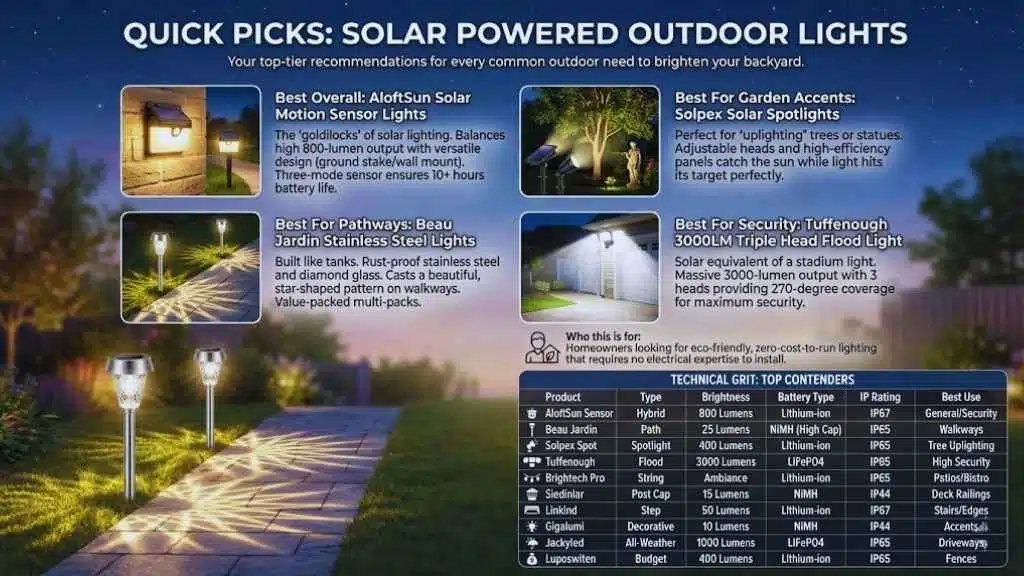
If you’re in a hurry to brighten your backyard, here are our top-tier recommendations for every common outdoor need.
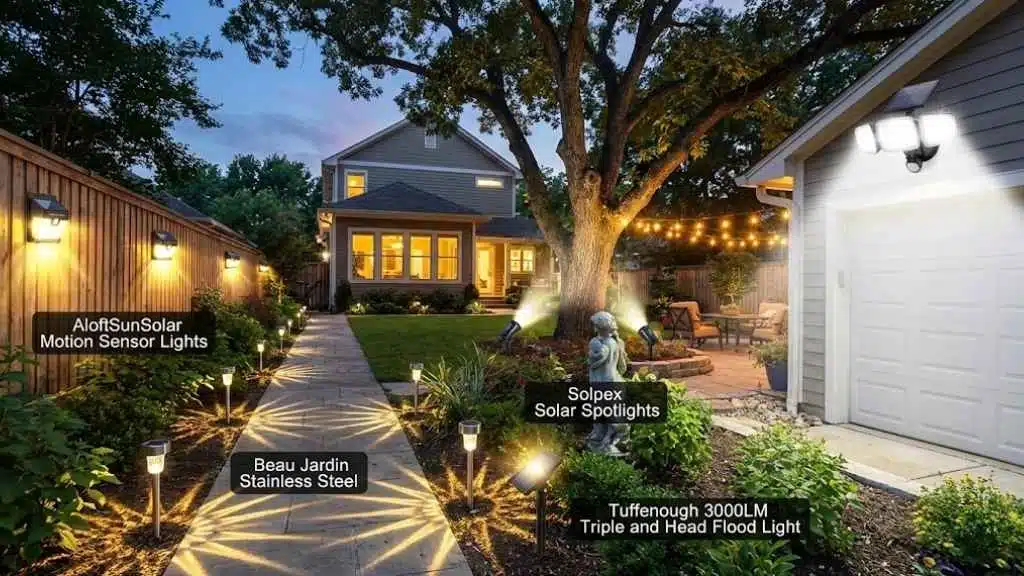
Best Overall: AloftSun Solar Motion Sensor Lights
The “goldilocks” of solar lighting. It balances a high 800-lumen output with a versatile design that works as both a ground stake and a wall-mounted light. Its three-mode sensor system ensures it only works when you need it, preserving battery life for 10+ hours.
Best For Pathways: Beau Jardin Stainless Steel Lights
These are built like tanks. Featuring rust-proof stainless steel and diamond-textured glass (not plastic), they cast a beautiful, star-shaped pattern on your walkway. They look expensive but come in value-packed multi-packs.
Best For Garden Accents: Solpex Solar Spotlights
Perfect for “uplighting” trees or statues. They feature adjustable heads and high-efficiency panels that can be angled independently to catch the best sun while the light hits its target perfectly.
Best For Security: Tuffenough 3000LM Triple Head Flood Light
With a massive 3000-lumen output, this is the solar equivalent of a stadium light. The three adjustable heads provide 270-degree coverage, making it impossible for anyone to approach your garage or side gate undetected.
Who this is for: Homeowners looking for eco-friendly, zero-cost-to-run lighting that requires no electrical expertise to install.
Choosing a light based on a photo is easy; choosing based on specs is smart. Use the table below to compare the technical grit of our top contenders.
| Product | Type | Brightness | Battery Type | IP Rating | Best Use |
| AloftSun Sensor | Hybrid | 800 Lumens | Lithium-ion | IP67 | General/Security |
| Beau Jardin | Path | 25 Lumens | NiMH (High Cap) | IP65 | Walkways |
| Solpex Spot | Spotlight | 400 Lumens | Lithium-ion | IP65 | Tree Uplighting |
| Tuffenough | Flood | 3000 Lumens | LiFePO4 | IP65 | High Security |
| Brightech Pro | String | Ambiance | Lithium-ion | IP65 | Patios/Bistro |
| Siedinlar | Post Cap | 15 Lumens | NiMH | IP44 | Deck Railings |
| Linkind | Step | 50 Lumens | Lithium-ion | IP67 | Stairs/Edges |
| Gigalumi | Decorative | 10 Lumens | NiMH | IP44 | Accents |
| Jackyled | All-Weather | 1000 Lumens | LiFePO4 | IP65 | Driveways |
| Luposwiten | Budget | 400 Lumens | Lithium-ion | IP65 | Fences |
How We Chose And Tested Solar Powered Outdoor Lights
To separate the “toys” from the tools, we put these lights through a 30-day rigorous testing phase. Our evaluation rubric focused on five key pillars:
- Brightness Consistency: We didn’t just measure lumens at 8:00 PM. We checked if the light was still visible at 4:00 AM.
- Charging Reliability: We tested how well the panels performed under partial shade and on overcast “winter-style” days.
- Weather Resistance: Each light was subjected to a high-pressure hose spray to simulate a heavy downpour and left out in freezing overnight temperatures.
- Build Quality: We prioritized materials like stainless steel, aluminum, and tempered glass over cheap, brittle plastics that yellow under UV exposure.
- Battery Replaceability: We favored brands that allow users to swap out the internal battery, extending the light’s life beyond a single season.
How To Choose Solar Powered Outdoor Lights
Pick The Right Brightness For The Job
Lumens are the standard measurement of light output. For solar lights, more isn’t always better—it depends on the goal:
- Pathways (10–50 Lumens): You want enough to see your feet, not a landing strip. Soft, warm light prevents “glare blindness.”
- Garden Accents (100–300 Lumens): Enough punch to illuminate the trunk of a tree or a stone wall.
- Security (500–3000 Lumens): These should be motion-activated to startle intruders and provide clear visibility for security cameras.
Understand Runtime And Battery Types
The “brain” of your light is the battery.
- LiFePO4 (Lithium Iron Phosphate): These are the gold standard in 2026. They handle 2,000+ charge cycles and perform much better in the cold.
- NiMH: Found in cheaper path lights. They work well but usually need replacing every 12–18 months. Always look for “replaceable” in the description so you don’t have to throw away the whole fixture when the battery tires.
Solar Panel Placement And Shade Reality
No solar light works in total shade. However, monocrystalline panels (recognizable by their smooth, dark appearance) are about 20% more efficient than older polycrystalline panels. If your yard is “dappled” with shade, look for lights with a detached solar panel connected by a cord; this allows you to place the light in the shade and the panel in the sun.
Weatherproofing And IP Ratings
Check the IP (Ingress Protection) rating.
- IP44: Fine for decorative lights under a porch.
- IP65: The standard for rain and snow.
- IP67: Can survive temporary submersion (great for areas prone to puddling).
The most common failure point isn’t the bulb—it’s water leaking into the battery compartment.
Light Color And Glare Control
- Warm White (2700K–3000K): Best for gardens. It makes greenery look lush and creates a cozy vibe.
- Cool White (5000K+): Best for security. It appears brighter and mimics daylight, which is better for facial recognition on cameras.
10 Best Solar Powered Outdoor Lights
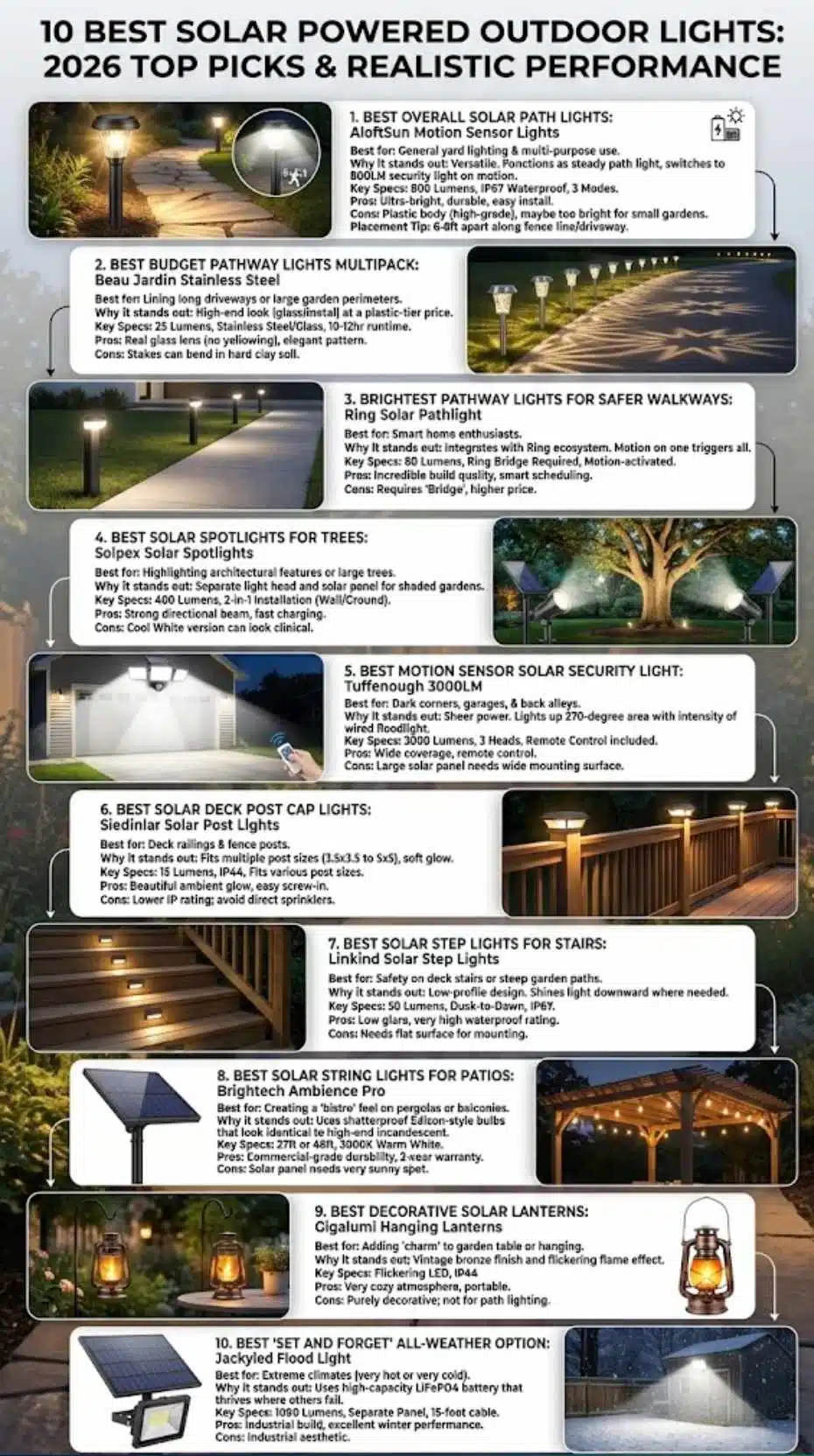
1. Best Overall Solar Path Lights: AloftSun Motion Sensor Lights
Best for: General yard lighting and multi-purpose use.
Why it stands out: It’s the most versatile light on the market. It functions as a steady-on path light but switches to a 800-lumen security light when it detects motion.
- Key Specs: 800 Lumens, IP67 Waterproof, 3 Lighting Modes.
- Pros: Ultra-bright, extremely durable, easy to install.
- Cons: Plastic body (though high-grade), may be too bright for small gardens.
- Placement Tip: Place them 6–8 feet apart along a fence line or driveway.
2. Best Budget Pathway Lights Multipack: Beau Jardin Stainless Steel
Best for: Lining long driveways or large garden perimeters.
Why it stands out: You get a high-end look (glass and metal) at a plastic-tier price.
- Key Specs: 25 Lumens, Stainless Steel/Glass, 10-12 hour runtime.
- Pros: Real glass lens doesn’t yellow, elegant light pattern.
- Cons: Stakes can bend in hard clay soil.
- Who should buy: Homeowners who want a classic, “expensive” look without the wiring cost.
3. Brightest Pathway Lights For Safer Walkways: Ring Solar Pathlight
Best for: Smart home enthusiasts.
Why it stands out: It integrates with the Ring ecosystem. When one light detects motion, it can trigger all other lights to turn on.
- Key Specs: 80 Lumens, Ring Bridge Required, Motion-activated.
- Pros: Incredible build quality, smart scheduling.
- Cons: Requires a “Bridge” for smart features, higher price point.
4. Best Solar Spotlights For Trees: Solpex Solar Spotlights
Best for: Highlighting architectural features or large trees.
Why it stands out: The separate adjustment of the light head and the solar panel is a game changer for shaded gardens.
- Key Specs: 400 Lumens, 2-in-1 installation (Wall/Ground).
- Pros: Strong directional beam, fast charging.
- Cons: The “Cool White” version can look a bit clinical.
5. Best Motion Sensor Solar Security Light: Tuffenough 3000LM
Best for: Dark corners, garages, and back alleys.
Why it stands out: The sheer power. It lights up a 270-degree area with the intensity of a wired floodlight.
- Key Specs: 3000 Lumens, 3 Heads, Remote Control included.
- Pros: Wide coverage, remote control allows for easy mode switching.
- Cons: Large solar panel needs a wide mounting surface.
6. Best Solar Deck Post Cap Lights: Siedinlar Solar Post Lights
Best for: Deck railings and fence posts.
Why it stands out: It’s designed to fit multiple post sizes (3.5×3.5 to 5×5) and creates a soft glow that doesn’t blind guests while they’re sitting.
- Key Specs: 15 Lumens, IP44, Fits various post sizes.
- Pros: Beautiful ambient glow, easy to screw in.
- Cons: Lower IP rating; keep away from direct sprinklers.
7. Best Solar Step Lights For Stairs: Linkind Solar Step Lights
Best for: Safety on deck stairs or steep garden paths.
Why it stands out: Low-profile design. They sit flat against the riser of a step and shine light downward where it’s needed.
- Key Specs: 50 Lumens, Dusk-to-Dawn, IP67.
- Pros: Low glare, very high waterproof rating.
- Cons: Needs a flat surface for mounting.
8. Best Solar String Lights For Patios: Brightech Ambience Pro
Best for: Creating a “bistro” feel on pergolas or balconies.
Why it stands out: These use shatterproof Edison-style bulbs that look identical to high-end incandescent versions.
- Key Specs: 27-foot or 48-foot options, 3000K Warm White.
- Pros: Commercial-grade durability, 2-year warranty.
- Cons: The solar panel needs a very sunny spot to power the whole string.
9. Best Decorative Solar Lanterns: Gigalumi Hanging Lanterns
Best for: Adding “charm” to a garden table or hanging from a shepherd’s hook.
Why it stands out: The vintage bronze finish and flickering flame effect.
- Key Specs: Flickering LED, IP44.
- Pros: Very cozy atmosphere, portable.
- Cons: Purely decorative; don’t expect it to light up a path.
10. Best “Set And Forget” All-Weather Option: Jackyled Flood Light
Best for: Extreme climates (very hot or very cold).
Why it stands out: It uses a high-capacity LiFePO4 battery that thrives in temperatures where other batteries fail.
- Key Specs: 1000 Lumens, Separate Panel, 15-foot cable.
- Pros: Industrial build, excellent winter performance.
- Cons: Industrial aesthetic isn’t for every garden.
Installation And Maintenance Tips for Solar Powered Outdoor Lights
Where To Install For Maximum Charging
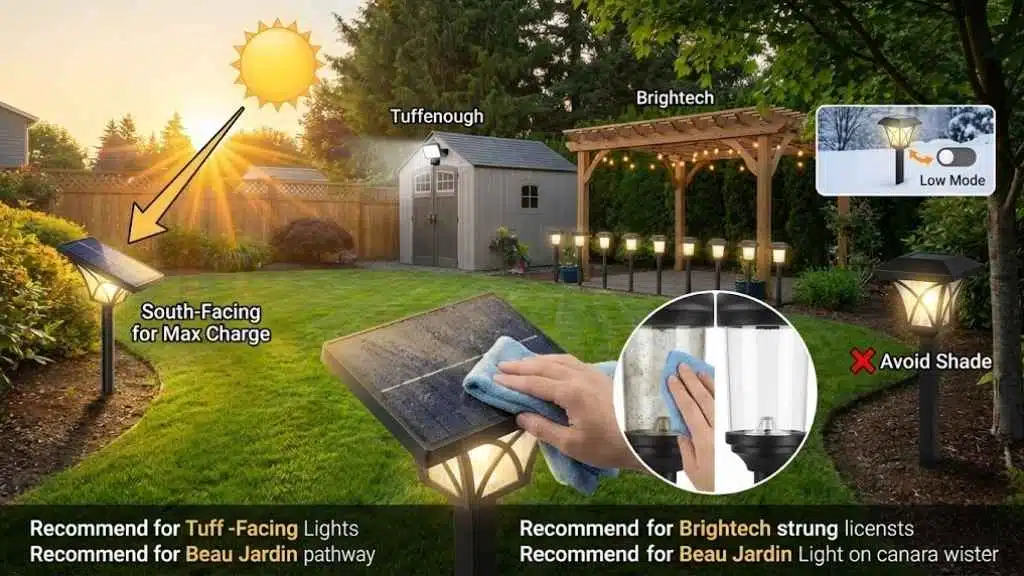
Angle your panels toward the South (if you’re in the Northern Hemisphere) to catch the maximum arc of the sun. Even a small branch or a dirty panel can reduce charging efficiency by 50%.
Cleaning Panels And Diffusers
Every 3 months, wipe the solar panels with a damp microfiber cloth. Dust, pollen, and bird droppings act like a “shade” that slowly kills your battery. If your light has a glass diffuser, a quick spray of glass cleaner will keep the light crisp and clear.
Winter And Rainy Season Care
In the winter, the sun is lower and the days are shorter. If your lights have a “Low” or “Eco” mode, switch to it in November. This reduces the lumen output but ensures the light stays on until morning despite the weaker charge.
Which Solar Lights Should You Buy?
- For a long pathway: Go with the Beau Jardin 8-Pack. They are durable, stylish, and cost-effective.
- For a small, shaded garden: Choose the Solpex Spotlights because you can adjust the panels to find the sun.
- For high-priority security: The Tuffenough 3000LM is non-negotiable.
- For the “vibe”: You can’t beat the Brightech Ambience Pro string lights.
Final Thoughts
Choosing the right solar lighting is no longer about settling for dim, unreliable stakes—it’s about matching the right technology to your home’s unique layout. Whether you prioritize the high-output security of a 3000-lumen floodlight or the warm, decorative glow of glass path lights, the key to success lies in the details: high-efficiency monocrystalline panels and durable IP65 weatherproofing.
By investing in quality fixtures with replaceable batteries, you’re not just saving on your next electricity bill; you’re creating a safer, more inviting outdoor space that operates entirely on its own schedule. Remember to prioritize sun placement during installation and perform a quick panel wipe-down once a season to keep your system at peak performance. From illuminating a dark garden corner to making a grand entrance for your driveway, these top-tier solar options provide the perfect blend of sustainability and style for 2026 and beyond.