In an era where energy costs feel like a moving target, the smart thermostat has evolved from a “cool gadget” into a financial necessity. No longer just a way to change the temperature from your phone, the latest generation of thermostats uses AI, occupancy sensing, and utility grid integration to shave hundreds off your annual bills.
Whether you are looking for a sleek, learning-capable flagship or a budget-friendly model that pays for itself in months, this guide breaks down the 12 best smart thermostats for 2026.
Choosing the right thermostat depends on your home’s layout, your HVAC system, and how much you want to “set it and forget it.” Here are our top recommendations at a glance:
- Best for Most: Ecobee Smart Thermostat Premium – A powerhouse of features, including air quality monitoring and a bundled remote sensor.
- Best Value: Amazon Smart Thermostat – Low entry cost and seamless Alexa integration; ideal for those on a budget.
- Best for Sensors: Honeywell Home T9 – Exceptional long-range sensors that focus on the rooms you actually use.
- Best for Zoning: Honeywell Evohome – The gold standard for multi-room control in the UK and Europe.
2026 Smart Thermostat
| Model | Price Range | ENERGY STAR | C-Wire Required | Matter Support | Best For |
| Nest Learning (4th Gen) | $$$ | Yes | No (Power Sharing) | Yes | Hands-off Automation |
| Ecobee Premium | $$$ | Yes | Yes (PEK Incl.) | Yes | Feature Seekers |
| Ecobee Enhanced | $$ | Yes | Yes | Yes | Balanced Performance |
| Honeywell Home T9 | $$ | Yes | Yes | No | Multi-room Comfort |
| Amazon Smart | $ | Yes | Yes | No | Budget-Conscious |
| Sensi Touch 2 | $$ | Yes | Yes | No | Easy Installation |
| Nest (Non-Learning) | $ | Yes | Recommended | Yes | Google Home Users |
| Hive (2024) | $$ | Yes | No | No | UK/Europe Homes |
A Note on Savings: ENERGY STAR certification for smart thermostats is unique because it’s based on real-world field data. On average, certified models save users about 8% on heating and cooling (roughly $50/year). However, results vary significantly based on your climate and how aggressively you use “Away” modes.
How Smart Thermostats Actually Cut Energy Costs
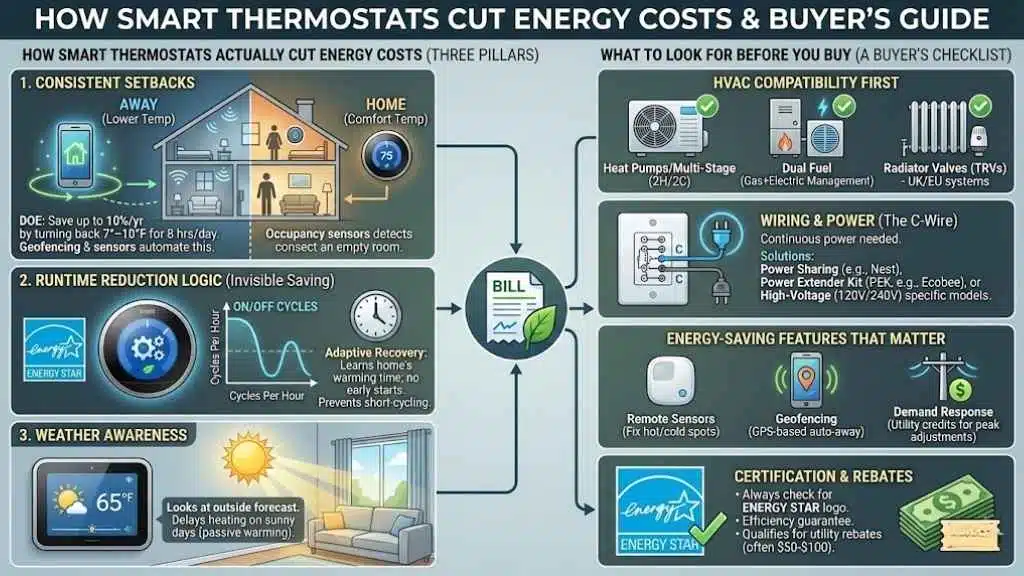
If you think a smart thermostat is just a digital version of the old dial on your wall, you’re missing out on the “smart” part of the equation. These devices use three primary pillars to reduce your carbon footprint and your bill.
1. Consistent Setbacks
The Department of Energy (DOE) reports that homeowners can save up to 10% a year on heating and cooling by simply turning the thermostat back 7°–10°F for 8 hours a day from its normal setting. While humans are forgetful, smart thermostats use geofencing (tracking your phone’s location) and occupancy sensors to ensure these setbacks happen every time you leave the house.
2. Runtime Reduction Logic
This is the “invisible” saving. ENERGY STAR-certified thermostats must prove they can reduce the total time your HVAC system runs. They do this by:
- Cycles Per Hour: Optimizing how often the system clicks on and off to prevent “short-cycling.”
- Adaptive Recovery: Learning how long it takes your home to reach a temperature so it doesn’t start the heater three hours early.
3. Weather Awareness
Modern thermostats “look” at the outside forecast. If it’s going to be a sunny 65°F day, the thermostat might delay the morning heat cycle, knowing the sun will naturally warm your living room.
What To Look For Before You Buy
HVAC Compatibility First
Before falling in love with a design, check your “wiring.”
- Heat Pumps & Multi-Stage: Ensure the thermostat supports “2H/2C” (two stages of heat, two stages of cool) if you have a modern high-efficiency system.
- Dual Fuel: If you have a gas furnace and an electric heat pump, you need a thermostat that can manage the hand-off between them.
- Radiator Valves: If you’re in the UK or EU, look for systems that support TRVs (Thermostatic Radiator Valves) like Hive or Tado.
Wiring And Power (The C-Wire)
The “C-wire” (Common wire) provides continuous power to the thermostat.
- The Problem: Many older homes only have two or four wires.
- The Solution: Look for models like the Nest Learning Thermostat that can “power share,” or brands like Ecobee that include a Power Extender Kit (PEK) in the box. If you see thick wires and wire nuts, you likely have a high-voltage system (120V/240V) which requires a specialized thermostat.
Energy-Saving Features That Matter
- Remote Sensors: These fix the “hot upstairs/cold downstairs” problem by telling the thermostat the temperature in the bedroom, not just the hallway.
- Geofencing: Uses your phone’s GPS to turn the heat down the moment you drive away.
- Demand Response: Some thermostats can talk to your utility company to slightly adjust temperatures during “peak” hours in exchange for bill credits.
Certification and Rebates
Always check for the ENERGY STAR logo. Beyond the efficiency guarantee, these models are the ones that qualify for utility rebates, which can often cover $50 to $100 of the purchase price.
12 Best Smart Thermostats
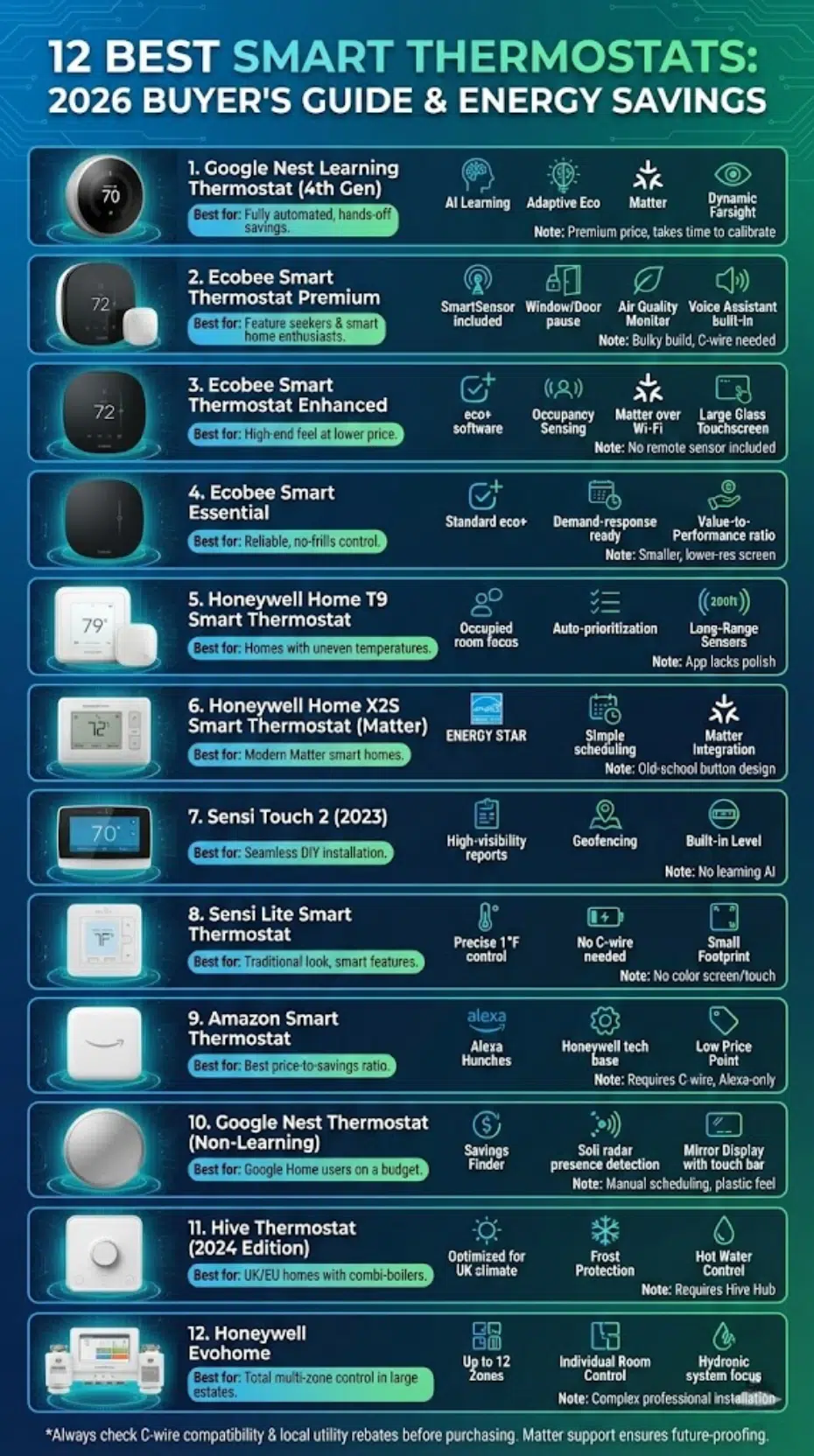
1. Google Nest Learning Thermostat (4th Gen)
Best for: Fully automated, “hands-off” energy savings.
- Why it saves energy: Uses AI to learn your habits and builds a schedule for you; “Adaptive Eco” mode finds the most efficient temp based on current weather.
- Compatibility: Works with 95% of 24V systems; no C-wire required in most cases; Matter-enabled.
- Standout Feature: Dynamic Farsight – The high-res screen changes to show you weather, time, or air quality as you walk by.
Watch-outs: It is the most expensive model on the market, and the learning feature can take 1–2 weeks to fully calibrate to your lifestyle.
Who should buy it: Design lovers who want a premium look and don’t want to spend time programming a schedule.
2. Ecobee Smart Thermostat Premium
Best for: Feature seekers and smart home enthusiasts.
- Why it saves energy: Includes a SmartSensor to eliminate hot/cold spots; automatically pauses HVAC if a window or door is left open (with additional sensors).
- Compatibility: Supports most HVAC types; requires C-wire (PEK included); works with Apple Home, Alexa, and Google.
- Standout Feature: Air Quality Monitor – Alerts you to high VOCs or CO2 levels, reminding you when to change filters.
Watch-outs: The metal build is durable but the unit is slightly bulkier than the Nest.
Who should buy it: People who want a thermostat that doubles as an air quality monitor and a smart speaker.
3. Ecobee Smart Thermostat Enhanced
Best for: Homeowners who want the Ecobee experience at a lower price.
- Why it saves energy: Features the same “eco+” software as the Premium model; uses occupancy sensing to reduce runtime when the house is empty.
- Compatibility: 24V systems; Matter support via Wi-Fi; works with all major voice assistants.
- Standout Feature: Large Glass Touchscreen – A vibrant, easy-to-read display that feels as premium as the flagship.
Watch-outs: Does not include a remote sensor in the box (though it supports them) and lacks the built-in air quality sensor.
Who should buy it: Those who want a high-end feel and Matter compatibility without the $250+ price tag.
4. Ecobee Smart Essential
Best for: Reliable, no-frills smart control.
- Why it saves energy: Standard “eco+” features for energy optimization; compatible with utility demand-response programs.
- Compatibility: Most 24V systems; primarily Apple Home and Alexa focused.
- Standout Feature: Value-to-Performance Ratio – Offers the core Ecobee logic at the lowest price point in their lineup.
Watch-outs: The screen is smaller and has a lower resolution than the “Premium” or “Enhanced” models.
Who should buy it: Apartment dwellers or landlords looking for a reliable, energy-efficient smart upgrade.
5. Honeywell Home T9 Smart Thermostat
Best for: Homes with uneven temperatures across rooms.
- Why it saves energy: Focuses heating/cooling on occupied rooms; “Auto-prioritization” ensures the HVAC doesn’t overwork to cool an empty kitchen.
- Compatibility: Works with most systems; requires a C-wire; does not support Matter (yet).
- Standout Feature: Long-Range Sensors – These sensors have a 200-foot range, making them the best for large, sprawling homes.
Watch-outs: The Honeywell app is functional but lacks the polished, modern feel of Nest or Ecobee.
Who should buy it: Families in two-story homes where the temperature varies wildly between the upstairs and downstairs.
6. Honeywell Home X2S Smart Thermostat (Matter)
Best for: Modern smart homes using the Matter protocol.
- Why it saves energy: ENERGY STAR certified; features simple scheduling and geofencing via the First Alert app.
- Compatibility: Matter-over-Wi-Fi; supports up to 2-stage heat/2-stage cool systems.
- Standout Feature: Matter Integration – One of the first Honeywell models to offer native Matter support for easier setup across different apps.
Watch-outs: The design is a bit “old-school digital,” featuring buttons rather than a full touchscreen.
Who should buy it: Users who want a budget-friendly Matter device and prefer physical buttons over touchscreens.
7. Sensi Touch 2 (2023)
Best for: A seamless DIY installation experience.
- Why it saves energy: High-visibility usage reports; geofencing capabilities to trigger setbacks when you leave the house.
- Compatibility: Requires a C-wire; works with Alexa, Google, and Samsung SmartThings.
- Standout Feature: Built-in Level – The backplate includes a bubble level to ensure your installation is perfectly straight—a small but genius touch.
Watch-outs: It lacks the “learning” AI of the Nest, so you will need to spend a few minutes setting up your initial schedule.
Who should buy it: The DIYer who wants a high-quality touchscreen without a complex setup process.
8. Sensi Lite Smart Thermostat
Best for: Those who want “smart” features in a traditional look.
- Why it saves energy: Precise temperature control within 1°F; energy-saving schedules that are easy to set via the app.
- Compatibility: No C-wire required for most systems (it uses batteries); very high compatibility with older wiring.
- Standout Feature: Small Footprint – It’s one of the most compact smart thermostats, making it ideal for tight wall spaces.
Watch-outs: No color screen or touch interface; you’ll do most of your interacting through the smartphone app.
Who should buy it: Renters or owners of older homes who don’t have a C-wire and don’t want to run new wiring.
9. Amazon Smart Thermostat
Best for: The absolute best price-to-savings ratio.
- Why it saves energy: Uses “Hunches” via Alexa to automatically turn the heat down when it thinks you’re asleep or away.
- Compatibility: Built with Honeywell Home tech; requires a C-wire; Alexa-only (no HomeKit or Google Home support).
- Standout Feature: Alexa “Hunches” – If you have Echo speakers, the thermostat learns your routine based on your interaction with other devices.
Watch-outs: You must have a C-wire or buy the separate adapter; it is not a “stand-alone” smart device and requires the Alexa app.
Who should buy it: Anyone already living in an Amazon Alexa ecosystem looking for a $60–$80 energy-saving solution.
10. Google Nest Thermostat (Non-Learning)
Best for: Google Home users on a budget.
- Why it saves energy: “Savings Finder” suggests small tweaks to your schedule; uses Soli radar technology to detect presence and switch to Eco mode.
- Compatibility: Most 24V systems; Matter-enabled; works best within the Google Home ecosystem.
- Standout Feature: Mirror Display – A stylish, minimalist design with a side-swiping touch bar for control.
Watch-outs: Does not “learn” your schedule; you have to set it yourself. It also feels a bit more “plasticky” than the metal Nest Learning model.
Who should buy it: Modern homeowners who want a sleek look and basic automation without the high flagship price.
11. Hive Thermostat (2024 Edition)
Best for: UK and European homes with combi-boilers.
- Why it saves energy: Optimized for the UK climate; “Ready by” technology ensures your home is warm exactly when you need it without over-firing the boiler.
- Compatibility: Works with most UK gas, oil, and LPG boilers; integrates with Hive Radiator Valves.
- Standout Feature: Frost Protection – Automatically kicks in if temperatures drop too low, preventing burst pipes while you’re on holiday.
Watch-outs: Requires a “Hive Hub” (included in most kits) to connect to the internet.
Who should buy it: UK residents who want a stylish, locally-supported system that handles hot water control too.
12. Honeywell Evohome
Best for: Total multi-zone control in large European estates.
- Why it saves energy: Allows you to create up to 12 independent zones; you only heat the rooms you are using, which can save significantly more than a single-point thermostat.
- Compatibility: Hydronic (wet) central heating systems; works with underfloor heating and radiators.
- Standout Feature: Individual Room Control – Each radiator can have its own smart valve that talks to the central Evohome controller.
Watch-outs: Installation is complex and usually requires a professional; the total system cost can be high if you have many radiators.
Who should buy it: Owners of large homes with hydronic heating who want the ultimate level of precision and energy savings.
Smart Thermostat Settings That Usually Deliver The Biggest Savings
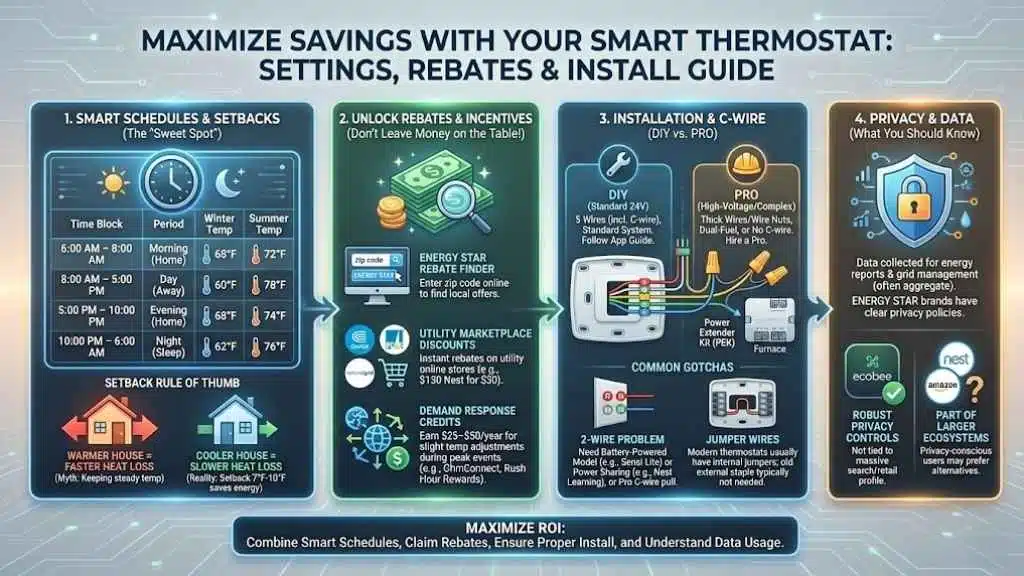
Simply installing a smart thermostat isn’t enough; you have to let it do its job. Here is how to maximize your ROI.
Copy-Paste Starter Schedules
Most people find success by creating three distinct “blocks” in their app:
| Time Block | Period | Winter Temp | Summer Temp |
| Morning | 6:00 AM – 8:00 AM | 68°F | 72°F |
| Day (Away) | 8:00 AM – 5:00 PM | 60°F | 78°F |
| Evening | 5:00 PM – 10:00 PM | 68°F | 74°F |
| Night | 10:00 PM – 6:00 AM | 62°F | 76°F |
The “Setback” Rule Of Thumb
The “Sweet Spot” for savings is a 7°F to 10°F difference between your “Home” and “Away” temperatures.
- The Myth: “It takes more energy to reheat the house than to keep it at a steady temp.”
- The Reality: Heat naturally moves toward cold. The warmer your house is compared to the outside, the faster it loses heat. Letting it cool down slows that loss, saving energy overall.
Rebates And Incentives
Before you click “buy,” you could be leaving $100 on the table. Most major utility companies offer incentives for smart thermostats because they help reduce the strain on the electrical grid.
- ENERGY STAR Rebate Finder: Visit the ENERGY STAR website and enter your zip code.
- Marketplace Discounts: Check your utility provider’s website (e.g., ConEd, PG&E, National Grid). They often have their own online stores where you can buy a $130 Nest for $30 after an instant rebate.
- Demand Response Credits: Programs like “OhmConnect” or your utility’s “Rush Hour Rewards” pay you (usually $25–$50 per year) to let them slightly adjust your temp during extreme heat waves.
Installation And C-Wire Questions
DIY vs. Pro Install
If you can change a light fixture, you can probably install a smart thermostat. Most apps provide a step-by-step video guide.
- DIY: If you have 5 wires (including a blue or black C-wire) and a standard 24V system.
- Pro: If you have high-voltage (thick wires/wire nuts), a complex dual-fuel system, or if you don’t feel comfortable opening your furnace panel to install a Power Extender Kit.
Common Install Gotchas
- The 2-Wire Problem: Many older homes only have a Red (R) and White (W) wire. You’ll need a model like the Sensi Lite (battery powered) or the Nest Learning Thermostat (power sharing), or you’ll need to hire a pro to pull a C-wire.
- Jumper Wires: Modern thermostats usually have internal jumpers. If your old thermostat had a tiny metal staple connecting “Rh” and “Rc,” you typically don’t need it for the new one.
Privacy And Data: What You Should Know
It’s a valid concern: does Google or Amazon know exactly when I’m home?
Smart thermostats collect usage patterns, humidity levels, and occupancy data to build your energy reports. ENERGY STAR certified brands are required to have clear privacy policies. Most data is used in “aggregate” (combined with thousands of others) to help utilities manage the grid. If you are privacy-conscious, look at Ecobee, which allows for robust privacy controls and isn’t tied to a massive search or retail profile like Nest or Amazon.
Final Thoughts
Investing in a smart thermostat is one of the few home upgrades that actually pays you back. Whether you choose the AI-driven Google Nest Learning Thermostat or the budget-friendly Amazon Smart Thermostat, the key is to leverage the automation features.