Building in 2026 requires speed, and traditional server management is the primary bottleneck for most startups. By utilizing the Best serverless platforms 2026, developers can deploy code that scales from zero to millions of users without ever touching a virtual machine.
Modern serverless architectures have evolved to include “Edge” computing and specialized GPU-powered functions, making it easier than ever to build high-performance applications.
Overview: Top Serverless Hosting Solutions
Choosing between platforms often comes down to your specific tech stack and where your users are located. This table breaks down how the leading providers compare in terms of execution environment and primary use case.
| Platform | Execution Model | Ideal Technology | Scaling Speed |
| Vercel | Edge & Serverless | Next.js / Frontend | Near-Instant |
| Cloudflare | V8 Isolates (Edge) | JS / TS / Wasm | Instant |
| AWS Lambda | MicroVMs | Python / Go / Node | Very Fast |
| Supabase | Backend-as-a-Service | PostgreSQL / Mobile | Automatic |
| Modal | Serverless GPU | Python / AI Models | Elastic |
| Google Cloud | Containers | Docker / Go | Fast |
| Fly.io | MicroVMs (Global) | Full-stack / Elixir | Regional |
These platforms represent the cutting edge of cloud computing, offering a mix of ease-of-use and raw power.
What Things Did We Consider When Choosing Our List?
To ensure this guide helps you find the truly Best serverless platforms 2026, we analyzed dozens of providers based on real-world developer requirements and the latest 2026 infrastructure benchmarks.
When selecting these platforms, we weighed the following factors:
-
Cold Start Performance: We prioritized platforms that minimize the delay between a request and code execution.
-
Ecosystem Integration: We looked for platforms that offer built-in databases, auth, and storage to reduce “glue code.”
-
Pricing Predictability: We favored providers with transparent billing models to avoid “bill shock” as your app scales.
-
Developer Experience (DX): We evaluated the CLI tools, documentation, and local testing environments.
With these rigorous standards in mind, here are the top seven serverless platforms to launch your app today.
Detailed Review of the Best Serverless Platforms 2026
The following platforms have been selected because they represent the best balance of performance, cost, and speed-to-market. Whether you are a solo developer or part of a growing team, these tools will help you ship faster.
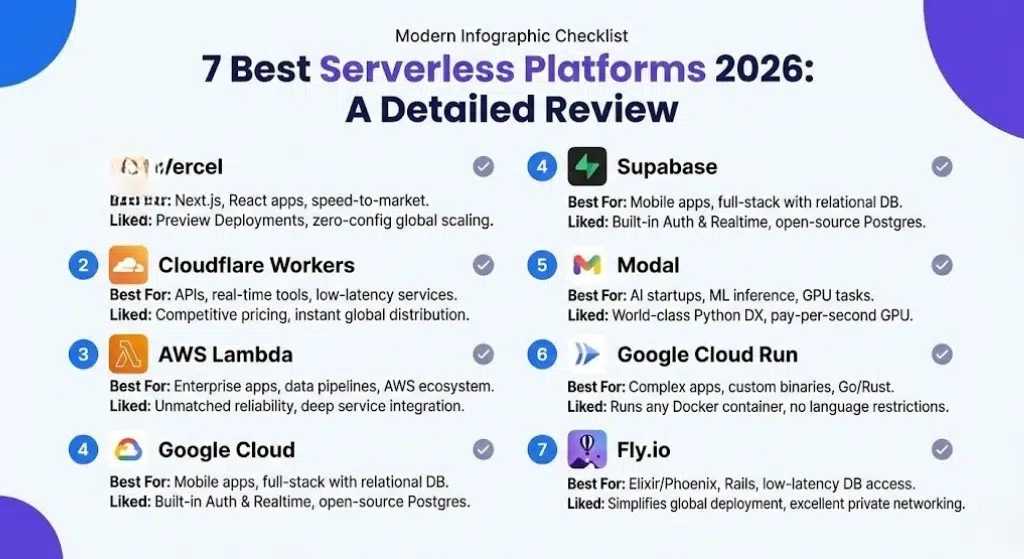
1. Vercel (The Frontend Powerhouse)
Vercel has maintained its position as the premier platform for web developers, particularly those using Next.js. In 2026, their “Edge Network” has become even more sophisticated, allowing complex backend logic to run on the edge with minimal latency.
-
Best For: Next.js developers, React apps, and teams prioritizing speed-to-market.
-
What We Liked: The “Preview Deployments” feature is unbeatable for team collaboration; their zero-config approach makes global scaling effortless.
-
Things to Consider: Pricing can escalate quickly for high-traffic sites with heavy bandwidth needs.
2. Cloudflare Workers (The Edge Specialist)
Cloudflare Workers doesn’t use traditional containers; it uses V8 isolates. This means cold starts are effectively zero. In 2026, with the addition of D1 (SQL) and R2 (Storage), it has become a full-stack powerhouse for global-first applications.
-
Best For: APIs, real-time collaboration tools, and latency-sensitive microservices.
-
What We Liked: The pricing is incredibly competitive (often cheaper than AWS); the global distribution ensures your app is fast everywhere.
-
Things to Consider: The “Isolate” environment has some limitations compared to full Node.js, requiring specific library compatibility.
3. AWS Lambda (The Ecosystem Giant)
As the original serverless platform, AWS Lambda remains the most robust option for enterprise-grade applications. It offers the deepest integration with other AWS services like S3, DynamoDB, and EventBridge, making it the anchor of the Best serverless platforms 2026 for complex workflows.
-
Best For: Enterprise apps, data processing pipelines, and teams already in the AWS ecosystem.
-
What We Liked: Unmatched reliability and a vast library of “triggers” from other cloud services; support for almost any programming language.
-
Things to Consider: The AWS console and IAM permissions have a steep learning curve for beginners.
4. Supabase (The Serverless Backend)
Supabase isn’t just a hosting provider; it’s a “Firebase alternative” that provides an entire backend-as-a-service. It gives you a real PostgreSQL database, authentication, and edge functions in a single, cohesive package.
-
Best For: Mobile apps and full-stack web applications that need a relational database.
-
What We Liked: It uses open-source tools (Postgres) so you aren’t locked into a proprietary database; the built-in Auth and Realtime features save weeks of work.
-
Things to Consider: Their Edge Functions are still slightly more limited in terms of execution time compared to dedicated FaaS providers.
5. Modal (The AI-Native Runtime)
New for 2026, Modal has taken the AI world by storm. It allows you to run Python functions on serverless GPUs (A100s, H100s) with just a decorator. This is perfect for apps that need to run LLMs or generate images on demand.
-
Best For: AI startups, machine learning inference, and GPU-intensive tasks.
-
What We Liked: The developer experience is world-class for Python; you pay only for the seconds the GPU is actually running.
-
Things to Consider: It is highly specialized for Python and heavy compute, making it overkill for simple web APIs.
6. Google Cloud Run (The Container King)
Google Cloud Run represents the bridge between serverless and containers. It allows you to package any Docker container and scale it to zero when not in use. In 2026, it is the go-to for developers who want the flexibility of a full OS with serverless scaling.
-
Best For: Complex apps with custom binaries, legacy migrations, and Go/Rust microservices.
-
What We Liked: There are no language restrictions; if it runs in a container, it runs on Cloud Run.
-
Things to Consider: Cold starts can be slightly longer than V8-based edge functions due to the overhead of starting a container.
7. Fly.io (The Global MicroVM Platform)
Fly.io treats your app like a globally distributed set of virtual machines. While it feels like a traditional PaaS, its “scale-to-zero” and “run near user” capabilities place it firmly among the best serverless options.
-
Best For: Elixir/Phoenix apps, Rails, and apps that need low-latency access to a persistent database.
-
What We Liked: It simplifies global deployment for stateful apps; their “private networking” between regions is excellent.
-
Things to Consider: It requires a bit more infrastructure knowledge compared to a purely “function-based” platform like Vercel.
How to Choose the Best Platform for Your Project
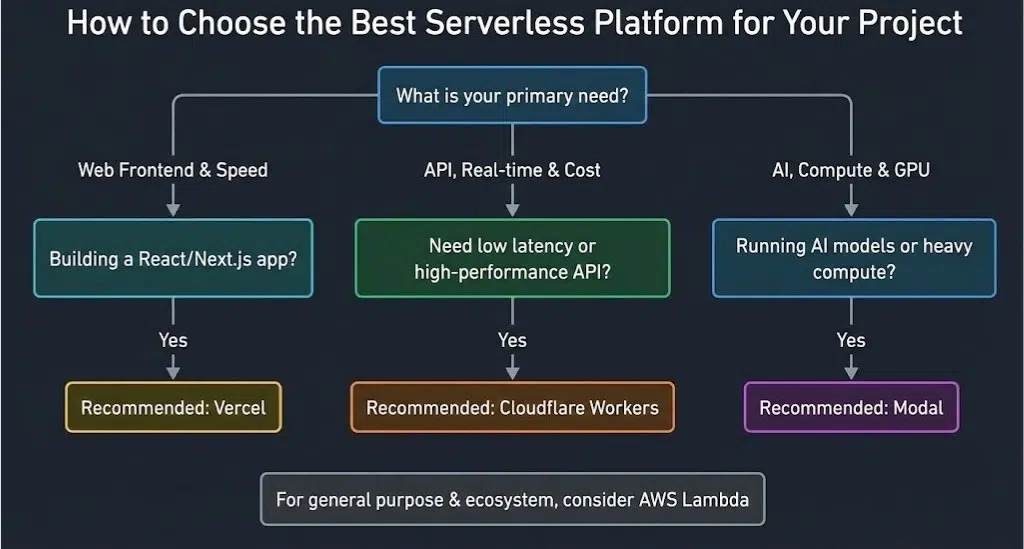
The decision often comes down to your primary language and specific needs. If you are building a React frontend, start with Vercel. If you are building a high-performance AI tool, Modal is the clear winner. For general-purpose APIs where cost is a major factor, Cloudflare Workers is hard to beat.
By matching your technical requirements to these Best serverless platforms 2026, you can ensure your app is built to scale from day one.
If you are looking for a specific solution right now, these three platforms are the current industry leaders for their respective categories.
-
Best for Web Apps: Vercel remains the gold standard for developer experience and seamless frontend integration.
-
Best for Low Latency: Cloudflare Workers is the top choice if your app needs to run as close to the user as possible.
-
Best for AI & Data: Modal is the breakthrough platform for 2026, offering serverless GPUs that make AI inference incredibly easy.
Selecting the right provider involves more than just looking at the features; it requires a deep look at the methodology behind the choices.
Wrap-Up: Launching Faster with Serverless
The era of server management is over. Utilizing the Best serverless platforms 2026 means your team can spend more time on features and less time on patches. Whether you choose a frontend-centric platform like Vercel or a compute-heavy one like AWS Lambda, the goal is the same: absolute scalability with minimal effort.