Feeling overwhelmed while trying to choose the best forex broker is more common than it seems. Endless websites, mixed reviews, and bold promises can make the decision confusing. Many traders struggle because brokers often advertise ideal conditions but fail to deliver in practice.
Key priorities usually include low trading fees, reliable customer support, and a platform that performs smoothly. Understanding which brokers truly offer tight spreads—and which ones quietly increase costs—can make a significant difference.
For its 2026 review, Investopedia evaluated 32 international and best forex brokers. The assessment focused on critical factors such as regulatory oversight, ease of use, pricing, and overall trading experience. This comparison highlights which brokers stand out and which fall short. A clear breakdown of spreads, fees, leverage, and regulation makes it easier to evaluate each option.
By the end, it becomes much simpler to identify a broker that aligns with specific trading goals. Take a moment, settle in, and explore everything needed to make a confident, informed choice.
What Makes a Forex Broker the Best?
Picking the right broker can make or break your trading journey. You need to know what separates the good ones from the rest.
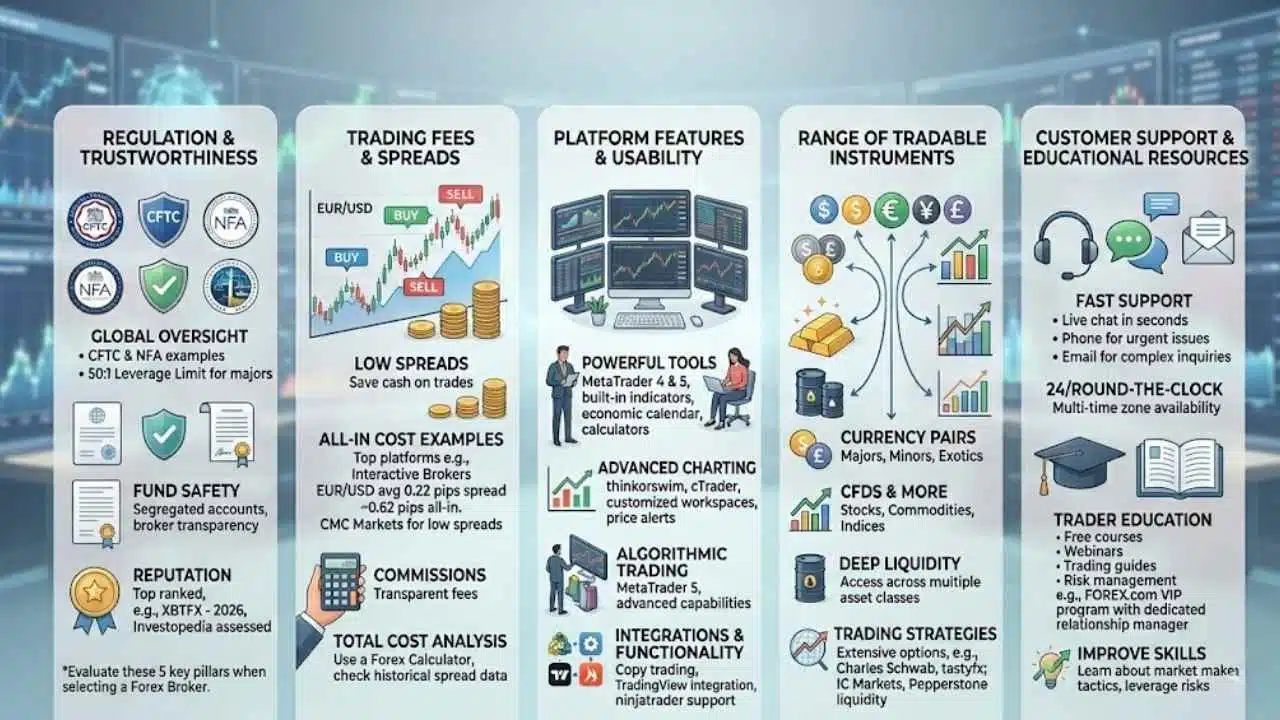
Smart traders look at regulation, fees, platform quality, available instruments, and customer support before they fund an account. Let’s break down exactly what you should look for.
Regulation and trustworthiness
Regulation stands as the foundation of any solid forex broker. Investopedia assessed 32 international forex brokers for their 2026 review, placing heavy weight on regulatory oversight.
In the US, you want to see licenses from the Commodity Futures Trading Commission (CFTC) and the National Futures Association (NFA). These regulatory bodies enforce strict rules about how brokers handle your money.
For example, the CFTC limits maximum leverage on major currency pairs to 50:1. This rule exists specifically to protect retail traders from massive, unexpected losses.
XBTFX earned a top spot for 2026 due to solid execution and deep liquidity, and regulatory compliance played a major role in that ranking. Trusting a broker goes beyond checking their paperwork.
The best platforms operate with total transparency about spreads, fees, and leverage limits. You can compare spreads and regulation simultaneously through investingLive’s forex brokers comparison page.
Top US brokers feature strong regulatory frameworks. This lets you trade with confidence instead of worry.
Trading fees and spreads
Forex brokers make money through spreads, which are the gaps between buying and selling prices. Lower spreads save you cash on every single trade.
Investopedia ranked spreads high in their 2026 evaluation criteria for 32 international brokers. Your trading costs add up extremely fast when spreads run wide.
For example, top-tier platforms like Interactive Brokers offer average EUR/USD spreads around 0.22 pips. Even after adding a small commission, your all-in cost stays near 0.62 pips.
CMC Markets stands out as a great choice for low spreads if you trade frequently. You can compare fees and leverage all at once through investingLive’s forex brokers comparison page.
The difference between a good broker and a great broker often comes down to the simple cost of doing business.
Different platforms charge different fees beyond basic spreads. US forex brokers like tastyfx and OANDA feature strong regulatory frameworks that protect your money, though this sometimes means slightly higher trading costs.
You should grab a forex calculator to figure out your total trading costs before committing to any account. Checking historical data on spreads during different market conditions helps you pick a platform that fits your style.
Platform features and usability
A solid trading platform dictates your entire experience. Top brokers like IG offer MetaTrader 4 and MetaTrader 5, which experienced traders know inside and out.
These platforms give you real-time market analysis, an economic calendar, and built-in forex calculators. Investopedia ranked platforms based on ease of use during their 2026 review.
Desktop platforms like thinkorswim and cTrader deliver advanced charting tools for serious traders. You can customize your workspace, set up price alerts, and track multiple currency pairs simultaneously.
- MetaTrader 5 provides advanced algorithmic trading capabilities for serious investors.
- TradingView offers top-tier charting and social sharing features.
- Proprietary mobile apps let you execute trades instantly from anywhere.
- thinkorswim delivers professional-level options and forex analysis tools.
Copy trading features let newer traders mirror experienced investors. Meanwhile, TradingView integration gives you access to community analysis and signals directly on your charts.
Some platforms support ninjatrader for algorithmic trading, while others focus on simplicity for beginners. The comparison resources on investingLive’s page let you stack brokers side by side.
This hands-on approach helps you pick a platform that actually works for your goals.
Range of tradable instruments
Top forex brokers give you access to many different trading options. You can trade major currency pairs like EUR/USD, minor pairs, and exotic currencies.
Most brokers also offer CFDs (contracts for difference) on stocks, commodities, and indices. The strongest platforms in 2026 provide deep liquidity and competitive pricing across multiple asset classes.
This variety matters because it lets you spread your risk and find opportunities in different markets. Some platforms focus mainly on forex trading, while others offer broader options.
Charles Schwab and tastyfx offer extensive investment strategies for US traders. IC Markets and Pepperstone give you access to liquidity providers that feed real-time data right into their systems.
When you compare spreads and regulation on investingLive’s comparison page, you see exactly which brokers match your style. Your broker should let you trade the specific assets that matter most to your financial plans.
Customer support and educational resources
Good brokers answer your questions fast. They offer live chat, email, and phone support during active trading hours.
Investopedia noted that customer service quality made a massive difference in their 2026 rankings. You need help when markets move quickly, and slow responses cost you money.
The best brokers staff their teams across multiple time zones so you get answers around the clock. They use different channels to help you out.
- Live chat services answer quick platform questions in seconds.
- Phone support helps resolve urgent trade execution issues immediately.
- Email support handles complex account inquiries and document verification.
Forex education also separates great brokers from average ones. Top platforms offer free courses, webinars, and trading guides that teach solid risk management.
For instance, FOREX.com provides a VIP program that gives high-volume traders a dedicated relationship manager. Steven Hatzakis and other forex experts regularly praise brokers that invest heavily in trader education.
You can learn about market maker tactics and leverage risks through resources like DailyForex.com. Brokers pack their platforms with video lessons and market analysis to help you improve your skills over time.
IG: Best All-Around Forex Broker for 2026
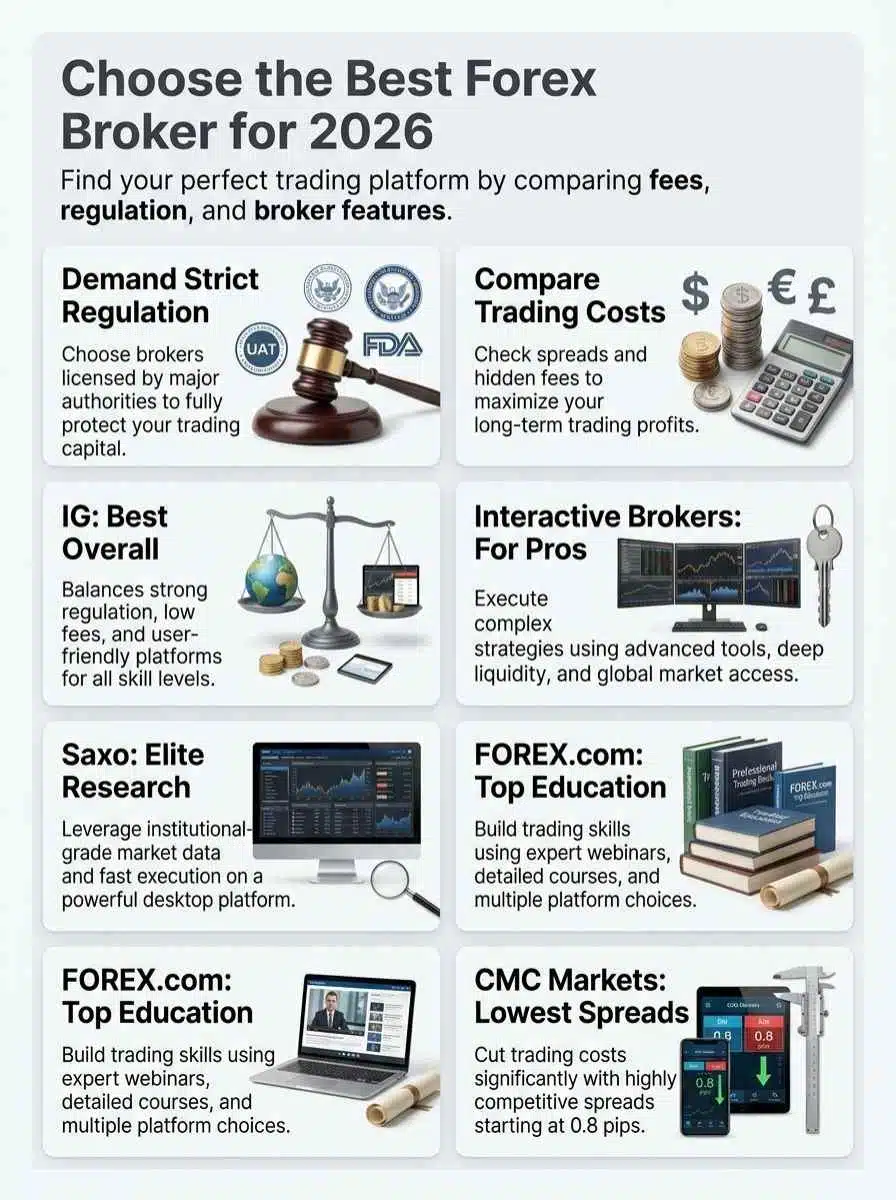
IG stands out as a top forex broker for 2026 because it combines strong regulation, low fees, and a great platform. The company recently expanded its reach for US clients by launching tastyfx, bringing its powerful tools to American shores.
You get access to thousands of forex pairs and CFDs, plus excellent customer support. IG offers free educational resources that help you learn the market fast.
Key features of IG
IG delivers competitive pricing, deep liquidity, and strong execution that keeps traders coming back. If you open a Forex Direct account, you can access EUR/USD spreads as low as 0.75 pips after commissions.
- IG provides access to over 80 currency pairs, giving you plenty of options to build your forex trading portfolio.
- The platform features low spreads on major currency pairs, so you keep more of your profits.
- Their web-based trading platform works smoothly on any device without downloading anything.
- Mobile trading apps let you monitor positions and execute trades on the go.
- The broker offers maximum leverage up to 50:1 for major currency pairs in the US.
- IG’s minimum deposit sits at zero for standard accounts, making it accessible for new traders.
- Educational resources include webinars, trading guides, and deep market analysis.
- Customer support operates 24 hours a day during the trading week.
- The platform supports CFDs on stocks, indices, and commodities for international clients.
- IG holds strong regulatory oversight from multiple authorities like the CFTC and NFA.
- Advanced charting tools help you spot trading opportunities based on price action.
- The broker offers competitive pricing compared to other major forex brokers.
Pros & Cons of IG
IG made waves in Investopedia’s 2026 forex broker assessment. Here is what traders encounter with this established platform.
| Pros | Cons |
|---|---|
| Strong regulatory framework: IG operates under solid regulatory oversight from the NFA and CFTC. Traders get peace of mind knowing their capital sits with a monitored entity. | Higher spreads on standard accounts: Standard accounts have higher spreads than Forex Direct accounts. You need higher trading volume to unlock the best pricing. |
| Comprehensive platform features: The trading interface offers solid execution and deep liquidity. IG delivers comparable trading tools without a massive learning curve. | Strict leverage limits: US regulations cap leverage at 50:1. Professional international traders comparing leverage find IG’s US offerings more conservative. |
| Excellent customer support: Response times matter when markets move. IG’s support team answers questions quickly to help traders resolve issues fast. | Desktop platform feels dated: Saxo Bank’s research tools outshine IG’s interface. Traders seeking modern charting capabilities sometimes prefer competitors with fresher technology. |
IG fits traders who value regulatory assurance and straightforward execution over rock-bottom pricing. Traders comparing fees through investingLive’s comparison page discover IG sits in the middle range on cost metrics.
The broker balances accessibility with professional-grade features. Beginners find the learning curve manageable, while experienced traders appreciate the consistent execution.
Interactive Brokers: Best for Professional Traders
Interactive Brokers serves traders who want serious tools and incredibly low costs. This broker gives you access to stocks, options, futures, and forex markets all in one place.
Key features of Interactive Brokers
Professional traders pick Interactive Brokers for serious trading power. The platform charges a tiny minimum commission of $2 per order for forex trades, which equals just 0.2 basis points.
- Advanced trading platforms serve multiple operating systems and devices smoothly.
- Deep liquidity flows through connections to major interbank forex dealers, keeping your spreads incredibly tight.
- Average EUR/USD spreads sit around 0.22 pips, making your all-in costs extremely competitive.
- Access to global markets opens doors to forex, stocks, bonds, options, and futures in one account.
- Professional-grade tools give you the technical edge that serious traders need in 2026.
- Margin trading options let you control larger positions with smaller amounts of capital.
- Extensive research materials help you make informed decisions based on real data.
- API access allows traders to build custom trading solutions and connect third-party tools.
- Strict regulatory oversight from the CFTC and SEC keeps your money safe.
- Multi-currency support lets you hold and trade in different currencies to reduce conversion fees.
- Real-time data feeds and charting tools help you spot opportunities before other traders do.
- They offer significant commission discounts if you trade massive monthly volumes.
Pros & Cons of Interactive Brokers
Interactive Brokers delivers powerful tools for serious traders who want advanced features. Here is what separates Interactive Brokers from the pack.
| Pros | Cons |
|---|---|
| Competitive Pricing: Spreads and fees rank among the absolute lowest in the industry. You save money on every trade.
Deep Liquidity: The broker accesses multiple top-tier liquidity sources. Your orders execute quickly without major slippage surprises. Multiple Asset Classes: You can trade forex, stocks, options, futures, and bonds from one account. |
Steep Learning Curve: The platform easily intimidates beginners with its complexity. New traders often struggle with the interface.
Complex Fee Structure: Multiple account types and tiered fee schedules confuse some traders. You must read the fine print carefully. Customer Support Limits: Phone support availability is restricted compared to other brokers. You rely more on email or chat. |
Interactive Brokers delivers powerful tools for serious traders who want advanced features and competitive execution. The platform shines when you evaluate options through investingLive’s forex brokers comparison page.
Your trading experience improves dramatically if you have prior market knowledge. Investopedia’s 2026 review recognized Interactive Brokers for solid execution and deep liquidity.
Consider your experience level carefully before opening an account. This broker demands a real commitment to learning its complex systems.
Saxo: Best Research Tools and Desktop Platform
Saxo Bank gives traders powerful research tools and a desktop platform that clearly stands out. The company now serves over 1.5 million clients globally with more than $116 billion in assets under management.
Key features of Saxo
Saxo Bank delivers real-time data, advanced charts, and analysis features that help you make smarter decisions. While it does not accept US retail forex clients, international traders consider it a top-tier destination.
US traders seeking a similar multi-asset experience often choose Charles Schwab instead.
- Advanced charting software lets you analyze price movements with multiple technical indicators.
- The desktop platform offers lightning-fast execution and deep liquidity for major currency pairs.
- Their massive research library contains in-depth market analysis from professional analysts.
- CFDs on forex pairs give you access to major and minor currency combinations globally.
- The mobile trading app keeps you connected to markets even when you leave your desk.
- Educational resources teach you how to read charts and understand economic data.
- Institutional-grade tools appeal to serious traders who want professional features.
- Multiple asset classes including stocks, commodities, and indices let you diversify your portfolio.
- Real-time data feeds show you price quotes exactly as they happen.
- Customizable watchlists help you track currencies and instruments that fit your strategy.
- Risk management features include stop-loss orders that protect your capital from big losses.
- Integration with fintech platforms makes it simple to connect your strategy across systems.
Pros & Cons of Saxo
Saxo Bank brings serious research tools to traders who want more than basic charting. Here is what works and what falls short with this broker.
| Pros | Cons |
|---|---|
| Advanced research capabilities: Saxo Bank delivers institutional-grade research tools. Traders access in-depth market analysis and real-time data feeds.
Superior desktop platform: The desktop experience ranks among the best in the industry. Customization options run incredibly deep. Extensive trading instruments: Beyond forex, Saxo Bank opens doors to tens of thousands of stocks, bonds, and commodities globally. |
Not available for US retail forex: US traders cannot open retail forex accounts here due to regulatory restrictions.
Steep learning curve: The massive platform intimidates beginners. Features multiply fast, so new traders need time to find their footing. Higher minimum deposits: Starting capital requirements exceed many competitors. Casual traders might feel priced out immediately. |
Saxo Bank attracts traders ready to climb the learning curve in exchange for professional-grade tools. The platform rewards patience with depth, power, and market access that casual traders rarely need.
Modern 2026 trading environments demand brokers built for how professionals actually work, and Saxo Bank delivers that promise. Beginners should explore simpler options first, then return as their skills sharpen.
FOREX.com: Best for Education and Trading Platforms
FOREX.com stands out because it packs powerful learning tools and multiple trading platforms into one place. Traders get access to educational resources that help them grow their skills daily.
Key features of FOREX.com
FOREX.com gives traders multiple ways to learn and trade at the same time. The standard minimum deposit is $100, but the broker strongly recommends starting with $2,500 for much better risk management.
- The broker offers a complete learning center covering forex basics and advanced market analysis techniques.
- Multiple trading platforms run on FOREX.com, including MetaTrader 4 and MetaTrader 5.
- Their VIP Active Trader program requires a $10,000 deposit or $50M monthly volume to qualify.
- VIP members earn up to 4% APY interest on their average daily available margin balances.
- Live market data flows into your account, letting you make decisions based on current price movements.
- Educational webinars happen regularly, featuring expert traders who share real strategies.
- Mobile trading apps work smoothly on both iOS and Android devices.
- Customer support staff answer questions through chat, email, and phone during market hours.
- The trading interface displays charts, technical indicators, and news feeds in one space.
- Account types range from standard to raw spread options.
- Leverage options go up to 50:1 on major pairs for US clients, matching CFTC regulations.
- The broker holds proper regulatory oversight from the CFTC and NFA.
- Demo accounts let you practice trading without risking real cash on the markets.
- Price alerts notify you exactly when currencies hit certain key levels.
- Traders can access daily research reports and market commentary from professional analysts.
Pros & Cons of FOREX.com
FOREX.com shines when traders want solid education paired with multiple platforms. The broker offers extensive learning materials that help both new and seasoned traders.
| Pros | Cons |
|---|---|
| Excellent educational resources: They provide a massive library of tutorials, webinars, and guides for all skill levels.
VIP Active Trader perks: High-volume traders get cash rebates, dedicated support, and up to 4% APY on idle cash. Strong US regulation: FOREX.com is fully regulated by the CFTC and NFA, ensuring your funds stay protected. |
Platform can feel overwhelming: The sheer number of tools and options can confuse brand new traders at first.
Higher standard spreads: Standard accounts have slightly wider spreads compared to discount brokers. Support response times vary: During extremely busy market hours, customer service response times occasionally lag. |
The broker comparison tools on investingLive’s page show how FOREX.com stacks up against competitors like eToro and XTB. Spreads remain reasonable across most currency pairs, making it easier on your wallet.
Advanced traders seeking deep liquidity and execution speeds comparable to XBTFX might find FOREX.com falls slightly short on standard accounts. However, the VIP Active Trader program makes it an incredible choice for heavy volume traders.
CMC Markets: Best for Low Spreads
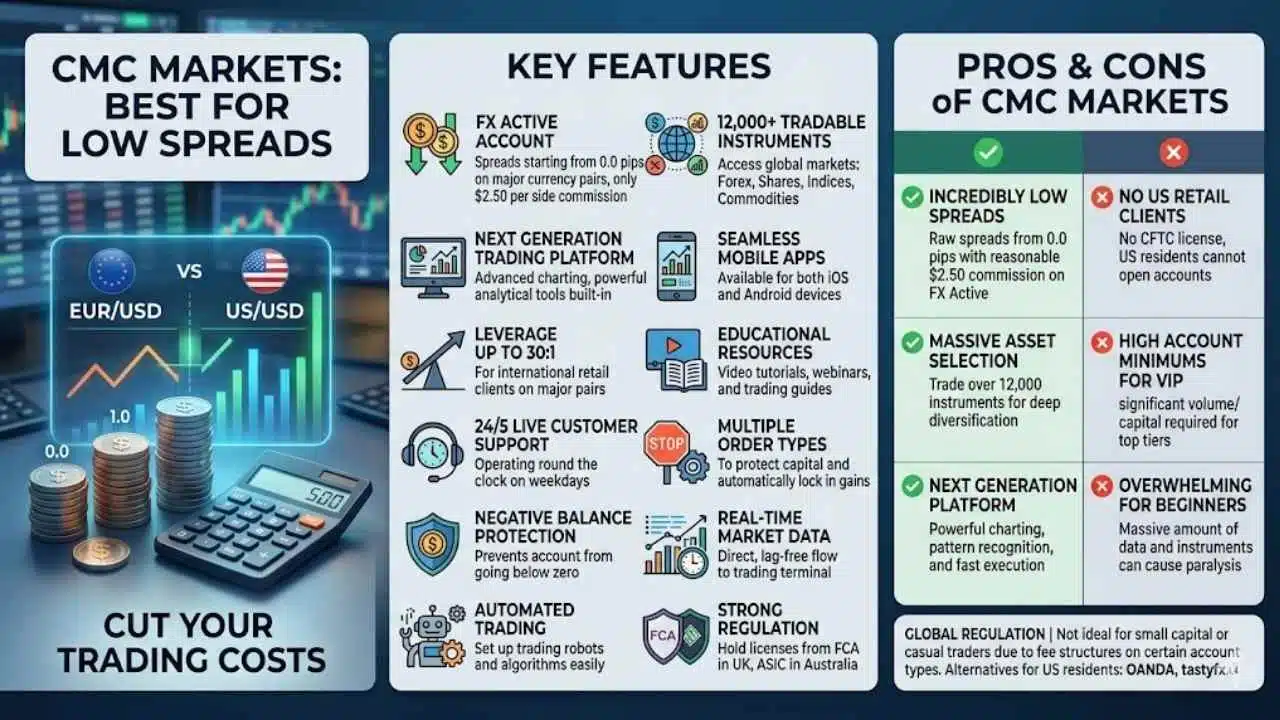
CMC Markets cuts your trading costs with spreads that sit lower than most competitors. Traders who watch every penny they spend on fees find this broker delivers immense value.
Key features of CMC Markets
CMC Markets stands out for traders who want low spreads and powerful trading tools. Their FX Active account charges just $2.50 per side while offering spreads starting from 0.0 pips.
- CMC Markets offers zero pip minimum spreads on major currency pairs for FX Active clients.
- The platform provides access to over 12,000 tradable instruments globally.
- Advanced charting tools come built right into their proprietary Next Generation trading platform.
- Mobile trading apps work seamlessly on both iOS and Android devices.
- Leverage options reach up to 30:1 for major currency pairs for international retail clients.
- Educational resources include video tutorials, webinars, and excellent trading guides.
- Live customer support operates 24 hours a day, 5 days a week.
- The platform supports multiple order types to protect your capital and lock in gains automatically.
- Negative balance protection prevents your account from going below zero.
- Real-time market data flows directly to your trading terminal without lag.
- Automated trading features let you set up trading robots and algorithms easily.
- They hold strong regulatory licenses from the FCA in the UK and ASIC in Australia.
Pros & Cons of CMC Markets
CMC Markets shines with low spreads that beat many competitors in the forex market. Traders get access to over 12,000 tradable instruments across multiple asset classes.
| Pros | Cons |
|---|---|
| Incredibly low spreads: The FX Active account offers raw spreads from 0.0 pips with a very reasonable $2.50 commission.
Massive asset selection: You can trade over 12,000 instruments, which provides excellent portfolio diversification. Next Generation platform: Their proprietary software offers powerful charting, pattern recognition, and fast execution. |
No US retail clients: CMC Markets lacks a CFTC license, so US residents cannot open retail forex accounts here.
High account minimums for VIP: Accessing the absolute best pricing tiers requires significant trading volume or capital. Overwhelming for beginners: The massive amount of data and instruments can paralyze new traders trying to learn the ropes. |
The company holds strong regulation globally, so your money stays safe. However, CMC Markets does not hold a CFTC license, meaning they do not accept US retail forex clients. US residents looking for similar low spreads often turn to OANDA or tastyfx instead.
Fees for certain account types add up quickly, eating into your profits. If you trade with small amounts of capital, this broker might not fit your needs as well as platforms built specifically for casual retail traders.
Final Thoughts
You now know exactly what separates the best forex brokers from the rest of the pack. The five factors that matter most are regulation, fees, platform quality, instrument variety, and customer support. IG, Interactive Brokers, Saxo Bank, FOREX.com, and CMC Markets each excel in different areas. Your choice depends entirely on what you value most as a trader.
Picking the right broker takes just a few minutes when you compare spreads and regulatory status side by side. Tools like investingLive’s comparison page make this process incredibly simple. Start with one broker that matches your trading style, and test their platform with a free demo account. You will quickly see how your trading improves with solid execution and competitive pricing.
Your success in forex trading is about finding the perfect fit for how you actually operate. Take action today and open an account with the broker that directly speaks to your needs.