

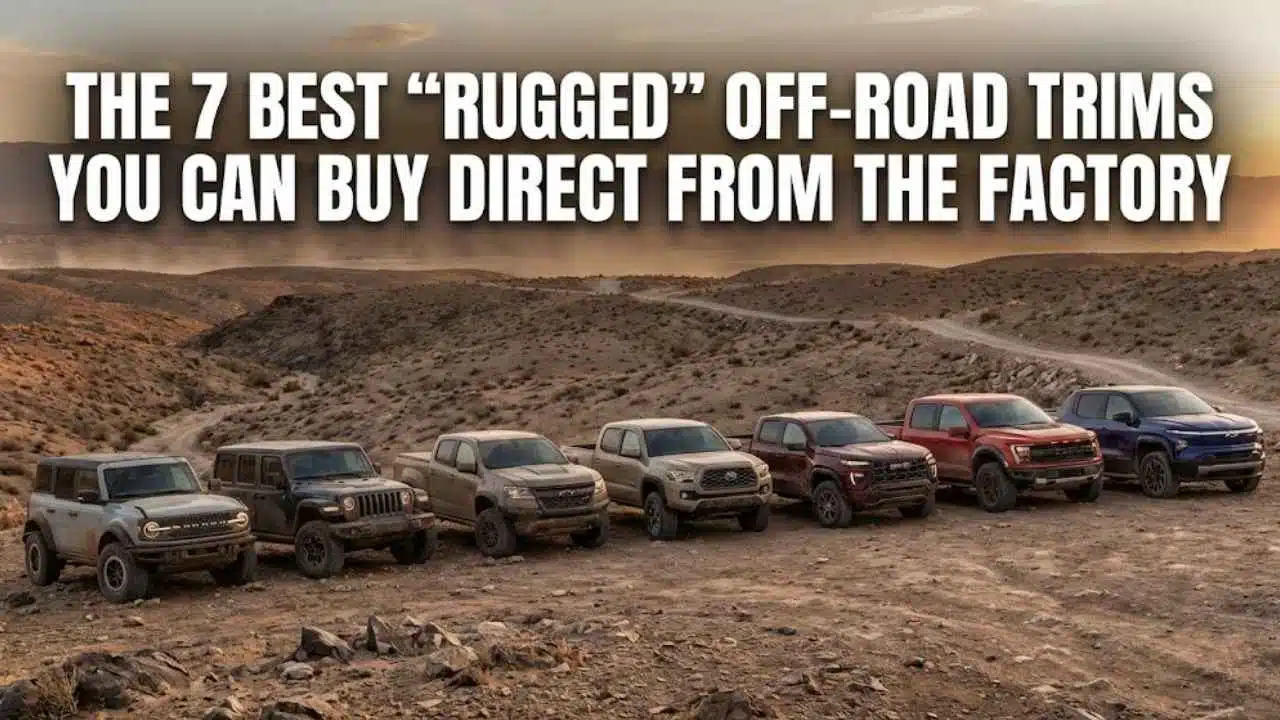
You do not need a huge lift or a custom build to enjoy real trail capability. In many cases, the smartest move is buying a rugged trim that is engineered, tested, and warrantied as a complete package. That is the promise behind the best factory off-road packages.
This guide is built for buyers who want real function. That means traction hardware, serious suspension tuning, underbody protection, and tires that can take abuse. You will also see the tradeoffs, because no factory off-road trim is perfect for every driver.
Below, you will find seven factory trims and packages that bring genuine capability straight from the showroom. You will also get a simple comparison approach, buying tips, and clear guidance for matching a trim to your terrain and budget.
Quick Take: What “Rugged From The Factory” Actually Means
A rugged factory trim is not about looks. It is about the parts you cannot fake. If a vehicle has aggressive graphics but no real traction hardware, it is not a true off-road package. If it has big tires but no protection underneath, it is not ready for sharp terrain. A real factory off-road trim is engineered to survive harder use without needing immediate upgrades.
Factory “rugged” typically means the manufacturer upgraded multiple systems as a complete set. That includes the driveline, suspension, tires, cooling, and protection. It also means the calibration is tuned to work with the hardware. The throttle mapping, traction programming, and transmission logic can change how a vehicle climbs, crawls, and descends.
Many buyers like factory packages because they are easier to finance, easier to insure, and often easier to resell. They also reduce the risk of mismatched parts. A rushed aftermarket lift can look cool but drive poorly. A factory setup usually feels more balanced on the road.
At the same time, “rugged” does not guarantee invincibility. It does not mean you can ignore tire pressure, skip maintenance, or drive beyond your skill level. A factory trim gives you better tools. You still need good judgment.
| What You See On The Window Sticker | What It Should Include | Why It Matters Off-Road |
| Off-road trim name | Locking differential or strong traction aid | Helps you climb when a wheel loses grip |
| Bigger tires | Matching suspension tuning and clearance | Prevents rubbing and improves stability |
| Skid plates | Real coverage for key components | Reduces damage risk on rocks |
| Trail modes | Hardware plus calibrated drive logic | Helps control power delivery and braking |
Best Factory Off-Road Packages: How This List Was Chosen
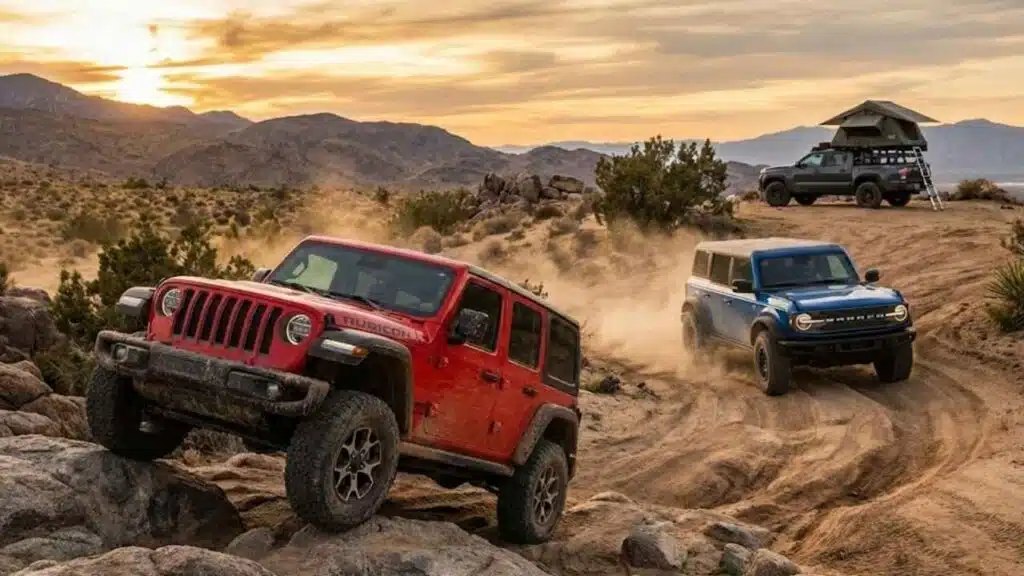
This list is built around one simple question. Can you buy the capability new, directly from the factory, without relying on a dealer add-on bundle? If the answer is yes, it qualifies. If the answer is no, it does not.
The goal is to recommend trims that give you real off-road value. That value can come from lockers, low-range gearing, advanced dampers, factory lift, serious underbody protection, or a proven combination of the above. The trims below also cover different use cases, because off-roading is not one thing.
Some drivers want rock crawling. Others want fast dirt roads and desert-style terrain. Many want overlanding, which is more about long-distance comfort and durability than extreme obstacles. Some want an EV adventure truck, which changes planning and performance in unique ways.
It is also important to be honest about compromises. A vehicle built for rocks can feel louder or less smooth on the highway. A high-speed off-road truck can be wide and harder to park. A premium off-road trim can be expensive even before accessories.
So this article focuses on capability you can use, and the tradeoffs you should expect.
| Selection Rule | What We Looked For | What We Avoided |
| Factory availability | Orderable trims and packages | Dealer “appearance” bundles |
| Hardware depth | Lockers, low range, real dampers | Cosmetic-only upgrades |
| Real-world usability | Daily comfort plus trail strength | Weekend-only extreme compromise |
| Use-case clarity | Rocks, desert, overlanding, EV trails | One-size-fits-all marketing |
A Quick Hardware Cheat Sheet For Comparing Off-Road Trims
If you are new to off-roading, the feature list can feel confusing. A simple way to cut through the noise is to focus on three pillars: traction, clearance, and control. Most factory off-road packages improve at least two of these areas. The best ones improve all three.
Traction is about putting power to the ground. Locking differentials matter when wheels lift or lose grip. Tire choice matters every time you leave pavement. Clearance is about avoiding contact with rocks and ruts. That includes ground clearance and key angles like approach, departure, and breakover. Control is about suspension tuning, gearing, and how smoothly power is delivered.
You should also match the build style to your terrain. Rock crawling wants articulation and locking differentials. Fast dirt wants strong damping and stability. Overlanding wants durability and comfort over long distances. Mixed trails want balanced capability and sensible tires.
Use the table below as a quick mental filter when comparing trims.
| Feature | Helps Most With | What Buyers Should Know |
| Rear locker | Ruts, uneven climbs | Big traction gain for the money |
| Front + rear lockers | Rock crawling | Strongest traction setup, but not always needed |
| Low range | Steep climbs, descents | Improves control and reduces brake heat |
| Advanced dampers | Washboard roads, speed | Can transform comfort and stability |
| Skid plates + rails | Sharp terrain | Protection is cheaper than repairs |
| A/T tires | Mixed use | Good balance of noise, grip, and wear |
| M/T tires | Mud and loose terrain | More noise and wear, more bite in soft ground |
The 7 Best Factory Off-Road Packages You Can Buy Stock
You do not need a custom build to enjoy real off-road performance. Many modern trucks and SUVs can be ordered with serious trail hardware straight from the factory. That means you can get the right suspension, tires, and traction tools without guesswork or mismatched parts. It also means you can keep your warranty cleaner and your resale value stronger. For many buyers, that peace of mind is worth as much as the capability itself. If you want a vehicle that is truly ready on day one, factory packages are often the smartest starting point.
The key is knowing what “off-road package” actually means. Some trims are mostly styling, with badges and dark wheels. Others include real equipment like locking differentials, low-range gearing, skid plates, and upgraded dampers. This guide focuses only on packages that bring meaningful capability you can feel on dirt, rocks, sand, or snow. It also stays realistic about tradeoffs like tire noise, fuel use, and replacement costs. By the end, you will know which factory off-road packages are genuinely rugged, and which one fits your terrain and your budget best.
1. Ford Bronco Badlands With Sasquatch Package
The Bronco is built around off-road use in a way many modern SUVs are not. The Badlands trim is already trail-focused, and the Sasquatch package pushes it into a more serious class. The point is not just bigger tires. The point is a full set of upgrades designed to work together.
For many buyers, Bronco’s biggest advantage is flexibility. You can choose two-door or four-door. You can choose different roof and door styles. You can also tailor your build for rocks, sand, or mixed terrain without starting from scratch at an aftermarket shop.
In real-world driving, Sasquatch-style upgrades can improve obstacle clearance and reduce the need for momentum. That matters because momentum can break parts. A good off-road package helps you go slow and controlled.
This trim is a strong fit for drivers who want a trail-capable SUV that still feels fun and modern on the road. It also works well for people who plan to add gear like roof racks, storage systems, or a light overlanding setup.
You should still expect tradeoffs. Bigger tires can increase road noise. Replacements can be expensive. And option packages can push pricing quickly if you do not set a budget early.
| Bronco Badlands + Sasquatch | Key Points | Why It Matters |
| Traction | Locking differentials (package dependent) | Helps crawl through uneven obstacles |
| Tires | 35-inch class tires | More clearance and better rollover |
| Suspension | Off-road tuned dampers | Better control over bumps |
| Best for | Rocks, sand, mixed trails | Balanced “do-it-all” setup |
| Watch-outs | Tire cost, option creep | Budget and comfort considerations |
Why It Makes The List
This trim makes the list because it delivers real off-road hardware and a strong clearance jump without requiring modifications. It also provides a well-known platform with broad support and clear off-road intent. That matters when you are buying capability, not just style.
It is also one of the easiest ways to get a factory-built setup that feels ready for harder trails on day one. You can buy it, learn the vehicle, and grow into the capability over time. That is a smarter path than building too much too early.
Bronco’s off-road features are also easy to understand. Even if you are new, you can see the practical benefit of lockers, tire size, and protection. That makes it a good learning platform.
Finally, it has strong versatility. It can be a weekend trail SUV, a daily driver, and a travel vehicle. Many off-road trims lean too far into one identity. This one stays flexible.
| Why It Makes The List | Summary |
| Real trail hardware | Designed for controlled crawling and traction |
| Clearance advantage | Helps reduce underbody hits on rough trails |
| Versatile platform | Works for daily use and weekend adventure |
| Strong learning curve | Easy to grow skills without immediate mods |
Who It’s Best For
This trim is best for drivers who want a true off-road SUV without turning it into a project. It fits people who like exploring trails, beaches, dunes, and rocky access roads. It is also good for families who want a practical adventure vehicle, not a hardcore toy.
If you plan to do mixed terrain, it is a strong match. It gives you the traction tools for slow sections, and enough comfort for long drives. It also works well if you want mild overlanding, because it can carry gear and handle rough approaches to campsites.
It is less ideal if you mostly commute and never leave pavement. The extra capability costs money, and the tires can feel like overkill if you do not use them. It is also not the cheapest path to looking rugged, but it is one of the more honest ones.
| Best Fit Buyer | Why It Fits |
| Mixed-terrain explorers | Balanced traction and clearance |
| Weekend trail drivers | Ready without modifications |
| Light overlanders | Strong base for gear and travel |
| Not ideal for | Pure city use with no trails |
2. Jeep Wrangler Rubicon
Wrangler Rubicon is a classic for a reason. It is one of the clearest factory answers for technical trails. The formula is simple and effective: traction tools, articulation help, and gearing designed for slow control. It is not trying to be a crossover. It is trying to be a trail machine you can drive daily if you accept the compromises.
Rubicon’s key advantage is how directly it targets rock crawling. Locking differentials help you climb where open diffs struggle. A sway bar disconnect can keep tires planted over uneven rocks. Low range gives fine control on steep climbs and descents.
Wrangler also has a huge ecosystem. That can be good and bad. It is easy to find accessories. It is also easy to waste money on junk. The smartest approach is to buy the trim for the core hardware and upgrade slowly with purpose.
On the road, expect more wind noise than a typical SUV. Expect ride and handling to vary by configuration. That is the trade. You get trail ability that is hard to match in a stock package.
| Wrangler Rubicon | Key Points | Why It Matters |
| Traction | Locking differentials | Helps when wheels lift |
| Articulation | Sway bar disconnect | Keeps tires in contact |
| Gearing | Low range | Better control, less stress |
| Best for | Technical trails and rocks | Purpose-built factory setup |
| Watch-outs | Noise, ride, efficiency | Daily comfort compromise |
Why It Makes The List
Rubicon earns its place because it brings serious rock-oriented hardware straight from the factory. It is not subtle about its mission. That helps buyers because you know what you are paying for.
It also offers a clear path for skill growth. A new off-road driver can learn traction management and line choice with a vehicle that has strong tools. As skill improves, Rubicon can handle more difficult obstacles without forcing a major build.
The platform is also proven. That matters when you are far from pavement. Reliability is not only about parts. It is also about how predictable the vehicle feels in tricky situations.
Finally, Rubicon remains a benchmark. Many other trims are compared against it for a reason.
| Why It Makes The List | Summary |
| Rock-focused toolkit | Built for technical crawling |
| Clear value proposition | You pay for hardware, not stickers |
| Proven platform | Strong identity and long-term demand |
| Upgrade-friendly | Big ecosystem if you choose wisely |
Who It’s Best For
Rubicon is best for buyers who want real technical trail performance. It fits drivers who live near rocky terrain, mountains, or rugged trail systems. It is also great for those who want a vehicle with character and open-air driving.
It can work as a daily driver if you are realistic. If you commute long highway miles and want quiet comfort, you may prefer a different format. If you accept some noise and a more upright feel, it can be a fun everyday vehicle.
It is also a solid choice for people who want a long-term hobby vehicle. Many owners keep them for years, upgrade slowly, and enjoy the community.
| Best Fit Buyer | Why It Fits |
| Rock crawlers | Traction and articulation tools |
| Mountain trail explorers | Great slow-control performance |
| Lifestyle buyers | Removable top and unique feel |
| Not ideal for | Quiet-luxury commuters |
3. Chevrolet Colorado ZR2
Colorado ZR2 is a strong pick for drivers who want a midsize truck that can handle rough terrain at speed while still being practical. In the off-road world, suspension tuning can matter as much as traction. A truck that controls bumps well feels safer, smoother, and easier to place on loose surfaces.
ZR2 is often praised because it blends two personalities. It can do slow trail work with traction tools. It can also handle fast dirt and rough roads with confidence when the suspension is working well. That makes it appealing for people who travel mixed terrain.
Midsize size is also a benefit. It is easier to park than a full-size truck. It fits many trails better. It can still carry camping gear, bikes, and work tools. For many buyers, it is the sweet spot.
The compromises are typical of off-road-focused trucks. Tires can be louder. Some trims sacrifice a bit of towing or payload for the off-road setup. That is not a flaw. It is a trade.
| Colorado ZR2 | Key Points | Why It Matters |
| Suspension | Advanced off-road dampers | Better control on rough roads |
| Traction | Locking differentials | Helps in ruts and rocks |
| Size | Midsize footprint | Easier on tight trails |
| Best for | Mixed terrain and rough backroads | Balance of fun and function |
| Watch-outs | Payload/towing tradeoffs | Match to your needs |
Why It Makes The List
ZR2 makes the list because it offers a rare combination: strong suspension focus plus real traction tools in a midsize package. Many trucks do one or the other. ZR2 aims to do both.
It is also a smart pick for buyers who drive rough roads often. If your “off-road” is gravel, broken pavement, ranch roads, and forest roads, suspension control is a big quality-of-life upgrade.
It is also a practical adventure truck. You can load gear, tow moderate loads (depending on configuration), and still have a trail-ready setup without modifying anything.
| Why It Makes The List | Summary |
| Suspension-first capability | Comfort and control on rough ground |
| Real traction hardware | Useful for slow technical sections |
| Midsize practicality | Easier daily use than full-size |
| Balanced mission | Works for travel and play |
Who It’s Best For
ZR2 fits drivers who want a truck that feels confident on bad roads and trails. It is ideal for people who drive into remote areas for work or recreation. It also fits drivers who like a more athletic off-road feel without going to a full-size performance truck.
It is also a strong pick for those who want one vehicle to do many jobs. Daily commute, weekend camping, and occasional tougher trails can all fit into the same ownership plan.
If you frequently tow heavy loads, you should check the specific towing numbers for your build. Off-road hardware can affect tow ratings, and you do not want surprises.
| Best Fit Buyer | Why It Fits |
| Rough-road travelers | Suspension control improves comfort |
| Midsize truck buyers | Better trail fit than full-size |
| Mixed-terrain drivers | Traction plus stability |
| Not ideal for | Frequent heavy towing |
4. Toyota Tacoma TRD Pro And Trailhunter
Tacoma’s off-road flagships speak to two types of buyers. TRD Pro is often the “performance off-road” identity. Trailhunter leans into “adventure travel” identity. Both aim to deliver strong capability straight from the factory, but the vibe and priorities can differ.
For many buyers, Tacoma’s strongest advantage is long-term ownership confidence and resale demand. People also like the size. It is easy to place on trails and manageable in cities. It feels like a real truck without being massive.
TRD Pro tends to be the trim people dream about. It usually brings upgraded suspension tuning, aggressive tires, and off-road-focused equipment. Trailhunter is often framed as the option for people who want an overland-ready direction with practical protection and travel-focused thinking.
The important point is this: you should choose based on how you actually drive. If you want rough-road fun and a sporty feel, TRD Pro may fit. If you want long trips with gear, Trailhunter may feel more aligned.
| Tacoma TRD Pro / Trailhunter | Key Points | Why It Matters |
| Mission | Off-road performance vs overland travel | Helps match your use case |
| Size | Midsize footprint | Easier daily use and trail fit |
| Suspension | Off-road tuned setup | Comfort and control off pavement |
| Best for | Mixed trails and adventure travel | Practical capability |
| Watch-outs | Cost and configuration choices | Options can change value |
Why It Makes The List
Tacoma earns its place because it offers factory off-road credibility with a daily-friendly shape. It also holds value well, which matters if you plan to change vehicles in a few years.
It also fits many real-world “off-road” needs. Most people are not rock crawling every weekend. They are driving forest roads, beach access roads, mountain trails, and rough campsite approaches. Tacoma is built for those realities.
The TRD Pro and Trailhunter approach also shows a trend. Manufacturers are now building trims that target specific adventure styles, not just generic toughness.
| Why It Makes The List | Summary |
| Strong off-road identity | Known for trail-ready trims |
| Daily-friendly size | Practical for cities and trails |
| Adventure-focused options | Pro vs overland approach |
| Resale confidence | Demand often stays strong |
Who It’s Best For
Tacoma off-road trims fit buyers who want a midsize truck for long-term ownership, travel, and weekend trails. It is a good choice for people who want capability without going extreme.
It is also a strong pick for people who value a balanced driving feel. You can live with it daily. You can travel far. You can still handle rough terrain with confidence.
If you need maximum interior space or a very large bed, you may prefer a bigger truck. Tacoma is a smart compromise, not the biggest option.
| Best Fit Buyer | Why It Fits |
| Adventure travelers | Comfortable and capable base |
| Midsize truck fans | Easy to drive and park |
| Light overlanders | Good platform for gear |
| Not ideal for | Maximum-size needs |
5. GMC Canyon AT4X And AT4X AEV Edition
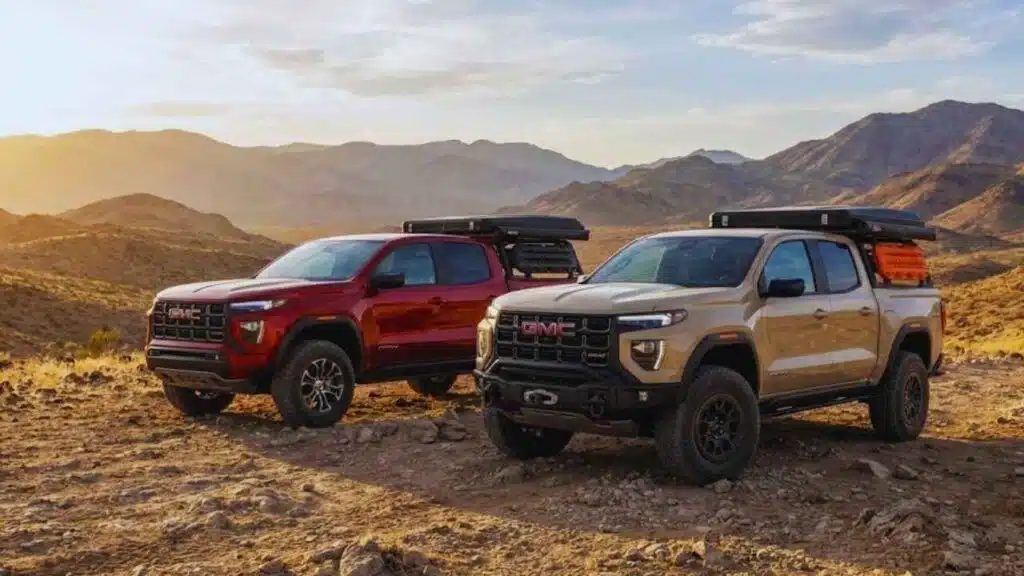
Canyon AT4X is the premium take on a midsize off-road truck. It aims to give you real trail ability while also delivering a nicer cabin and strong tech. For many buyers, that combo matters because they want to enjoy the drive to the trail as much as the trail itself.
A premium off-road trim can make sense if you drive long distances. Better seats, better cameras, and better sound insulation can reduce fatigue. That can be more valuable than a cosmetic upgrade.
The AT4X AEV Edition leans further into protection and durability. That matters if you plan to travel farther from help. Extra armor and off-road durability features can reduce risk on remote routes.
The tradeoff is cost. Premium trims can quickly enter price territory where you should compare full-size options too. The right answer depends on your priorities.
| Canyon AT4X | Key Points | Why It Matters |
| Mission | Premium off-road midsize | Comfort plus capability |
| Protection | Skid plates and armor focus | Helps on sharp terrain |
| Tech | Cameras and drive modes | Easier trail placement |
| Best for | Overland-style travel | Long-distance comfort |
| Watch-outs | Price and tire wear | Premium costs add up |
Why It Makes The List
This trim makes the list because it delivers serious capability in a refined package. Not everyone wants a bare-bones trail truck. Many buyers want a comfortable interior without giving up real off-road gear.
It also reflects a modern trend. Manufacturers now understand that adventure buyers often want both comfort and capability. That does not make the trim less rugged. It simply changes the ownership experience.
The AEV angle also matters for buyers who want added protection without aftermarket guesswork. Factory-backed integration can be a big confidence boost.
| Why It Makes The List | Summary |
| Capability with comfort | Strong blend for daily use |
| Protection emphasis | Useful for remote travel |
| Premium ownership feel | Better long-drive experience |
| Factory-integrated approach | Less risk than random mods |
Who It’s Best For
AT4X fits buyers who want a midsize truck but do not want to feel like they are sacrificing comfort. It is ideal for people who drive long highway stretches to reach trails. It also fits those who want tech support like cameras for tight obstacles.
The AEV-style protection focus fits overlanders and remote travelers. If you spend time on rough roads far from pavement, protection and durability matter more than flashy accessories.
If your budget is tighter, you may find better value in a less premium off-road trim. AT4X is a “want” choice as much as a “need” choice.
| Best Fit Buyer | Why It Fits |
| Comfort-focused adventurers | Better daily driving experience |
| Remote travelers | Protection and durability helps |
| Tech-friendly drivers | Cameras support trail placement |
| Not ideal for | Strict budget shoppers |
6. Ford F-150 Raptor
Raptor is built for a different kind of off-road driving. It is about speed, control, and stability on rough surfaces. It is the kind of truck that makes washboard roads feel less punishing and fast dirt roads feel more composed.
High-speed off-roading is not reckless driving. Done correctly, it is about suspension performance, stability, and safe space. Raptor’s mission is to handle repeated impacts while staying predictable.
This kind of capability matters if you live near desert terrain, wide-open backroads, or large off-road areas. It is less useful if your trails are narrow, rocky, and tight. Raptor’s width and size can be a limitation in forests and technical trails.
On the road, it can still be a comfortable daily driver, but you should expect higher running costs. Tires, fuel, and insurance can be more expensive than a normal truck.
| F-150 Raptor | Key Points | Why It Matters |
| Mission | High-speed off-road control | Stability on rough terrain |
| Suspension | Performance-focused tuning | Smooths repeated impacts |
| Size | Full-size, often wide | Limits tight trail access |
| Best for | Desert-style off-roading | Fast dirt and open terrain |
| Watch-outs | Cost and practicality | Parking and tire replacement |
Why It Makes The List
Raptor makes the list because it represents a factory-built performance off-road category that few competitors match in the same way. It is not built to be the best rock crawler. It is built to be stable and strong at speed.
It also gives buyers a unique ownership experience. Many trucks can tow. Many trucks can haul. Fewer trucks deliver this kind of off-road confidence without modifications.
Raptor is also a strong option for buyers who want a “halo” truck but still want a usable daily vehicle. It can be fun and functional if you accept the cost.
| Why It Makes The List | Summary |
| High-speed off-road focus | Built for stability and control |
| Factory performance category | A distinct off-road identity |
| Daily usability | Still works as a real truck |
| Strong demand | Many buyers seek this format |
Who It’s Best For
Raptor is best for buyers who have access to open off-road terrain and want a truck built for rough surfaces at speed. It fits people who enjoy desert roads, dunes, and wide trails where size is not a limitation.
It can also work for those who want a premium-feeling truck with a bold personality. Many owners enjoy it as a daily driver, but you should budget for higher operating costs.
If your off-road driving is mostly tight trails and rocks, you may get more practical value from a smaller vehicle with better maneuverability.
| Best Fit Buyer | Why It Fits |
| Desert and dune drivers | Suspension built for speed |
| Open-terrain explorers | Size becomes less of an issue |
| Performance truck fans | Unique factory experience |
| Not ideal for | Tight wooded trails |
7. Chevrolet Silverado EV Trail Boss
Silverado EV Trail Boss points to where factory off-road packages are heading. EVs bring instant torque and smooth control. They can also be quiet and relaxing in remote areas. But they also introduce new planning needs, especially around range and charging.
A factory lift and larger tire package can improve trail clearance without requiring modifications. That matters because EV weight can be high, and you want the setup engineered to work correctly.
EV off-roading can be surprisingly enjoyable at low speeds because torque delivery is instant and smooth. That can reduce the need for aggressive throttle inputs. At the same time, range can drop on soft sand, steep climbs, and rough terrain.
This trim is best for buyers who are excited about EV adventure travel and can plan routes confidently. If you regularly drive far from charging options, you need to be realistic about trip planning.
| Silverado EV Trail Boss | Key Points | Why It Matters |
| Mission | EV adventure off-roading | A new style of trail travel |
| Clearance | Factory lift + larger tires | Reduces underbody risk |
| Torque delivery | Smooth low-speed control | Easier crawling feel |
| Best for | Moderate trails and travel | Modern adventure use |
| Watch-outs | Range planning | Terrain impacts efficiency |
Why It Makes The List
This trim makes the list because it delivers factory off-road intent in an EV format. That is a meaningful shift. It is not just an EV with rugged styling. It is an EV version that targets trail readiness with clearance and tires.
It also fits a growing buyer group. Many adventure drivers want quiet travel, onboard power potential, and modern tech. EV trucks can offer that experience, especially for camping and road-to-trail trips.
The main point is balance. This is not the best choice for every remote route, but it is one of the clearest factory EV off-road directions available.
| Why It Makes The List | Summary |
| EV-specific trail focus | Built for adventure identity |
| Factory clearance upgrades | Less need for modifications |
| Smooth torque control | Helpful for slow terrain |
| Modern travel appeal | Quiet, tech-forward ownership |
Who It’s Best For
Trail Boss EV fits buyers who want to explore trails and backroads but also want EV technology. It is ideal for people who do moderate off-road routes, camping trips, and adventure travel where charging can be planned.
It can also fit buyers who want a unique daily driver with weekend capability. If most of your driving is city and highway, an EV can be comfortable. If your weekends involve trails, the off-road package adds useful tools.
If your travel often goes deep into remote areas with no infrastructure, a traditional off-road SUV or truck may still be easier today.
| Best Fit Buyer | Why It Fits |
| EV adventure buyers | Designed for modern travel |
| Moderate-trail drivers | Clearance and tires help |
| Campers and road-trippers | Tech and comfort advantages |
| Not ideal for | Very remote, infrastructure-free trips |
Which Off-Road Trim Fits Your Terrain
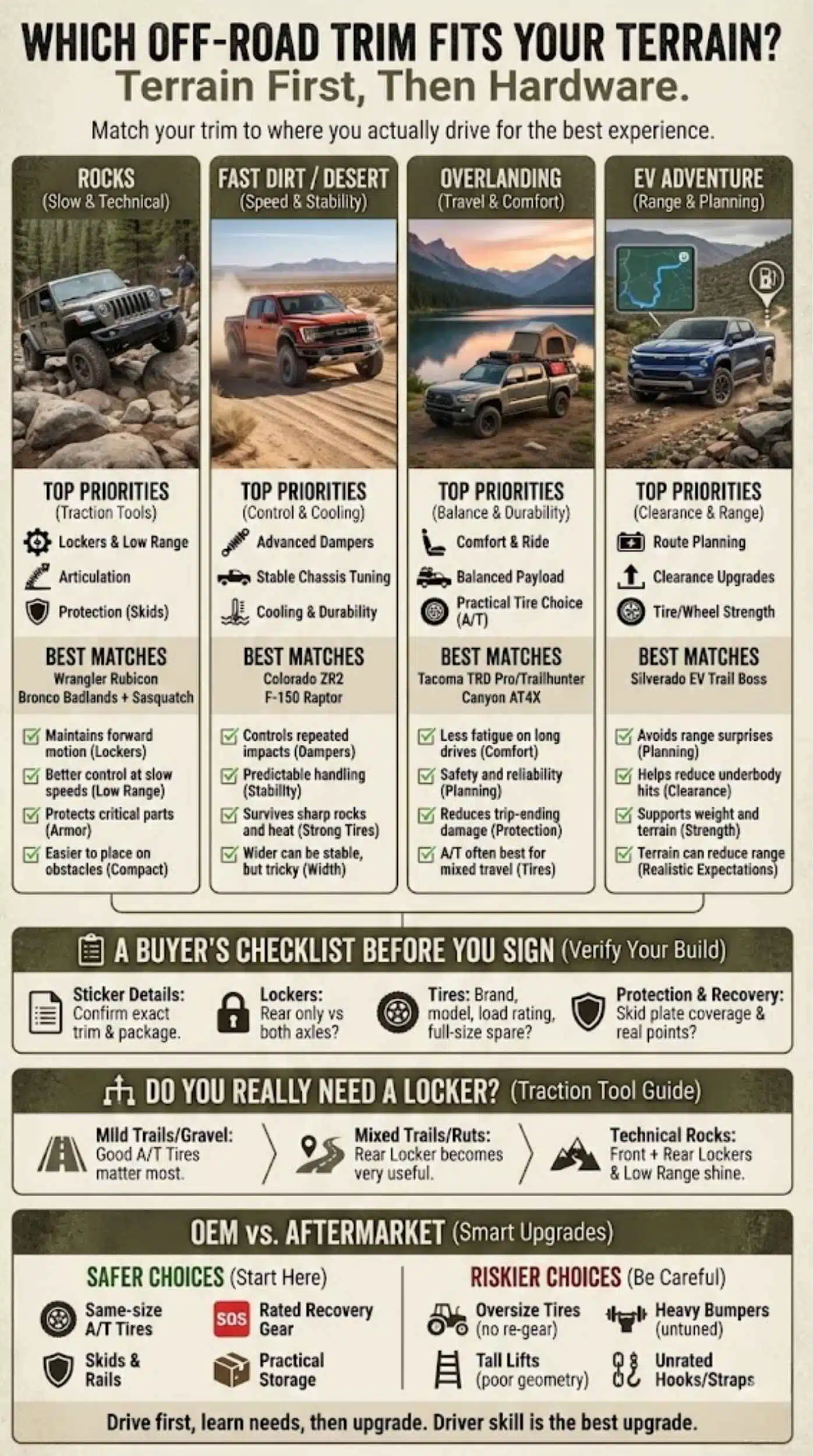
Buying the wrong trim is common. Many people buy the most famous name instead of the best match. A better approach is to pick your terrain first, then choose hardware that supports it.
Rock crawling wants traction tools and articulation. Fast dirt wants suspension control and stability. Overlanding wants comfort, durability, and balanced payload. EV adventure wants planning tools, clearance, and realistic range expectations.
Also think about how often you will actually use the extreme features. If you only do mild trails twice a year, a less extreme trim with good all-terrain tires may be enough. If you drive rough roads weekly, suspension and protection matter more.
Below is a simple mapping that can help you narrow choices quickly.
| Terrain Type | Top Priorities | Best Matches From This List |
| Rocks | Lockers, low range, articulation | Wrangler Rubicon, Bronco Badlands + Sasquatch |
| Fast dirt / desert | Advanced dampers, stability | Colorado ZR2, F-150 Raptor |
| Overlanding | Comfort, protection, balance | Tacoma TRD Pro/Trailhunter, Canyon AT4X |
| EV adventure | Clearance, planning, smooth control | Silverado EV Trail Boss |
If You Mostly Rock Crawl
Rock crawling is slow, technical, and unforgiving. The terrain is uneven, and wheels often lift. That is why traction tools matter so much. Locking differentials can keep you moving when a tire loses grip. Low range helps you stay controlled without overheating brakes.
Articulation also matters. When the suspension can move, tires stay on the ground longer. That reduces slipping and improves control. Protection is important too, because rocks can hit vulnerable parts.
For this style of driving, choose a trim that is designed for technical terrain, not just fast dirt roads.
| Rock Crawling Checklist | Why It Matters |
| Front and/or rear locker | Maintains forward motion |
| Low range | Better control at slow speeds |
| Rock rails and skid plates | Protects critical parts |
| Compact size (if possible) | Easier to place on obstacles |
If You Mostly Drive Fast Dirt And Desert
Fast dirt driving is about stability and control. Washboard roads can shake a vehicle violently. Poor damping can make the truck feel nervous and tiring. Advanced dampers can make a huge difference in comfort and confidence.
Cooling and durability also matter because high-speed rough driving creates heat and repeated impacts. Tires matter too, because you need sidewall strength and predictable grip.
If you do this style of off-roading, prioritize suspension quality over extreme rock-crawling hardware.
| Fast Dirt Checklist | Why It Matters |
| Advanced dampers | Controls repeated impacts |
| Stable chassis tuning | Predictable handling |
| Strong tires | Survives sharp rocks and heat |
| Practical width | Wider can be stable, but harder on tight trails |
If You Want Overlanding And Long Trips
Overlanding is more about travel than obstacles. You want a vehicle that can carry gear reliably, handle rough access roads, and stay comfortable for long hours. Protection is important, but so is balance. A heavy build can reduce payload and efficiency.
For overlanding, good all-terrain tires are usually a better daily choice than aggressive mud-terrains. You want durability, not constant tire noise. You also want a smart packing plan and basic recovery gear.
A factory off-road trim helps here because it gives you a strong base. You can then add only what you need.
| Overlanding Checklist | Why It Matters |
| Comfortable seats and ride | Less fatigue on long drives |
| Balanced payload planning | Safety and reliability |
| Protection for underbody | Reduces trip-ending damage |
| Practical tire choice | A/T often best for mixed travel |
If You Want An EV Adventure Truck
EV adventure is exciting, but it needs a different mindset. You have instant torque and smooth control, which can be great on trails. You also need to plan your route carefully because terrain can reduce range.
For moderate trails and travel, a factory EV off-road package can be a smart choice. It reduces the need to modify a heavy vehicle. It also keeps integration cleaner.
The key is being honest about how remote your trips are and where charging fits.
| EV Adventure Checklist | Why It Matters |
| Route planning | Avoids range surprises |
| Clearance upgrades | Helps reduce underbody hits |
| Tire and wheel strength | Supports weight and terrain |
| Realistic expectations | Terrain can reduce range |
A Buyer’s Checklist Before You Sign
This is where you protect your money. Many buyers assume an off-road trim name guarantees certain hardware. That is not always true. Packages can vary by configuration, model year, and options. Always confirm the exact build.
Start with the window sticker. Confirm lockers. Confirm low range. Confirm the tire model and size. Confirm the spare tire. Confirm the skid plate coverage. Confirm recovery points. These details determine whether the vehicle is trail-ready or just trail-themed.
Also budget for ownership basics. Off-road tires wear differently than highway tires. Alignments can be more frequent if you drive rough roads often. Recovery gear is not optional if you plan to travel remote.
Finally, think about training. Driver skill is the best upgrade. A careful driver with a stock off-road trim can often go farther than a reckless driver with expensive mods.
| Pre-Purchase Checklist | What To Verify | Why It Matters |
| Sticker details | Exact trim + off-road package | Prevents paying for missing equipment |
| Lockers | Rear only vs both axles | Huge traction difference |
| Tires | Brand, model, load rating | Impacts grip and durability |
| Spare | Full-size and matching | Remote safety and convenience |
| Protection | Skid plates and rails coverage | Avoids expensive damage |
| Recovery points | Real hooks or tow points | Safe recoveries depend on them |
Do You Really Need A Locker
A locker is one of the most misunderstood features. Some buyers think it is essential for any off-road trip. Others ignore it completely. The truth is in the middle.
A locker is most valuable when traction is uneven. If one wheel is in the air or on a slippery surface, an open differential can send power to the wheel that slips. A locker forces both wheels on an axle to turn together, which helps you keep moving.
But lockers are not magic. Tires often make a bigger difference on mild trails. Driver line choice also matters a lot. If you do moderate dirt roads, a locker might rarely be used. If you do steep ruts and rocks, it can save the day.
A simple way to decide:
- Mild trails and gravel roads: good A/T tires matter most
- Mixed trails with ruts: a rear locker becomes very useful
- Technical rocks: front + rear lockers and low range shine
| Traction Tool | What It Does | Best Use |
| Open differential | Power follows least resistance | Pavement and mild dirt |
| Limited-slip | Shares torque when slipping | Mixed conditions |
| Rear locker | Locks rear axle together | Ruts, climbs, uneven traction |
| Front + rear lockers | Locks both axles | Technical rock crawling |
OEM Accessories Vs Aftermarket Mods
Many buyers start with a factory off-road trim and then feel tempted to modify immediately. That is usually a mistake. The smartest approach is to drive the vehicle first, learn what it does well, and then upgrade only what your real trips demand.
Good early upgrades are simple and functional. Recovery gear, tire repair, and air management are the basics. Protection upgrades can also be worth it if your trails are rocky. These upgrades improve capability without ruining road manners.
High-risk upgrades usually involve major suspension changes and oversized tires. These can cause rubbing, poor alignment, worse braking feel, and long-term wear issues. They can also make a vehicle less enjoyable daily.
If you want to stay close to factory reliability, keep changes modest. Choose quality parts. And avoid stacking heavy accessories without considering payload and balance.
| Upgrade Type | Safer Choices | Riskier Choices |
| Tires | Same-size A/T | Oversize tires without gearing |
| Protection | Skids and rails | Heavy bumpers without tuning |
| Suspension | Mild factory-style lift | Tall lift with poor geometry |
| Recovery | Rated strap and shackles | Unrated hooks and cheap straps |
| Storage | Practical cargo systems | Overloaded roof builds |
Final Thoughts: Best Factory Off-Road Packages For Real-World Buyers
The best factory off-road packages are not about bragging rights. They are about buying the right tools for the trails you actually drive. If you want technical rock ability, prioritize lockers, low range, and articulation. If you want fast dirt stability, prioritize suspension control. If you want overlanding, prioritize comfort, protection, and balance. If you want EV adventure, prioritize clearance and trip planning.
The seven trims in this guide cover a wide range of styles. Bronco Badlands with a serious package is a versatile SUV choice. Wrangler Rubicon remains a strong rock-focused benchmark. Colorado ZR2 blends midsize practicality with rough-road confidence. Tacoma TRD Pro and Trailhunter target adventure buyers who want a balanced daily-friendly truck. Canyon AT4X adds premium comfort to a capable midsize format. F-150 Raptor is the high-speed off-road icon. Silverado EV Trail Boss shows how factory capability is evolving.






























