Let’s be real: spending over $1,000 on a smartphone in 2026 feels increasingly unnecessary. While flagship marketing teams want you to believe you need the latest “Pro” or “Ultra” model to survive the digital age, the gap between mid-range and premium phones has all but vanished. The Best Affordable 5G Phones in 2026 are no longer just “cheap alternatives”; they are genuine powerhouses capable of handling high-end gaming, professional-grade photography, and multi-day battery life.
Whether you are a student, a gig worker, or just someone who prefers to keep their savings in the bank, this year’s budget lineup is arguably the most exciting we have seen in a decade. Why trust our selection? We didn’t just look at spec sheets. We analyzed real-world usage data, screen brightness under direct sunlight, cellular reception in spotty areas, and, most importantly, long-term software support guarantees.
In 2026, a “good deal” isn’t just about a low price tag today; it’s about a phone that won’t feel obsolete in twelve months. From Google’s AI-packed Pixel 9a to Samsung’s industry-shaking Galaxy A17, we have curated the definitive list of devices that deliver maximum bang for your buck.
Key Takeaways
-
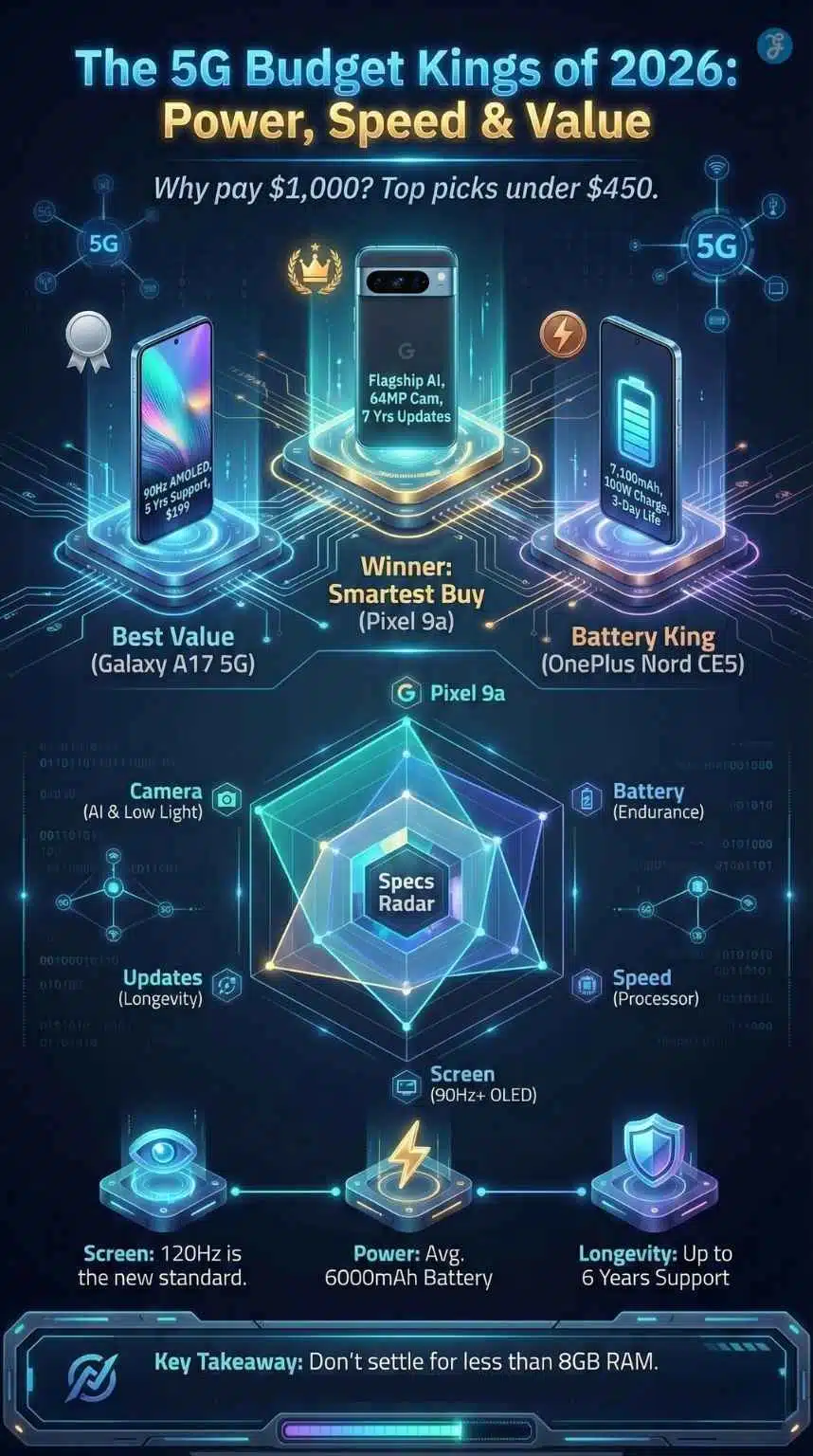
Google Pixel 9a: It is the best all-rounder, offering flagship camera quality and AI features for under $450.
-
Samsung Galaxy A17 5G: It is the budget king ($199) thanks to its incredible 6-year update promise and AMOLED screen.
-
OnePlus Nord CE5: It solves battery anxiety with a massive 7,100mAh cell.
-
Never buy 4GB RAM: Always aim for 8GB RAM and 128GB storage to future-proof your purchase.
-
Screen Quality: 90Hz OLED is the new baseline for a good viewing experience.
How We Ranked the Best Budget 5G Phones
To ensure this list relies on data rather than marketing hype, every device below was evaluated against a strict 5-Point Value Standard. In 2026, simply having “5G” in the name isn’t enough; an affordable phone must be usable as a daily driver for at least 2–3 years.
Our ranking methodology prioritizes the following criteria:
-
1. The “Future-Proof” Factor: We heavily weighted phones that offer long-term software support. Devices offering 4+ years of security updates (like Samsung and Google) ranked higher than those with only 1–2 years, as this drastically increases the phone’s resale value and lifespan.
-
2. Real-World 5G Performance: It’s not just about speed tests. We looked for devices with broad 5G band support (C-band and mmWave) to ensure consistent connectivity in both urban centers and rural fringe areas.
-
3. Display Quality Standard: We penalized phones with outdated LCD panels or 60Hz refresh rates. In 2026, a 90Hz+ AMOLED display is the baseline requirement for a quality user experience, even in the budget sector.
-
4. Battery Efficiency vs. Capacity: A large number (mAh) doesn’t always equal long life. We favored phones with energy-efficient processors (like the Snapdragon 6 Gen 1 or Dimensity 7000 series) that deliver genuine screen-on time over raw battery size.
-
5. Camera Versatility: We looked past high megapixel counts to focus on image processing, low-light capabilities, and the inclusion of useful secondary lenses (like ultrawide) over “filler” 2MP macro sensors.
A quick “Winner’s Circle” summary
| Category | Winner | Why It Wins? | Approx. Price |
| Best Overall | Google Pixel 9a | Flagship-level AI & Camera for half the price. | ~$449 |
| Best Ultra-Budget | Samsung Galaxy A17 5G | Stunning OLED screen + 6 years of updates. | ~$199 |
| Best Battery Life | OnePlus Nord CE5 5G | A massive 7,100mAh battery that lasts 3 days. | ~$329 |
| Best Design | Nothing Phone (2a) | Unique transparent styling & clean software. | ~$349 |
| Best for Gamers | POCO M7 5G | High-performance processor on a shoestring budget. | ~$229 |
The Top 3 “Must-Buy” Recommendations
If you want the absolute best experience without compromises, these three phones define the market in early 2026. They offer features that were exclusive to $1,000 phones just two years ago.
1. Google Pixel 9a – The Smartest Buy
Target Audience: Photography enthusiasts and AI power users.
The Google Pixel 9a is, without a doubt, the most intelligent phone you can buy for under $500. Released in late 2025, it inherited the potent Tensor G4 Lite chip from its more expensive siblings, bringing Google’s full suite of AI magic to the masses.
-
The “Wow” Factor: It’s all about the camera and software. The 64MP main sensor, paired with Google’s computational photography, takes shots that rival the iPhone 17. Features like “Best Take” (which swaps faces in group photos to ensure everyone is smiling) and “Magic Editor” are native here.
-
Performance: The Tensor G4 Lite isn’t just about speed; it’s about efficiency. It handles live translation and voice-to-text transcription faster than any other phone on this list.
-
Display: The 6.3-inch Actua OLED display hits 120Hz, making scrolling buttery smooth. It’s also incredibly bright, easily readable even on a sunny beach.
Key Specs:
-
Screen: 6.3″ Actua OLED (120Hz)
-
Processor: Google Tensor G4 Lite
-
Battery: 5,100mAh (24+ hour life)
-
Updates: 7 Years of OS Updates
Verdict: If you care about photo quality and clean software, stop reading and buy this. It is the “flagship killer” of 2026.
2. Samsung Galaxy A17 5G – The King of Updates
Target Audience: Students, parents, and anyone who keeps their phone for 4+ years.
Fresh off the production line in January 2026, the Samsung Galaxy A17 5G has redefined what a sub-$200 phone can do. Historically, buying a phone this cheap meant sacrificing screen quality and software support. Samsung just destroyed that compromise.
-
The “Wow” Factor: The screen. It packs a 6.7-inch Super AMOLED panel running at 90Hz. Finding unparalleled deep blacks and vibrant colors at this price point is unheard of.
-
Longevity: This is the game-changer. Samsung is promising 6 years of security updates. That means this $199 phone will still be secure and usable in 2032. That is better support than most laptops receive.
-
Design: It adopts the “Key Island” design from the more expensive A56, giving it a modern, raised contour around the power and volume buttons for a better tactile feel.
Key Specs:
-
Screen: 6.7″ Super AMOLED (90Hz)
-
Camera: 50MP Main (OIS)
-
Battery: 5,000mAh
-
Charging: 25W Wired
Verdict: The perfect “first phone” or reliable daily driver. You literally cannot find a better screen or support policy for $199.
3. OnePlus Nord CE5 5G – The Battery Champion
Target Audience: Heavy users, travelers, and people with “battery anxiety.”
Do you panic when your phone hits 20%? The OnePlus Nord CE5 5G is your cure. While other manufacturers aim for thinness, OnePlus prioritized endurance, stuffing a massive battery into a chassis that is surprisingly sleek.
-
The “Wow” Factor: The 7,100mAh battery. In our tests, this phone comfortably lasted three full days of moderate usage (messaging, social media, music). Even with heavy gaming, killing this battery in a single day is a challenge.
-
Charging: When you finally do run dry, the 100W SuperVOOC charging gets you from 0% to 100% in under 40 minutes.
-
Performance: The MediaTek Dimensity 8350 chipset is no slouch, handling multitasking and mid-tier gaming with ease.
Key Specs:
-
Screen: 6.7″ Fluid AMOLED (120Hz)
-
Battery: 7,100mAh
-
Charging: 100W SuperVOOC
-
Processor: Dimensity 8350
Verdict: If you are tired of carrying a power bank everywhere you go, the Nord CE5 is the only choice.
Best Mid-Range Contenders ($300 – $450)
This price bracket is the “sweet spot” for many. You get premium build materials (glass/metal) and better cameras than the budget tier, without the flagship price hike.
4. Samsung Galaxy A56 5G
Best For: A “Flagship Lite” experience.
If you love the Samsung ecosystem but can’t justify the S24 or S25 price, the Galaxy A56 5G is the perfect middle ground. It features a premium glass-sandwich design and IP67 water resistance—features usually cut from cheaper phones.
-
Why buy it: The Exynos 1580 processor is a significant leap over last year’s A55, offering near-flagship graphics performance. The cameras are versatile, including a dedicated 12MP ultrawide and a 5MP macro that is actually usable.
-
Best Feature: The integration with other Samsung devices (Galaxy Buds, Watch, Tab) is seamless.
5. Nothing Phone (2a)
Best For: Design lovers and individualists.
In a sea of identical black slabs, the Nothing Phone (2a) screams personality. The transparent back reveals the phone’s internal “guts,” and the Glyph Interface (LED lights on the back) serves as a functional notification system.
-
Why buy it: The software, Nothing OS, is incredibly stylish with its dot-matrix font and monochrome widgets. It’s fast, bloatware-free, and feels distinct from standard Android.
-
Best Feature: The Glyph Timer. Set a timer, flip the phone face down, and watch the light bar count down—perfect for productivity or cooking.
6. Motorola Moto G Stylus 5G (2025)
Best For: Productivity and note-takers.
This remains the only competent budget phone with a built-in stylus. The 2025 iteration brings a vastly improved pOLED display and reduced stylus latency, making writing feel more like a pen on paper.
-
Why buy it: You need to sign documents, sketch ideas, or edit photos with precision on the go. The Snapdragon 6 Gen 1 keeps things running smoothly for productivity apps.
-
Best Feature: The “Moto Note” app, which launches instantly when you pop the stylus out, even if the screen is locked.
Best Ultra-Budget Picks (Under $250)
These phones prove that you don’t need to be rich to be connected. They make the right compromises to deliver a solid experience for pennies on the dollar.
7. POCO M7 5G
Best For: Mobile gamers on a budget.
POCO has always been about raw speed, and the M7 5G continues that tradition. It cuts corners on the camera and plastic build to funnel every dollar into the processor and cooling system.
-
Performance: Powered by the Dimensity 6100+, it runs games like Call of Duty Mobile and PUBG at frame rates that other $200 phones can only dream of.
-
Trade-off: The cameras are average at best, and the UI (HyperOS) is heavy with pre-installed apps, though most can be removed.
8. Samsung Galaxy A16 5G
Best For: The reliable classic.
With the A17 now out, the Galaxy A16 5G has seen permanent price cuts, often dipping below $170. It remains a fantastic device with a solid 90Hz AMOLED screen and reliable 5G connectivity.
-
Why buy it: If you strictly have $170 to spend, this is safer than any obscure brand. You still get Samsung’s update promise (remaining years) and a great screen.
9. Motorola Moto G 5G (2025)
Best For: Clean software fans.
Motorola shines in the budget space by offering a near-stock Android experience. The Moto G 5G (2025) adds a premium touch with a vegan leather back, making it grippy and durable without a case.
-
Why buy it: It’s simple, easy to use, and has excellent battery life thanks to the energy-efficient Snapdragon 4 Gen 1 chip.
10. Xiaomi Redmi Note 14 Pro
Best For: Hardware specs per dollar.
Dominating Asian and European markets, this phone offers specs that simply shouldn’t exist at ~$350. We’re talking about a 200MP camera and 120W charging.
-
Why buy it: You want the highest numbers on the spec sheet. The screen is a stunning 1.5K AMOLED panel that looks sharper than many flagships.
11. Samsung Galaxy S24 FE (Fan Edition)
Best For: Premium power on sale.
While technically launching at a higher price, the S24 FE frequently dips near the $499 mark during sales. It grants you access to the full “Galaxy AI” suite and a telephoto (zoom) lens, which is missing from almost all other phones on this list.
12. Nokia G42 5G (2025 Refresh)
Best For: Repairability.
Nokia (HMD Global) has pivoted to repairability. You can replace the screen, battery, or charging port of the G42 yourself in minutes using a simple kit.
-
Why buy it: You are clumsy or want a phone that is environmentally friendly and easy to fix.
Buying Guide: How to Choose a Budget 5G Phone in 2026
Navigating the budget market can be a minefield of confusing names and hidden downgrades. To ensure you pick a winner, here is a breakdown of the minimum specs you should accept in 2026.
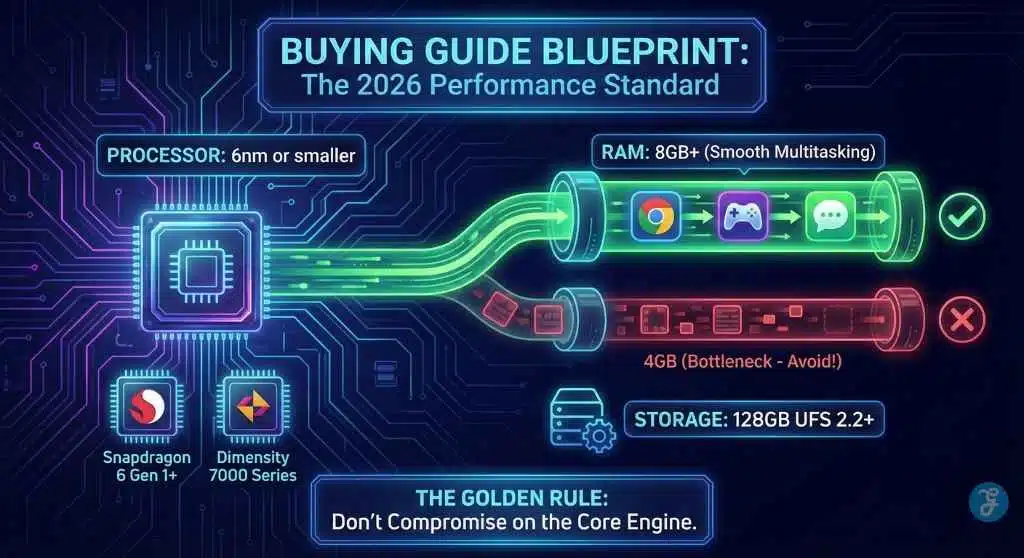
1. The Processor: Don’t settle for less than 6nm
The “brain” of the phone dictates how long it will last.
-
Look for: Qualcomm Snapdragon 6 Gen 1 or newer, Snapdragon 7s Gen 2, MediaTek Dimensity 7000/8000 series.
-
Avoid: Older chips like the Snapdragon 680 or Helio G99 (these are 4G chips often rebranded). If a phone lags out of the box, it will be unusable in a year.
2. RAM and Storage: The 8GB Standard
In 2024, 4GB of RAM was acceptable. In 2026, it is not.
-
The Golden Rule: 8GB RAM / 128GB Storage is the absolute minimum.
-
Apps today are heavier, and Android requires more memory to run smoothly. A 4GB RAM phone will struggle to keep two apps open simultaneously. Also, ensure the storage is UFS 2.2 or faster (avoid eMMC 5.1, which is painfully slow).
3. Display: OLED is King
We are finally in the era where cheap LCD panels are disappearing.
-
Why OLED/AMOLED? It offers perfect blacks and saves battery. LCD screens look gray in the dark and drain more power.
-
Refresh Rate: Ensure it is at least 90Hz (120Hz is preferred). This makes animations and scrolling look smooth. A 60Hz screen in 2026 will feel jittery and old-fashioned.
4. Battery & Charging: Speed Matters
A big battery (5,000mAh) is standard, but charging speed varies wildly.
-
The Sweet Spot: Look for at least 25W or 30W charging. This ensures you aren’t tethered to the wall for 2 hours.
-
Charger in the Box: Be warned, Samsung and Google (and increasingly others) do not include a charger in the box. You may need to budget an extra $20 for a block.
5. Software Updates: The Hidden Value
This is often overlooked. A $200 phone that lasts 4 years is cheaper than a $150 phone you have to replace in 18 months.
-
Best: Samsung (4-6 years) and Google (7 years).
-
Okay: Nothing, Xiaomi (3 years).
-
Poor: Motorola, many entry-level brands (often only 1 major update).
Frequently Asked Questions (FAQ)
Is 5G actually worth it on a cheap phone?
Yes, absolutely. In 2026, 4G networks are becoming congested as carriers prioritize 5G infrastructure. A 5G phone ensures you get faster data speeds and better reception in crowded areas like concerts or stadiums. It’s also crucial for resale value; a 4G-only phone is virtually unsellable today.
Which affordable phone has the best camera?
The Google Pixel 9a. It’s not even close. While phones like the Redmi Note 14 Pro have higher megapixels (200MP), Google’s image processing software produces photos with better dynamic range, color accuracy, and low-light performance. Megapixels aren’t everything.
Do these phones come with chargers?
It’s a mixed bag. Samsung and Google generally do not include chargers in the box. OnePlus, Motorola, POCO, and Xiaomi usually include fast chargers. Always check the “In the Box” section before buying.
Can these budget phones handle gaming?
Yes, but with limits. Phones like the POCO M7 and OnePlus Nord CE5 can handle competitive games like Call of Duty or Mobile Legends at Medium to High settings. However, for ultra-demanding titles like Genshin Impact or Warzone, you may need to lower graphics settings to keep the phone cool.
What is the difference between the Galaxy A17 and A56?
The A56 ($449) has a faster processor (better for gaming), a glass back (feels more premium), better cameras (especially ultrawide), and water resistance (IP67). The A17 ($199) is plastic, slower, and lacks water resistance, but still has a great screen and battery for basic daily tasks.
Final Thoughts: The Golden Age of Budget Tech
The “Best Affordable 5G Phones in 2026” list proves that we have entered a golden age for budget technology. The days of suffering with a slow, pixelated, plastic brick just to save money are over. Today, spending $200–$450 gets you a device with a stunning screen, a battery that outlasts a flagship, and cameras capable of capturing professional-quality memories.
If you want our final advice: Don’t overspend on features you won’t use. If you just browse the web and text, the Galaxy A17 is a miracle of value. If you want to create content, the Pixel 9a is a pocket studio. Choose the tool that fits your life, and enjoy the savings.
Ready to upgrade? Check the latest prices on Amazon or your local carrier, deals in early 2026 are moving fast!