

There is a romantic allure to the Australian beach house—the open doors, the salty breeze, and the sound of the ocean. But for your timber floors and decks, that same environment is a relentless assault. If you own a property near the water, you likely already know that standard maintenance rules simply don’t apply here. The combination of abrasive silica sand and salt-laden humidity creates a unique set of challenges that can destroy a standard floor finish in less than two years. Beach House Floor Maintenance Australia is not just about cleaning; it is about strategic defense.
Whether you are battling “tea staining” on your stainless steel fittings, scratches from tracked-in sand, or the dreaded cupping of floorboards due to humidity, this guide explores the latest industry standards for protecting your coastal investment.
We move beyond generic advice to look at the specific products and methods—like “sacrificial” oiling and flexible polyurethanes—that Australian architects and timber pros are using right now.
Key Takeaways
-
Avoid “Film” Finishes Outdoors: Traditional paints and varnishes trap moisture and peel in salt air. Use penetrating oils (like Cutek) that fade rather than flake.
-
The “Poly” vs. “Oil” Choice: For interiors, water-based polyurethane (Bona Traffic HD) offers the best armor for rentals, while Hardwax Oils (Whittle Waxes) allow for invisible spot repairs in owner-occupied homes.
-
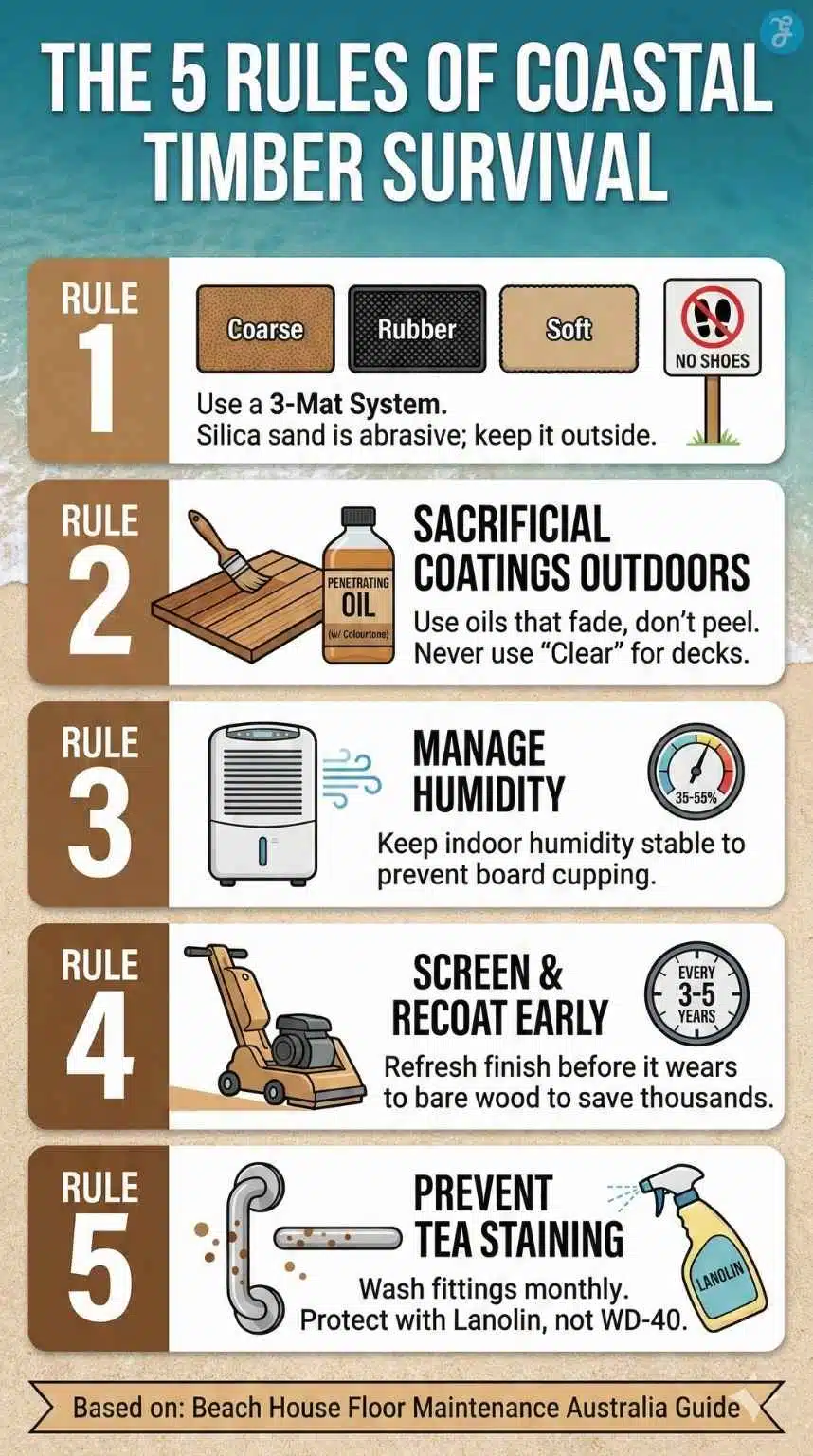
Stop Sand at the Gate: Implementing a 3-mat entry system is the single most effective way to prolong your floor’s life.
-
Tea Staining is preventable: That brown rust on your stainless steel isn’t permanent corrosion; it’s surface salt buildup. Wash it and seal it with Lanolin, not standard oil.
-
Humidity Management: Timber is hygroscopic; keep indoor humidity between 35-55% where possible to stop boards from cupping.
The Science of Coastal Decay: Why Standard Finishes Fail
To understand how to protect your floors, you first need to understand the enemy. In Australian coastal regions—from the humid tropics of Queensland to the surf coasts of Victoria—timber faces two primary threats: Hygroscopic Expansion and Chemical Breakdown.
Wood is a “hygroscopic” material, meaning it breathes. It absorbs moisture from the air and releases it. In a city home, humidity fluctuations are minor. In a coastal home, humidity can swing from 40% to 90% in a single day. When this happens, your timber floorboards swell and contract significantly.
If you have covered your floor in a rigid, old-school solvent-based polyurethane (the “glassy” look), that coating cannot stretch. As the wood expands, the finish cracks. Once cracked, salt air penetrates the timber fibers, crystallizing inside the wood cells and physically breaking them apart. This is why you often see grey, weathered patches on beach house floors, even when the finish looks intact from a distance.
Interior Floors: The Great Finish Debate
When refinishing interior timber floors in a beach house, you generally have two modern choices. Both are excellent, but they serve very different lifestyles.
Option 1: Water-Based Polyurethane (The “Rental Defense”)
For holiday rentals or high-traffic homes, a 2-pack water-based polyurethane is the gold standard. Unlike the old solvent-based finishes that turn yellow (ambering), modern water-based poly is clear and non-yellowing.
-
The Product to Watch: Bona Traffic HD or Loba 2K Invisible Protect.
-
Why it works: These are “flexible” finishes. They are chemically engineered to stretch slightly with the timber, preventing the micro-cracking common in coastal homes.
-
The Finish: Always choose Matte or Satin. Never use Gloss in a beach house. Gloss acts like a magnifying glass for every single scratch caused by sand. Matte finishes absorb light and hide imperfections.
Option 2: Hardwax Oils (The “Owner’s Choice”)
This is the darling of modern Australian coastal design. Instead of sitting on top of the wood like a plastic sheet, hardwax oils soak into the timber and harden within the fibers.
-
The Product to Watch: Whittle Waxes, Osmo, or Fiddes.
-
Why it works: Because there is no plastic skin on top, the wood feels like real wood. More importantly, it is spot-repairable. If you drag a sandy surfboard across the floor and make a scratch, you don’t need to sand the whole room. You simply rub a little oil into the scratch with a cloth, and it disappears.
-
The Catch: It requires maintenance. You will need to apply a “maintenance oil” or refresher coat every 12-18 months.
Option 3: Eco-Friendly & Low-VOC
Many Australian beach houses are designed to be closed up for weeks at a time. If you use high-solvent finishes, those toxic fumes (VOCs) get trapped inside, creating a “sick house” smell that greets you when you arrive for your holiday.
-
Go Low-VOC: Modern water-based polyurethanes (like Bona or Loba) and plant-based oils (like Whittle Waxes) have extremely low Volatile Organic Compounds.
-
The “Holiday” Test: With a solvent-based finish, you cannot sleep in the house for at least 7 days. With a low-VOC water-based finish, you can often sleep in the house 24 hours after the final coat. For holiday homes where time is precious, this is a massive advantage.
Quick Comparison: Which One Is For You?
| Feature | Water-Based Polyurethane (e.g., Bona) | Hardwax Oil (e.g., Osmo/Whittle) |
| Best For | Holiday Rentals & Families with Kids | Owner-Occupiers & Design Lovers |
| Durability | High (Forms a protective shell) | Moderate (Relies on saturation) |
| Sand Resistance | High, but scratches show as white lines | Scratches blend in and are less visible |
| Repairability | Low (Must resand entire floor) | High (DIY spot fix in minutes) |
| Maintenance | Low (Mop and go) | Medium (Annual top-up oiling) |
| Look & Feel | Coated, smooth | Natural, textured timber feel |
The “Sand-Trap” Strategy: Stopping Damage at the Door
The single biggest destroyer of beach house flooring is silica sand. Australian beach sand is high in silica, which is the exact same material used to make sandpaper. Walking on a timber floor with sandy shoes is literally sanding your finish off.
Architects now recommend a 3-Mat System to mechanically remove sand before it touches the timber:
-
The Crusher (Outside): A coarse coir or stiff-bristle mat. Its job is to dislodge large grit and sand particles from the tread of shoes.
-
The Scraper (Threshold): A rubber or heavy-duty synthetic mat with deep grooves. This traps the medium-sized particles that the first mat loosened.
-
The Absorber (Inside): A soft, long-fiber runner or cotton mat. This removes the fine dust and, crucially, the salt moisture.
Pro Tip: Shake these mats out weekly. If the mats are full of sand, they become abrasive themselves.
Exterior Decking: The “Sacrificial Coat” Rule
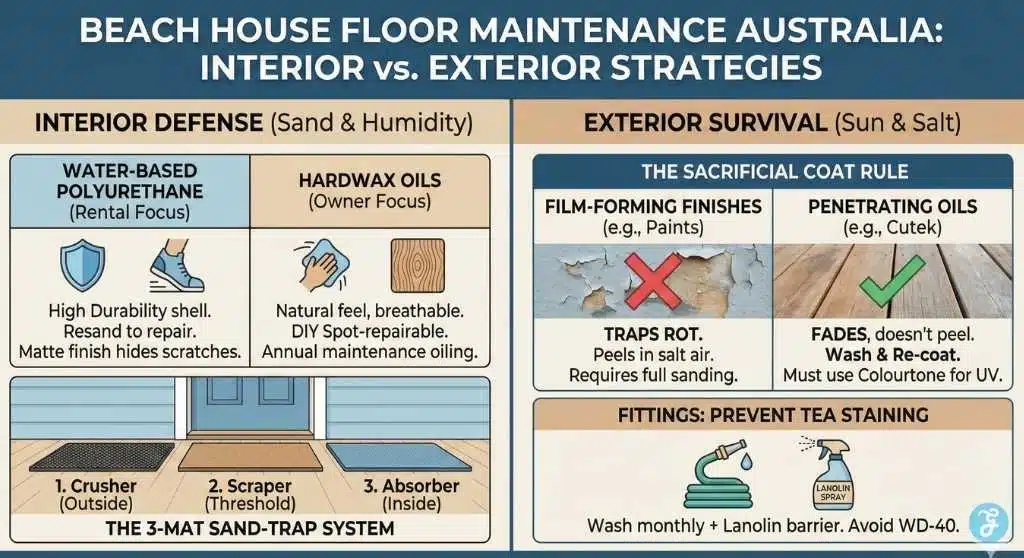
If you have a Spotted Gum, Merbau, or Blackbutt deck, do not, under any circumstances, paint it with a film-forming acrylic stain. The Australian sun breaks down the bond between the paint and the wood, and the salt air gets underneath, causing it to peel. Once it peels, you have to sand the entire deck back to bare wood to fix it.
The Solution: Penetrating Oils
In the industry, we call modern decking oils “sacrificial coatings.” They are designed to slowly fade away over 6-12 months rather than peeling.
-
The Product to Watch: Cutek Extreme CD50. This is widely considered the benchmark for Australian coastal decks. It is an oil that migrates deep into the wood, providing stability from the inside out. Intergrain UltraDeck is a great water-based alternative if you need faster drying times.
-
The “Clear” Myth: Never use “Clear” oil on an exposed deck. Clear oil has zero UV protection. Your beautiful red Merbau deck will turn grey in 3 months. You must add a “Colourtone” (tint). The pigment acts as a sunscreen for the wood. For a natural look, use a “Grey Mist” or widely available “Natural” tint—it adds just enough pigment to block UV without painting over the grain.
The Termite Connection: Sand & Subfloors
It is impossible to discuss coastal timber without mentioning termites. Australian coastal soils are often sandy, which Subterranean Termites love because it is easy to tunnel through.
-
The Trap: When you sand and oil a deck, you often create a “moisture shadow” underneath it—the top is dry, but the soil underneath stays damp.
-
The Fix: While refinishing your deck, ensure you aren’t piling mulch or garden beds up against the sub-floor posts.
-
Inspection: Refinishing is the perfect time to check for “mud tubes” on your stumps. If you find termite damage during a floor sanding, stop immediately. Do not vibrate the floor with heavy sanders until a pest controller has treated the active nest, or you risk spreading them.
The “Screen and Recoat” Secret (How to Save Thousands)
One of the best-kept secrets in Beach House Floor Maintenance Australia is that you don’t always need to sand your floors back to bare timber. If you catch the wear early enough, you can opt for a “Screen and Recoat.”
-
What is it? Instead of using heavy drum sanders to strip the wood raw (which removes 1-2mm of your precious timber), a professional uses a fine abrasive mesh to remove just the top layer of dirt and old coating. They then apply a fresh topcoat.
-
The Benefit: It costs about half the price of a full sand, generates 90% less dust, and takes half the time.
-
The Coastal Rule: In a beach house, you should aim to Screen and Recoat every 3–5 years. If you wait until the finish has worn through to the grey wood, it’s too late—you’ll have to pay for a full sand.
Budgeting for your Refinish: Australian Cost Guide
A major part of maintenance is knowing when to DIY and when to call a professional. Refinishing floors is labour-intensive, and prices in Australia vary by state (Sydney and Melbourne tend to be higher than regional areas).
Here is a realistic breakdown of what you should expect to pay for professional services in Australia.
| Service | Estimated Cost (Per m²) | Notes |
| Floor Sanding & Polishing | $30 – $60 | Covers standard sanding + 3 coats of solvent or water-based poly. |
| Premium / Non-Toxic Finish | $45 – $75 | Higher cost for premium commercial-grade water-based finishes (e.g., Bona Traffic). |
| Deck Sanding Only | $25 – $40 | Removing old paint/stain to get back to bare timber. |
| Deck Restoration (Sand + Oil) | $50 – $100 | Full service: punching nails, sanding, washing, and 2 coats of oil. |
| Staircases | $50 – $100 per step | Stairs are labour-intensive and usually quoted per tread, not per metre. |
DIY Note: You can hire a drum sander for roughly $80-$100 per day from Bunnings or Kennards, but be warned: drum sanders can gouge soft coastal timbers if you aren’t experienced. For a high-value beach house, professional sanding is usually the safer investment.
Preventing “Tea Staining” on Fittings
Have you noticed brown, rust-like spots on your stainless steel balustrades or door handles? This is called “tea staining.” It is not structural rust (yet), but a buildup of salt crystals that are corroding the surface layer of the steel. Even Marine Grade 316 Stainless Steel will tea stain if not maintained.
The Maintenance Routine:
-
Fresh Water Wash: Wash your external fittings with fresh water (hose them down) once a month. This dissolves the salt crystals.
-
Lanolin Protection: Do not use WD-40; it evaporates too quickly in the heat. Use a Lanolin-based spray (derived from sheep’s wool grease), such as Lanotec. It leaves a natural, waxy film that is incredibly resistant to salt spray.
Maintenance Checklist for Australian Coastal Homes
Keeping a beach house in top condition requires a seasonal rhythm.
| Frequency | Task | Method |
| Weekly | Vacuum (Suction Only) | Use a vacuum with a soft-bristle head. Avoid beater bars (rotating brushes), which can whip sand into the finish. |
| Monthly | Wash Balustrades | Hose down exterior stainless steel and glass to prevent salt buildup and tea staining. |
| Seasonally | Inspect “Traffic Paths” | Check the high-traffic areas (hallways, kitchen). If they look dull, it’s time for a “clean and buff” before the finish wears through to the wood. |
| Annually | Oil the Deck | Apply a fresh coat of penetrating oil (like Cutek) in Spring. No sanding needed—just a wash and a coat. |
| Every 5-7 Years | Screen and Recoat | For polyurethane floors, have a pro “screen” (lightly sand) the floor and apply one fresh topcoat. This delays a full re-sand for decades. |
Frequently Asked Questions (FAQs)
1. Can I use a steam mop on my beach house timber floors?
Absolutely not. This is the quickest way to destroy a floor in a humid environment. The steam forces moisture deep into the cracks of the timber. Since the wood is already dealing with high coastal humidity, this extra thermal shock causes boards to cup (curl up at the edges) and the finish to turn milky (blush). Stick to a slightly damp microfiber mop with a pH-neutral cleaner.
2. My deck is already grey and weathered. Do I have to sand it?
Not necessarily. If you use a high-strength timber cleaner (like Reviva or Cutek Proclean), you can often scrub away the grey oxidized layer to reveal the fresh timber underneath without aggressive sanding. However, if the wood is splintering, a light sand is recommended before oiling to smooth the surface.
3. What is the best timber species for Australian coastal homes?
Spotted Gum and Blackbutt are the reigning champions. They are high-density Australian hardwoods that are naturally resistant to termites and fire (BAL rated). They are also oily woods, which helps them resist drying out in the salt air. Avoid softwoods like Pine for decking unless they are H3/H4 treated and diligently maintained.
4. Why does my floor look rippled (cupping)?
This is a classic sign of moisture imbalance. The bottom of the boards (subfloor) might be wetter than the top, or the room humidity is too high. In coastal homes, this often happens if the house is locked up for weeks with no ventilation. Running a dehumidifier or ensuring good cross-ventilation when the house is empty can help the boards settle back down.
5. How do I fix a deep scratch from a fridge or furniture?
If you have a Hardwax Oil floor, you can sand just that small rectangle of wood and re-oil it—it will blend in perfectly. If you have a Polyurethane floor, you cannot spot-repair it seamlessly. You can try a “timber crayon” or wax stick from Bunnings to hide the color difference, but to fix the surface finish properly, the whole room usually needs a recoat. This is why felt pads on furniture legs are non-negotiable!
Final Thought
Refinishing a beach house is less about fighting nature and more about working with it. By choosing flexible, breathable finishes like Bona Traffic HD or Hardwax Oils for your interiors, and “sacrificial” penetrating oils like Cutek for your decks, you stop the cycle of peeling and scraping.
Remember the golden rule of Beach House Floor Maintenance in Australia: Sand and salt are abrasive. If you can keep the sand outside with a 3-mat system and keep the wood nourished with the right oils, your coastal timber will age gracefully into that silver-grey driftwood look, rather than rotting away.





























