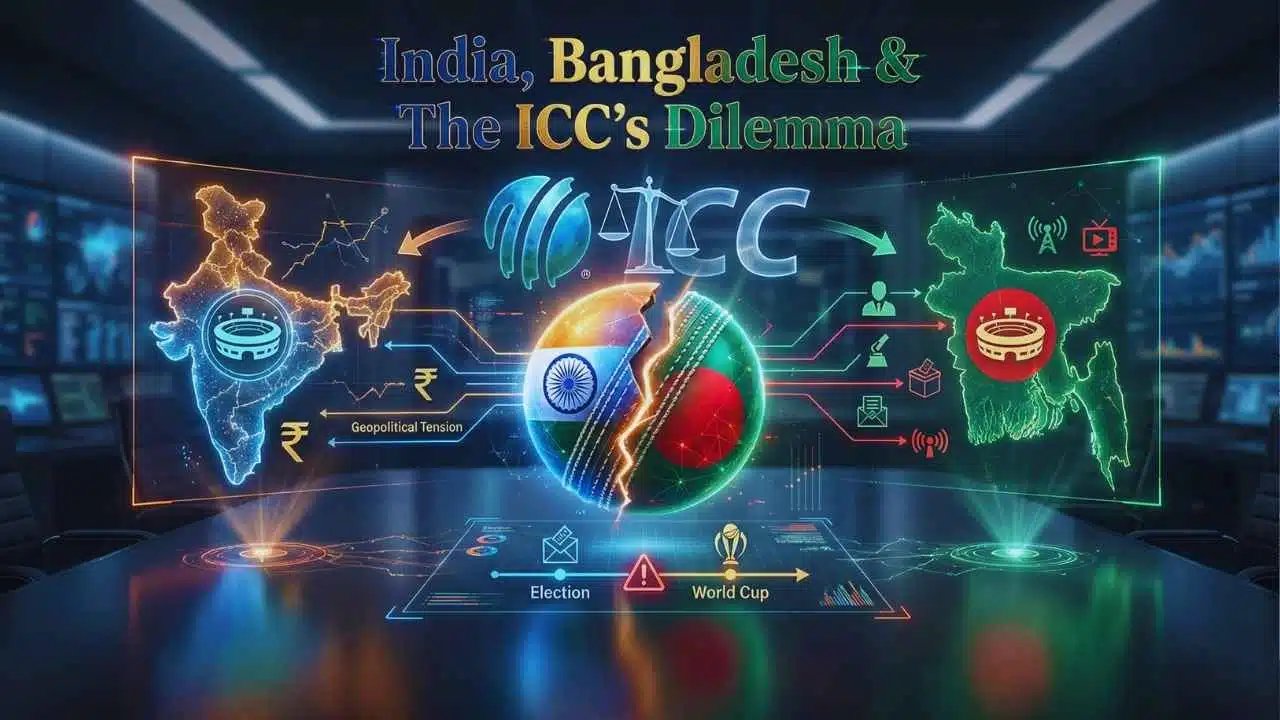
Bangladesh’s attempt to shift its 2026 Men’s T20 World Cup matches out of India began as a safety claim. It has since evolved into something bigger: a test of how international cricket is governed when politics, public sentiment, and commercial power collide.
The flashpoint was unusually specific. Bangladesh fast bowler Mustafizur Rahman was released from Kolkata Knight Riders after being bought at the IPL auction, a move widely reported as tied to Board of Control for Cricket in India (BCCI) intervention. Dhaka reacted with a symbolic counterpunch, a broadcast ban on the IPL. Then came the escalation: Bangladesh would not travel to India for its World Cup group matches, and asked the ICC to relocate those fixtures to co-host Sri Lanka.
Within days, media in India reported the ICC had rejected Bangladesh’s request, saying there was no credible security red flag, and warning non-travel could mean forfeiting points. Even if the reporting is only partially accurate, the broader signal is clear. A dispute involving a single player’s franchise contract has become the pretext for a state-backed challenge to the idea that sport can be insulated from geopolitics in South Asia.
What makes this moment especially consequential is timing. The tournament starts on February 7, 2026. Bangladesh’s parliamentary election is scheduled for February 12, 2026. Security anxieties are not theoretical in an election cycle, and both governments know that public sentiment can outrun diplomacy.
This is why the Bangladesh T20 Venue Dispute matters. It is a referendum on three things at once: the credibility of “security” as a diplomatic argument, the ICC’s willingness to apply hybrid hosting rules consistently, and the degree to which India’s centrality to cricket’s finances shapes everyone’s options.
How We Got Here: From Domestic Turbulence To Cricket Diplomacy?
The immediate chain of events is short. The deeper context is not.
Since the political transition in Bangladesh after 2024, Dhaka’s relationship with New Delhi has carried more friction, more suspicion, and more domestic political salience. India is not just a neighbor. It is also Bangladesh’s largest regional market link, a security partner in some files, a rival in others, and a permanent reference point in Bangladeshi politics.
Cricket, in that environment, stops being just entertainment. It becomes a low-cost way to send high-visibility signals.
Here is the key sequence that turned background tension into a tournament controversy.
| Date | What Happened | Why It Shifted The Story |
| Aug 2024 onward | Bangladesh enters a high-volatility political period, with persistent street pressure and competing legitimacy claims | Sports events become easier to politicize, especially against a powerful neighbor |
| 2025 | Human-rights monitors report heightened violence, including mob violence and political clashes | “Safety” arguments gain domestic credibility, even when applied selectively |
| Late 2025 to early 2026 | A killing involving a Hindu worker triggers protests and inflames cross-border narratives | Minority protection becomes part of bilateral rhetoric and media framing |
| Early Jan 2026 | Mustafizur is released by KKR after being purchased at the auction | A cricket decision is recast as national humiliation in Bangladesh |
| Jan 2026 | Bangladesh bans IPL broadcasts, then requests ICC to move World Cup matches out of India | A consumer and media lever is turned into a diplomatic lever |
| Jan 2026 | Indian media reports ICC refuses venue change | The standoff shifts from “request” to “compliance versus consequence” |
Two points stand out.
First, Bangladesh did not choose a neutral venue request in a vacuum. The ICC already built a political accommodation into the 2026 tournament design by scheduling Pakistan’s matches in Sri Lanka. Once that exists, other teams will ask: if a hybrid solution is legitimate for one geopolitical rivalry, why not for another dispute that claims security risk?
Second, Bangladesh’s moves were not only about India. They were also about domestic positioning. In a heated election period, governments often find it easier to appear strong against external pressure than to negotiate quietly and be accused of weakness. Cricket provides the perfect stage for that performance because the audience is massive and emotionally invested.
Why The Bangladesh T20 Venue Dispute Became A Security Argument Overnight?
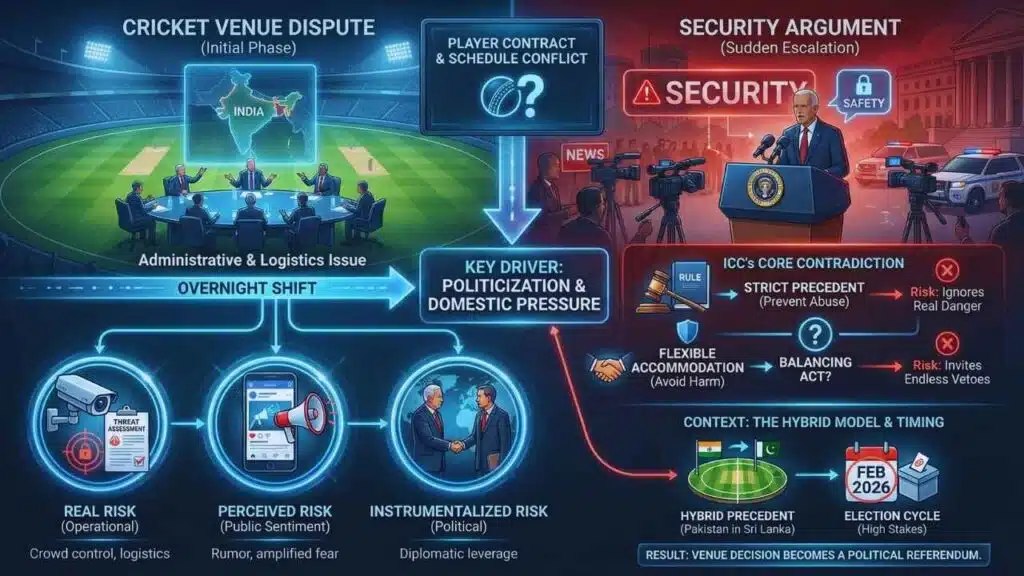
A useful way to read this crisis is to separate “security” into three layers.
- Real operational risk. Any touring team evaluates crowd control, threat levels, travel logistics, and policing. Big tournament hosts do this constantly.
- Perceived risk. In politically tense moments, a player’s family worries, social media amplifies threats, and rumor becomes “risk” even without intelligence confirmation.
- Instrumentalized risk. Governments use “safety” language because it is internationally legible. It sounds responsible, not political.
Bangladesh’s official framing leaned heavily on the third layer, while drawing credibility from the second.
The challenge for the ICC is that it cannot accept “perceived risk” alone as a reason to redraw a schedule a month before a World Cup. If it did, any bilateral dispute could become a de facto veto over venues. That would create a permanent incentive for political actors to manufacture or amplify fear right before tournaments.
But the ICC also cannot dismiss “safety” too casually. If something goes wrong after an explicit warning from a member board, the reputational damage to the ICC is enormous.
That produces the core contradiction: the ICC must be strict enough to prevent precedent abuse, but flexible enough to avoid being blamed for foreseeable harm.
This is the competing logic in simplified form.
| Actor | Public Claim | Underlying Incentive | Red Line |
| Bangladesh government and board | Players’ safety cannot be guaranteed | Signal sovereignty, respond to domestic outrage, avoid political backlash | Do not appear to accept “insult” or risk player harm |
| India’s cricket establishment | Schedule integrity and logistics must be protected | Preserve hosting credibility, avoid giving other teams a playbook | No new “hybrid” carve-outs beyond what is already agreed |
| ICC | Decisions must be risk-based and consistent | Protect tournament governance and commercial stability | Avoid setting a precedent that invites endless venue challenges |
There is also an unstated factor: the ICC chairmanship and perception of neutrality. When the ICC leadership is seen as closely connected to the most powerful cricket market, even a technically sound decision can be interpreted as politically biased. That perception alone can harden positions.
Tournament Architecture: The Hybrid Model Was Designed For Politics, Not Just Logistics
The 2026 Men’s T20 World Cup is co-hosted by India and Sri Lanka, with matches spread across multiple venues. It is a format built for scale and travel efficiency. It is also built for geopolitics.
The clearest proof is Pakistan’s allocation to Sri Lanka. Tournament planners anticipated that India–Pakistan political constraints would shape venue feasibility, and they designed around that.
Bangladesh’s request effectively asked the ICC to broaden the hybrid principle beyond India–Pakistan. In other words, Bangladesh argued: if a major geopolitical constraint already dictates venue decisions, then Bangladesh’s own constraints should also be accommodated.
Bangladesh’s group-stage schedule, as published, places three matches in Kolkata and one in Mumbai. That matters because Kolkata is emotionally charged in Bangladesh–India narratives due to shared Bengali identity, migration politics, and symbolic proximity. If any venue becomes a proxy battlefield for national sentiment, Kolkata is an obvious candidate.
Here is the practical footprint Bangladesh wanted changed.
| Bangladesh Group Match | Date | Scheduled Venue | What A Shift Would Break |
| Bangladesh vs West Indies | Feb 7, 2026 | Kolkata | Ticketing, broadcast plans, team hotel blocks, security planning |
| Bangladesh vs Italy | Feb 9, 2026 | Kolkata | Same as above, plus Italy’s logistics |
| Bangladesh vs England | Feb 14, 2026 | Kolkata | Higher-profile match, bigger commercial stakes |
| Bangladesh vs Nepal | Feb 17, 2026 | Mumbai | Different city policing plan and different local ticket markets |
At a month-to-go horizon, moving these fixtures is not impossible, but it is costly and disruptive. It affects not only Bangladesh. It affects opponents, broadcasters, sponsors, venue operators, and fans who already planned travel.
The deeper governance question is more important than the logistics: who gets to trigger a hybrid override? If Pakistan’s relocation is treated as exceptional, the ICC can claim it is a one-off. If Bangladesh also gets an override, the ICC must define a rule, and that rule becomes a tool in every future dispute.
The Money Layer: Cricket’s Financial Gravity Makes Neutral Governance Harder
Cricket governance is often described as rule-based. In reality it is also revenue-based.
Three financial facts shape the ICC’s risk tolerance:
- The ICC’s audited 2024 financials show a very large surplus, driven heavily by event economics.
- The BCCI’s audited financials show India’s domestic cricket economy is in a different universe from most members.
- The IPL media-rights deal sets the commercial tone of the sport, and countries respond to that gravity.
When Bangladesh banned IPL broadcasts, it was not only a political signal. It was a reminder that fan markets can be used as pressure points, even if only temporarily.
Here is the money map that sits behind the current standoff.
| Money Indicator | Reported Value | Why It Matters In This Dispute |
| ICC net surplus (year ending Dec 31, 2024) | $474.0 million | Incentive to protect tournament stability and avoid disruptions that threaten broadcast value |
| BCCI total income (FY ending Mar 31, 2024) | ₹9,741.71 crore | Demonstrates the scale of India’s cricket economy and its leverage in the ecosystem |
| IPL contribution to BCCI income (FY 2023–24) | ₹5,761 crore | Explains why IPL-related disputes trigger outsized political and media reactions |
| IPL media rights (2023–27 cycle) | ₹48,390 crore | Reinforces that the sport’s commercial center of gravity is India |
This financial structure creates an uncomfortable dynamic. The ICC must appear neutral, but the economic incentives often align with protecting India-hosted events from disruption because those events are seen as commercially critical.
That does not mean ICC decisions are “bought.” It means the system is built so that the cost of displeasing the biggest market feels higher than the cost of displeasing a smaller one. In any governance system, incentives shape behavior.
Bangladesh’s leadership likely understood this, which is why the venue request was paired with symbolic escalation (the IPL broadcast ban). It was an attempt to increase the cost of ignoring Dhaka.
The Bilateral Friction Map: Cricket Became The Arena For Longstanding Disputes
If this controversy were only about one player’s IPL status, it would have cooled quickly. It did not, because it landed on top of older and unresolved issues in India–Bangladesh relations.
Several files regularly inflame domestic politics on both sides:
- border deaths and border management disputes
- water sharing and the looming timeline around existing arrangements
- trade frictions and logistics restrictions
- narratives around minority protection and political legitimacy
In late 2025, rights monitors in Bangladesh reported sharply higher levels of mob violence and political violence. Separately, rights reporting on border killings remained a sensitive issue in Bangladesh’s public debate. These factors shape the emotional plausibility of “we do not feel safe,” even if the immediate security question is about travel to India.
Here is a compact view of the broader friction environment.
| Issue Area | What’s Driving Tension | Why It Amplifies The Venue Dispute |
| Domestic stability in Bangladesh | Election pressure, violence concerns, contested legitimacy | Governments become less willing to appear conciliatory toward India |
| Border management | Longstanding allegations and recurring incidents | “Safety” narratives travel easily across issues |
| Water sharing | Persistent disputes and negotiation pressure points | Adds another layer of distrust in the relationship |
| Trade and transit | Periodic restrictions, fee disputes, and connectivity politics | Creates a backdrop of “retaliation logic” that cricket can mirror |
| Minority protection narratives | High salience in media and protests | Turns cricket travel into a symbolic referendum on identity politics |
Key Statistics Readers Should Track
- Bangladesh parliamentary election date: February 12, 2026
- 2026 Men’s T20 World Cup dates: February 7 to March 8, 2026
- Bangladesh group-stage venues: 3 matches in Kolkata, 1 in Mumbai
- Reported mob violence deaths in Bangladesh (2025): 197
- Reported border killings (Bangladesh nationals, last decade): 296
- ICC net surplus (year ending Dec 31, 2024): $474.0 million
- BCCI total income (FY 2023–24): ₹9,741.71 crore
The election timing is especially important. Bangladesh is asking the public to accept a major international tour right as domestic politics reaches peak intensity. That is exactly when fringe actors can try to provoke incidents, and when governments become most risk-averse.
Winners, Losers, And The Real Stakeholders In A Venue Standoff
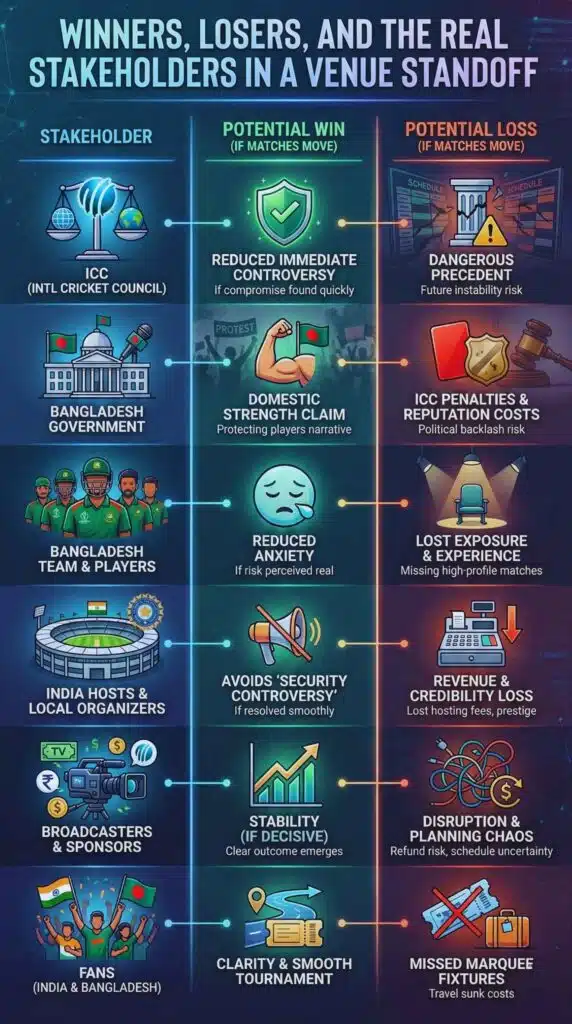
A venue dispute looks like a fight between boards. In reality, it redistributes costs and benefits across multiple stakeholder groups, some of whom have no vote.
The ICC’s biggest fear is not that Bangladesh complains. It is that the tournament’s predictability collapses. Broadcasters and sponsors pay premiums for certainty. Fans plan travel. Teams plan performance cycles. Once schedule certainty is weakened, the commercial value of future hosting rights can erode.
Bangladesh’s biggest fear is not only security. It is domestic backlash. If something happens to players abroad, political consequences at home can be severe. If the government appears to “bow” to external pressure, it can also be punished politically, especially in an election environment.
Here is the incentive landscape in plain terms.
| Stakeholder | What They Gain If Matches Move | What They Lose If Matches Move |
| Bangladesh government | Claims of protecting players, domestic strength narrative | Potential ICC penalties, reputational costs in sport governance |
| Bangladesh team and players | Reduced anxiety if they believe risk is real | Lost high-profile exposure and competitive experience in India |
| ICC | Reduced immediate controversy if compromise found | Dangerous precedent for future disputes and tournament instability |
| India hosts and local organizers | Avoids “security controversy” narrative if resolved smoothly | Loss of matches, revenue, and hosting credibility if matches moved |
| Broadcasters and sponsors | Stability if a single decisive outcome emerges | Disruption, refund risk, and planning chaos |
| Fans (India and Bangladesh) | Clarity and a tournament that runs smoothly | Loss of marquee fixtures in specific cities and travel sunk costs |
If reports are accurate that the ICC rejected Bangladesh’s request, then the immediate distribution of costs shifts again. Bangladesh must choose between compliance (and the domestic political cost) or escalation (and the sporting cost).
Expert Perspectives: Two Competing Readings Of The Crisis
You can interpret the Bangladesh T20 Venue Dispute in two ways, and both have logic.
Reading One: This Is Mostly Domestic Politics, Not Real Threat Intelligence
Under this view, Bangladesh’s leadership used “security” as a diplomatic language to justify a political signal. The player dispute and IPL broadcast ban show the conflict is rooted in emotion, sovereignty, and public messaging more than operational risk.
Supporters of this reading point to the ICC’s reported conclusion that there is no credible security red flag. They argue that if the ICC’s risk assessments do not support relocation, then accepting Bangladesh’s claim would effectively reward politicization.
Reading Two: The ICC Is Underestimating How Quickly Perception Becomes Risk
Under this view, you do not need an “official threat” for danger to become real. If public sentiment is inflamed, if online threats spike, if protests intensify, and if politics is hot in both countries, then the risk environment can change fast. Teams, especially those with high-profile players, become targets for opportunistic disruption.
Supporters of this reading point to rising violence reporting in Bangladesh’s election climate and broader regional volatility as reasons to take Bangladesh’s concerns seriously, even if intelligence is incomplete.
A neutral synthesis looks like this: Bangladesh’s security claim can be politically motivated and still create a real risk environment, because politicization itself can generate threats. That is the paradox the ICC is trying to manage.
What Happens Next: Scenarios And Milestones To Watch?
If the ICC has in practice rejected Bangladesh’s request, the crisis does not automatically end. It simply moves to the next phase: enforcement, compliance, or escalation.
Here are the most plausible scenarios, ranked from least disruptive to most disruptive.
| Scenario | What It Looks Like | Probability Signal | What To Watch |
| Quiet de-escalation | Bangladesh travels to India with enhanced security coordination | If Dhaka pivots to “security assurances received” language | Any official statement about guarantees or special protocols |
| Partial accommodation | One or two matches moved, or venue swaps within India | If the ICC looks for a face-saving compromise | Sudden venue “logistics adjustments” announced without political framing |
| Standoff with compliance | Bangladesh travels but domestic rhetoric stays aggressive | If Dhaka needs to avoid sporting penalties | Government messaging that separates politics from players |
| Non-travel and forfeits | Bangladesh refuses to tour and accepts sporting consequences | If domestic politics dominates decision-making | Statements from BCB about “principle” and “safety” overriding sport |
| Wider contagion | Other teams cite “precedent” to challenge venues in future events | If the ICC appears inconsistent | Any new venue demands in other tournaments and bilateral series |
The Milestones That Matter
- January 2026: Any formal ICC communication clarifying the decision and consequences.
- February 7, 2026: Tournament begins, meaning the window for schedule changes effectively closes.
- February 12, 2026: Bangladesh election day, which could reshape political incentives overnight.
- Mid-February 2026: Bangladesh’s key group match window, including the higher-profile clash against England.
- Post-tournament 2026: The ICC’s policy response, because the real governance impact often arrives after the immediate crisis.
If Bangladesh ultimately travels, the crisis still changes South Asian cricket. It teaches future actors that venue politics can be activated quickly through a mix of public emotion, media pressure, and symbolic retaliation.
If Bangladesh does not travel, the consequences go beyond a points table. It would normalize the idea that participation in ICC events is conditional on bilateral political comfort, not only on sporting qualification. That is an existential governance challenge for international cricket.
Final Thoughts
The Bangladesh T20 Venue Dispute is a warning about where global cricket is headed. The sport is entering an era where the “hybrid model” is no longer an exception reserved for one rivalry. It is becoming a template that other political disputes can attempt to reuse.
In South Asia, cricket is the loudest language governments can speak to each other without issuing a diplomatic note. That is why a player’s IPL release and a broadcast ban can spiral into a World Cup venue fight. The match locations are no longer just coordinates on a schedule. They are symbols of respect, sovereignty, and leverage.
For the ICC, the long-term task is to create a consistent, transparent standard for when security and politics justify venue shifts. Without that, every tournament becomes a negotiation, and every negotiation becomes a precedent.
For Bangladesh and India, the immediate task is simpler but harder find a way to protect players and fans while preventing cricket from becoming a permanent hostage to election cycles, outrage loops, and bilateral mistrust.