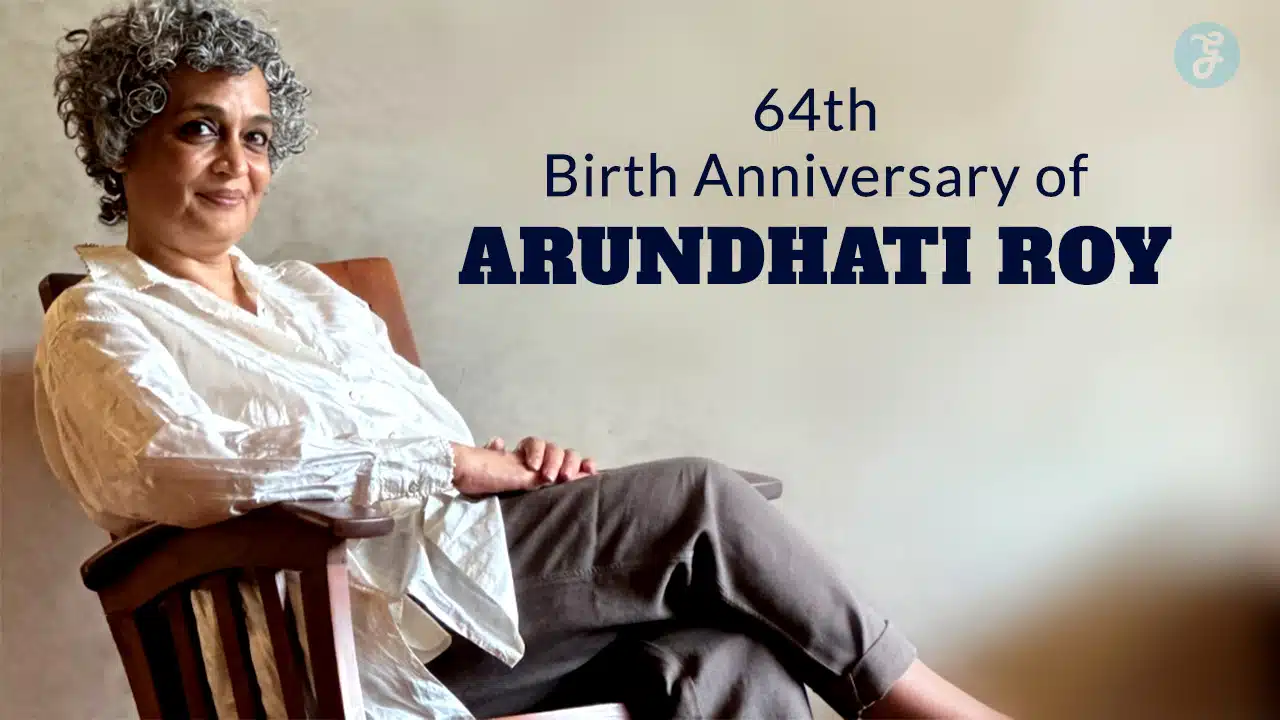
Have you ever wondered what transforms a writer from a literary star into a global voice for justice? You know that feeling when you discover someone who not only writes beautifully but lives boldly? Today is the 64th birth anniversary of Arundhati Roy. It means Arundhati Roy at 63 today.
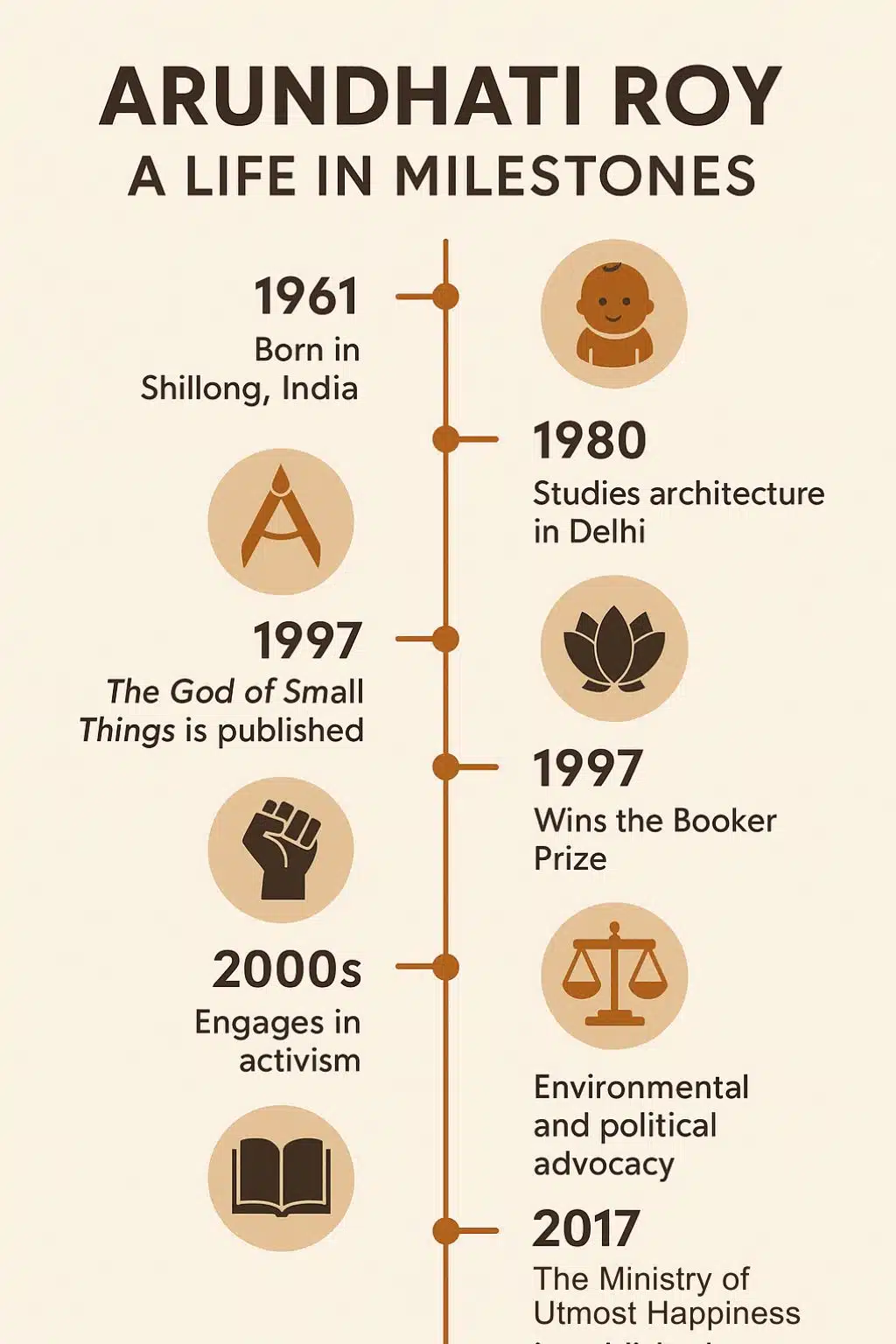
Arundhati Roy at 63 embodies both. She won the Booker Prize in 1997 for The God of Small Things, a novel that sold over 8 million copies worldwide and was translated into more than 40 languages. But her story didn’t end with literary fame. She turned her pen into a tool for activism, speaking out on Kashmir, nuclear weapons, and environmental destruction, even when it put her freedom at risk.
In September 2025, she released Mother Mary Comes to Me, a raw 352-page memoir about her complicated relationship with her mother, Mary Roy. It’s a book born from grief but filled with sharp humor and uncomfortable truths.
Ready to see how one person’s refusal to stay quiet changed both literature and activism? Let’s walk through her journey together.
Key Takeaways
- Arundhati Roy won the Booker Prize in 1997 for The God of Small Things, which became the biggest-selling book by a non-expatriate Indian author, with over 8 million copies sold globally.
- After her literary success, Roy became a fearless political activist, challenging Hindu nationalism, environmental destruction like the Narmada Dam, and nuclear weapons policies.
- She faced legal backlash, including a contempt of court conviction in 2002 and charges in October 2023 and June 2024 over comments on Kashmir’s status under the anti-terror law UAPA.
- In her memoir Mother Mary Comes to Me (released September 2025), Roy explores grief after her mother Mary Roy’s death in September 2022 and reflects on their shared fight for women’s rights.
- Her activism earned her the PEN Pinter Prize in 2024 and recognition as a human rights icon who stands up for minorities and justice worldwide.
Early Life and Background
Arundhati Roy grew up in Shillong, where hills met heavy monsoons and stories danced in every home.
Her mother, Mary Roy, stood tall for inheritance rights for Christian women. She took on the Union of India in court and won a landmark case in 1986 at the Supreme Court. That victory gave Syrian Christian women equal inheritance rights for the first time.
This shaped Arundhati’s fire for justice from a young age.
What was Arundhati Roy’s childhood like in Shillong, Meghalaya?
Life in Shillong threw many challenges at Susanna Arundhati Roy. Born to Mary Roy, a fierce women’s rights activist, and Rajib Roy, her early years were full of changes.
Moving from the lush hills of Meghalaya to Kerala and then Delhi exposed her to many cultures.
The air smelled sweet with pine needles but home life was not always calm. Her parents separated while she was young. Money was tight. She watched her mother fight for inheritance rights for Christian women in India, making their family famous but also lonely sometimes.
School days mixed English lessons with tales about princely states like Manipur and Assam nearby, filling her head with questions about identity and belonging.
At sixteen, she swapped northeastern clouds for Delhi’s busy streets. Independence called out louder than comfort ever could.
Changing her name from Susanna to Arundhati felt like choosing a new path herself, a restlessness that shaped this future Booker Prize writer long before The God of Small Things came alive on paper.
How did Mary Roy influence Arundhati’s views on women’s rights?
Mary Roy fought for justice, even when people called her stubborn.
She founded the Pallikoodam school in Kottayam, Kerala, and ran it with an iron will. According to a 2025 review in The Nation, Mary had to battle her own brother and mother for family property after returning to her father’s abandoned home following her divorce.
Her Supreme Court victory in 1986 shook old traditions in Kerala and across India. Her bold moves lit a fire in Arundhati Roy.
As an Indian author, Arundhati grew up watching Mary challenge unfair rules every day. Their home held endless talk about equality, anger at injustice, grief over lost battles, and laughter after small victories.
Writing books like The God of Small Things or essays such as My Seditious Heart felt natural in that atmosphere.
Stories from their life fill pages of Mother Mary Comes to Me, where grief mixes with fierce pride after Mary’s death in September 2022. Today, Arundhati stands as a political activist for women’s rights because she witnessed courage close up. Her mother showed her how it’s done.
Literary Achievements of Arundhati Roy
Arundhati Roy stunned the world with The God of Small Things. She snatched the Booker Prize and made waves for Indian authors everywhere. The novel earned her a publishing advance of half a million pounds. By the end of June 1997, just weeks after its May release, the book had been sold in 18 countries.
With The Ministry of Utmost Happiness, she painted a vivid picture of pain, hope, and resilience across India’s many fault lines.
What is The God of Small Things and why did it win the Booker Prize in 1997?
The God of Small Things hit bookshelves in May 1997. This debut novel pulled people into the lives of twins growing up in Kerala, India.
Roy used English in new ways, played with time and memory, and spoke about family secrets and caste rules. The story mixed pain with hope using simple yet powerful words.
Judges at the Booker Prize called it fresh and original fiction. Britain’s most important literary award went to this book that year because it broke old molds for Indian writing in English. The citation noted, “The book keeps all the promises that it makes.”
According to a 1998 analysis, The God of Small Things became “the best-selling Booker hardback ever” and sold over 3 million copies by September 1998, with 1 million in Britain and the Commonwealth alone.
Reviews from places like The New York Times praised her voice during India’s economic changes and its fiftieth year of independence too. Winning lifted Roy alongside other famous writers from India as part of a wave that changed how people viewed South Asian literature worldwide.
Roy donated both her Booker Prize money (approximately $30,000) and royalties from the book to human rights causes.
What themes does The Ministry of Utmost Happiness explore?
Identity and belonging take center stage in The Ministry of Utmost Happiness. Arundhati Roy shines a light on people history tends to forget.
The novel takes readers through the crowded streets of Old Delhi, across graveyards, and deep into Kashmir’s conflict zones.
Characters like Anjum, a hijra woman living in a cemetery, show how exclusion shapes lives. Many characters long for home but face walls built by society’s rules.
Roy highlights marginalized groups:
- Muslims facing violence after the Partition of India
- Dalits fighting for dignity
- Queer communities seeking acceptance
- Families torn apart by war in Kashmir
Grief fires their search for love and hope. Stories about the Narmada Bachao Andolan protest or references to Maoist guerrillas give faces and voices to India’s oppressed millions.
At its heart, this book asks if happiness is even possible when injustice sits at your doorstep every day.
Arundhati Roy’s Transition to Activism
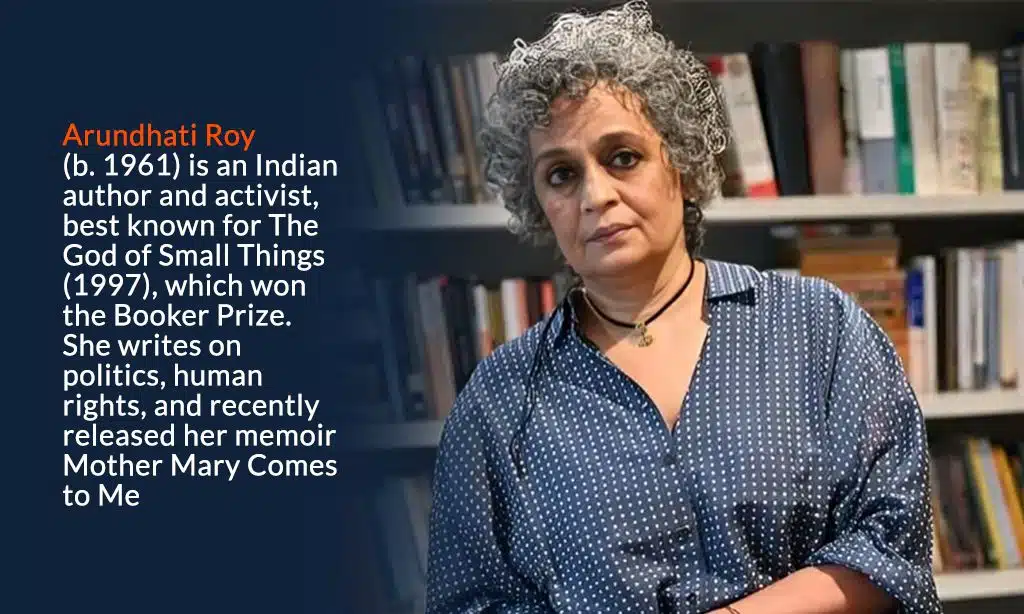
Arundhati Roy did not stay silent after her Booker Prize win. Her sharp pen turned to politics, shaking up debates about the future of India and justice for those left behind.
Critique of nationalism and globalization
Sharp criticism cuts through Roy’s essays, especially after her Booker win in 1997.
She calls out rising Hindu nationalism, often symbolized by slogans like “India Shining,” and questions the steady shift to the right under Prime Minister Narendra Modi and his Bharatiya Janata Party.
Her words do not tiptoe around sensitive issues. She highlights danger when government policies silence Kashmiris or use laws like the Unlawful Activities (Prevention) Act to attack dissent.
Her book The Algebra of Infinite Justice tackles global topics, tearing into America’s War on Terror and its bombing campaign in Afghanistan. Corporate power grabs hidden behind globalization face her scorn as well.
Roy shines a light on how these sweeping changes leave India’s poorest behind while government officials promise progress. She picks apart blind patriotism with biting wit, warning that true justice gets buried when profit matters more than people.
Arundhati Roy fights for people hurt by big projects like the Narmada Dam.
She raises her voice at rallies, writes sharp essays, and stands with activists such as Medha Patkar against the Sardar Sarovar Project. The Narmada dam project threatens villages, forests, and rivers that support tribal families. Roy calls out leaders who ignore their cries for help.
Her work shines a light on:
- Caste bias and discrimination against Dalits
- Poverty and economic inequality
- Religious violence against minorities, especially Muslims in India
- Land grabs forcing eviction of tribal communities
Time after time, Roy uses her platform to argue that progress must never trample human rights or nature’s balance. She urges everyone (leaders and citizens) to protect both soil and society from lasting harm.
Key Advocacy Areas
Arundhati Roy stands firm against projects and policies she sees as unfair or harmful.
She sparks heated debate with her words on the Narmada Dam, the Kashmir conflict, and India’s use of nuclear weapons. Her strong voice for human rights rings out in protests, courts, and books like My Seditious Heart.
Why does Arundhati Roy oppose large dam projects like the Narmada Dam?
Big dams like the Narmada Dam uproot families. Villagers lose their land, homes, and history overnight.
Roy traveled to protest sites along the Narmada River and saw these struggles up close. She spoke with mothers who watched their fields vanish under water and heard children cry as schools disappeared behind concrete walls.
Her essays highlight how thousands of poor farmers and tribal people in India were forced out so cities could have more power or water.
The projects promise progress but ignore nature’s warnings:
- Concrete kills ancient forests
- Fish can no longer swim home
- Whole animal species disappear from flooded lands
- Money meant for help often gets lost in dirty politics, not reaching those left homeless
Roy’s writing brought global attention to these issues. She pushed readers around the world to question if giant dams really solve problems or just drown voices that are easy to ignore.
What is her stance on Kashmir and human rights issues?
Arundhati Roy has always spoken out against Indian government actions in Kashmir.
She calls the region “occupied” and points to crackdowns by police. She highlights curfews and blocked internet access as attacks on human rights.
In 2010, she faced legal action after saying Kashmir was never an integral part of India’s union, sparking outrage among some politicians.
At a 2010 conference, Roy stated: “Kashmir has never been an integral part of India. It is a historical fact. Even the Indian government has accepted this.”
Her words keep echoing. In October 2023, authorities moved to prosecute her for those same comments. Then, in June 2024, Delhi’s Lieutenant Governor VK Saxena granted permission to prosecute her under the Unlawful Activities (Prevention) Act (UAPA), India’s anti-terror law.
She writes about forced disappearances, censorship of journalists, and the pain felt by Kashmiri families living under conflict. Roy stands with activists like Syed Ali Shah Geelani from the Hurriyat Conference who ask for self-determination.
She often draws attention to victims: Muslims caught between militants and soldiers or people jailed under laws like UAPA without fair trial rights. For Roy, peace won’t grow where justice is denied or voices are silenced by power.
How does she criticize nuclear weapons and India’s foreign policy?
Roy fights hard against India’s nuclear program.
She calls nuclear bombs “weapons of mass destruction” and says they only bring fear and danger, not safety. Her essays, like those in The Algebra of Infinite Justice, warn that building more nukes invites disaster, not peace.
During debates on the Pokhran-II tests in 1998, she compared the joy around atomic power to playing with matches near a powder keg.
Her sharp words cut into India’s foreign policy too. She accuses leaders of chasing military glory instead of real security for people.
Roy slams what she sees as blind nationalism growing under Prime Minister Narendra Modi’s government. She criticizes how state power is used to silence dissent or push risky plans abroad. In her writing, she links Osama bin Laden’s rise to CIA actions during the war in Afghanistan, arguing that global superpowers create their own monsters by meddling overseas.
Legal and Social Challenges of Arundhati Roy
Courts and critics have tossed many hurdles in Arundhati Roy’s path.
From contempt charges to heated backlash over her views on the Kashmir conflict, her bold words often act like sparks, lighting up fierce debates across India’s political landscape.
What was the contempt of court conviction in 2002 about?
In 2002, Arundhati Roy faced a contempt of court conviction from the Supreme Court of India.
Her outspoken criticism targeted judicial decisions related to large dam projects like the Narmada Dam. She spoke out in strong words against what she saw as injustice, saying that some rulings ignored the rights of poor and displaced people.
The court said her comments insulted its dignity and authority.
As a result, it found her guilty under the law. Roy received jail time for one day and had to pay a fine.
This legal battle put her activism directly at odds with Indian judges. Supporters saw this as proof that speaking up on issues such as environmental justice or human rights could anger powerful groups, even at high levels like the judiciary itself.
What controversies has she faced regarding her statements on Kashmir?
Arundhati Roy’s comments about the Kashmir conflict in 2010 lit a firestorm across India.
She said that Kashmir was never an “integral part” of India and backed Kashmiri separatism during public events in Delhi with Hurriyat leaders. Her statements fueled outrage on TV news and social media, sparking calls for her arrest under sedition laws like the Unlawful Activities (Prevention) Act.
The Indian government’s response grew even sharper over time.
| Year | Action Taken | Legal Basis |
|---|---|---|
| 2010 | Initial FIR filed for sedition | Indian Penal Code sections 153A, 153B, 504, 505 |
| October 2023 | Authorities sought prosecution approval | Multiple IPC sections |
| June 2024 | Prosecution sanctioned by Lt. Governor VK Saxena | UAPA Section 13, 45(1) |
In October 2023, officials tried again to charge Roy for her old remarks. By June 2024, authorities gained approval to prosecute her for those same comments made years before.
According to PEN America, the UAPA “allows for the lengthy detention of individuals without charge and contains a high threshold for bail.” More than 200 Indian academics, activists, and journalists signed an open letter urging the government to drop the charges.
These battles have split public opinion right down the middle. Some see her as a bold human rights activist. Others label her anti-national or even terrorist-friendly because of how she spoke about topics like the Instrument of Accession and the independence of Kashmir.
Arundhati Roy: Recent Work and Reflections
Arundhati Roy’s latest memoir, Mother Mary Comes to Me, digs deep into her grief and memories of Mary Roy. Her storytelling cuts right to the bone, leaving readers wanting more of her sharp reflections on life and loss.
What insights does her memoir Mother Mary Comes to Me (2025) offer?
Mother Mary Comes to Me, released in September 2025, lifts the veil on Roy’s complicated relationship with her mother, Mary Roy.
The memoir blends memories of childhood in Kerala and student days in Delhi with honest stories about grief after her mother’s death in September 2022. Each section mixes sharp humor with anger at injustice, showing how writing became a way for Roy to cope.
Readers see glimpses of the same fiery voice that challenged India’s nuclear weapons policy and spoke out during protests against the Citizenship Amendment Act.
The cover features a teenage Arundhati smoking a beedi, caught by Italian photographer Carlo Buldrini. Her clothing for the book tour has already caused headlines. She wears dresses supporting Palestine as silent protest against violence in Gaza.
According to a 2025 Bloomberg review, Roy was “a teenager who refused to come home” and often “retreated to the banks of the open river” to escape her “divorced mother’s volatile household.”
Mother Mary Comes to Me reads more like an open conversation than a formal autobiography. It gives rare insight into how loss shaped one of India’s boldest political activists and Booker Prize winners. Every page feels raw yet full of life, equal parts memory lane and call-to-action for justice seekers worldwide.
The memoir spans 352 pages and was broadcast in five parts on BBC Radio 4 as Book of the Week.
How does she reflect on grief and her relationship with her mother?
After Mary Roy died in September 2022, Arundhati Roy felt lost and adrift.
Grief washed over her like a heavy monsoon rain. She poured these feelings into her memoir, Mother Mary Comes to Me, turning pain into pages. Writing became a lifeboat as she tried to make sense of that huge loss.
Her words paint scenes both tender and tough, never shying away from the tangled parts of their bond.
Mary Roy’s fierce independence shaped Arundhati’s restless spirit and distrust of power. Their relationship was never simple. It swung between love and conflict, pride and frustration.
The book draws clear lines connecting her activism for women’s rights back to lessons learned at home in Kerala with her mother, a campaigner for Christian women’s inheritance rights.
Roy described her mother as “my shelter and my storm” and said, “I left my mother not because I didn’t love her, but in order to be able to continue to love her.”
Even now, memories sneak up on her: a smell in the kitchen or old photos tucked behind letters make the ache fresh again. Grief seeps through every chapter but so does gratitude for everything she inherited, stubborn hope included.
Awards and Recognition of Arundhati Roy
Arundhati Roy’s shelf is heavy with awards like the Booker Prize and PEN Pinter Prize.
These honors show her global impact as an Indian author. Her bold activism and books, such as The God of Small Things, keep earning her worldwide respect and recognition.
What global awards has Arundhati Roy received for her literary and activist work?
The God of Small Things earned her the Booker Prize in 1997, bringing the Indian author global fame overnight.
The award came with approximately $30,000 in prize money. Roy donated both the prize money and royalties from her book to human rights causes.
Her bold voice reached new heights with the PEN Pinter Prize in 2024. According to English PEN, Roy was chosen in April 2024 for telling “urgent stories of injustice with wit and beauty.” At the October 10, 2024 ceremony at the British Library, she shared the prize with imprisoned British-Egyptian writer Alaa Abd el-Fattah, whom she named Writer of Courage.
The St. Louis Literary Award came her way in 2022 for excellence across literature. Earlier, she won India’s National Award for Best Screenplay in 1989 with In Which Annie Gives It Those Ones, a film classic.
Other major recognitions include:
- Lannan Cultural Freedom Prize (2002)
- Sydney Peace Prize (2004)
- Sahitya Akademi Award (2006, which she declined)
- European Essay Prize for lifetime achievement (2023)
Many call The God of Small Things a landmark in Indian writing in English. Worldwide critics took notice after features like The New York Times highlighted her work soon after its release. Each honor reflects Roy’s courage as both a storyteller and a political activist.
How is she recognized as a human rights icon?
Arundhati Roy stands out as a human rights icon because of her loud, bold fight for justice.
Her opposition to projects like the Narmada Dam placed her in direct conflict with powerful groups. She spoke out against nuclear weapons and raised tough questions about Kashmir’s future, even as it put her on trial for contempt of court in 2002.
Activists see her as a hero. She speaks truth to power and stands up for minorities, including Muslims in India and Tamil civilians.
Her style is more than words. Roy uses bold saris and political clothes, wearing activism on her sleeve. Groups like English PEN honored her with prizes such as the PEN Pinter Prize in 2024, cementing global respect.
According to actor and activist Khalid Abdalla, one of the 2024 PEN Pinter Prize judges, “Arundhati Roy is a luminous voice of freedom and justice whose words have come with fierce clarity and determination for almost thirty years now.”
From New Delhi to London, Roy’s voice rings clear at protests from Gaza bombing campaigns to social justice fights during the COVID-19 pandemic. Her courage inspires dissenters worldwide. Few Indian authors match her influence or willingness to risk so much for her beliefs.
Takeaways
Sixty-three years, and the story’s far from over.
With every page, the Indian author behind The God of Small Things shakes up old ideas about justice. Her voice as a political activist rings out in debates on the Kashmir conflict, human rights, and more.
She weaves threads of her life with Mary Roy into her memoir, Mother Mary Comes to Me. The 352-page book, released in September 2025, lets readers walk beside her through hope and grief.
Booker Prize winner or not, Roy stands tall as a human rights icon whose pen never runs dry.
FAQs on Arundhati Roy
Arundhati Roy shot to global fame in 1997 when her debut novel, The God of Small Things, won the Booker Prize and sold millions of copies worldwide.
2. How did Arundhati Roy become a political activist?
She shifted her focus to activism to address urgent issues like the Naxalite insurgency and the Kashmir conflict. Her unwavering commitment to these causes recently earned her the 2024 PEN Pinter Prize for her courage.
3. What controversies has Arundhati Roy faced?
Indian officials sanctioned her prosecution in 2024 under the Unlawful Activities (Prevention) Act (UAPA) for past remarks regarding Srinagar and Kashmir. She has also faced contempt of court charges for her essays on Mohammad Afzal Guru and her sharp criticism of Narendra Modi.
4. Who was Mary Roy and how did she influence Arundhati?
Mary Roy was a tenacious educator who won a landmark 1986 Supreme Court victory securing equal inheritance rights for Christian women. Her lifelong battle for gender justice deeply shaped Arundhati’s own worldview and writing.
5. What other creative work has Arundhati Roy done?
She wrote the screenplay for In Which Annie Gives It Those Ones and criticized the film Bandit Queen for its exploitation of Phoolan Devi. After a twenty-year hiatus from fiction, Hamish Hamilton published her second novel, The Ministry of Utmost Happiness, in 2017.
6. What global causes does Arundhati Roy support?
Roy actively supports the international boycott of Israeli political and cultural institutions and condemns the bombing campaign in Gaza. She recently used her platform to advocate for the release of jailed Egyptian writer Alaa Abd El-Fattah.