Apple has once again postponed the release of its AI-powered Siri voice assistant upgrade, pushing the launch timeline to spring 2026—nearly two years later than its original target of fall 2024. This delay marks the third major postponement of the feature, which was initially showcased with ambitious promises to revolutionize how users interact with Siri using cutting-edge generative AI.
Original Timeline: From Fall 2024 to Spring 2026
Apple first introduced the enhanced AI features for Siri at its Worldwide Developers Conference (WWDC) in June 2024. At the time, the company had announced its vision for a more intelligent, context-aware Siri, built using advanced large language models (LLMs)—the same core technology behind tools like ChatGPT and Google Gemini.
These updates were initially scheduled for a fall 2024 rollout, likely to coincide with the release of iOS 18 and the launch of the iPhone 16 lineup. However, Apple later revised its plan and shifted the expected launch to spring 2025, and then again to an unspecified timeframe labeled as “the coming year.”
Now, according to a June 12 report from Bloomberg, Apple has quietly delayed the Siri AI upgrade to spring 2026, citing ongoing technical challenges and internal organizational changes.
Why the Delay? Technical Setbacks and Internal Restructuring
Several factors have contributed to the extended delay of Siri’s AI upgrade:
1. Technical Challenges
Sources close to Apple revealed that the AI upgrade required a complete overhaul of Siri’s backend infrastructure. Engineers reportedly struggled to maintain consistent performance during early testing of the updated system. As a result, the company decided to rebuild Siri from the ground up, focusing on improved understanding of context, multi-step task execution, and natural conversation flow.
The integration of LLMs—while powerful—proved difficult to fine-tune for the privacy-focused and resource-efficient environment of Apple devices. While cloud-based models used by competitors can offload heavy processing, Apple wanted Siri to run many features on-device, which increased complexity.
2. Leadership Changes
Apple also reorganized its internal teams responsible for Siri’s development. Key management responsibilities were reassigned, with Craig Federighi, Apple’s Senior Vice President of Software Engineering, now leading part of the Siri overhaul project. This change came after the company reassessed its strategy for implementing generative AI features across its ecosystem.
According to internal sources cited by Bloomberg, the company has made several shifts to ensure better coordination between teams responsible for iOS, macOS, and AI technologies.
What Apple Promised with the New Siri
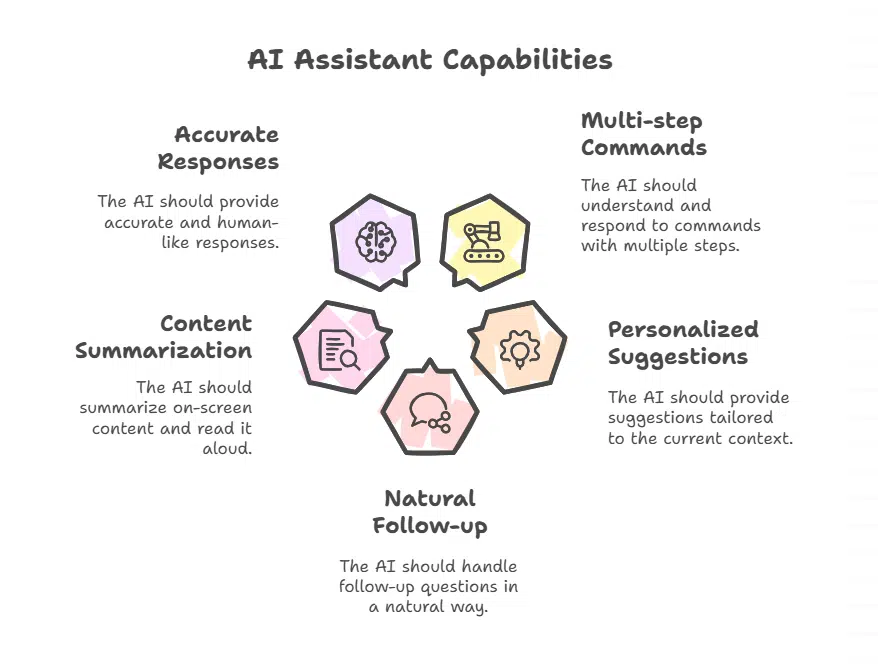
The upgraded Siri was intended to offer a significantly smarter and more proactive experience than the current version. Apple had planned for Siri to:
-
Understand and respond to multi-step commands.
-
Offer personalized suggestions based on context (like scheduling a meeting based on a conversation).
-
Handle follow-up questions more naturally.
-
Summarize on-screen content and read it aloud.
-
Provide more accurate and human-like responses to complex queries using on-device generative AI.
These improvements would align Siri more closely with rivals like Amazon’s Alexa, Google Assistant, and Microsoft’s Copilot, which have all integrated LLMs more aggressively.
Apple’s Cautious Approach to AI Draws Criticism
Apple’s delayed rollout has raised questions about whether the company is falling behind in the fast-moving AI race. While competitors like Google, Microsoft, and Amazon are already deploying advanced AI assistants and services in consumer and enterprise settings, Apple has taken a much more measured, privacy-focused approach.
Apple has made it clear that it wants AI features to run safely and reliably, especially on its devices, without compromising user privacy. CEO Tim Cook, during the company’s earnings call on May 1, said:
“We are making progress, and we look forward to getting these features into customers’ hands. But it’s just taking a bit longer than we thought.”
When asked to clarify the reason for the delay, Cook responded:
“There’s not a lot of other reasons. It’s just taking a bit longer than we thought.”
In contrast, critics have pointed out that Google, Microsoft, and even startups are moving swiftly to dominate the AI space. Apple’s more restrained rollout could risk falling behind in user expectations and market positioning.
Insider Insights: Former Employees Confirm Internal Struggles
According to sources cited by Bloomberg, former Apple employees who recently left the company said the tech giant was struggling to incorporate generative AI models into Siri. These models are designed to improve Siri’s ability to understand natural speech and deliver more intelligent responses. However, Apple’s notoriously high bar for quality—and its complex integration across iOS, macOS, and iPadOS—slowed progress.
They also revealed that internal demos of the upgraded Siri were inconsistent. Sometimes, the assistant would fail to complete tasks that other LLM-based assistants could perform reliably, such as generating summaries or handling chained requests.
What’s Next for Siri? Possible Preview in Fall 2025
While the official launch of the revamped Siri is now pushed to spring 2026, Apple may preview some of the new features earlier. Sources suggest that a limited rollout or beta preview could be unveiled in fall 2025, possibly tied to the release of the iPhone 17 and iOS 19.
At the same time, Apple is continuing to roll out other AI-powered tools under its Apple Intelligence suite, including:
-
Smart text summarization
-
AI-powered photo editing
-
Mail and Notes enhancements using generative AI
-
On-device privacy protections for all AI processes
These features are expected to arrive throughout 2025, while the full Siri upgrade remains in the pipeline.
Apple Prioritizes Quality Over Speed
Apple’s decision to delay Siri’s AI upgrade once again reflects its broader approach to artificial intelligence—careful, deliberate, and user-centric. While this may frustrate some users and investors eager to see Apple match or outpace its AI rivals, the company insists that delivering a trustworthy and reliable assistant is more important than rushing to market.
With a release now targeted for spring 2026, the company has a narrow window to refine Siri, restore investor confidence, and win back users who might already be leaning toward more capable voice assistants in the meantime.