Elon Musk, founder of the artificial intelligence company xAI, has intensified his criticism of Apple by accusing the tech giant of manipulating its App Store to favor OpenAI. Musk claims Apple’s App Store design and editorial promotion practices make it extremely difficult for any AI developer other than OpenAI to secure the top position in app rankings. According to him, this structure unfairly disadvantages rival products, including xAI’s own offerings.
Musk pointed specifically to the “Must Have” section of the App Store, a curated collection of applications that receive prominent visibility for iOS users. He noted that neither of xAI’s major products—X (the social media platform formerly known as Twitter) nor Grok (xAI’s AI chatbot)—has been featured there, despite X being the most popular news app globally and Grok maintaining a position among the top five apps overall. For Musk, this omission is a clear sign of platform bias.
The billionaire entrepreneur described this as a breach of fair competition laws and indicated that xAI is preparing to take immediate legal action against Apple for what he considers an antitrust violation. This marks one of Musk’s most direct confrontations with Apple to date, setting the stage for a potentially high-profile legal battle between two of the world’s most influential technology companies.
Apple Rejects Allegations, Defends App Store Processes
Apple responded swiftly to Musk’s accusations, denying any form of bias or preferential treatment toward OpenAI. The company outlined how its App Store rankings and recommendations work, emphasizing that app visibility is determined through a combination of data-driven charts, algorithmic recommendations, and human-curated lists created by its editorial team. These curations, Apple said, are based on objective and consistent criteria designed to help users discover apps safely and efficiently.
The company also stressed its commitment to supporting a wide range of developers, particularly in emerging categories like artificial intelligence, where user interest is growing rapidly. Apple’s statement underscored that the App Store is intended to be a level playing field where applications succeed on the basis of merit, popularity, and relevance to users—not favoritism.
Data Points Undermine Musk’s Core Argument
While Musk maintains that only OpenAI’s apps can rise to the top of Apple’s App Store, recent history presents examples that contradict this narrative. In January 2025, DeepSeek, a Chinese-developed AI application, climbed above OpenAI’s ChatGPT to claim the top position in the App Store’s free-app rankings. Similarly, in July 2025, the AI-powered search tool Perplexity reached the number one spot overall in India’s App Store.
Both of these successes occurred well after Apple and OpenAI announced their partnership in 2024, suggesting that other AI-focused apps still have the opportunity to achieve top rankings under Apple’s current system. These instances weaken Musk’s claim that Apple’s platform is entirely closed to competitors.
Altman and Musk’s Personal Rivalry Enters the Spotlight
The dispute quickly drew a response from Sam Altman, CEO of OpenAI, who turned the spotlight back on Musk by raising questions about his own business practices. Altman referred to long-standing allegations that Musk has used the recommendation algorithms of X to favor content from his own companies while limiting the reach of competitors and critics.
Musk rejected Altman’s remarks and responded with sharp personal attacks. Altman, in turn, challenged Musk to formally swear in a legal statement that he has never interfered with X’s algorithms for personal gain. This challenge added a new dimension to the feud, transforming it from a dispute over App Store rankings into a broader and more personal rivalry between two of the most high-profile figures in the AI industry.
Long-Standing Tensions Between Musk and Altman
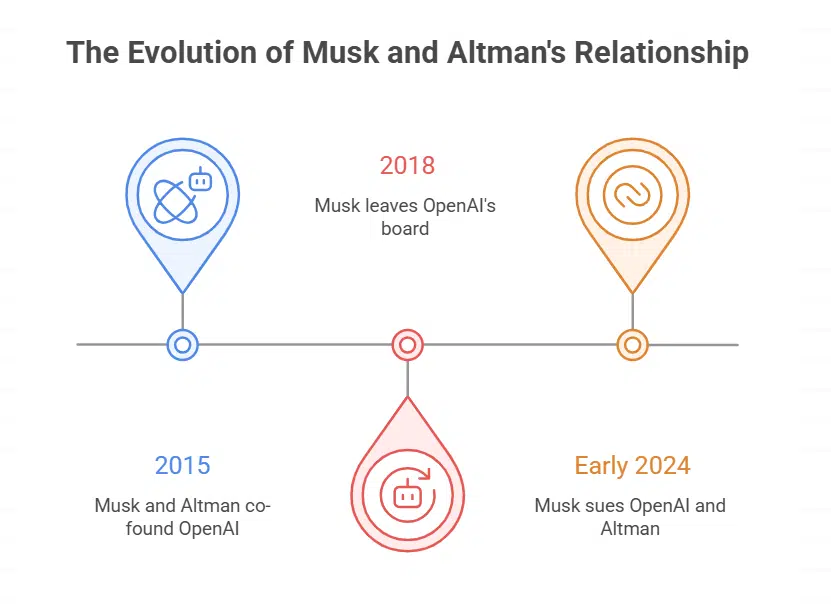
This is not the first time the two tech leaders have clashed. Musk and Altman were once collaborators, having co-founded OpenAI in 2015 with the shared mission of advancing artificial general intelligence in a safe and open manner. Musk left OpenAI’s board in 2018 after disagreements over the company’s direction and later became a vocal critic of its transition from a non-profit research lab to a capped-profit model with significant commercial ambitions.
In early 2024, Musk sued OpenAI and Altman, alleging that they had abandoned the organization’s founding principles by prioritizing profit over openness. That lawsuit was eventually dropped, but the public animosity remained. The current dispute over Apple’s App Store has reignited these old tensions and placed them in the context of today’s fast-changing AI market.
Regulatory Pressures Heighten the Stakes
Musk’s legal threat comes at a time when Apple is already facing intense regulatory scrutiny over its App Store practices. The U.S. Department of Justice has an ongoing antitrust case against the company, alleging that Apple maintains a monopoly in the smartphone ecosystem through restrictive policies that limit competition. In Europe, Apple has been fined €500 million under the Digital Markets Act (DMA) for limiting app developers’ ability to direct users to payment options outside the App Store. Apple has appealed the fine but remains under close watch by EU regulators.
Apple has also been engaged in a long-running legal battle with Epic Games, the developer of Fortnite, over similar issues related to App Store fees and rules. Although the case has resulted in some changes—such as allowing developers to link to external payment options—Apple continues to face calls for more transparency and less control over app distribution.
Musk’s new allegations could add to these legal and political pressures, especially if his legal challenge focuses on self-preferencing—the practice of giving certain apps or services more visibility or advantages than competitors on a platform the company controls.
The disagreement over App Store visibility also reflects the broader competition in the AI sector. Apple has been integrating OpenAI’s technology into its products, while Musk’s xAI is working to establish Grok as a viable alternative to ChatGPT. Other companies like Google, Anthropic, and Meta are also fighting for dominance in AI-powered services. Visibility on mobile platforms like the App Store is a critical factor in reaching users quickly and at scale.
If Musk’s claims lead to legal changes in how Apple curates and promotes apps, the outcome could have a significant impact not just on his own business but on the entire AI app ecosystem. Developers of smaller AI tools could gain more opportunities for visibility, while Apple might be forced to adjust its promotional strategies to avoid legal risk.
Market Reaction and Business Implications
The public clash has already had some spillover effects in the financial markets. Tesla’s share price rose modestly following Musk’s announcement, as investors speculated about the potential for xAI to grow as part of Musk’s broader portfolio of companies. Meanwhile, Apple’s stock has been under pressure throughout 2025, with declines driven by regulatory uncertainty, slower hardware sales, and growing investor concerns about the company’s ability to compete in the rapidly evolving AI landscape.