
As the Swedish Academy announced the winner of the 2025 Nobel Prize in Literature this week, a familiar wave of discussion swept through the literary circles of Bengal. Yet, the initial flicker of disappointment that celebrated author Amitav Ghosh was once again overlooked quickly gave way to a powerful, unified affirmation: his monumental contribution to global literature and thought stands far above the need for any single award, even one as prestigious as the Nobel.
The Ghosh Legacy
- Pioneering Voice: Amitav Ghosh is widely credited with pioneering the genre of climate fiction (‘cli-fi’), most notably with his non-fiction work The Great Derangement: Climate Change and the Unthinkable (2016).
- Highest Indian Honour: In 2018, Ghosh became the first English-language writer to be awarded the 54th Jnanpith Award, India’s highest literary honour, for his “outstanding contribution towards literature.” (Source: Jnanpith Award Committee)
- Global Reach: His works have been translated into more than 30 languages, with novels like The Glass Palace and the Ibis Trilogy becoming staples in postcolonial literature courses worldwide.
- Recurring Candidate: For over a decade, Ghosh’s name has consistently featured in literary betting odds and predictions for the Nobel Prize, highlighting his sustained global relevance.
The Perennial Question and a Resounding Answer
Every October, as the leaves turn in Stockholm, the question arises among readers in South Asia: will this be Amitav Ghosh’s year? His vast body of work—spanning meticulously researched historical fiction, profound ecological inquiry, and incisive essays on colonialism and migration—places him in the highest echelon of contemporary writers. Yet, year after year, the call from the Swedish Academy has not come.
However, speaking to authors, critics, and publishers across Kolkata and Dhaka, a clear consensus emerges. The sentiment is not one of grievance, but of profound respect for a writer whose influence has already been cemented.
“To think that Amitav Ghosh’s stature is diminished by not winning a Nobel is to fundamentally misunderstand the nature of his work,” says a prominent Kolkata-based publisher and literary critic, who preferred to remain anonymous to speak freely. “The Nobel is a moment, but Ghosh’s work is a movement. He has changed how a generation thinks about history, the environment, and the interconnectedness of human stories across continents. That is a greater prize.”
This view is echoed widely. The Bengali literary tradition, which boasts its own Nobel laureate in Rabindranath Tagore, has a unique perspective on such global accolades. The focus, many argue, should be on the lasting intellectual and cultural impact of an author’s oeuvre.
A Body of Work That Redefined Genres
Amitav Ghosh’s legacy is built on several formidable pillars, each of which could be considered Nobel-worthy in its own right.
The Historian’s Novelist
His early works, such as The Shadow Lines (1988), masterfully dissolved the boundaries of time and memory, exploring the lingering traumas of the Partition of India. But it was the epic Ibis Trilogy—comprising Sea of Poppies (2008), River of Smoke (2011), and Flood of Fire (2015)—that truly showcased his genius. The trilogy, set against the backdrop of the 19th-century opium wars, is not merely a historical epic but a sprawling, polyphonic narrative that gives voice to the subaltern figures erased from colonial records.
His meticulous research, drawing from obscure archives and forgotten maritime logs, brings a world of lascars, opium traders, and indentured labourers to vivid life. As a senior professor of English at Jadavpur University noted, “Ghosh doesn’t just write about history; he conducts an archaeological dig into the past, unearthing stories that force us to reconsider the very foundations of modern global capitalism.”
The Climate Prophet
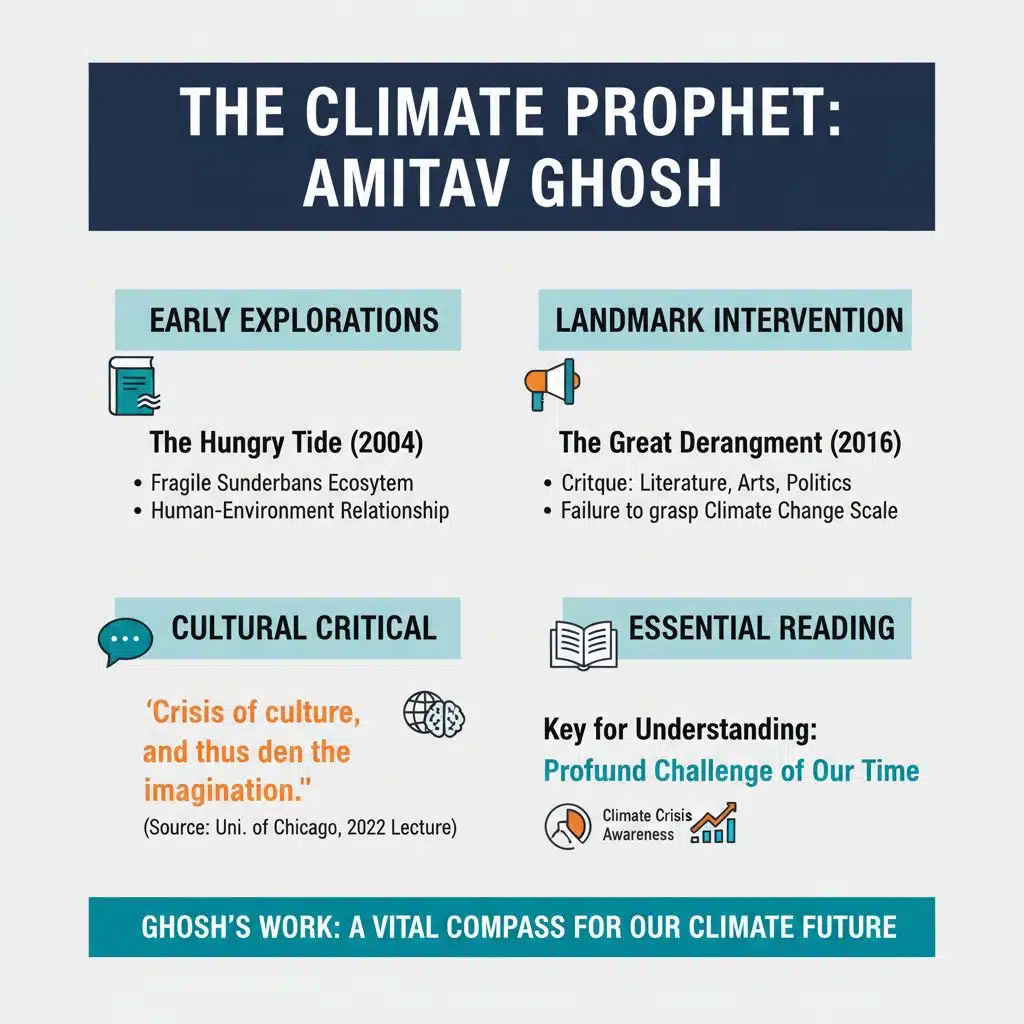
Perhaps Ghosh’s most urgent and globally significant contribution has been his work on the climate crisis. Long before “climate fiction” became a buzzword, novels like The Hungry Tide (2004), set in the fragile ecosystem of the Sundarbans, explored the intricate relationship between humans and their environment.
His 2016 non-fiction book, The Great Derangement: Climate Change and the Unthinkable, was a landmark intervention. In it, he powerfully critiqued the failure of modern literature, arts, and politics to grapple with the scale and reality of climate change.
In a public lecture in 2022, Ghosh stated, “The climate crisis is also a crisis of culture, and thus of the imagination.” (Source: University of Chicago, Committee on Social Thought). This singular focus has made his work essential reading for understanding the most profound challenge of our time.
By the Numbers: Quantifying an Unquantifiable Impact
While literary influence is difficult to measure, certain metrics underscore Ghosh’s reach:
- India’s Highest Literary Award (2018): Amitav Ghosh was the recipient of the 54th Jnanpith Award. The Bharatiya Jnanpith committee noted that “Ghosh treads through historical settings to the modern era and weaves a space where the past connects with the present in relevant ways.” This marked a historic moment, as the award had previously been given only to authors writing in Indian languages. (Source: The Hindu, Press Trust of India)
- Extensive Academic Citation: As of October 2025, his work The Great Derangement has been cited in over 2,500 academic papers, theses, and books, according to Google Scholar data, indicating its profound impact on scholarly discourse in environmental humanities, literary studies, and postcolonial theory. (Source: Google Scholar, search conducted October 11, 2025)
- Global Translations and Readership: His novels and non-fiction works have been translated into over 30 languages, including French, German, Spanish, and Japanese, ensuring a vast and diverse international readership that extends far beyond the Anglophone world. (Source: Penguin Random House India, publisher data)
A Field Note: The Reader’s Perspective
At a popular bookstore in College Street, Kolkata, the sentiment is less academic but just as heartfelt. “People don’t ask if Ghosh has won the Nobel,” says the store manager. “They come asking for The Glass Palace because their parents recommended it, or for The Hungry Tide because they are travelling to the Sundarbans. His books are alive in a way that has nothing to do with awards. They are part of our landscape.”
A Legacy Written in Ink, Not Gold
The annual Nobel speculation will undoubtedly continue, and Amitav Ghosh’s name will remain on the list of perennial contenders. But within the heart of the Bengali literary world, and among his millions of readers globally, the verdict is already in. The Nobel Prize would be a fitting acknowledgment of his genius, but its absence does nothing to diminish it.
His legacy is not contingent on a medal from Stockholm. It is etched in the pages of his powerful books, in the new avenues of thought he has opened, and in the critical conversations he has forced the world to have about its past and its precarious future. For a writer who has given so much, that is the most enduring honour of all.