
Amanda Knox was only 20 years old when her life changed dramatically in 2007. While studying abroad in Perugia, Italy, the American exchange student shared an apartment with British student Meredith Kercher. When Kercher was found dead in their flat, Italian authorities quickly turned their attention to Knox and her then-boyfriend, Raffaele Sollecito. Despite a lack of conclusive evidence, both were arrested, convicted, and repeatedly retried in a long and chaotic judicial process that made headlines across the world. Knox spent four years in prison before Italy’s highest court eventually acquitted her in 2015.
The case was not just about the trial itself, but about how media shaped Knox’s image. Sensationalist tabloids branded her “Foxy Knoxy” and painted her as manipulative, hypersexual, and untrustworthy. For years, she struggled against a narrative imposed on her by journalists, prosecutors, and the public.
Hulu Brings Amanda Knox’s Story to Television
Now, nearly two decades after Kercher’s death, Hulu has launched an eight-part limited series called The Twisted Tale of Amanda Knox. The show dramatizes not only the investigation and court battles, but also Knox’s personal journey through imprisonment, media scrutiny, and the long fight to clear her name. For the first time, Knox herself is heavily involved in shaping the story onscreen. She serves as an executive producer, has had input into scripts, and even co-wrote the final episode.
The series premiered on August 20, 2025, with new episodes rolling out weekly until October 1. Grace Van Patten portrays Knox, capturing her transformation from a confused young student to a woman forced to grow up in the glare of public judgment. Other cast members include Sharon Horgan as Knox’s mother and Francesco Acquaroli as Italian magistrate Giuliano Mignini, the lead prosecutor who played a pivotal role in the case.
Monica Lewinsky Joins as Co-Producer
Perhaps the most surprising element of this project is the partnership between Amanda Knox and Monica Lewinsky. Lewinsky, once at the center of the infamous White House scandal in the 1990s, has herself endured decades of media vilification. She was shamed, sexualized, and cast as a villain in one of the most widely publicized political scandals in U.S. history.
Over the past decade, Lewinsky has rebuilt her public life as a writer, producer, and anti-bullying activist. She co-produced Impeachment: American Crime Story, a dramatization of the Bill Clinton scandal, and has delivered high-profile talks about the long-term impact of shame culture. Her empathy for Knox’s plight made this collaboration feel natural. Both women were interrogated intensely at a young age—Knox by Italian police for more than 50 hours, and Lewinsky by U.S. federal investigators for 11 hours. Both endured a level of scrutiny that profoundly shaped their adult lives.
Together, Knox and Lewinsky bring a shared understanding of how public opinion, misogyny, and institutional failures can devastate lives.
A Multi-Perspective Retelling
The Twisted Tale of Amanda Knox does not only tell Knox’s side. Showrunner K.J. Steinberg and the writing team drew on thousands of pages of trial records, police files, forensic documents, and witness testimony to present multiple perspectives. The narrative includes Knox’s experiences, the perspective of Sollecito, the grief of Kercher’s family, and even the viewpoint of the prosecutors.
By weaving these perspectives, the series avoids being a simple one-sided defense. Instead, it highlights how complex, messy, and tragic the case truly was. This approach invites viewers to reflect on the role of justice systems, cultural bias, and media sensationalism in shaping global opinion.
Knox’s Life After Exoneration
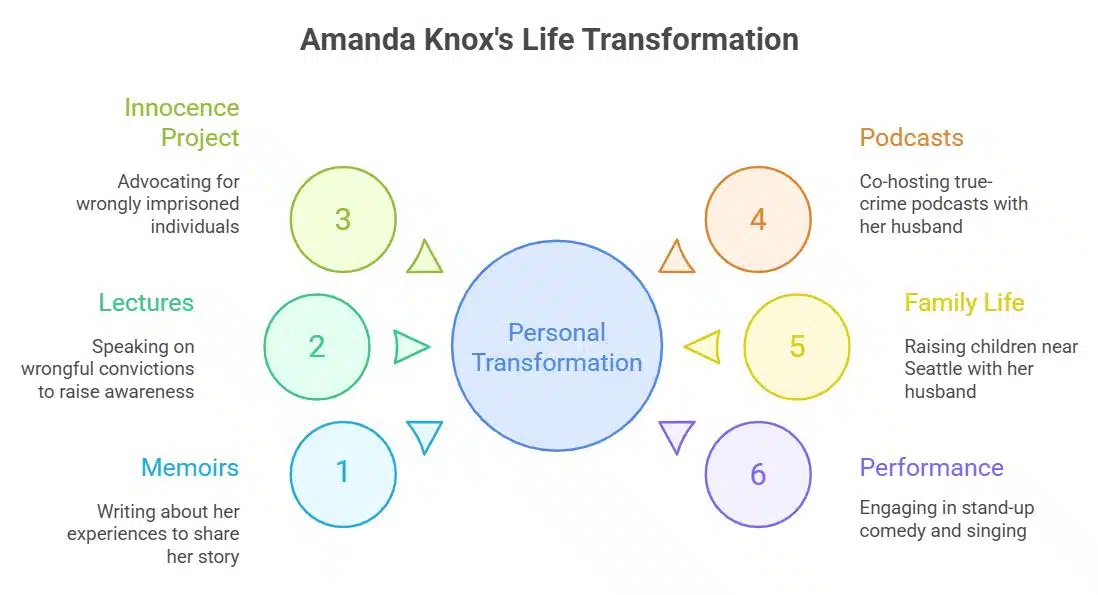
Since her acquittal, Amanda Knox has worked to rebuild her life. She has written two memoirs, given lectures on wrongful convictions, and served on the board of The Innocence Project, which advocates for individuals wrongly imprisoned. Together with her husband, author Christopher Robinson, she co-hosts two true-crime podcasts. The couple are raising two young children near Seattle.
Knox has also taken an interest in performance, including stand-up comedy and singing with The Exonerees, a band formed by people who were wrongly convicted. These creative outlets reflect her desire to transform personal trauma into meaningful expression.
The Role of Media Scrutiny
Central to both Knox’s and Lewinsky’s stories is how the media amplified and distorted their lives. Knox has spoken about how headlines reduced her to a caricature, while Lewinsky has been vocal about the destructive power of internet shaming and misogynistic coverage. Both women argue that young women in particular suffer when their identities are shaped by the worst kind of public judgment.
Lewinsky’s own reemergence into public life began with a 2014 essay for Vanity Fair, followed by a viral TED Talk in 2015 titled The Price of Shame. Through those projects, she redefined herself not as a scandal figure, but as a voice advocating for compassion and accountability in digital culture.
Knox hopes that The Twisted Tale will do something similar for her: not erase the past, but allow audiences to see her as more than a tabloid headline.
Cultural Impact and Controversy
The release of The Twisted Tale of Amanda Knox has generated significant debate. Some Italian commentators have criticized the dramatization, seeing it as intrusive or disrespectful to Kercher’s family. Others view it as a necessary opportunity to reevaluate one of the most sensationalized cases in modern memory. In the United States, early reviews praise Grace Van Patten’s performance and the raw emotional intensity of the series.
The project is part of a larger cultural shift in which women once vilified in the media—such as Britney Spears, Monica Lewinsky, and now Amanda Knox—are reclaiming their narratives. For many viewers, the show is not only about Knox but also about how society treats young women under pressure.
Amanda Knox has said that her goal is to show that even in the face of devastating trauma, life can continue. She emphasizes resilience, growth, and the importance of human connection. Monica Lewinsky echoes this message, underscoring how vital it is to understand the long-lasting damage of public shaming.
For both women, this series is more than television. It is an act of reclaiming identity, reshaping cultural memory, and challenging viewers to think more critically about justice, truth, and media responsibility.