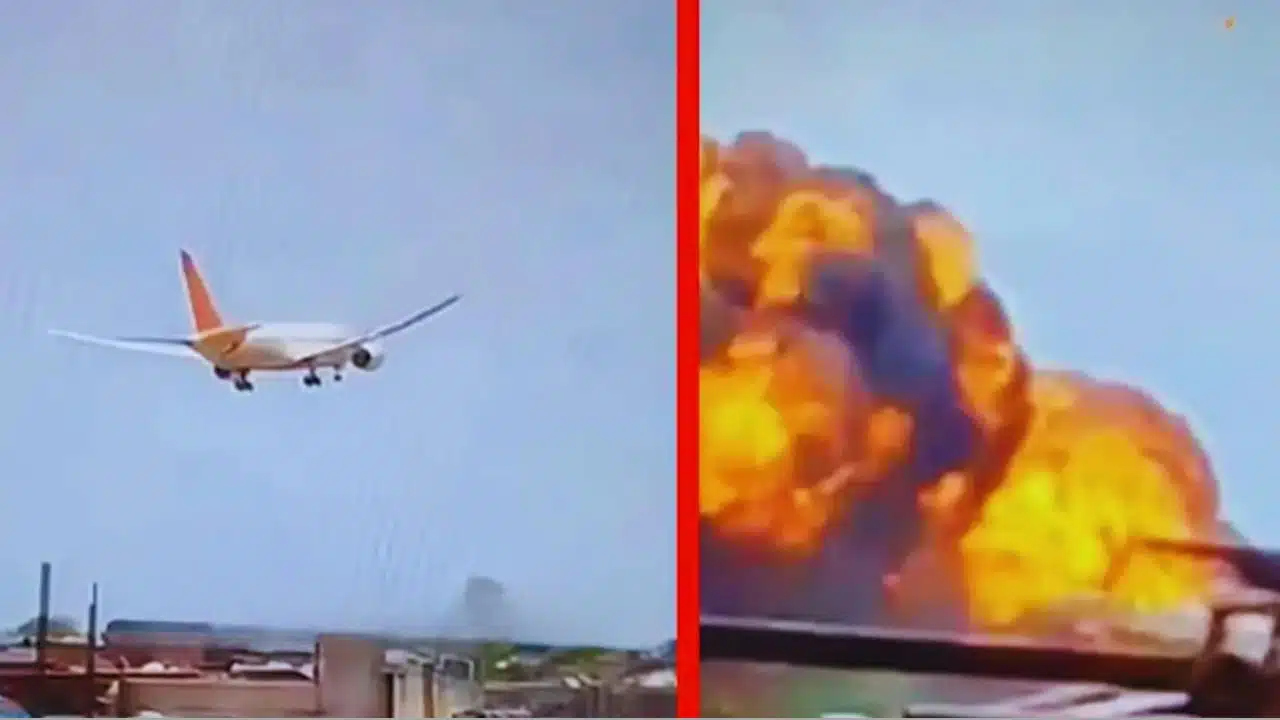
On June 12, 2025, Air India Flight AI 171, a Boeing 787-8 Dreamliner, tragically crashed just minutes after taking off from Sardar Vallabhbhai Patel International Airport in Ahmedabad, India. The aircraft was en route to London Gatwick Airport, scheduled for a nearly 9-hour international journey. Onboard were 242 people—230 passengers and 12 crew members.
The Crash Location
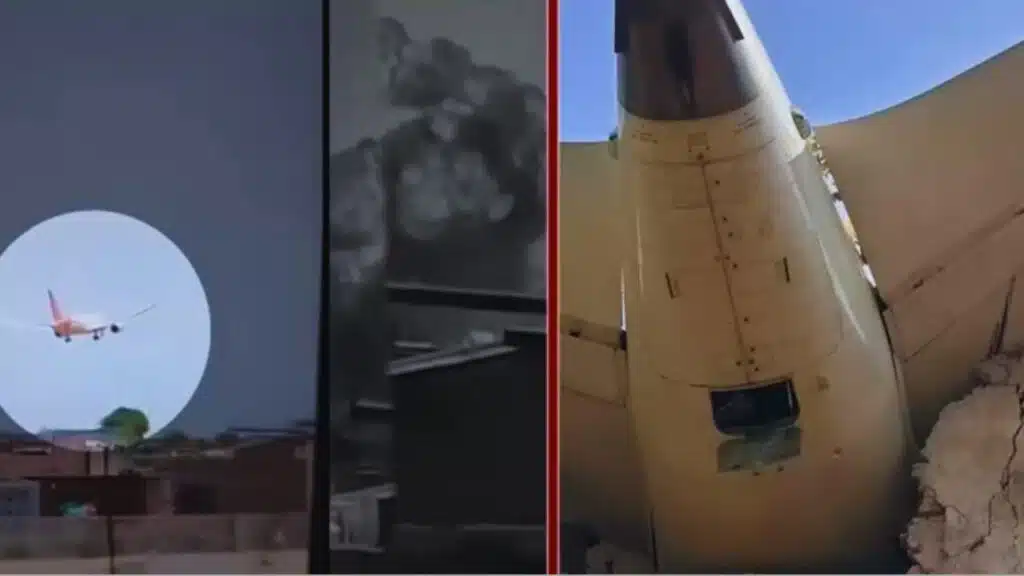
The jetliner crashed into a densely populated area—specifically the doctors’ hostel complex of B.J. Medical College in Meghani Nagar, located just 3 km south of the runway. The crash occurred at approximately 1:42 p.m. IST, within four minutes of takeoff.
According to video footage verified by news agencies, a large fireball and thick black smoke billowed from the crash site. Witnesses said the plane flew unusually low, with landing gear down and flaps deployed—indications that something was technically wrong before impact.
Who Was on Board?
Air India confirmed the following breakdown of passengers:
- 169 Indian nationals
- 53 British nationals
- 7 Portuguese nationals
- 1 Canadian national
A final list of passenger names is being held pending family notifications. The nationalities of the 12 crew members have not yet been disclosed.
Death Toll and Casualties
The crash was catastrophic. Initial reports from authorities indicated no survivors. However, rescue teams later discovered one critically injured survivor, seated at 11A, who managed to escape through a broken window or emergency exit and is now in intensive care.
As of June 12 evening:
- 204 bodies had been recovered and moved to civil and military hospitals for postmortem and DNA testing.
- 5 people on the ground, including students living in the hostel, were confirmed dead.
- 41 others, mostly medical students, sustained burns and injuries from the explosion and fire.
Due to the severe burns, many victims will require forensic identification.
Pilot’s Mayday Call
Moments after takeoff, the cockpit crew issued a Mayday alert. The distress call mentioned “unusual engine vibration” and “loss of thrust in one engine”. This message was received by the Air Traffic Control tower at Ahmedabad but was cut off shortly after.
Flight data captured by Flightradar24 showed the aircraft reached 625 feet altitude before beginning a sharp descent. Analysts note this is extremely low for a widebody aircraft, indicating a rapid and unrecoverable failure.
The Aircraft Involved
- Type: Boeing 787-8 Dreamliner
- Registration: VT-ANB
- First Flight: December 2013
- Powered by: General Electric GEnx-1B engines
- Operator: Air India (owned by Tata Group since 2022)
The aircraft had logged over 32,000 flight hours and underwent scheduled maintenance just three weeks prior. Preliminary inspection of the flight logs did not show any significant issues before this flight.
The Boeing 787 series had not suffered a single fatal accident since its introduction in 2011, making this the first deadly crash involving the Dreamliner globally.
Early Theories & Investigation
The Aircraft Accident Investigation Bureau (AAIB) of India is leading the investigation, with support from:
- Directorate General of Civil Aviation (DGCA)
- National Transportation Safety Board (NTSB, USA)
- Boeing (USA)
- GE Aerospace
- UK’s Air Accidents Investigation Branch (AAIB-UK)
Investigators are focusing on the following potential causes:
- Engine failure or uncontained engine fire
- Hydraulic failure or loss of flight control
- Electrical malfunction impacting fly-by-wire systems
- Foreign object ingestion into the engines on takeoff
The Cockpit Voice Recorder (CVR) and Flight Data Recorder (FDR)—commonly known as black boxes—were recovered from the crash debris by NDRF teams and are now being analyzed.
Airline & Government Response
Air India and Tata Group issued an emergency response protocol:
- Family hotlines activated in India, UK, and Portugal
- Emergency teams deployed to Gujarat hospitals and international embassies
- Tata Group chairman Natarajan Chandrasekaran expressed deep sorrow and is overseeing crisis coordination personally
India’s Prime Minister Narendra Modi said:
“It is heartbreaking beyond words. My thoughts are with the affected families. I have directed swift rescue and medical operations.”
UK Prime Minister Keir Starmer, Portugal’s Foreign Ministry, and Canada’s High Commission have all issued statements offering condolences and are working to confirm the identities of their citizens.
Global Reaction and Boeing Fallout
The crash sent ripples through the aviation industry:
- Boeing’s share price fell by more than 8% in pre-market trading
- GE Aerospace also saw its stock dip as questions arose over engine reliability
- Global media and analysts are closely watching how this incident affects Boeing’s ongoing efforts to rebuild trust after recent 737 MAX scrutiny
Boeing released a short statement:
“We are aware of the accident involving Air India Flight AI171 and are cooperating fully with authorities to gather all necessary data.”
Historical Context
India’s aviation sector has seen major improvements over the past two decades. Yet, this crash is among the worst in recent history, echoing tragedies such as:
- 2020 Kozhikode Air India Express crash (21 fatalities)
- 2010 Mangalore crash (158 fatalities)
- 1985 Air India Flight 182 bombing (329 fatalities, over Irish waters)
This is the deadliest aviation disaster in India since the Charkhi Dadri mid-air collision in 1996.
What Happens Next?
The investigation will likely take several months to complete, especially due to international coordination. In the meantime:
- The affected families will receive financial aid from Air India, insurance providers, and respective governments
- Policy reviews will examine Boeing 787 flight safety, Indian emergency response protocols, and pilot training procedures
- New protocols may be introduced regarding urban flight corridors near airports, especially over densely populated areas like Ahmedabad
As the world grieves, what stands out is the speed and scale of the tragedy. A state-of-the-art aircraft like the Dreamliner—equipped with cutting-edge avionics and redundancy systems—plunging into a residential building within minutes of takeoff, raises profound questions. While the loss is immeasurable, investigators, engineers, and policy-makers must work together to ensure such a disaster is never repeated.