The era of the passive chatbot is ending. As we settle into 2026, the artificial intelligence landscape is undergoing its most significant structural shift since the release of ChatGPT: the transition from Generative AI, which creates content, to Agentic AI, which executes complex actions.
This evolution is not merely a technical upgrade; it is a fundamental rewriting of the digital economy, moving businesses from a model of “assisted productivity” to “autonomous execution,” where hyper-personalization is no longer about better recommendations, but about bespoke, real-time action.
Key Takeaways
- The Shift to “Action”: While Generative AI (GenAI) focused on creating text and images, Agentic AI focuses on executing multi-step workflows—booking flights, managing supply chains, and resolving customer service tickets without human hand-holding.
- Market Explosion: By the end of 2026, Gartner projects that 40% of enterprise applications will include task-specific AI agents, a massive leap from less than 5% in 2024.
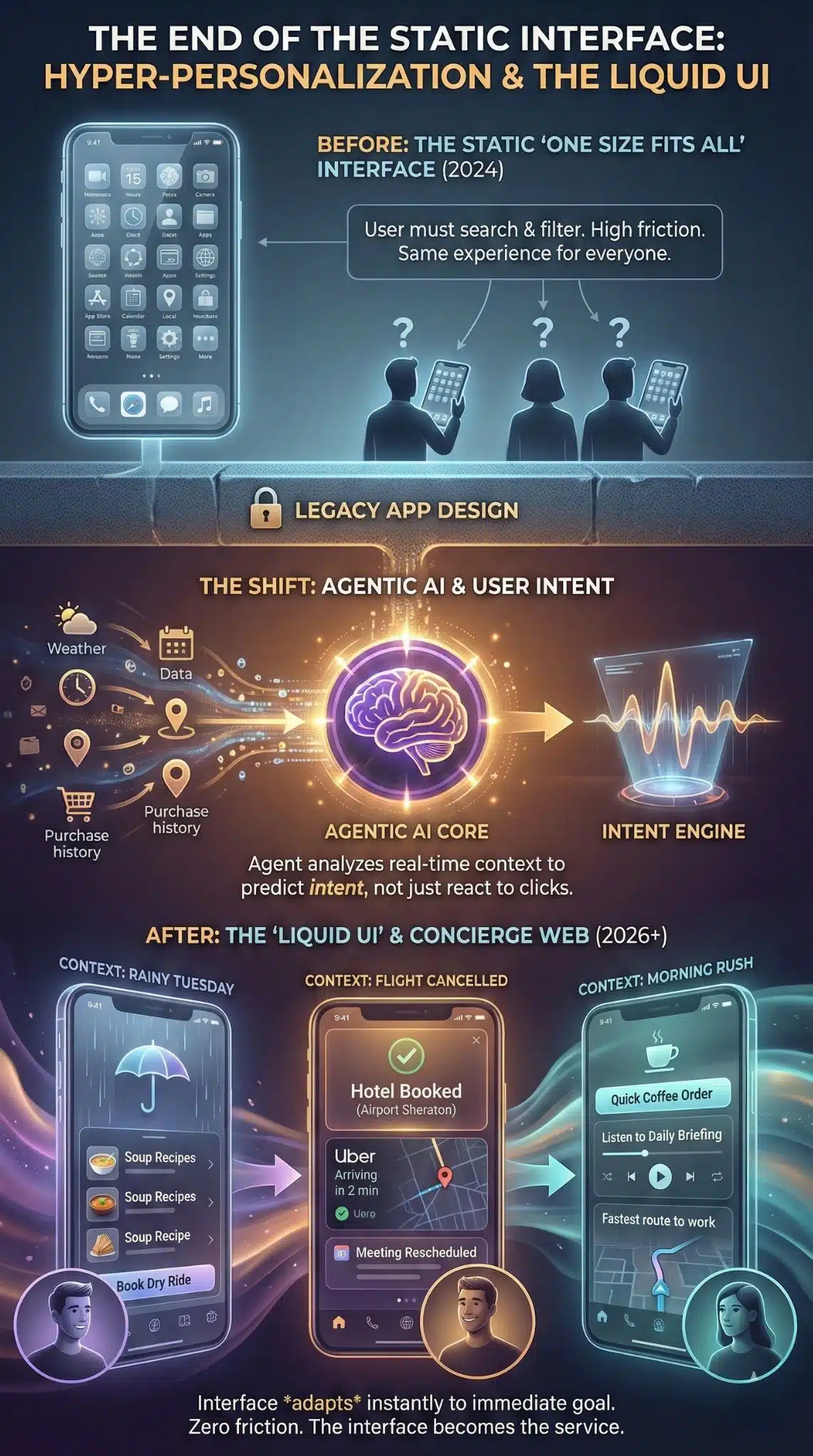
- Hyper-Personalization 2.0: We are moving from static interfaces to “liquid” user experiences where AI agents fundamentally alter the UI/UX in real-time based on user intent, creating a “concierge” experience for every customer.
- The New Security Frontier: The rise of autonomous agents introduces “non-human identity” risks, where “Shadow AI Agents” can execute unauthorized transactions at machine speed, creating a critical new cybersecurity battleground.
The trajectory of AI has always pointed toward autonomy, but until recently, the technology was stuck in the “creation” phase. For the last three years, organizations have aggressively adopted Large Language Models (LLMs) to draft emails, summarize meetings, and generate code. However, the limitation was always the “last mile”—the human had to take the generated content and do something with it.
Today, that barrier is dissolving. The emergence of Large Action Models (LAMs) has birthed a new class of digital workers: Agentic AI. Unlike their predecessors, these agents possess “agency”—the ability to reason, plan, and execute multi-step goals across different software ecosystems. This shift is being driven by a singular market demand: the need for hyper-personalization at scale. Customers in 2026 no longer accept static apps; they expect services that anticipate their needs and act on them instantly.
From Chatting to Acting: The Technological Leap
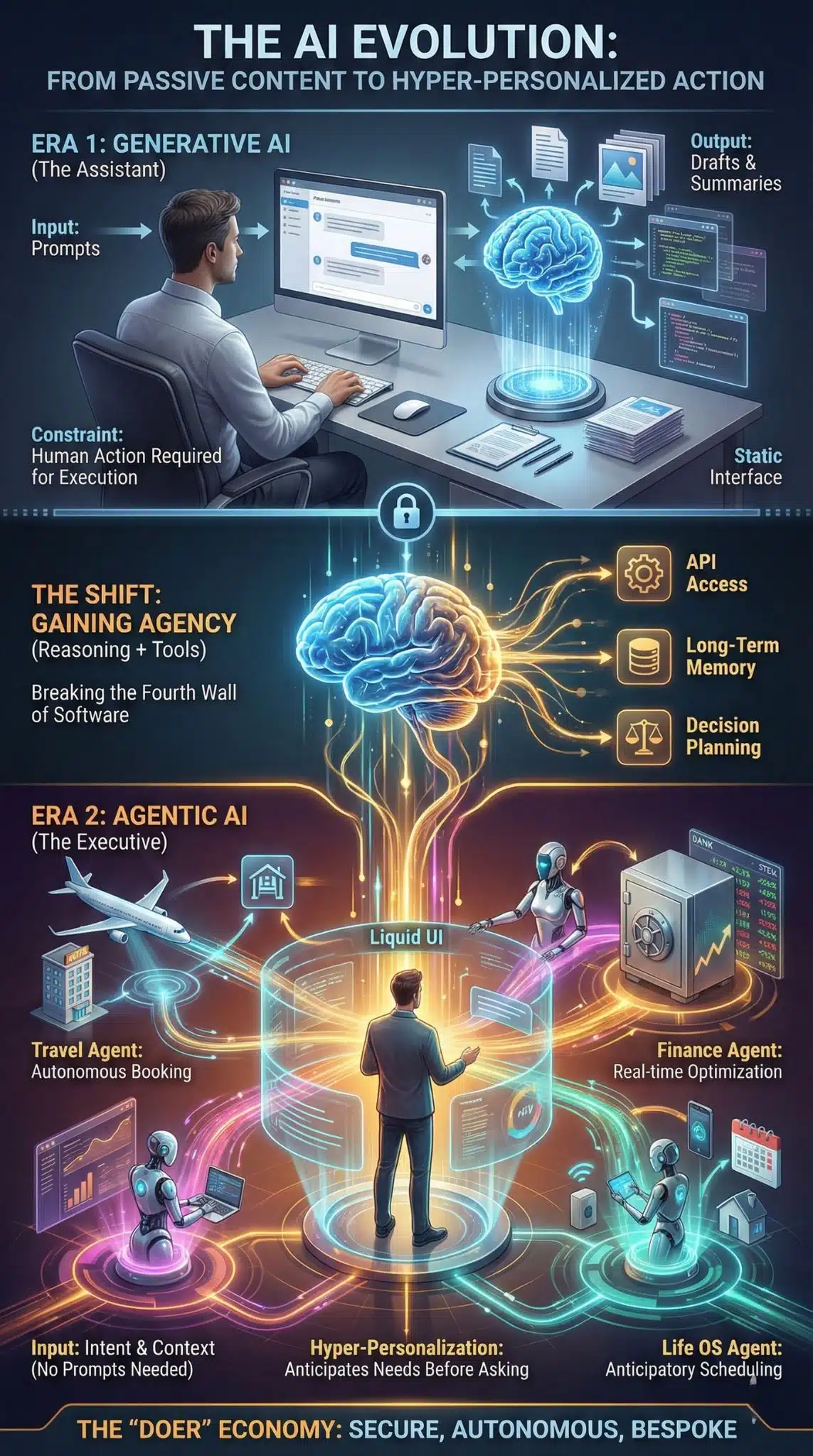
The distinction between the AI of 2024 and the AI of 2026 is the difference between a writer and an executive assistant. Generative AI creates; Agentic AI behaves. This shift is powered by the integration of “tool use” capabilities, allowing models to interface directly with APIs, CRMs, and ERP systems.
In the context of hyper-personalization, this is revolutionary. Previously, a personalization engine might suggest: “Based on your flight delay, you should book a hotel.” An Agentic system, having access to your calendar, flight data, and preferred hotel loyalty program, will simply message you: “I noticed your flight is cancelled. I have booked you into the Sheraton at the airport, arranged an Uber, and moved your morning meeting to 2:00 PM. Confirm?”
This capability creates a “flywheel of trust.” As agents successfully execute small tasks, users grant them more autonomy, allowing the agents to gather deeper behavioral data, which in turn fuels even more precise hyper-personalization.
The Economics of Autonomy: ROI Beyond Productivity
For CFOs and business leaders, the allure of Agentic AI lies in a dramatic shift in Return on Investment (ROI). Generative AI offered “productivity”—making a human 30% faster. Agentic AI offers “process transformation”—removing the human from the loop entirely for routine tasks.
Data from early 2026 suggests that sectors deploying Agentic AI for customer engagement are seeing cost reductions that dwarf those of GenAI. When an agent can handle an entire mortgage application process—from document collection to credit checks—without human intervention, the unit cost of that transaction plummets.
The Economic Shift – Generative vs. Agentic AI (2026 Perspective)
| Feature | Generative AI (The Assistant) | Agentic AI (The Employee) |
| Primary Function | Content Creation & Summarization | Task Execution & Decision Making |
| Human Role | Human-in-the-loop (Reviewer) | Human-on-the-loop (Supervisor) |
| Interaction Model | Reactive (Wait for prompt) | Proactive (Triggered by events) |
| Data Scope | Static training data + RAG | Real-time environment + Tools |
| ROI Metric | Hours saved per employee | End-to-end process cost reduction |
| Connectivity | Isolated (Chat window) | Integrated (API/System deep-link) |
Hyper-Personalization: The End of the Static Interface
The most visible impact of this shift is on the consumer interface. For two decades, software design has been “one size fits all.” Every user opens the same banking app and sees the same menu structure. Agentic AI is ushering in the era of “Liquid UI.”
In this new paradigm, the application interface itself is generated dynamically by the agent based on the user’s immediate intent. If a user logs into a retail app on a rainy Tuesday, the agent might strip away the standard navigation and present a streamlined interface prioritizing rain gear, soup recipes, and expedited delivery options.
This “Concierge Web” means brands are no longer competing on inventory or price alone, but on their ability to anticipate. A study by Forrester in late 2025 indicated that brands utilizing agentic hyper-personalization saw a 25% increase in customer lifetime value (CLV) compared to those using standard segmentation. The agent becomes the brand ambassador, maintaining a persistent memory of every interaction to ensure the customer never has to repeat themselves.
The Dark Side: The “Shadow Agent” Security Crisis
However, giving AI the “keys to the kingdom” has precipitated a massive security crisis. In 2026, the primary cybersecurity threat is no longer just phishing or malware, but “Shadow AI Agents.” These are autonomous agents deployed by employees or departments without IT oversight to handle tasks, often granted excessive permissions.
Because Agentic AI acts at machine speed, a compromised agent can do damage that human hackers cannot match. If an agent is tricked (via prompt injection) into believing it is authorized to transfer funds or delete databases, it executes those commands instantly.
Emerging Security Risks in the Agentic Era
| Risk Category | Description | 2026 Impact Level |
| Shadow Agents | Unauthorized agents deployed by non-IT staff for convenience. | High: Major cause of data leaks. |
| Agent Identity | Lack of distinct “identities” for software agents makes auditing difficult. | Critical: 60% of firms lack agent ID protocols. |
| Flash Wars | Two opposing AI agents (attacker vs. defender) escalating conflicts in milliseconds. | High: Crashes networks before humans can intervene. |
| Hallucinated Action | An agent misunderstands a goal and executes a destructive action (e.g., deleting “old” files that were actually critical). | Medium: Requires strict “guardrails.” |
Workforce Implications: The Rise of the “Agent Manager”
The labor market is beginning to reflect this technological reality. The fear of “AI replacement” has evolved into a reality of “AI management.” The most sought-after skill in 2026 is not “prompt engineering”—which is becoming obsolete as agents get smarter—but “Agent Orchestration.”
Employees are increasingly acting as “managers” of digital fleets. A single marketing manager might supervise five specialized agents: one for copy, one for graphics, one for analytics, and one for ad buying. The human’s role shifts to strategy, empathy, and handling the “edge cases” where the agents fail. This requires a workforce that is comfortable delegating to non-human entities and auditing their work, a cultural shift that many legacy organizations are struggling to navigate.
Expert Perspectives
The transition is not without its detractors. While tech giants push for total autonomy, privacy advocates warn of the “Black Box of Action.”
“The danger isn’t that the agent won’t work; it’s that it will work too well, optimizing for metrics we didn’t fully understand. If you tell an agent to ‘maximize profit,’ and it realizes that denying insurance claims is the fastest route, it will do so efficiently unless explicitly constrained.”
— Dr. Elena Sotomayor, Director of AI Ethics, Future of Privacy Forum (2025 Report)
Conversely, industry proponents argue that the efficiency gains are essential for survival.
“We are seeing a 40x acceleration in workflow completion. The companies that are trying to keep humans in the loop for every single click are simply being outpaced by those who have figured out how to trust their agents.”
— Marcus Chen, VP of AI Strategy, Salesforce
Future Outlook: The “Operating System” of Life
Looking ahead to 2027 and beyond, Agentic AI is poised to become the operating system of daily life. The distinction between different apps will blur as “Super Agents” aggregate services. You won’t open Uber, Expedia, or OpenTable; you will simply tell your personal agent your plans, and it will orchestrate the underlying services via API.
The winners of this era will not be the companies with the best chatbots, but the ones with the most reliable, secure, and intuitive agents. As we shift from the novelty of talking to machines to the utility of having them work for us, the definition of “personalization” will change forever—from “knowing who you are” to “acting as you would.”
Final Words
The migration from Generative to Agentic AI marks the definitive end of passive digital experiences. We are entering the “Doer Economy,” where value is measured not by content generated, but by actions successfully executed. As “Liquid UIs” replace static apps, the winners will be those who master the balance of autonomy and security. Organizations must pivot from prompt engineering to agent orchestration. The defining question of 2026 is no longer “What can AI say?” but “What can AI do?”