The modern warehouse floor is an unforgiving physical environment. You have machines weighing upwards of ten thousand pounds operating at maximum velocity. They share narrow, heavily congested aisles with a massive workforce of pedestrians.
It is a gritty operational reality where margins are tight, and production quotas are constantly expanding. Floor managers are trapped in a daily battle to hit aggressive throughput metrics without causing a catastrophic accident. Relying on old school safety methods like convex mirrors and painted floor lines is actively failing in the logistics sector.
A standard forklift carrying a heavy load can take up to forty feet to come to a complete stop. A fraction of a second is the entire difference between a clean shift and a multimillion dollar OSHA investigation. That is exactly why implementing AI Solutions for forklift tracking is shifting from a basic IT experiment to a mandatory boardroom directive.
You cannot protect your operating budget or your workforce when your daily safety protocols rely entirely on human reaction times.
Financial Reality of Blind Intersections
Every high velocity distribution center has notorious blind corners. These are the exact physical locations where pickers and heavy machinery constantly cross paths. Operators hit their warning horns out of habit, but the acoustic warning is completely lost in the chaos.
In a loud manufacturing plant, those horns become permanent background noise. Near misses happen every single shift and go entirely unreported by the floor staff. These unreported incidents are massive red flags indicating a broken safety infrastructure just waiting to fail.
When a collision finally happens, the financial bleed hits the balance sheet instantly. The CFO is not just paying the insurance deductible for an injured worker. They are paying for structural repairs, ruined pallets of raw materials, and completely bottlenecked inventory.
Smashed Racking and Destroyed Throughput without Real-Time Visibility
When a forklift clips a structural upright, the damage creates a catastrophic ripple effect across the concrete floor. It is never just a quick patch job. You have to physically unload the entire rack segment and order custom replacement steel to fix the hazard.
That specific aisle must be shut down for days, forcing pickers to route around the dead zone. This physical disruption kills your daily shift efficiency completely. You are bleeding capital to fix a preventable accident instead of investing in operational output.
The indirect costs heavily dwarf the actual repair bill. It is a massive operational disruption caused by a three-second driver error.
Why Passive Safety Technology Fails Often
A decade ago, safety directors thought that adding a basic proximity buzzer to the back of a forklift was the ultimate solution. Today, we know that these legacy systems actively fail the floor staff. They rely entirely on passive warnings that require a human being to notice, process, and react.
Operators and pedestrians suffer from extreme sensory overload during a twelve-hour shift. When a legacy system cries wolf every time a truck passes a concrete pillar, the technology becomes functionally useless. The floor staff simply tunes out the flashing blue lights and the constant beeping.
When fatigue sets in around hour nine of a shift, human reaction time plummets. You cannot expect a tired driver to brake in milliseconds based on a generic buzzer sound.
The Danger of Dashboard Fatigue in Warehouses
Dashboard fatigue is a massive operational liability that auditors look for immediately. Operators learn to physically bypass the annoying alarms just so they can hit their aggressive shift quotas without the constant noise.
A safety system that your operators actively hate and ignore is entirely useless. It gives the front office a false sense of security while the physical floor remains incredibly dangerous. Operations directors are left staring at spreadsheets of generic warning triggers, completely unable to determine if the driver was actually at fault.
Enter Agentic AI: Active Forklift Safety Over Passive Alarms
This is where agentic AI completely changes the math on the warehouse floor. We are no longer talking about dumb alarms that beep on concrete walls. We are talking about edge computing systems that understand the physical difference between a structural pillar and a walking human being.
Agentic AI systems can perceive the environment, reason through the variables, and act entirely independently. These smart cameras detect the presence of pedestrians at sixty frames per second. They calculate trajectory, speed, and approach angles in mere milliseconds.
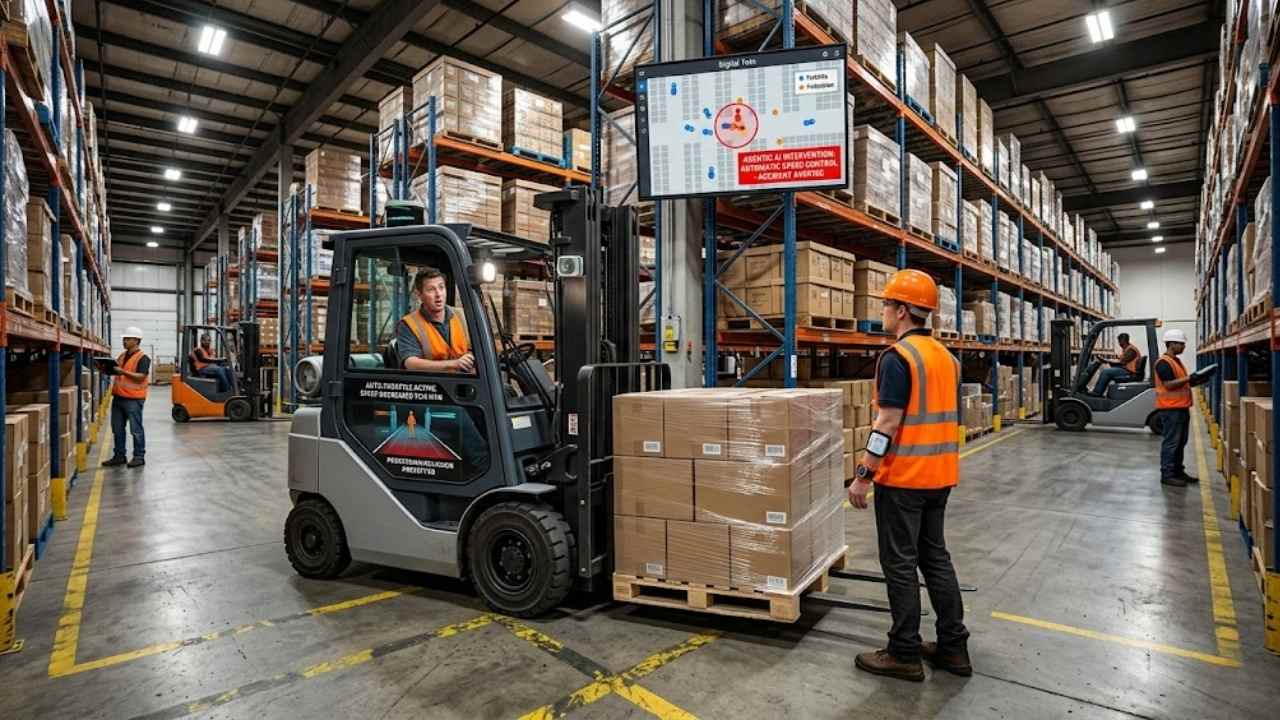
If an operator is coming in hot around a blind corner and a pedestrian step out, the system does not just beep. It actively intervenes. It decelerates the machine before the human driver even flinches.
Automated Forklift Speed Limiter in Action
Passive safety systems only alert the driver. Active systems take physical control of the vehicle’s speed and braking mechanisms. This allows the system to control slowdowns more reliably and quickly than any human brain could process the visual data.
The system slows the vehicle’s speed down gradually based on the exact physical proximity. It first warns the driver, then decelerates the forklift automatically when the gap narrows. Finally, it stops the forklift altogether when a collision is imminent.
This graded response protects the pedestrian without throwing the forklift driver through the windshield. It is a highly calculated physical intervention that saves lives and protects inventory simultaneously.
Solving Visibility Issues with Real-Time Digital Twins
The biggest complaint from forklift operators regarding safety tech is the sheer volume of false positive alarms. If an alarm triggers when a pedestrian is standing safely behind a heavy steel guardrail, the system loses all credibility.
Advanced AI solutions solve this exact problem by mapping the physical context of the facility. A Digital Twin provides immediate contextual awareness of the entire warehouse environment. It knows exactly where the physical barriers, designated walkways, and active operational areas are located.
When the smart camera spots a pedestrian, the Digital Twin instantly crosses references their exact physical location against the facility map.
Mapping the Physical Context of the Floor with RTLS
If the person is standing in a specific area protected by safety barriers, the system ignores them. It avoids unnecessary braking and completely eliminates false alerts. This accuracy creates deep confidence in the equipment operators.
They no longer disregard the system because they know it only intervenes when a real physical threat exists. It entirely avoids unwarranted operation stoppages in dense locations, keeping your daily throughput incredibly high.
Wearable tags on employees also increase reliability dramatically. These wearables track personnel even behind tall stacks of inventory where the cameras cannot physically see. They jointly eradicate the dangerous blind spots entirely.
Post Impact Intelligence and Continuous Improvement via Real-Time Forklift Tracking Solutions
When an accident does happen, operations directors need undeniable post impact intelligence. Relying on handwritten incident reports or grainy security footage is a massive liability. Drivers panic and deny fault, while floor managers scramble to figure out exactly what happened.
Agentic AI and tracking data provide absolute ground truth. The system actively analyzes operational patterns and points locations where the highest number of near misses occur. It turns raw, messy telemetry into undeniable operational intelligence.
These analytics engine then proposes specific operational adjustments automatically. It suggests dynamic speed limits in high-risk areas, rerouted workflows, or changed shift patterns. You stop blaming the drivers and start fixing the broken infrastructure.
Escaping the Hardware Lock in Trap with LocaXion
A major hurdle in upgrading safety infrastructure is the expensive trap of legacy hardware lock-in. Traditional tracking vendors force facilities to buy their proprietary tags and exclusively use their closed loop software platforms.
When OSHA updates a safety standard, you are entirely at the mercy of that single vendor to release an expensive system patch. Warehouses desperately need agnostic infrastructure that scales with the physical footprint of the actual operation.
You need the freedom to mix and match the best proximity sensors for your specific environment. Open architecture allows the facility to scale efficiently and protects your initial capital investment from vendor monopolies.
Achieving this level of undeniable operational truth requires partnering with an expert to deploy an enterprise grade real time location system.
Grounded in Reality with Real-Time Forklift Tracking
Safety is not a separate department from operations. The two are permanently linked to the warehouse floor. A safe floor moves faster, costs significantly less to insure, and retains better machine operators.
By deploying active AI interventions, you eliminate the massive operational blind spots that cause accidents. You protect your workforce, your inventory, and your operating margins all at the exact same time.
LocaXion is the world’s first pure-play RTLS & Digital Twin systems integrator. We engineer systems for your business outcomes-not just “tracking.”
That means less risk, less integration of guesswork, and faster time-to-value. And because we’re not locked to one technology stack, you get the freedom to scale with the right technology-not the technology we happen to sell.
RTLS tracks your assets. LocaXion transforms how your operation runs.
That’s the difference. And it’s not a small one.
Stop forklift collisions and wasted margins and engineer your outcomes today at https://locaxion.com/