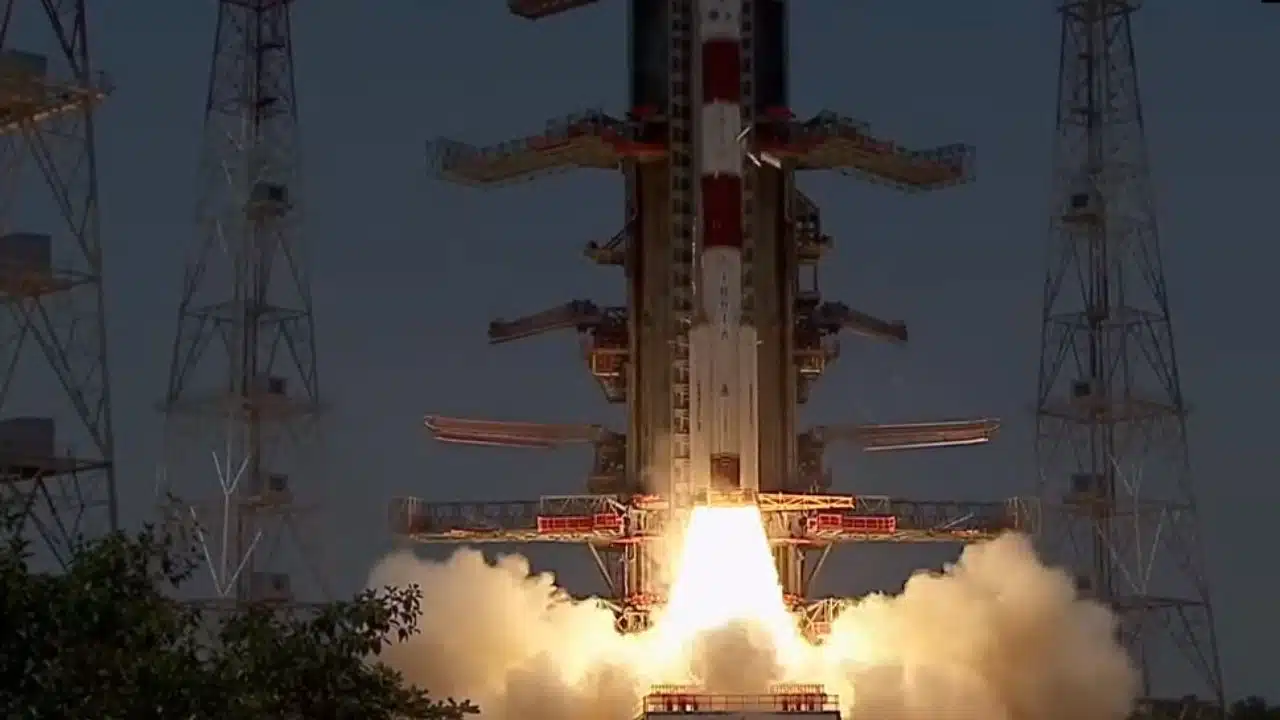
In a remarkable feat, India has achieved another milestone by launching its inaugural observation mission to the Sun, closely following its historic achievement of being the first nation to successfully land near the Moon’s southern pole.
The spacecraft, named Aditya-L1, took off from the launch pad in Sriharikota on a significant Saturday at 11:50 AM India time (06:20 AM GMT). Its voyage is set to cover a remarkable distance of 1.5 million kilometers (932,000 miles) from Earth, which corresponds to a mere 1% of the vast expanse between our planet and the Sun. The ambitious journey is anticipated to span four months in total.
This pioneering space mission, designed to study the largest entity within our solar system, is aptly named after Surya, revered as the Hindu deity symbolizing the Sun, often referred to as Aditya. The mission’s designation, Aditya-L1, also incorporates a reference to Lagrange point 1, denoting the specific region situated between the Sun and Earth where the spacecraft is bound.
In the realm of space exploration, a Lagrange point holds unique significance as it signifies a point where the gravitational pulls of two substantial celestial bodies, such as the Sun and the Earth, nullify each other. This phenomenon permits a spacecraft to maintain a stable position, akin to “hovering” in space.
Upon its arrival at this strategic “parking spot,” Aditya-L1 is poised to adopt an orbital path synchronized with the Sun’s movements, mirroring Earth’s orbit. The inherent stability of this position translates to minimal fuel requirements for the satellite’s operation, marking a significant stride in space efficiency and sustainability.
On a Saturday morning, a few thousand individuals converged in the specially designated viewing gallery arranged by the Indian Space Research Agency (Isro) adjacent to the launch site, eagerly awaiting the moment of liftoff.
The significant event was also showcased to the nation via live broadcast on national television, where enthusiastic commentators characterized the launch as “magnificent.” Isro’s team of scientists echoed the sentiment of success, asserting that the launch had unfolded seamlessly, and the spacecraft’s performance remained within the expected parameters.
After precisely an hour and four minutes of flight duration, Isro officially declared the mission as a resounding success. Addressing the gathered crowd, Isro Chief Sreedhara Panicker Somanath shared that the next phase of the journey entails a lengthy passage spanning 135 days. He extended well wishes, stating, “Now it will continue on its journey – it’s a very long journey of 135 days, let’s wish it [the] best of luck.”
Highlighting the broader significance, Project Director Nigar Shaji emphasized that once Aditya-L1 reaches its intended destination, its impact will transcend beyond India’s borders, serving the interests of the global scientific community.
Aditya-L1’s trajectory will encompass multiple orbits around the Earth before it embarks on its trajectory towards Lagrange point 1.
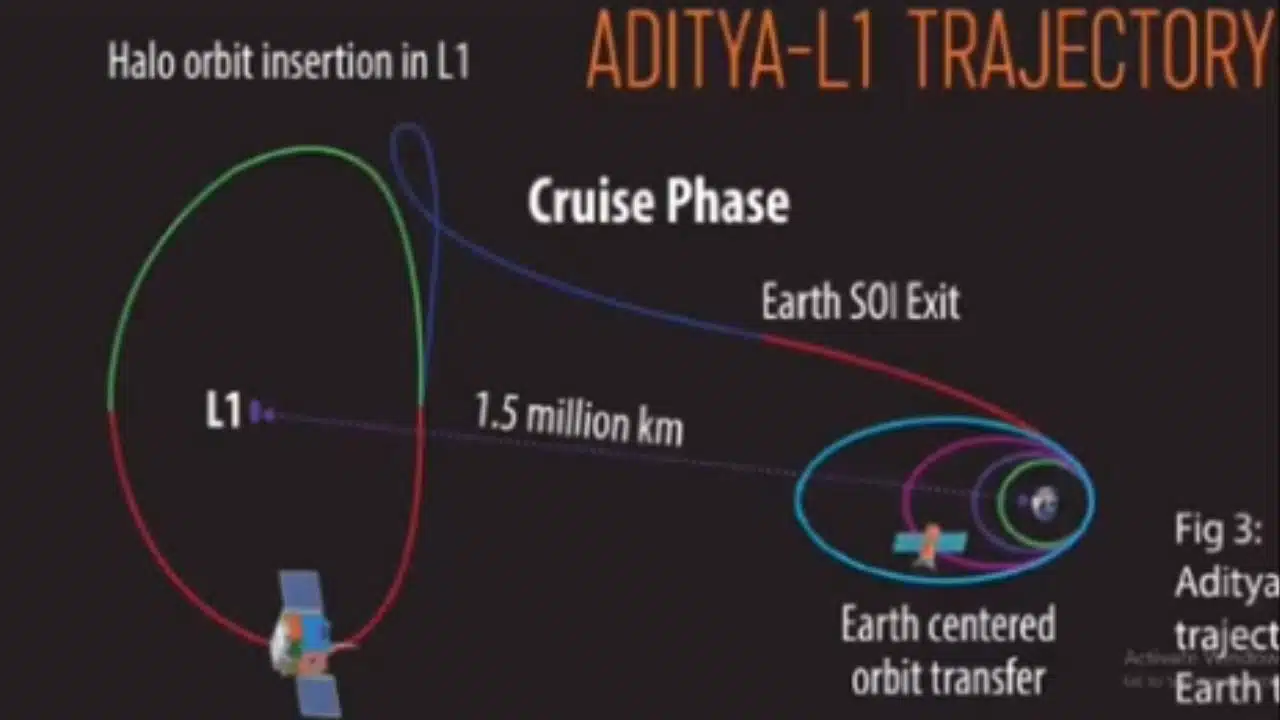
Once positioned there, the spacecraft will possess a unique vantage point that enables it to consistently observe the Sun, even during eclipses, facilitating a range of scientific investigations.
While Isro has refrained from disclosing the exact cost of the mission, reports within the Indian media have pegged the figure at 3.78 billion rupees ($46 million; £36 million).
Isro has revealed that the orbiter is equipped with seven advanced scientific instruments designed to meticulously observe and analyze various aspects of the Sun. These instruments are tailored to study the solar corona, the outermost layer; the photosphere, which constitutes the Sun’s visible surface; and the chromosphere, a thin plasma layer situated between the photosphere and the corona.
These comprehensive studies have a pivotal goal: to unravel the intricacies of solar activity encompassing phenomena such as solar wind and solar flares. By doing so, scientists aim to comprehend the Sun’s influence on Earth and the immediate space environment, known as near-space weather.
Former Isro scientist Mylswamy Annadurai underscores the profound impact of the Sun on Earth’s weather conditions, attributing it to radiation, heat, particle flows, and magnetic fields. He elaborates that this influence extends beyond Earth’s atmosphere, significantly affecting space weather.
The implications of space weather reverberate across various domains, including satellite functionality. Annadurai notes that solar winds or storms can potentially disrupt satellite electronics and even disrupt power grids. Acknowledging the existing gaps in understanding space weather, he highlights the significance of Aditya-L1’s mission.
In India, where over 50 satellites operate in space, their contributions are integral, serving vital roles such as communication links, weather data collection, and disaster prediction. According to the United Nations Office for Outer Space Affairs (UNOOSA), an impressive count of approximately 10,290 satellites populate Earth’s orbit, with almost 7,800 of them actively functioning.

The significance of Aditya-L1 transcends mere observation; it is poised to enhance our comprehension of the star that fundamentally sustains life on our planet. By offering advanced insights and early warnings, the mission could potentially safeguard satellites from impending solar events. This proactive approach, Mr. Annadurai contends, can potentially extend the operational life of satellites, contributing to a more resilient and sustainable space presence.
Above all, the mission is poised to significantly advance our scientific comprehension of the Sun – a celestial body that has been radiating for a remarkable 4.5 billion years, orchestrating the delicate equilibrium within our solar system.
Remarkably, India’s foray into solar exploration comes on the heels of another notable achievement: the successful touchdown of the world’s inaugural probe near the lunar south pole. This accomplishment propelled India into an exclusive league, as only the fourth nation globally to achieve a soft landing on the Moon. This esteemed club has hitherto been graced by the United States, the former Soviet Union, and China.
In a span of days, India has etched its name in history by making substantial strides in both lunar and solar exploration, reaffirming its prowess in the realm of space exploration.
If the Aditya-L1 mission achieves its objectives, India will earn a place among the exclusive cohort of nations actively engaged in the study of the Sun.
The journey of solar exploration commenced with Japan, which pioneered this field in 1981 by launching a mission focused on understanding solar flares. Subsequently, the United States’ space agency NASA and the European Space Agency (ESA) embarked on their solar scrutiny endeavors, initiating their observations in the 1990s.
In February 2020, a collaborative effort between NASA and ESA gave birth to the Solar Orbiter, a spacecraft designed to closely observe the Sun. This mission involves gathering critical data that holds the promise of unveiling the intricate mechanisms driving the Sun’s dynamic behavior.
In a monumental achievement in 2021, NASA’s groundbreaking spacecraft, the Parker Solar Probe, etched its name in history by becoming the first to venture through the Sun’s corona, its outermost atmospheric layer. This significant milestone in solar exploration adds another layer of understanding to the Sun’s enigmatic nature.
With the Aditya-L1 mission, India’s stride in solar research not only aligns with the efforts of these established players but also underscores the nation’s commitment to advancing scientific knowledge about the Sun’s profound impact on our solar system.