
In this era of cutthroat competition, it is extremely important to be aware of the real value of your business, whether you’re operating in major business hubs across the United States or in smaller markets. This value hinges heavily on business valuation. This reflects not just the potential buyers’ perspective but the decision-making of sellers too.
A proper valuation facilitates negotiations, builds confidence, and helps execute a sensible deal. For businesses seeking professional assistance, comprehensive business valuation services can provide the expertise needed to determine accurate market value. In this post we will take a deep dive into how an accurate business valuation affects the offers you receive as well as the process of completing your transaction.
The Basics of Business Valuation
Business valuation is the process of determining the economic value of a business. The business valuation can be based on a number of methods, and you will need to determine what you think your business is worth. Common methods that can be used include asset-based valuation, market value, and the income approach. By learning these methods, you can evaluate the financial health and growth potential of a company.
Influence on Buyer Perception
The success of buyers depends heavily on a good valuation for a business. To maintain confidence, a valuation report is required with proper documentation. Buyers tend to trust a company that knows what it brings to the table. It can open up the possibility for higher offers and a more seamless negotiation. Buyers may then begin to doubt the legitimacy of the asking price without a valuation, and, in turn, hesitate or drop out of the sale completely.
Impact on Seller Decisions
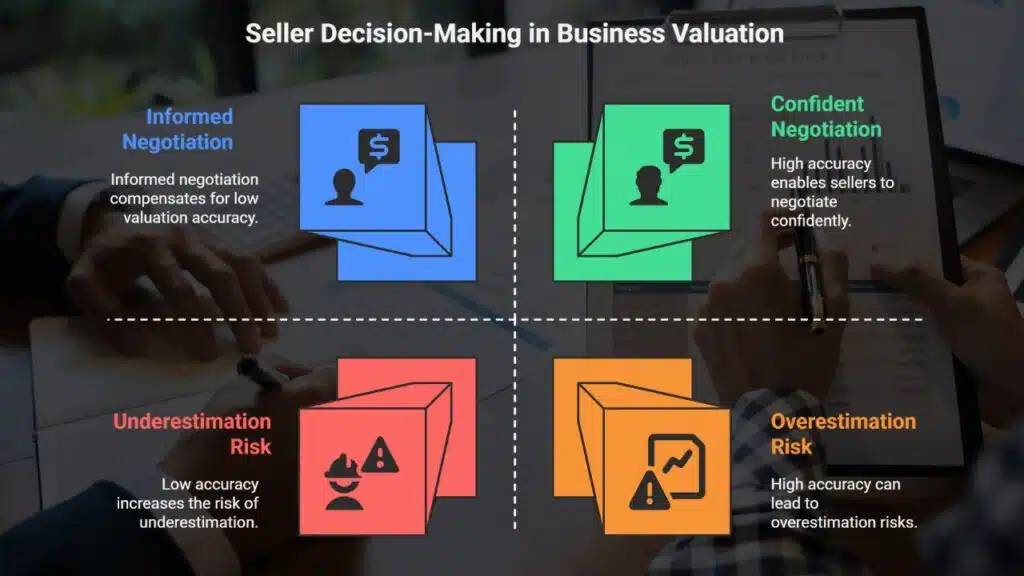
This provides sellers with the ability to determine realistic expectations. This is useful in establishing a starting point for the asking price, ensuring the business is not selling too low or too high. With this information in hand, sellers can negotiate from a stronger position. Knowing what your business is worth also provides you with a yardstick against which to compare offers and makes it possible for sellers to identify good and appropriate offers.
Negotiation Dynamics
During negotiations, business valuation serves as an important foundation. This information acts as support for both parties to validate their cases while finding a solution that works for everyone. Buyers can use a comprehensive valuation report to identify areas of the business that meet their strategic objectives. Sellers, on the other hand, can use it to highlight positives, such as recurring revenues or a dominant competitive position. An accurate valuation allows for productive discussions that help both parties negotiate from an educated point of view.
Ensuring Fairness and Transparency
Fairness in business transactions is essential across all industries. Accurate valuation ensures all parties have the same information on hand, according to established standards outlined by organizations like the American Society of Appraisers. This transparency prevents miscommunication and disputes. When everyone knows the true value of the business, they operate on a basis of trust and cooperation.
Guiding Investment Decisions
Business valuations are crucial for making informed decisions by investors. The accurate valuation allows them to gauge the potential profits and risks of an investment. Investors seek businesses that offer the best value and meet their financial objectives. A proper valuation report contains the information needed to determine if a business fits these criteria.
Influence on Financing Options
Business valuation is also a consideration for banks and financial institutions when deciding whether or not they will grant financing. A detailed valuation report can influence the terms and conditions of loans and credit facilities. Companies with proper valuations may be able to negotiate better financing terms. That can be vital for growth and expansion, providing access to better financing options.
Enhancing Strategic Planning
Business owners benefit significantly from having a clear sense of their company’s value when making strategic plans. Determining what you are worth provides visibility into areas of strength and weakness, which can serve as a basis for future growth strategies. It allows business owners to identify improvement areas and allocate resources effectively. Such a roadmap can make them more competitive and help ensure their long-term success.
Takeaways
When it comes to buying and selling businesses, accurate business valuation is one of the most critical components. It influences how buyers perceive you, how sellers make their decisions, and the negotiation phase as a whole. It affects the offers in numerous ways, including ensuring fairness and transparency, guiding investment decisions, and influencing financing options. By engaging professional valuators and understanding the real complexities behind accurate valuation, you will be better positioned to complete a successful transaction.