Account abstraction is the upgrade that finally makes crypto behave the way you expect modern technology to work. It transforms your wallet from a passive storage unit into an intelligent, programmable assistant that can protect your assets and simplify your daily tasks.
You know how frustrating it is to manage complex private keys or worry that one mistake could lose your funds forever. That fear is the single biggest barrier to entry for most people. Account abstraction removes this hurdle by introducing “Smart Accounts” that handle the heavy lifting for you.
The data shows this isn’t just a theory anymore. In 2024 alone, the ecosystem saw over 100 million “UserOperations” (the technical term for these smart transactions). This massive spike proves that users are actively moving away from clunky, old-school wallets toward these smarter solutions.
Let’s look at the data, what it actually tells us about the future of your wallet, and then explore practical ways you can start using these features today.
What is Account Abstraction?
Account abstraction (AA) changes the fundamental nature of a crypto wallet. It upgrades your account from a basic address that only holds funds into a smart contract that can execute code.
Definition and Explanation
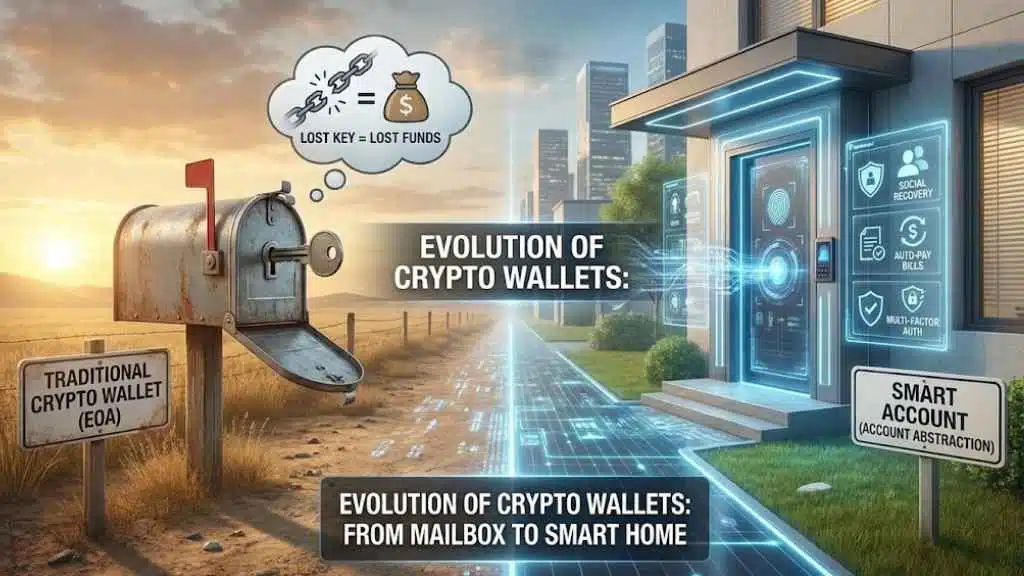
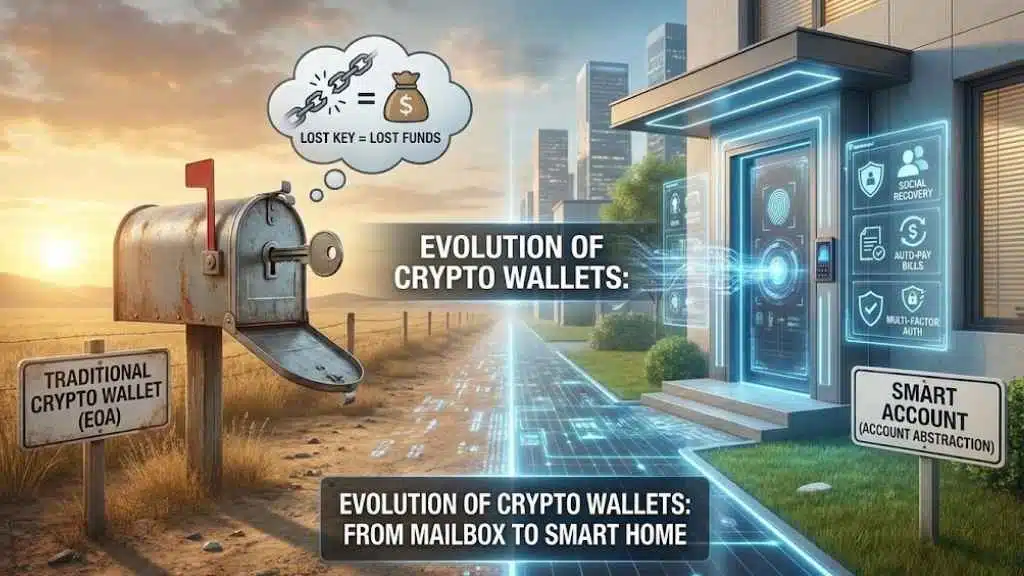
Think of a traditional crypto wallet like a physical mailbox. It has a slot for mail and a key. If you lose the key, you lose access to the contents forever. There is no customer support and no way to change the lock.
Account abstraction turns that mailbox into a smart home system. You can program it to open for your family, automatically pay bills, or lock itself down if it detects a burglar. In technical terms, AA separates the “signer” (your key) from the “account” (your wallet), allowing you to define your own security rules.
This shift relies on “Smart Accounts.” These are wallets controlled by code rather than just a private key. Because they are programmable, they can do things that were previously impossible on Ethereum, such as paying gas fees for you or recovering your account if you lose your phone.
How It Differs from Traditional Wallets
The industry distinguishes between two main types of accounts. Understanding this difference is key to seeing why AA is such a leap forward.
| Feature | Traditional Wallet (EOA) | Smart Account (Account Abstraction) |
|---|---|---|
| Control | Controlled by one private key. | Controlled by programmable logic (code). |
| Recovery | Impossible. Lose key = lose funds. | Flexible. Use social recovery or backup keys. |
| Gas Fees | Must pay ETH for every action. | Apps can pay for you, or you can pay in USDC. |
| Security | Single point of failure. | Multi-factor authentication (MFA) enabled. |
Most people today still use Externally Owned Accounts (EOAs), like a standard MetaMask setup. These are simple but unforgiving. Account abstraction allows you to move to Smart Contract Wallets (SCWs), like Safe (formerly Gnosis Safe) or Argent.
This upgrade is powered largely by ERC-4337. This standard allows these smart features to work on the Ethereum network without requiring a “hard fork” or major disruption to the blockchain itself.
Why Account Abstraction is Important
This technology is important because it solves the “usability crisis” in Web3. For years, experts have known that mass adoption is impossible if users have to write down 12-word seed phrases on pieces of paper.
Simplifying Blockchain Interactions
The complexity of blockchain tasks often drives users away. In a traditional setup, if you want to swap a token on a decentralized exchange, you often have to sign two separate transactions. One to approve the token and another to do the swap.
Account abstraction groups these steps into a single action. This is called a “batch transaction.” It saves you time and gas fees.
It also removes the “dust” problem. Usually, you need a specific amount of ETH to pay for gas. If you only have USDC in your wallet, you are stuck. With AA, you can pay for the transaction using the USDC you already have.
Enhancing User Experience in Web3
The goal is to make using a crypto app feel exactly like using a regular fintech app like Venmo or PayPal.
“The best user experience is one where the user doesn’t even know they are interacting with a blockchain.”
Major companies are betting on this. Visa, for example, has conducted experiments on the Ethereum Goerli testnet to demonstrate how users could pay gas fees directly with a credit card. This bridges the gap between traditional finance and the crypto world.
When you remove the technical friction, you open the door for the next billion users. They don’t need to understand “gas limits” or “nonce management.” They just need an app that works.
Key Features of Account Abstraction
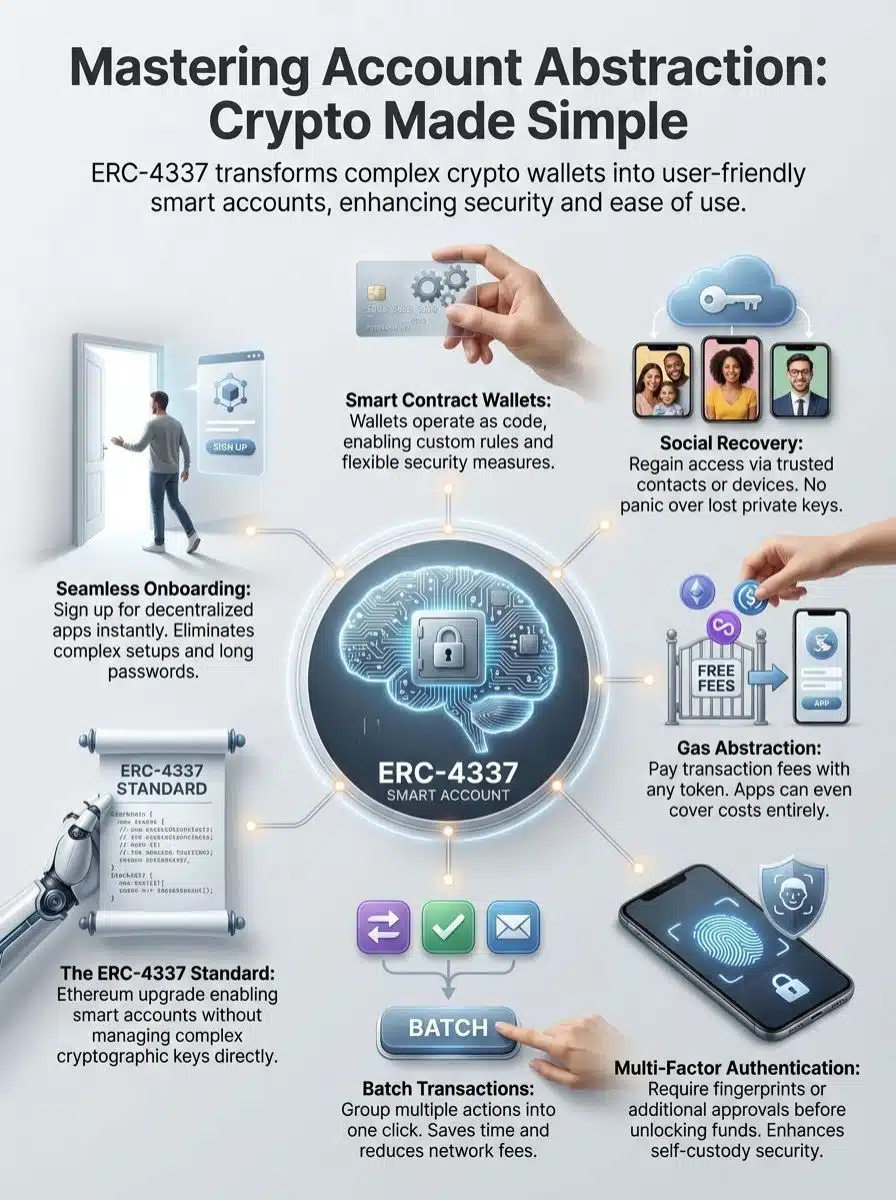
These features are not just theoretical concepts. They are tools you can use right now to secure your assets and save money.
Smarter Wallets with Custom Logic
Custom logic puts you in charge of your own security parameters. You can set up specific rules that act as a safety net for your funds.
- Spending Limits: Set a daily withdrawal limit (e.g., $1,000). If a hacker steals your key, they cannot drain your entire life savings in one go.
- Whitelisting: Allow transactions only to known addresses, like your cold storage wallet or a trusted exchange.
- Kill Switch: Freeze your account instantly from a different device if you detect suspicious activity.
Gas Abstraction for Fee Management
This feature uses a special component called a “Paymaster.” A Paymaster is a smart contract that agrees to pay the gas fees for a transaction on your behalf.
Data from 2024 reveals that 87% of all UserOperations used a Paymaster. This means the vast majority of people using these new wallets are enjoying sponsored or simplified transactions.
For developers, this is a game-changer. An app developer can now subsidize the first five transactions for a new user, effectively making the “onboarding” process free. This removes the awkward step where a new user signs up but can’t do anything until they buy ETH.
Social Recovery Mechanisms
Social recovery is the antidote to the “lost key” nightmare. Instead of relying on a piece of paper, you designate “Guardians.”
Guardians can be:
- Other hardware wallets you own.
- Trusted friends or family members.
- A third-party service or institution.
If you lose access to your account, you contact your Guardians. If a majority of them (e.g., 3 out of 5) confirm your identity, the smart contract generates a new key for you. You regain access without ever exposing your seed phrase.
Multi-Factor Authentication and Security
Smart accounts can integrate directly with the security hardware in your phone. You can configure your wallet to require a biometric scan (FaceID or fingerprint) to sign a transaction. This turns your phone’s “Secure Enclave” into a hardware wallet. This is significantly safer than typing a password or copying a private key, which can be captured by malware or keyloggers.
The Role of ERC-4337 in Account Abstraction
ERC-4337 is the technical standard that made all of this possible on the Ethereum mainnet. It launched on March 1, 2023, and serves as the backbone for the current wave of smart wallets.
Overview of the ERC-4337 Standard
Before ERC-4337, implementing account abstraction required changing the core protocol of Ethereum. This was risky and difficult. ERC-4337 bypassed this by building a “higher-layer” infrastructure.
It introduced a new object called a UserOperation (or UserOp). This looks like a transaction but contains more data.
These UserOps are sent to a separate waiting area called an “alt mempool.” This ensures they don’t clog up the main network until they are processed.
How It Enables Account Abstraction
The system relies on a few new players in the ecosystem to make the magic happen.
The New Power Players
- The Bundler: This actor collects UserOps from the mempool and “bundles” them into a single transaction to submit to the blockchain. Major bundlers include companies like Coinbase, Alchemy, and Pimlico.
- The EntryPoint: This is a global smart contract that verifies and executes the bundles. It acts as the gatekeeper, ensuring that the wallet has enough funds (or a Paymaster) to cover the cost.
- The Aggregator: This is a helper tool that validates signatures. It allows for advanced cryptography that is more efficient than the standard Ethereum signature scheme.
This structure allows developers to build wallets that are compatible with any EVM (Ethereum Virtual Machine) chain, including Polygon, Base, and Optimism. In fact, networks like Base and Polygon have seen some of the highest adoption rates because they offer low fees that make smart accounts very affordable.
Benefits of Account Abstraction
Moving to an account abstraction model offers tangible benefits that improve both your security and your sanity.
Improved Security and Flexibility
The “all or nothing” security model of traditional crypto is outdated. With smart accounts, you can layer your defenses.
For example, you can require multiple signatures for large transactions but allow single-click approval for small ones. This flexibility matches how we use money in the real world. You don’t show your ID to buy coffee, but you definitely do to buy a house.
Streamlined Transactions
We mentioned batching earlier, but the impact on everyday use is huge.
Imagine playing a Web3 game. In a normal wallet, you might have to sign a popup every time your character picks up an item. With “Session Keys” enabled by AA, you can sign once to start the game, and the wallet will automatically approve small, pre-defined transactions for the next hour.
Accessibility for Everyday Users
The biggest win is removing the need to hold ETH for gas. This has always been a major friction point.
If you want to send USDC to a friend, you shouldn’t need to check if you have $2 worth of ETH to pay the network. Account abstraction makes the “gas” concept invisible to the end user, just like you don’t pay a “server fee” every time you send an email.
Examples of Account Abstraction in Action
You might already be using account abstraction without realizing it. Several top-tier applications have integrated these features to smooth out the user journey.
Gasless TransactionsCyberConnect, a decentralized social network, used account abstraction to gain massive traction. They subsidized the gas fees for their users, allowing people to create profiles and post content without buying crypto first.
Similarly, Visa demonstrated a Paymaster solution where a user could pay gas fees using USDC on the Goerli testnet. This experiment proved that existing financial giants could easily plug into this infrastructure.
Batch Transactions for EfficiencyAmbire Wallet allows users to batch multiple actions. You can perform a “approve” and “deposit” into a DeFi protocol in one go.
Sequence Wallet, which is popular in web3 gaming, uses batching to ensure that gameplay isn’t interrupted by constant wallet popups. This creates a seamless experience that gamers expect.
The Future of Account Abstraction
While ERC-4337 was the breakthrough, the technology is evolving rapidly. We are already seeing the next phase of innovation that will make these features standard for everyone.
Potential for Broader Crypto Adoption
The next big step is EIP-7702. This is a proposal co-authored by Vitalik Buterin in May 2024.
EIP-7702 is designed to let regular wallets (EOAs) temporarily act like smart contracts. This means you wouldn’t need to create a brand new wallet to get these benefits. You could “upgrade” your existing address for a single transaction to enjoy features like batching or sponsored gas.
This creates a bridge for the millions of existing users to access smart features without the hassle of migrating their assets to a new address.
Integration with Artificial Intelligence and dApps
The combination of AI and Account Abstraction is powerful. Imagine an AI agent that manages your portfolio.
With a smart account, you could authorize an AI to trade on your behalf, but with strict limits encoded in the smart contract (e.g., “Only trade with 10% of my portfolio” or “Stop if losses exceed 5%”). The smart contract enforces the rules, so you don’t have to trust the AI blindly.
Final Thoughts
Account abstraction is more than just a technical upgrade; it is the shift that makes crypto usable for the rest of us. It replaces fear with control and complexity with convenience.
Whether you are a developer looking to build smoother apps or a user tired of managing seed phrases, the tools are ready. Wallets like Safe, Argent, and the new Coinbase Smart Wallet are already proving that you don’t have to sacrifice security for ease of use.
The best way to understand it is to try it. Download a smart wallet today and experience the difference of a “gasless” transaction for yourself.