Have you ever wondered what is the hardest language to learn in the world? Whether you’re a curious language enthusiast, a student planning your next challenge, or a professional expanding your skill set, this question comes up more than you might think — and the answer is more nuanced than a simple ranking.
The difficulty of learning a language depends on several factors: your native tongue, prior language experience, exposure to the target language, and your personal motivation. That said, linguists and language experts — particularly the U.S. Foreign Service Institute (FSI) — have spent decades cataloguing how long it takes native English speakers to reach professional proficiency in various languages. Their data gives us the most credible foundation for answering this question.
In this comprehensive guide, we’ll break down the top 10 hardest languages to learn, answer the most common questions about language difficulty, explore some easy languages to learn for contrast, and share actionable tips to help you actually succeed.
What Makes a Language Hard to Learn?
Before diving into the list, it helps to understand what factors make a language difficult in the first place. Linguists generally point to three core areas:
1. Writing System: Languages that use non-Latin scripts — such as Arabic (right-to-left), Chinese characters (logographic), or Japanese (three separate scripts) — demand significantly more time just to achieve basic literacy. This is one of the single biggest barriers for English speakers.
2. Grammar Complexity: Some languages have relatively simple grammar (no gendered nouns, no verb conjugation). Others have dozens of grammatical cases, complex verb aspects, or honorific systems that completely change word forms based on social context.
3. Phonology and Tones:Tonal languages like Mandarin and Vietnamese change the meaning of a word entirely based on pitch. Languages like Arabic also include guttural and pharyngeal sounds that simply don’t exist in English.
The FSI classifies languages into four categories based on learning hours needed for English speakers to reach general professional proficiency:
| FSI Category | Estimated Hours | Example Languages |
|---|---|---|
| Category I | 575–600 hours | Spanish, French, Italian |
| Category II | 750 hours | German, Indonesian |
| Category III | 900 hours | Hebrew, Russian, Hindi |
| Category IV | 2,200+ hours | Arabic, Chinese, Japanese, Korean |
Top 10 Hardest Languages to Learn in the World
1. Mandarin Chinese — The Undisputed #1
FSI Category: IV (2,200+ hours)
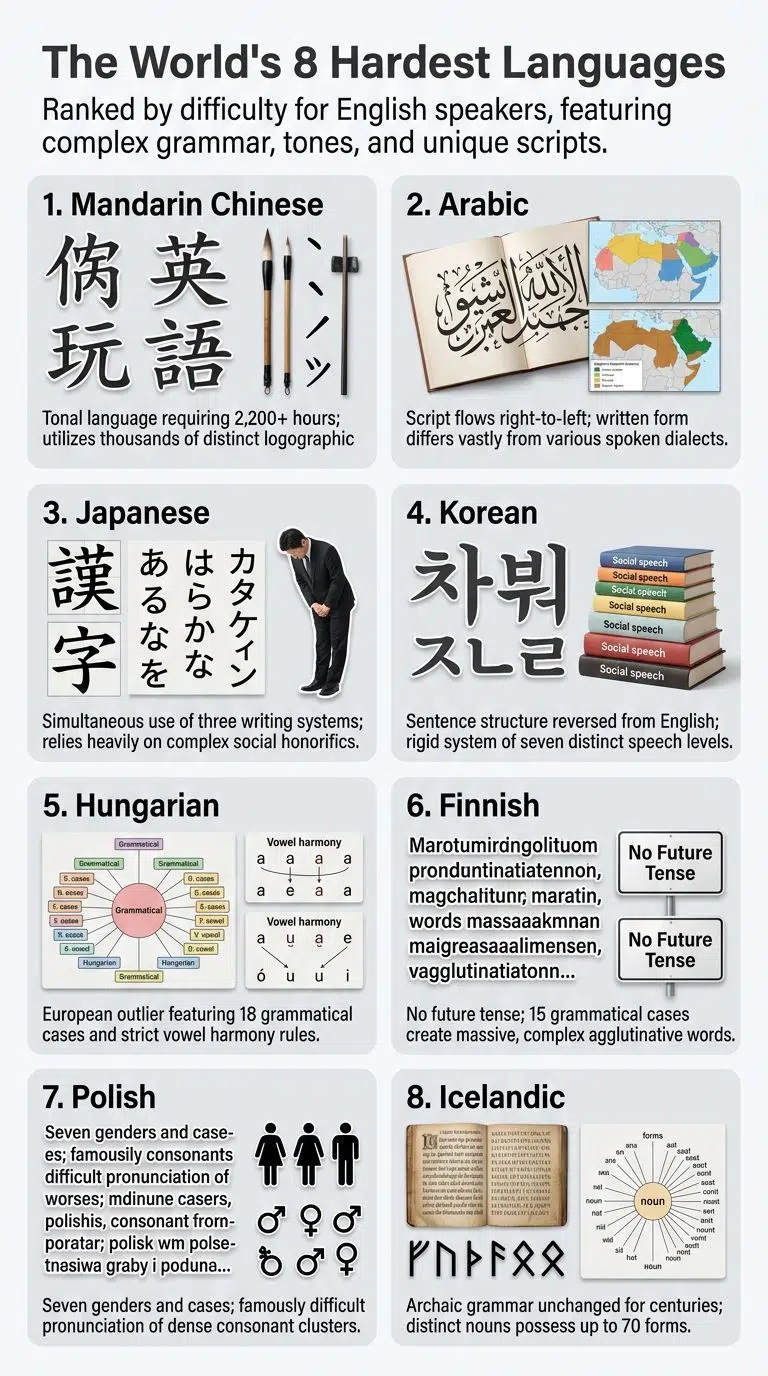
When people ask what is the most hardest language to learn, the overwhelming consensus among linguists, the FSI, and language teachers worldwide points to Mandarin Chinese. It consistently tops every credible ranking, and for good reason.
Mandarin is a tonal language with four distinct tones — flat, rising, falling-rising, and falling — plus a neutral tone. The syllable mā (妈) means “mother,” while mǎ (马) means “horse.” Say it with the wrong pitch, and you’ve said something entirely different.
Beyond tones, Mandarin uses a logographic writing system with over 50,000 characters. Basic literacy requires knowing at least 3,500. There is no alphabet, no phonetic clues in the written characters, and no grammatical overlap with English. Everything about it is foreign to an English speaker’s brain.
Key challenges:
- Four tones that change word meaning entirely
- No alphabet — thousands of characters must be memorized
- Simplified and Traditional Chinese variants
- Vast cultural context needed for full fluency
Despite its difficulty, Mandarin is spoken by over 1.1 billion people worldwide, making the payoff considerable. The growing importance of China in global business makes Mandarin one of the most valuable languages you can learn today.
2. Arabic — Complex, Beautiful, and Deeply Divided
FSI Category: IV (2,200+ hours)
Is Arabic hard to learn? Absolutely — and it’s hard in multiple dimensions simultaneously. Arabic is written right to left, the letters change shape depending on their position in a word, and the script doesn’t always show short vowels, meaning you need context to read correctly.
But the grammar is perhaps the most challenging aspect. Arabic builds words from three-consonant roots, and meaning shifts dramatically based on the vowel patterns applied to those roots. The verb system includes dual forms (separate from singular and plural), and the gender system applies to all nouns.
Then there’s the dialect problem. Modern Standard Arabic (MSA) — the formal written form — is barely spoken in everyday life. Each Arab country has its own dialect: Egyptian Arabic, Levantine Arabic, Gulf Arabic, Maghrebi Arabic. They are sometimes mutually unintelligible. This means learning Arabic effectively requires mastering MSA and a regional dialect.
Key challenges:
- Right-to-left script with shape-changing letters
- Root-based morphology creating enormous word families
- Vast difference between written and spoken Arabic
- Multiple dialects that can be mutually unintelligible
3. Japanese — Three Writing Systems, One Enormous Challenge
FSI Category: IV (2,200+ hours)
Japanese is unique in its complexity because it requires mastery of three separate writing systems simultaneously:
- Hiragana — a syllabic alphabet of 46 characters for native Japanese words
- Katakana — a parallel syllabic alphabet for foreign loan words
- Kanji — thousands of logographic characters borrowed from Chinese
A single sentence in Japanese can use all three systems at the same time. For daily reading and writing, you’ll need around 2,000 kanji characters, and educated Japanese speakers know closer to 4,000.
On top of that, Japanese has an intricate honorific system called keigo, which changes the entire vocabulary and verb forms depending on the social relationship between speakers. Casual speech, polite speech, and formal speech are almost like three sub-languages within one.
Key challenges:
- Three writing systems used simultaneously
- Complex honorific speech levels (keigo)
- Sentence structure is Subject-Object-Verb (opposite of English)
- Context-heavy communication with many implied subjects
4. Korean — A Language Isolate With Rigid Social Codes
FSI Category: IV (2,200+ hours)
Is Korean hard to learn? Yes — and it’s harder than many expect, especially given the popularity of K-dramas and K-pop, which have inspired millions to start learning. Korean is a language isolate, meaning it has no established genetic relationship to other major language families. You can’t leverage Spanish, French, or even Japanese knowledge to shortcut your way through.
Korean’s sentence structure is Subject-Object-Verb, the complete reverse of English. Verbs come at the end of the sentence, and you must adjust them based on the social status and age of who you’re talking to — a system called speech levels. There are seven distinct speech levels, and using the wrong one in the wrong situation is a serious social mistake.
The writing system, Hangul, is actually phonetically logical and surprisingly learnable (you can master the alphabet in a day). But the vocabulary, grammar, and social nuance make Korean a long-term investment.
Key challenges:
- SOV sentence structure (reversed from English)
- Seven honorific speech levels
- Verb endings change based on social context
- Completely alien vocabulary with no Latin or Germanic roots
5. Hungarian — The European Outlier
FSI Category: III–IV (~1,100+ hours)
Hungarian stands as one of the hardest languages in Europe, and it’s a genuine outlier — a Uralic language in a continent dominated by Indo-European tongues. It shares almost no vocabulary with English and features an astonishing 18 grammatical cases.
These cases mean that nouns take different suffixes depending on their role in the sentence (subject, object, direction, location, etc.). The vowel harmony system adds another layer: suffixes change their vowels based on the vowel sounds in the root word. It’s a system that feels totally alien to English speakers.
Key challenges:
- 18 grammatical cases
- Vowel harmony rules
- Completely unfamiliar vocabulary
- Agglutinative structure (words built by chaining suffixes)
6. Finnish — Elegant but Exhausting
FSI Category: III–IV (~1,100+ hours)
Like Hungarian, Finnish is a Uralic language with 15 grammatical cases and a highly agglutinative structure. A single Finnish word can carry the meaning of an entire English phrase.
Finnish has no future tense — context determines time. It has no articles (no “the” or “a”). And its vocabulary has almost zero overlap with English. The pronunciation is regular and logical, which is a rare mercy, but the grammar demands intense dedication.
Key challenges:
- 15 grammatical cases
- Agglutinative word formation creates very long words
- No shared vocabulary with English Complex consonant gradation rules
7. Polish — The Hardest Slavic Language
FSI Category: III (~900+ hours)
What is the second hardest language to learn? Many linguists would put Polish close to the top. It uses the familiar Latin alphabet, which seems encouraging at first — but the grammar complexity quickly humbles even confident learners.
Polish has 7 grammatical cases and 7 grammatical genders (a concept that doesn’t exist in English). Pronunciation is notoriously difficult, with clusters of consonants that feel physically uncomfortable for English speakers — words like szczególnie (especially) or bezwzględny (ruthless) give even advanced students trouble.
Interestingly, research has shown that average Polish native speakers achieve full fluency in their language at around age 16, compared to age 12 for English speakers — a testament to the language’s inherent complexity.
Key challenges:
- 7 cases and 7 genders
- Extremely difficult consonant clusters
- Verb aspect pairs (perfective vs. imperfective)
- Free word order that still requires case accuracy
8. Icelandic — Frozen in Viking-Age Grammar
FSI Category: III (~900+ hours)
Icelandic has changed remarkably little since the Viking Age. While other Nordic languages like Danish and Norwegian have simplified over centuries, Icelandic preserved its archaic grammar — making it a fascinating but formidable challenge.
A single Icelandic noun can take up to 70 different forms depending on case, number, and definiteness. The vocabulary is also highly puristic — instead of borrowing foreign words for new technologies, Icelandic creates entirely new words from Old Norse roots. The word for “computer,” for example, is tölva — a blend of Old Norse words meaning “number” and “prophetess.”
Key challenges:
- Archaic grammar preserved from Old Norse
- Nouns with up to 70 inflectional forms
- Highly specific vocabulary with no loan words
- Very limited learning resources outside Iceland
9. Georgian — The Ancient Caucasian Enigma
FSI Category: III (~900+ hours)
Georgian is one of the world’s oldest literary languages, with a script dating to the 5th century. It belongs to the Kartvelian language family — a completely isolated family unrelated to any major world language group.
Georgian consonant clusters are legendary in their density. The word gvprtskvni — meaning “you peel us” — has no vowels at all. Verbs in Georgian can encode subject, object, indirect object, tense, and aspect all simultaneously within a single word. It’s a fascinating linguistic system, but one that demands enormous patience.
Key challenges:
- Unique, non-Latin script
- Dense consonant clusters (sometimes no vowels)
- Highly complex verb system encoding multiple relationships
- Completely isolated language family
FSI Category: IV (difficulty comparable to top-tier languages)
Navajo is a polysynthetic language of the Na-Dené family, spoken by the Navajo Nation in the American Southwest. Its complexity is so unique that it was used as a military code during World War II — and the Japanese never cracked it.
Navajo verbs are extraordinarily complex, capable of encoding vast amounts of information — who is doing what to whom, the shape of an object, the direction of movement, and the manner of an action — all within one word. There is no simple equivalent in any European language.
Key challenges:
- Polysynthetic structure (entire sentences in one word)
- Four tones plus nasalization
- Verb complexity unlike any Indo-European language
- Extremely limited learning resources
Honorable Mentions: Also Extremely Difficult
Beyond the top 10, several other languages deserve recognition:
Is Hebrew Hard to Learn?
Yes. Hebrew is an FSI Category III language requiring around 1,100 hours for English speakers. Like Arabic, it uses a right-to-left script, root-based morphology, and doesn’t typically write short vowels. However, its relatively small vocabulary and the strong global community of learners make it more accessible than Arabic. Modern Hebrew (revived in the 20th century) is also more standardized than Arabic.
- Vietnamese: A tonal Southeast Asian language with six tones and a complex regional dialect divide.
- Thai: Five tones, a unique script, and no spaces between words.
- Turkish: Highly agglutinative with vowel harmony and SOV structure, though its consistency makes it somewhat learnable with dedication.
Rare Languages: The Ultimate Linguistic Frontiers
If the top 10 aren’t challenging enough, some rare languages take difficulty to another level entirely due to extreme structural complexity combined with near-zero learning resources:
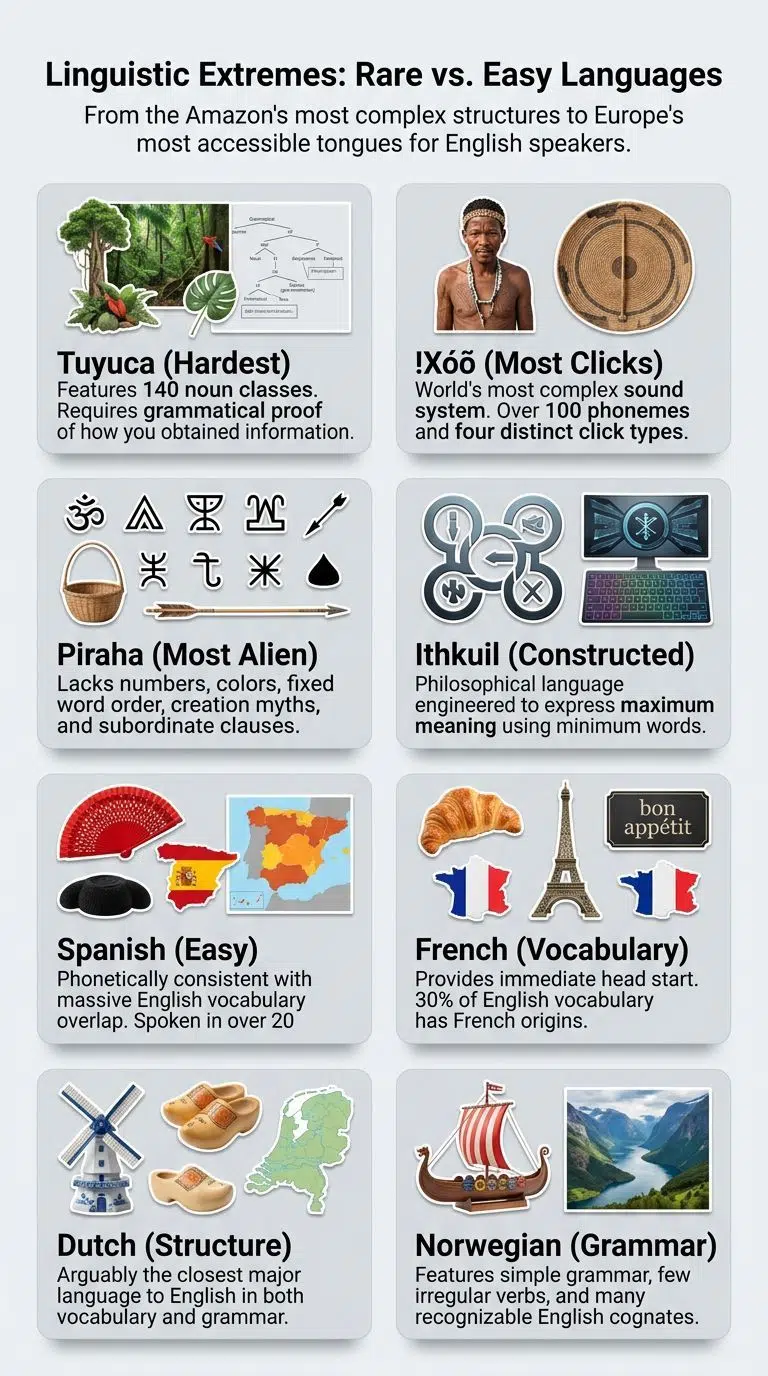
- Tuyuca (Amazon Basin, Brazil/Colombia) — Has over 140 noun classes and requires you to grammatically indicate how you know what you’re saying (whether you witnessed it, heard it, or inferred it). Often cited by linguists as one of the most complex languages ever documented.
- Ithkuil — A constructed philosophical language designed to express maximum meaning with minimum words. While not a natural language, it’s studied as a linguistic extreme.
- !Xóõ (Botswana/Namibia) — A Khoisan language with over 100 phonemes including four different types of click sounds. Its sound system alone is considered the most complex of any known language.
- Piraha (Amazon, Brazil) — Has no numbers, no colors, no fixed word order, no subordinate clauses, and no creation myths. Its structure is so alien it has sparked fierce academic debate.
Easy Languages to Learn: The Other End of the Spectrum
For balance, let’s look at easy languages to learn — specifically for native English speakers. FSI Category I languages (575–600 hours to proficiency) share vocabulary, grammar patterns, or both with English:
- Spanish: Phonetically consistent, huge vocabulary overlap with English, and widely spoken across 20+ countries. Is Spanish a Romance language? Yes — it evolved from Latin, as did French, Italian, Portuguese, and Romanian. This shared Latin heritage is precisely why Romance languages are among the most accessible for English speakers.
- French: Roughly 30% of English vocabulary has French or Norman French origins, giving beginners an immediate head start.
- Italian: Often considered the most phonetically beautiful and phonetically regular of the Romance languages.
- Portuguese: Especially Brazilian Portuguese, which has a vast content ecosystem and a large speaker community for practice.
- Dutch: Arguably the closest major language to English in both vocabulary and grammar structure.
- Norwegian: Simple grammar with few irregular verbs, and many English cognates.
How to Learn a New Language: Practical Strategies for Any Difficulty Level
Whether you’re taking on Mandarin or starting with Spanish, these evidence-based strategies will help you succeed.
1. Start with the FSI Data: Know what you’re getting into. If you’re committing to Arabic, plan for 2,200+ hours over several years. Realistic expectations prevent burnout.
2. Build a Daily Habit, Not a Weekly Marathon: Language acquisition works best with consistent daily exposure — even 20–30 minutes per day beats a 3-hour weekend session. Spaced repetition locks vocabulary into long-term memory.
3. Prioritize Speaking Early: Many learners delay speaking because they fear mistakes. Research shows the opposite approach works better: speaking early, even imperfectly, accelerates fluency by forcing your brain to actively retrieve language rather than passively absorb it.
4. Immerse Through Content: Watch TV shows, listen to podcasts, read news — all in your target language. This develops intuition for grammar and pronunciation that textbooks can’t replicate. For hard languages, even watching dubbed content in the target language helps.
5. Use Spaced Repetition Software (SRS): Apps like Anki use algorithms to show you vocabulary at the optimal moment before you’d forget it. For logographic languages like Japanese and Chinese, SRS is essentially mandatory.
6. Find Native Speaker Partners: Language exchange apps and platforms connect you with native speakers who want to learn your language in return. Real conversation with real humans is irreplaceable.
7. Learn the Culture: Language and culture are inseparable. Understanding the social context behind Japanese keigo or Korean honorifics makes them far more intuitive than memorizing rules in isolation.
Frequently Asked Questions (FAQs)
What is the hardest language to learn in the world?
Based on FSI data and linguistic consensus, Mandarin Chinese is widely considered the hardest language to learn in the world for native English speakers, requiring approximately 2,200 hours to reach professional proficiency. Arabic and Japanese are close competitors.
What is the second hardest language to learn?
Arabic and Japanese are typically ranked second and third after Mandarin, both requiring 2,200+ FSI hours. Polish, Hungarian, and Georgian are often cited as the hardest non-Asian languages to learn.
Is Korean hard to learn?
Yes. Korean is an FSI Category IV language requiring approximately 2,200 hours of study. Its inverted sentence structure, complex honorific system, and completely alien vocabulary make it a serious challenge for English speakers — despite the accessibility of its Hangul alphabet.
Is Arabic hard to learn?
Yes. Arabic is one of the two or three hardest languages for English speakers. Its right-to-left script, root-based morphology, complex dialect landscape, and guttural phonology all contribute to its difficulty.
Is Hebrew hard to learn?
Hebrew is challenging but somewhat more manageable than Arabic. It’s an FSI Category III language (~1,100 hours). The script and root-based structure are demanding, but Modern Hebrew has a smaller vocabulary and more standardized grammar than Arabic.
What are easy languages to learn for English speakers?
The easiest languages for English speakers are Spanish, French, Italian, Portuguese, Dutch, and Norwegian — all FSI Category I or II languages requiring 575–750 hours of study.
Is Spanish a Romance language?
Yes. Spanish is a Romance language, meaning it descended from Latin. The other major Romance languages are French, Italian, Portuguese, Romanian, and Catalan. This shared heritage gives English speakers a significant vocabulary advantage when learning any of them.
What are some rare languages that are extremely difficult?
Among rare languages, Tuyuca (Amazon), !Xóõ (Khoisan), and Piraha (Amazon) are considered some of the most structurally complex languages ever documented by linguists.
Final Thoughts
So, what is the hardest language to learn? The honest answer is: it depends on who you are — but for most native English speakers, Mandarin Chinese, Arabic, and Japanese consistently top the list. Their unfamiliar writing systems, tonal or root-based structures, and vast cultural context requirements make them the most demanding linguistic challenges a learner can take on.
But here’s the truth that every polyglot eventually discovers: no language is truly unlearnable. Millions of people around the world are fluent in Mandarin, Arabic, and Japanese as second or third languages. With the right strategy, realistic expectations, daily consistency, and genuine motivation, you can conquer even the most difficult language in the world.
The hardest language to learn isn’t necessarily the one that’s objectively most complex — it’s the one you give up on. Choose a language you love, a culture that moves you, and a goal that keeps you going on the hard days. That’s the only formula that really matters.