

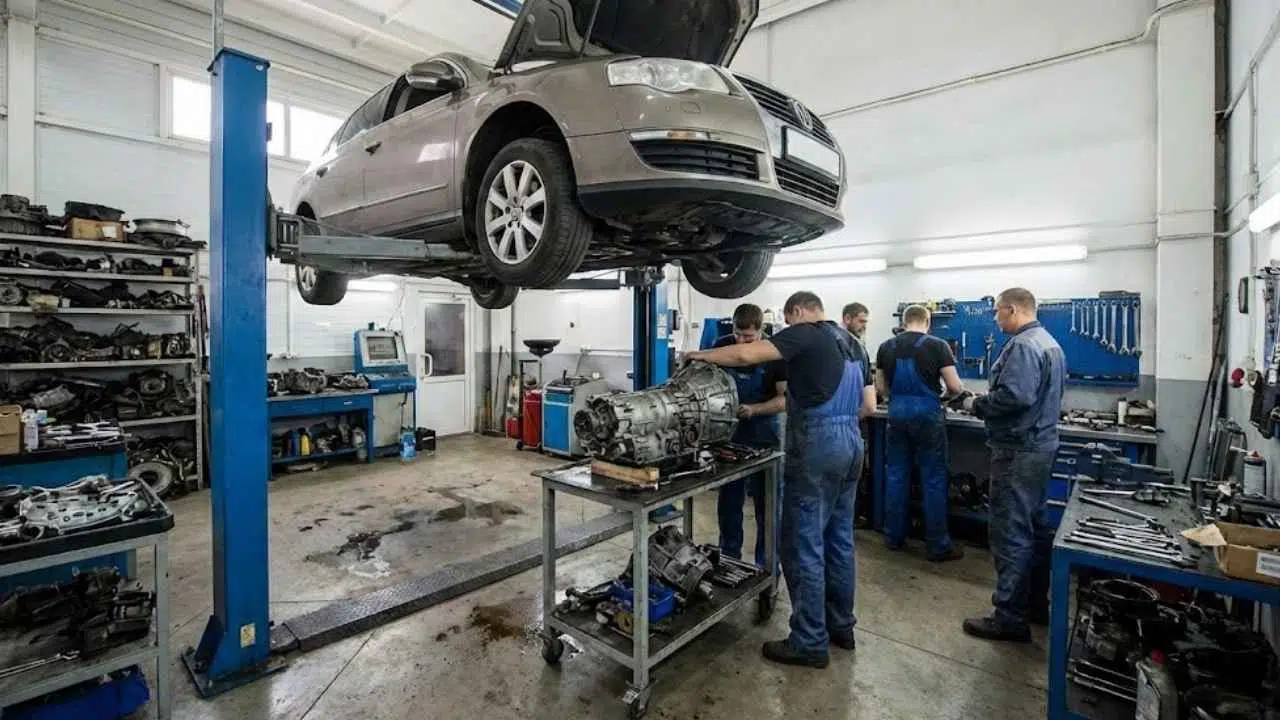
Engines get the headlines, but transmissions quietly carry just as much responsibility. When one fails, the bill often shocks people, not because mechanics are inflating prices, but because the transmission is one of the most complex systems in the vehicle.
It isn’t a single part. It’s a tightly packed network of gears, clutches, hydraulics, electronics, and precision tolerances that all have to work in perfect sequence. When something inside breaks, you’re not replacing a component. You’re repairing a mechanical ecosystem. That complexity is where the cost begins.
A transmission lives on friction
A transmission works by parts inside it constantly grabbing and letting go. Every time the car shifts, those pieces rub together on purpose.
It’s designed for that, but the wear never stops. Little by little the surfaces thin out. After enough time, the system just can’t grip the way it used to. Over time, those friction surfaces thin out, and the system loses its ability to hold power smoothly.
Every shift is a controlled slip. Day by day, those friction materials wear, fluid degrades, and heat rises up. Tiny particles circulate through the system. None of this is dramatic at first. The car still drives. The shifts feel mostly normal. But internal wear is accumulating with every kilometer.
By the time a driver notices slipping or harsh shifting, the damage has usually been developing for months. And once wear reaches a tipping point, it spreads quickly.
Heat is the real enemy
Transmission fluid does more than lubricate. It cools and carries away microscopic debris. It cushions internal components. When fluid ages or drops below proper levels, temperatures rise.
Heat hardens seals. It burns clutch material and it thins lubrication. Once fluid overheats, it loses protective ability, which causes even more heat. The cycle feeds itself.
Drivers rarely notice overheating. There’s no loud warning. The transmission simply starts aging faster than it should. By the time symptoms appear, internal surfaces may already be scorched beyond recovery.
Modern transmissions are packed tight
Older gearboxes were simpler. Modern ones are engineering puzzles. To improve fuel economy and performance, manufacturers design transmissions with more gears, tighter packaging, and integrated electronic control. The result is efficiency, but also density.
Everything inside sits closer together. Tolerances shrink. Repair access becomes harder. A technician can’t swap one piece easily. The entire assembly often has to come out of the vehicle and be disassembled on a bench.
Labor hours multiply. Transmission repair isn’t just parts cost. It’s precision labor. Each component must be measured, cleaned, inspected, and reassembled with exact clearances. One mistake ruins the rebuild. You’re paying for expertise as much as hardware.
Diagnosis alone is expensive
Transmission problems are rarely obvious. A slipping shift might be fluid. It might be electronics. It might be internal mechanical wear. Modern transmissions depend on sensors and control modules as much as gears. A failure can hide inside software or wiring as easily as inside metal.
Technicians spend hours diagnosing before repair even begins. That diagnostic time protects the customer from unnecessary work, but it adds cost. Unlike simple mechanical repairs, transmission troubleshooting requires specialised tools and knowledge. Shops invest heavily in training and equipment to handle it. The complexity shows up on the invoice.
Partial repairs rarely exist
Engines sometimes allow targeted fixes. Transmissions rarely do. If a gearbox is opened, most professionals recommend replacing multiple wear components at once. It doesn’t make sense to rebuild half a transmission and leave aging parts inside. The labor to access the system is too significant.
So a “small” failure becomes a full rebuild. From a reliability standpoint, that’s smart. From a financial standpoint, it’s heavy. Customers aren’t paying for the broken part alone, they’re paying to restore the entire system to safe operating condition. And that scale changes the price dramatically.
The vehicle’s value becomes part of the equation
This is where transmission failure stops being purely mechanical. A rebuild might make perfect sense on a newer vehicle. On an aging car, the numbers get complicated. The transmission can be restored, but the rest of the vehicle keeps its original mileage.
Suspension, electronics, cooling systems, and engine wear don’t reset. Owners aren’t just fixing a gearbox. They’re deciding how much life remains in the whole car. Sometimes the repair cost approaches the vehicle’s resale value. That’s the moment the decision shifts from repair to economics. It’s not about whether the transmission can be fixed, It’s about whether it should be.
Why many cars exit instead of rebuilding
When repair costs climb too close to market value, vehicles move into a different lifecycle stage. They stop being daily transportation investments and become material assets. That’s where industries built around car removal and cash for cars operate. These services exist because many vehicles reach a point where rebuilding major systems no longer makes financial sense.
For drivers evaluating options in large cities, the cash for cars Sydney market represents that transition. Instead of pouring thousands into a declining vehicle, owners convert it into immediate value and step out of the repair cycle.
Transmission failure feels sudden, but it isn’t
Like most major failures, transmission collapse is gradual. Shifts become slightly delayed. There is a time when engagement feels rough, the fluid’s color gradually changes, and drivers adapt to it. They normalise the change because the car still moves. The warning phase can last a long time.
Then one day it stops cooperating entirely. What feels sudden is actually the final step in a long progression. By the time the transmission refuses to shift, internal damage has been accumulating quietly for months or years.
Complexity equals cost
When the transmission fails, there is an expensive cost that involves complex systems, precise, and expert. You’re not paying for a simple part replacement. You’re paying to rebuild one of the most intricate assemblies in the vehicle.
Heat, friction, aging fluid, and mechanical wear all contribute. Once failure crosses a threshold, restoration requires time, skill, and full-system replacement of worn components.
There’s no shortcut version of a proper transmission repair. And when that reality collides with vehicle age, the decision becomes bigger than the gearbox itself.
Understanding the price changes the conversation
Understanding what lives inside that metal housing changes perspective. The cost isn’t arbitrary. It reflects engineering density, labor precision, and the risk of doing the job incorrectly. A transmission is a compact factory of moving parts. When it fails, repairing it means rebuilding that factory by hand.
And sometimes, knowing that helps owners step back and evaluate the bigger picture, not just the repair in front of them, but the future of the vehicle around it. Because expensive repairs aren’t just mechanical events, they’re decision points.

























