Do you ever feel like your brain is jumping from one thing to another at work? Phones buzz, emails stack up, and coworkers chat nearby. It gets hard to focus even for five minutes straight. You are not the only one feeling this way. In fact, research from the University of California, Irvine found that the average attention span on a screen is now just 47 seconds.
Many of us want to do our best work, but distractions make it tough. Deep work helps people get more done and be happier on the job. Working with real focus lets you solve tricky problems and finish important tasks faster. I found that mastering this skill changed my entire career. This post will show simple ways to build deep concentration in a busy office.
So, grab a cup of coffee. I am going to walk you through the exact steps I use, and I think you’ll be surprised at how easy it can be. Your better workflow starts here!
What is Deep Work?
Deep work means working with strong focus and blocking out all distractions for long stretches. Cal Newport’s 2016 book, “Deep Work: Rules for Focused Success in a Distracted World,” shines a light on this skill. It takes your mind to its peak. This lets you master hard tasks and create things that hold real value. You sit down, shut out noise, and push your brain’s limits until everything else slips away.
Nothing buzzes or pings while you’re in deep work mode. Phones go silent and email tabs close. This is the state where time blurs because you engage so fully. It is often called “flow.”
Deep work boosts happiness and productivity by allowing you to tackle complex problems with clear concentration. Modern offices often make deep work rare. But learning it can turn average days into creative bursts of progress that shape careers.
“The ability to perform deep work is becoming increasingly rare at exactly the same time it is becoming increasingly valuable in our economy.” – Cal Newport Companies like Basecamp have famously implemented “Library Rules” to support this. Everyone works in silence like they are in a library, ensuring that deep focus is the default rather than the exception.
Why Deep Work Matters in a Distracted Office

Deep work gives your brain space to think, create, and solve problems without interruptions. In a busy office filled with noise and pings, these focused moments are pure gold for getting real work done.
Increased productivity
Blocking out distractions helps you produce more in less time. In a focused state, your brain works at full speed. Tasks feel easier and progress happens quickly.
Working without interruptions helps you reach what experts call flow. Time seems to disappear because you are locked into the task. A report by productivity researchers found workers lose up to 2 hours a day from digital distractions alone.
The cost of this lost time is massive. Kickidler reported that distracted employees cost US businesses upwards of $650 billion annually. Deep work flips the script. It turns lost minutes into solid achievements.
It can mean finishing projects days ahead or solving tricky problems before lunch rolls around. This leaves space for fresh ideas and maybe even an early coffee break.
Enhanced creativity
Cutting out distractions lets your brain wander and play with ideas. Deep work pushes your mind to its limits. This helps you spot new connections that are easy to miss in a noisy office.
People who master deep focus often produce things of real value. This includes creative solutions or bold designs. Studies back this up. Workers create better work while in flow states where time just slips by.
Long stretches of mindful attention help you enter a mental zone called “flow.” In this state, you can blend skills and insights in ways that surprise even yourself.
Big companies like Google encourage quiet working hours for this reason. Open-ended problems need clear concentration for the best results. Creative sparks come easier when there is less pinging from email or chat apps.
Improved focus on complex tasks
Tackling hard projects takes serious concentration. Deep work lets you block out distractions and zone in on each step. Big tasks stop feeling scary or out of reach.
Time seems to slip away during deep focus. The brain works at full power, making learning and problem-solving smoother. Building this skill helps with cognitive performance on complex jobs.
In 2026’s fast-paced offices, dropping into a flow state is like turning on headlights in thick fog. Everything becomes clearer. A key study by Gloria Mark at UC Irvine revealed it takes an average of 23 minutes and 15 seconds to get back on track after a distraction.
This data shows why “quick checks” of your email are so damaging. Setting clear goals makes it easier to manage priorities and finish every demanding part with confidence.
Challenges to Deep Work in Modern Offices
Modern offices can feel like a circus. They are full of noise and distraction that make it hard to truly concentrate. Read on to find out how you can master focus in all this chaos.
Open office layouts
Open office layouts fill the room with chatter, shuffling feet, and bright screens. Each sound slices through concentration like a car alarm at midnight.
A 2024 Global Workplace Survey by Gensler found that 55% of offices are described as “noisy.” Furthermore, 69% of workers in those environments report that noise negatively impacts their concentration.
It becomes tough to do deep work or reach a flow state when you can hear every phone call or keyboard tap around you. People working in these spaces may find it hard to master difficult skills fast.
Minds crave clarity and calm for deep thinking. Open offices chip away at both with each new distraction. Even small disruptions break momentum and stretch out simple jobs.
Digital distractions
Phones buzz, emails ping, and chat apps never stop. In a typical office, each tap and notification chips away at concentration.
A recent DemandSage report highlights that the average user spends 90 minutes actively working on Slack every day. With over 1.5 billion messages sent weekly on the platform, the volume of interruption is staggering.
Quick glances can spiral into lost minutes or hours. This shrinks time for deep work. Social media feeds tempt your brain with fast rewards while urgent pop-ups pull focus from tasks that demand heavy thinking.
Deep work needs distraction-free zones to push cognitive limits and reach flow states where ideas really spark. Guarding your workflow is like building a fence around your best thinking time.
Always-on work culture
Work never seems to stop. Messages buzz, emails ping, and meetings fill up calendars long after five o’clock. The pressure to answer right away pulls focus from deep work.
An Asana “Anatomy of Work” report revealed that knowledge workers spend 60% of their day on “work about work.” This includes chasing status updates and sitting in unnecessary meetings.
Minds stay on high alert as tasks spill into personal moments and weekends. Deep concentration becomes rare in this environment. People feel drained without time to recover or disconnect fully.
Stress rises while creativity drops. This makes it tough for anyone to reach a flow state or do their best thinking. This constant engagement keeps everyone busy but chips away at true productivity.
Lack of boundaries and recovery time
Staff often feel forced to answer emails or messages at all hours. This always-on work culture makes it tough for anyone to find focus. Modern offices blur the lines between tasks, so brains rarely get true breaks.
Without clear boundaries or recovery periods, attention scatters fast. Productivity drops like a stone and stress levels rise. Real flow states become rare because minds never get a chance to recharge fully.
In this state of constant stimulation, even creative sparks lose their power. Every person needs quiet moments away from distractions if they’re going to push cognitive limits.
Strategies to Cultivate Deep Work

People find it hard to focus, but small changes can help a lot. Simple habits spark big boosts to attention and energy at work.
Time blocking and scheduling
Carve out blocks of time on your calendar for deep work, just as you would do for meetings. Mark those hours as busy and treat them like gold.
Set a timer or block off 60 to 90 minutes where nothing pulls at your focus. A great insider tip is to align these blocks with your “ultradian rhythms.” These are natural 90-minute energy cycles your body goes through during the day.
Protect these windows with clear boundaries. Tell teammates you are heads-down. Stack easier tasks and breaks before or after this slot. This ensures your mind is ready to push its limits during deep work periods.
Many find they get twice as much done using time blocking. It helps the brain enter a flow state where productivity surges.
Practicing digital hygiene
Phones buzz, emails ping, and pop-up messages never rest. Each alert chips away at focus and pulls you from deep work. Turning off notifications sets the stage for real productivity.
Create clear routines for tech use. Set your phone to “Do Not Disturb” during high-concentration tasks. Close tabs you don’t need, mute chat apps, or set email checks for only two times a day.
Choosing the right tool can make this much easier. Here is a quick comparison of two popular options:
| Feature | Forest App | Freedom App |
|---|---|---|
| Best For | Visual motivation & students | Heavy-duty blocking across all devices |
| Cost | ~$3.99 one-time purchase | ~$8.99/month (subscription) |
| Key Feature | Plants real trees when you focus | Blocks internet entirely if needed |
Efficiency rises fast when your brain gets real quiet time. Digital hygiene protects your workflow like a moat guards a castle.
Setting clear goals and priorities
Clear goals cut through office noise like a sharp knife. Having strong targets helps you stay locked in, even as chatty coworkers hover nearby or emails pour in.
Mark your workday with must-do tasks first. Think about which projects truly move the needle and list them at the start of each morning. The “Eisenhower Matrix” is a classic tool for this. It helps you separate what is “Urgent” from what is actually “Important.”
Focusing on top priorities keeps your brain free from decision overload. Aim to finish one meaningful task before lunch instead of juggling ten tiny jobs that zap mental energy.
Using mindfulness and taking breaks
Mindfulness turns a noisy office into a space for real focus. Sit at your desk, take five slow breaths, and notice the feel of your chair or your feet on the floor. This helps you spot distractions before they steal your attention.
Short breaks keep brains sharp too. Walk to refill water, stretch by the window, or simply close your eyes for sixty seconds after finishing a hard task. These pauses let thoughts settle and refresh creative thinking.
Researchers find that working in chunks with breaks lowers stress. It helps people perform complex tasks better all day long. Small mindful moments help protect deep focus like armor against distraction.
Optimizing Your Workspace for Deep Work
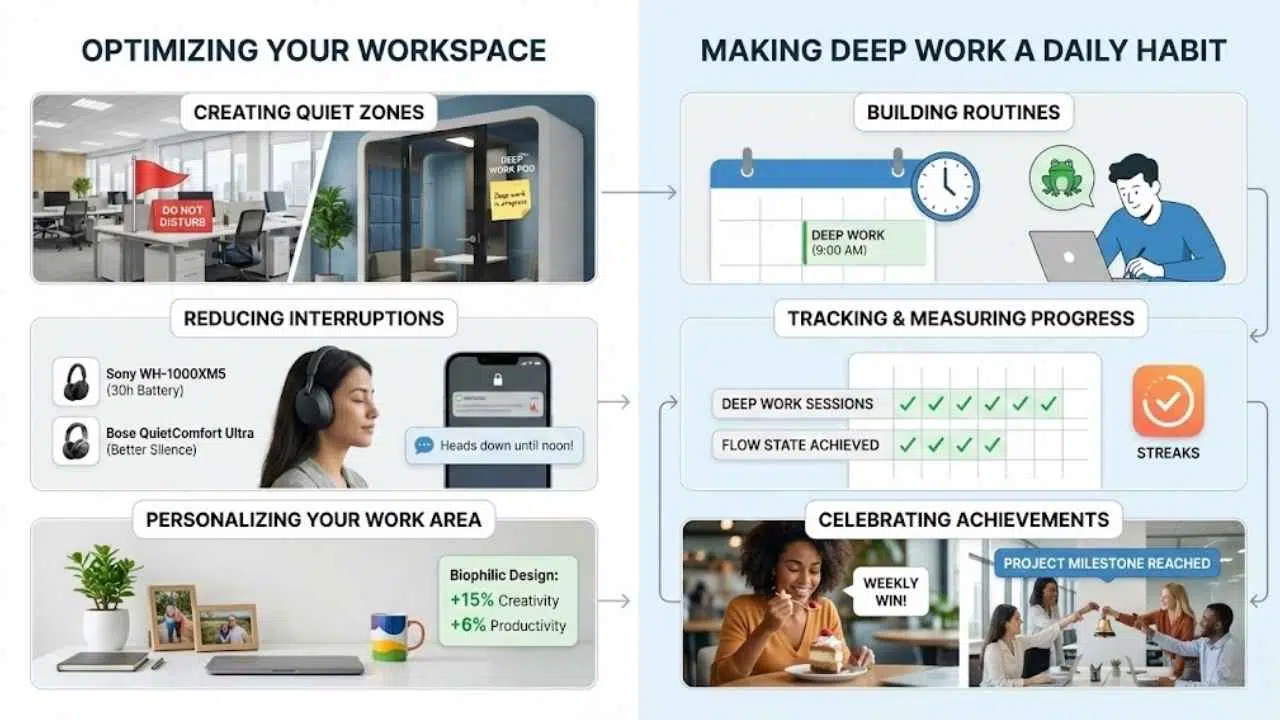
Your desk is your launch pad, so shape it for focus and calm. Small changes spark big gains in concentration and clarity. Give them a try.
Creating quiet zones
Walls do wonders for the mind. Small rooms with a door, sound-absorbing panels, or even bookcases can help cut out noise. Offices that add quiet zones see higher engagement and focus.
Many employees share stories of slipping into flow while sitting in a silent spot away from ringing phones. Sticky notes with friendly “deep work in progress” reminders on doors keep others from barging in.
If you don’t have a door, look for a “phone booth” or a booked meeting room. Every minute reclaimed for deep focus helps brains tackle complex tasks.
Reducing interruptions
Fewer interruptions protect your focus and keep productivity high. Deep work needs long hours of concentration, so it helps to silence phones and close chat apps.
Some offices even use red signs or flags on desks to show “Do Not Disturb.” Colleagues then know not to start casual chats or ask quick questions right away. Noise-canceling headphones are the universal symbol for “I am focusing.”
Here is how the top two models compare for office use:
- Sony WH-1000XM5: Best for all-day wear. They are lighter and have a massive 30-hour battery life.
- Bose QuietComfort Ultra: Best for pure silence. They offer slightly better noise cancellation and comfort for larger heads.
Even if you don’t play music, wearing them signals that you are deep in thought mode. Even sharing a simple “Heads down until noon!” message can set clear boundaries for everyone nearby.
Personalizing your work area
Small touches can make a huge difference for focus and productivity. Add a plant or two, some photos of your favorite memories, or even just a colorful coffee mug that makes you smile.
This isn’t just about decoration. A study by Human Spaces found that biophilic design (adding plants and natural elements) can increase creativity by 15% and productivity by 6%.
Keep tools and supplies within arm’s reach so you do not lose time looking for things mid-task. Your space should signal to your mind that this is where important work happens.
Making Deep Work a Daily Habit
Building deep work into your daily routine can turn focus from a struggle into second nature. Keep the momentum going. Little by little, smart choices grow strong habits.
Building routines
Starting each workday with a set routine trains your brain for focus and concentration. Many people find that blocking out time for deep work boosts productivity and clarity.
Try starting at the same hour every day. Turn off notifications and focus on one task at a time. This level of structure helps you tap into flow states where minutes melt away.
Simple actions matter most. Use the “Eat the Frog” method. This means doing your hardest, most important task first thing in the morning when your brain is fresh. Over time, these habits make it easier to ignore distractions from open office buzz.
Tracking and measuring progress
Use a simple chart or checklist to track your deep work sessions. Mark the days you focused without distraction for 60 or even 90 minutes at a time.
Count how often you reach that “flow state” where hours pass and your mind feels sharp. Apps like “Streaks” or a simple physical journal can be very effective for this. Seeing a chain of successful days creates a psychological drive to keep going.
Keep an eye on what tasks get done during these focused times instead of just counting hours. Celebrate each small win. Finishing a big report, solving a tricky problem, or crafting something new all show progress.
Celebrating achievements
Small wins matter. Big or small, each goal met in a distracted office shows progress with focus and effort. Mark one week of deep work? Treat yourself to your favorite dessert after lunch.
Hit a tough project milestone? Share that success with your team. Maybe even ring the bell at the front desk if you have one like some offices do.
Tracking these moments fires up motivation. It makes future goals clearer and more exciting. Experts say celebrating keeps brains wired for engagement and efficiency, not just productivity for its own sake.
Final Thoughts
Deep work helps you get more done, spark new ideas, and focus on the tough stuff without distractions. These tips make it simple. Just block your time, clean up digital clutter, set clear goals, and take mindful breaks. You can shape your space to keep interruptions at bay. Building these habits boosts both happiness and results. Your efforts pay off each day you protect your concentration. Even five extra focused minutes can change how you feel about work.