Choosing the right green building certifications can feel a lot like debugging a complex codebase. You know the end goal: a high-performance, efficient, and healthy environment, but the documentation is dense, the standards are constantly updating, and the “best” solution often depends on your specific stack.
With the release of LEED v5 in 2025 and the rapid growth of BREEAM in the US market, the landscape has shifted. It’s no longer just about earning a plaque for the lobby; it’s about optimizing your building’s operating system for real-world performance.
Here is the data that matters: Recent studies from 2024 show that certified green buildings can command rent premiums of up to 20% compared to non-certified peers. I’m going to walk you through the technical specs of LEED, BREEAM, and WELL, comparing them feature-by-feature so you can deploy the right framework for your project.
Ready to refactor your sustainability strategy? Let’s get into the details.
Overview of Green Building Certifications
Think of green building certifications as the quality assurance (QA) testing for your property. Just as you wouldn’t deploy code without testing it against rigorous standards, you shouldn’t build or operate a facility without verifying its performance. These systems provide the metrics and frameworks needed to measure efficiency, sustainability, and human health.
What are green building certifications?
Green building certifications are third-party verification systems that benchmark a building’s performance against specific sets of criteria. They measure “invisible” metrics like energy intensity, indoor air quality (IAQ), and water efficiency.
LEED (Leadership in Energy and Environmental Design): It’s managed by the U.S. Green Building Council (USGBC) and is the most widely recognized system globally, with over 100,000 certified projects.
BREEAM: It originated in the UK, actually predates LEED (launching in 1990), and has seen a massive 43% growth in US certifications in 2024, particularly in the industrial and data center sectors.
WELL: It is different; it functions less like a structural framework and more like a user experience (UX) audit, focusing almost exclusively on the health and biology of the people inside the building.
“A good certification helps people live healthier lives while caring for the planet.”
Projects earn points, similar to passing unit tests, across various categories. The more requirements you meet, the higher your final “score” or rating level (like Silver, Gold, or Platinum). This gamification drives developers to optimize performance rather than just meeting the bare minimum code requirements.
Why do certifications matter for sustainability?
Without a standardized framework, “sustainability” is just a buzzword. Certifications translate vague goals into executable code. They force teams to document their claims and prove their results.
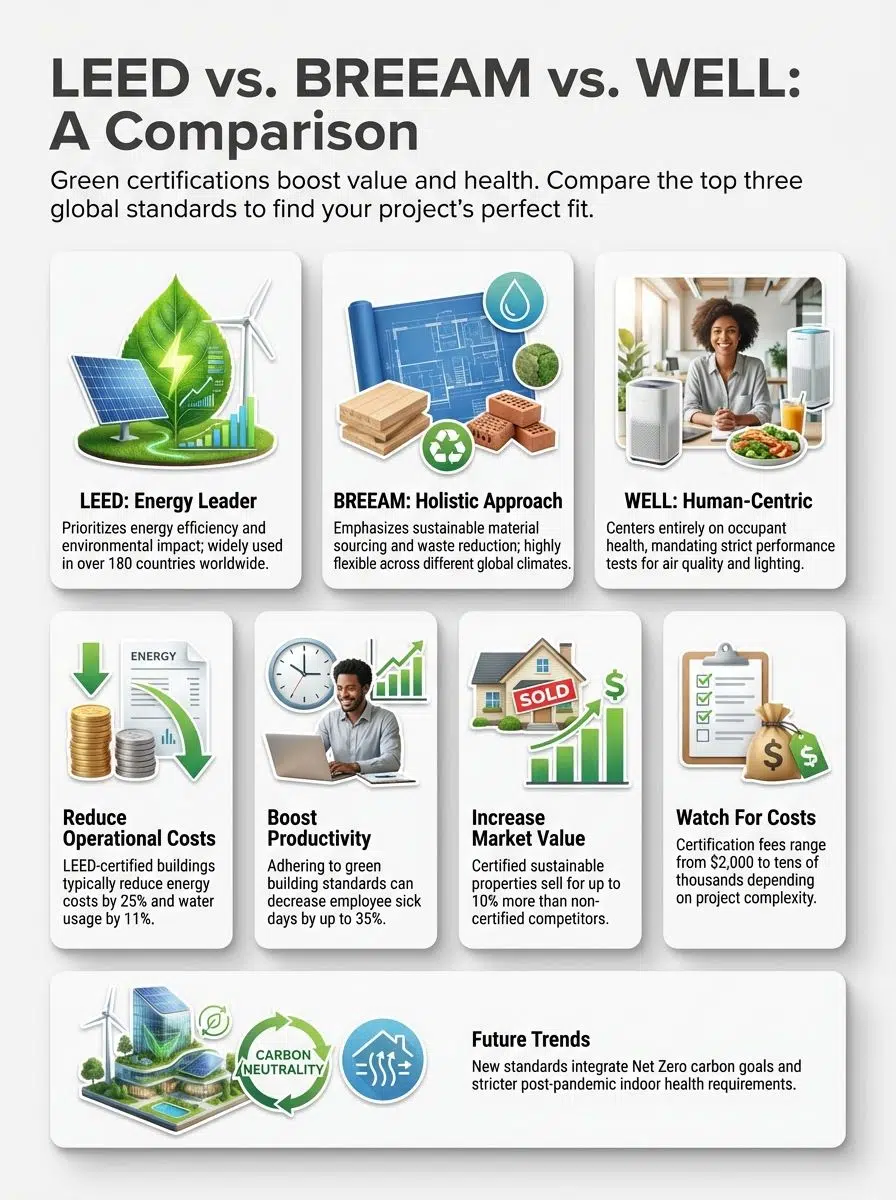
Data from the 2025 LEED v5 rollout highlights a major shift: certifications are now mandatory for measuring decarbonization. A LEED-certified office isn’t just “green”; it typically consumes 25% less energy and 11% less water than a standard building. For investors, this data reduces risk. It validates that the asset is future-proofed against tightening regulations, such as New York City’s Local Law 97.
Key Certification Systems: LEED, BREEAM, and WELL
Each system runs on a different logic. Choosing one is like choosing between React, Vue, or Angular—they all build websites, but their architecture and best use cases differ significantly.
LEED [Leadership in Energy and Environmental Design]
LEED is the “enterprise solution” of green building. Created by the USGBC, it is the dominant standard in North America. As of April 2025, the system has been upgraded to LEED v5, which represents a significant refactor of the previous version.
The new LEED v5 framework focuses on three critical outputs:
- Decarbonization: Reducing carbon emissions is now a prerequisite, not just an option.
- Quality of Life: Enhanced requirements for human health and equity.
- Ecological Conservation: Stricter rules on site selection and biodiversity.
Projects earn points to achieve Certified (40-49), Silver (50-59), Gold (60-79), or Platinum (80+) status. High-profile examples, like the Empire State Building’s Gold retrofit, prove that even legacy “hardware” can be updated to run modern efficiency standards.
Healthy buildings start with healthier choices, says Mahesh Ramanujam, former CEO of the U.S. Green Building Council.
BREEAM [Building Research Establishment Environmental Assessment Method]
If LEED is the rigid enterprise standard, BREEAM is the flexible, modular alternative. It is scientifically rigorous but allows for more local adaptation. While it started in the UK, BREEAM has gained serious traction in the US, especially for existing buildings that don’t want to undergo a full construction overhaul.
BREEAM uses a star rating system from Pass to Outstanding. Its “In-Use” program is particularly popular for asset managers who want to benchmark their current portfolio without massive capital expenditure. A notable recent win for the platform was the CitizenM Menlo Park Hotel, which became the first hotel in the US to achieve a BREEAM In-Use “Outstanding” rating.
WELL Building Standard
WELL is the “Human-Centric” layer. Launched in 2014 by the International WELL Building Institute (IWBI), it doesn’t care much about your building’s insulation thickness unless it affects the occupant’s thermal comfort. It cares about the code that runs the people.
WELL v2 measures 10 concepts, including Air, Light, Nourishment, and Mind. It is highly evidence-based. A landmark study published in the Journal of Building and Environment found that employees in WELL-certified spaces reported a 30% increase in workplace satisfaction and a 10% boost in productivity.
Companies like Citigroup and JLL use WELL to attract talent, effectively using the certification as a recruitment tool to show prospective employees that the office is designed to prevent burnout.
Comparing LEED, BREEAM, and WELL: Which One is Popular?
Comparing these systems directly is tricky because their core objectives overlap but don’t match 1:1. It is often smarter to look at them as complementary layers rather than competitors.
Focus Areas and Objectives
To help you visualize the differences, I’ve broken down their primary “source code” logic in the table below:

| Feature | LEED (v5) | BREEAM (USA) | WELL (v2) |
|---|---|---|---|
| Core Logic | Carbon & Energy Performance | Science-Based Holistic Sustainability | Human Biology & Health |
| Best For | New Construction & Major Renovation | Existing Building Portfolios (In-Use) | Interior Fit-outs & HR Strategy |
| Key Metric | Energy Use Intensity (EUI) | Asset Performance Rating | Occupant Satisfaction Scores |
LEED is your go-to for demonstrating environmental leadership in design. BREEAM is excellent for operational benchmarking. WELL is the standard for Human Resources and tenant well-being.
Global Reach and Popularity
LEED is the global heavyweight, used in over 180 countries. If you are building a headquarters in New York that needs to be recognized by investors in Tokyo, LEED is the standard currency.
BREEAM dominates Europe and is scaling fast in the US, with a 96% growth rate in certified assets in 2023. It is becoming the preferred tool for industrial assets and data centers, where LEED’s requirements can sometimes be too rigid.
WELL is the fastest-growing standard for Class A office space. Since 2014, it has been adopted by over 42,000 projects globally. It is particularly strong in markets where talent retention is a high priority, such as San Francisco, London, and Singapore.
Assessment Criteria and Scoring Systems
The documentation, or “paperwork,” is where these systems diverge most.
LEED is famous (or infamous) for its rigorous documentation requirements. Every credit requires specific calculations, often involving complex energy modeling software. You need to prove your design intent before you even break ground.
BREEAM relies on licensed Assessors. Instead of submitting everything to a central review body, an independent assessor visits your site to verify compliance. This can sometimes be faster and more interactive, allowing for on-site debugging of issues.
WELL is unique because it is performance-based. You can’t just submit a design; a Performance Testing Agent must physically visit your building to test the air quality, check the water filters, and measure light levels. If the building fails the test, you don’t get the certification. It’s strictly pass/fail on the metrics.
Benefits of Green Building Certifications
Why spend the budget on these certifications? The ROI comes from two places: operational efficiency (saving money) and asset value (making money).
Environmental Impact and Sustainability
The environmental case is solid. LEED buildings consistently outperform the market on energy usage. By mandating low-flow fixtures and smart metering, a typical LEED Gold building creates a direct reduction in utility overhead.
For example, BREEAM’s focus on sustainable materials often leads to waste reduction during construction. Their standards encourage the use of recycled aggregates and locally sourced timber, which lowers the project’s embodied carbon, a metric that is becoming critical as we approach 2030 climate targets.
Improved Occupant Health and Well-being
This is where WELL shines, but LEED and BREEAM play a part too. Poor indoor air quality (high CO2, VOCs) makes people tired and foggy, literally “glitching” their cognitive function.
By enforcing high ventilation rates and low-toxicity materials, these standards keep the “human operating system” running smoothly. The COGfx Study by Harvard famously showed that people working in green-certified environments had cognitive function scores that were 26% higher than those in standard offices. That is a massive productivity upgrade for any business.
Increased Property Value and Marketability
Data consistently shows that certified buildings trade at a premium. A 2025 report referencing widespread market data noted that LEED-certified buildings in top US markets command rent premiums of roughly 20% over non-certified buildings.
Investors view these assets as “de-risked.” They are less likely to face regulatory fines and more likely to attract high-credit tenants like Google or Microsoft, who often have internal mandates to only lease certified space.
Challenges of Achieving Certifications
It’s not all smooth sailing. Achieving these standards introduces friction into the development process. You need to account for these “bugs” in your project timeline.
Costs and Resource Requirements
The cost isn’t just the plaque. You have “hard costs” (better HVAC, solar panels) and “soft costs” (consultants, modeling, registration fees).

- LEED: Registration is roughly $1,350 for members, but certification fees scale with size, easily reaching $30,000+ for large projects.
- WELL: Pricing is often subscription-based now, costing approximately $0.16 per square foot depending on the project type.
- BREEAM: Generally has lower registration fees but requires paying the independent Assessor.
Complexity of Certification Processes
The most common complaint from project teams is “documentation fatigue.” Tracking every scrap of construction waste or verifying the chemical ingredients of every carpet tile is tedious.
LEED v5 attempts to streamline this with better digital tools, but the complexity remains high. BREEAM’s challenge is often finding a qualified Assessor in specific US regions, though the network is growing. WELL’s recertification requirement (every 3 years) means you can’t just “set it and forget it”, you have to maintain performance continuously.
Future Trends in Green Building Certifications
The code is being updated. The static checklists of the past are evolving into dynamic, real-time performance monitoring.
Integration of Net Zero Goals
Net Zero is the new baseline. LEED v5 has explicitly aligned its credits with the Paris Agreement targets. It’s no longer enough to be “efficient”; the goal is to be “carbon neutral.”
We are seeing a surge in Zero Carbon certifications, where buildings must prove they generate as much energy as they consume. This is driving the adoption of on-site solar and battery storage systems, turning buildings into active nodes on the energy grid.
Advancements in Health-Centric Standards
The definition of “health” is expanding. It started with air quality, but now includes mental resilience and community equity.
WELL is pushing boundaries with features that address “neurodiversity” in the workplace, designing spaces that work for people with different sensory needs. We are also seeing the integration of real-time display dashboards in lobbies, showing tenants the live air quality data. Transparency is becoming the ultimate amenity.
Wrapping Up: Selecting the Right Standard
There is no “perfect” certification, just as there is no perfect programming language. The right choice depends on your project’s specific parameters.
If you are building a new Class A office tower and need global investor recognition, LEED v5 is your solid, enterprise-grade foundation. If you have an existing portfolio of warehouses and need a flexible, cost-effective way to benchmark them, BREEAM In-Use is the smart patch. If your primary goal is attracting top talent and reducing burnout, WELL is the essential upgrade.
Many industry leaders are now using a “full stack” approach: LEED for the core and shell, and WELL for the interior fit-out. Analyze your budget, your goals, and your audience, and choose the framework that compiles the best results for you.