Sustainable architecture is no longer just a trend for the eco-conscious; it is the cornerstone of 21st-century development. In 2026, the global architecture industry has shifted from simply “reducing harm” to creating buildings that are actively regenerative. For developers, homeowners, and urban planners, the question is no longer if a project should be sustainable, but which firm is pushing the boundaries of what is possible.
Whether it is a skyscraper that breathes, a library that produces more energy than it consumes, or a city master plan that restores local biodiversity, these leaders are redefining our relationship with the built environment. In this guide, we explore the top 5 sustainable architecture firms to watch in 2026, analyzing their signature styles, groundbreaking projects, and the unique “X-factors” that set them apart.
Why Sustainable Architecture is Non-Negotiable in 2026
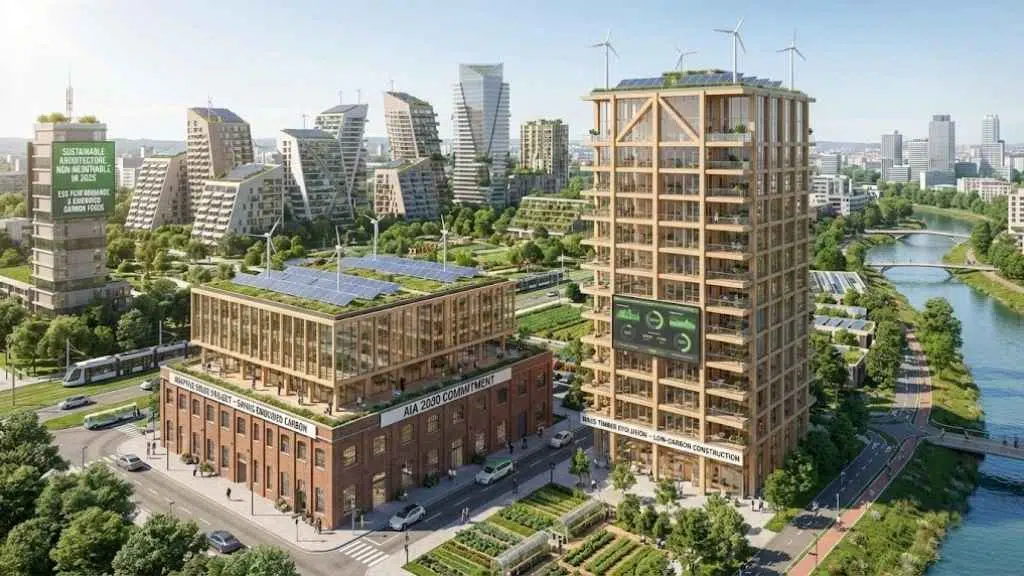
The landscape of 2026 is vastly different from even five years ago. We are seeing a “perfect storm” of strict environmental regulations, such as the AIA 2030 Commitment, and a massive surge in investor demand for ESG (Environmental, Social, and Governance) performance.
One of the most significant shifts this year is the focus on Embodied Carbon. In the past, we focused on “Operational Carbon” (the energy used to run a building). Today, top firms are obsessed with the carbon footprint of the materials themselves—the steel, concrete, and timber used in construction.
Key trends driving the industry in 2026 include:
- Adaptive Reuse: Renovating existing structures instead of tearing them down to save the carbon already “locked” in the building.
- Climate-Responsive Design: Using data to orient buildings for natural heating and cooling, reducing reliance on mechanical HVAC systems.
- Mass Timber Evolution: Replacing carbon-heavy steel with cross-laminated timber (CLT) for high-rise buildings.
1. Studio Gang: The Intersection of Nature and Urbanity
Founded by Jeanne Gang, Studio Gang has long been a pioneer in “Ecological Urbanism.” In 2026, they are recognized for moving beyond “iconic” shapes to focus on systemic relationships between people and their habitats.
Signature Style: Biophilic High-Rises
Studio Gang specializes in Solar Carving—a technique where building shapes are determined by the sun’s path to prevent overshadowing public parks and to maximize natural light for residents.
Key 2026 Project: The Marlboro Agricultural Education Center
Located in Brooklyn, this project is a masterclass in civic gathering. By using mass timber and “Up in the Canopy” design principles, the building functions as both a community hub and an ecological classroom.
The Sustainability Edge
The firm is a leader in Bird-Safe Design. As glass towers often disrupt migratory paths, Studio Gang uses patterned glass and “fritting” to make buildings visible to birds, proving that high-density urban living doesn’t have to come at the cost of local wildlife.
2. Perkins&Will: Leading the Charge in Healthy Materials
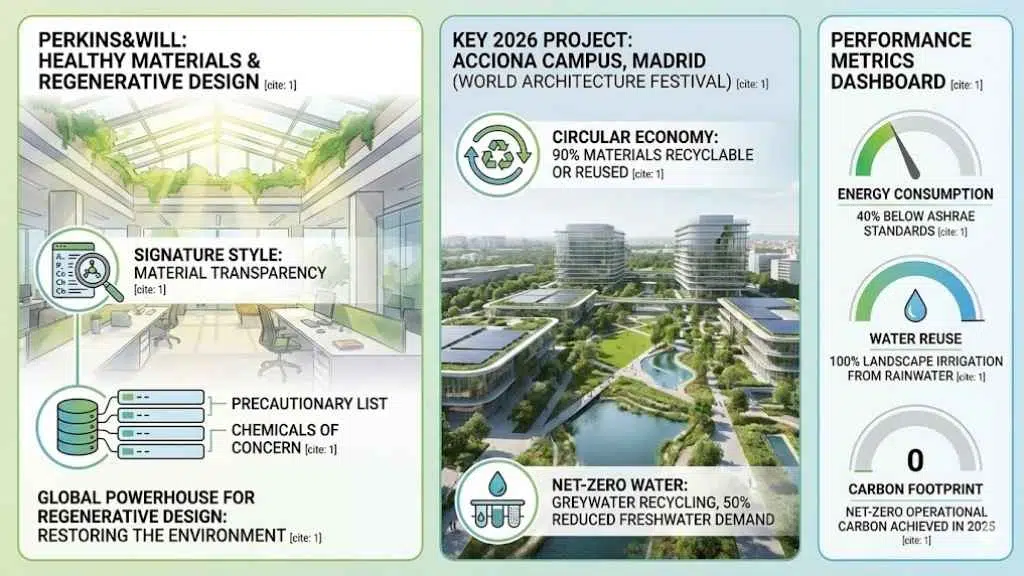
With a history spanning decades, Perkins&Will has evolved into a global powerhouse for Regenerative Design. They don’t just want buildings to be “less bad”; they want them to restore the environment.
Signature Style: Material Transparency
The firm is famous for its Precautionary List, a publicly available database of chemicals of concern in building materials. They treat every project as a “healthy building” lab.
Key 2026 Project: ACCIONA Campus, Madrid
Recently celebrated at the World Architecture Festival, this campus is a flagship for the sustainable workplace. It focuses on:
- Circular Economy: 90% of materials are recyclable or reused.
- Net-Zero Water: Advanced greywater recycling systems that reduce freshwater demand by 50%.
| Feature | Performance Metric |
| Energy Consumption | 40% below ASHRAE standards |
| Water Reuse | 100% of landscape irrigation from rainwater |
| Carbon Footprint | Net-Zero Operational Carbon achieved in 2025 |
3. Foster + Partners: Scaling Sustainability to the City Level
Led by Lord Norman Foster, this firm is synonymous with “High-Tech Green.” In 2026, they are applying sustainable principles not just to individual buildings, but to entire Smart Cities.
Signature Style: The Breathable Façade
Foster + Partners often utilizes automated louvers that open and close based on real-time weather data. This allows buildings to “breathe” naturally, drastically cutting energy use.
Key 2026 Project: Lusail Master Plan, Qatar
As part of the Norman Foster Institute’s focus on sustainable cities, the Lusail project in 2026 focuses on:
- Autonomous Mobility: Reducing the need for paved roads and heat-absorbing parking lots.
- Passive Cooling: Using traditional Arab housing layouts to create natural wind tunnels that cool outdoor public spaces by up to 10°C.
The Sustainability Edge
They were the first major practice to sign the Net Zero Carbon Buildings Commitment, pledging that all their offices and projects will be carbon neutral by 2030.
4. Snøhetta: Powerhouses that Give Back
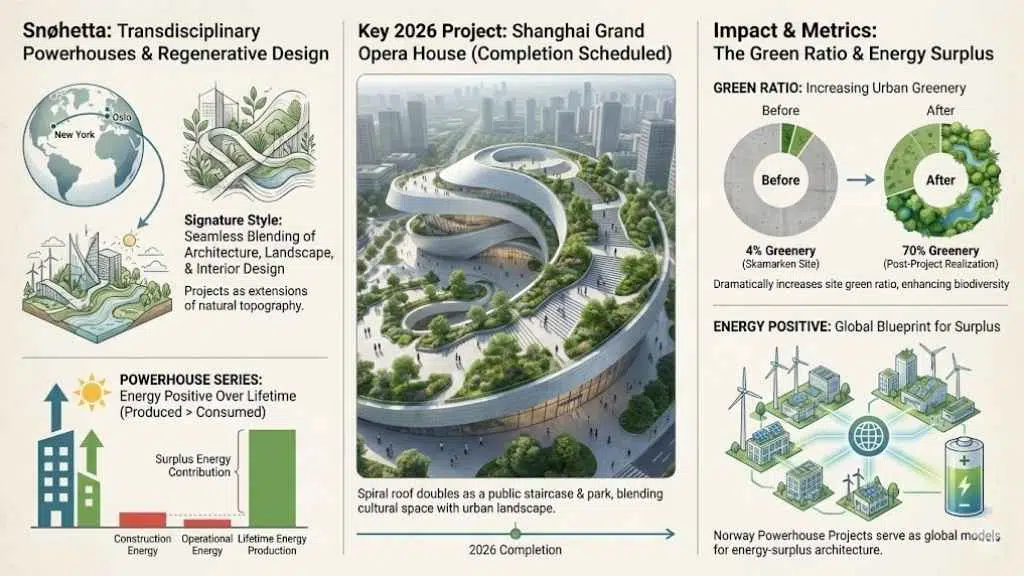
Based in Oslo and New York, Snøhetta is famous for its “Powerhouse” series—buildings that produce more energy over their lifetime than they consumed during construction and operation.
Signature Style: Transdisciplinary Design
Snøhetta blends architecture with landscape and interior design seamlessly. Their projects often look like extensions of the natural topography.
Key 2026 Project: Shanghai Grand Opera House
Scheduled for completion in 2026, this project features a spiral roof that doubles as a public staircase and park.
- Green Ratio: Snøhetta projects often increase the “green ratio” of a site. In their Skamarken project, they increased greenery from 4% to 70%.
- Energy Positive: Their “Powerhouse” projects in Norway serve as the global blueprint for energy-surplus architecture.
5. SUP Atelier: Regionalism and Low-Tech Innovation
Representing the vanguard of Asian sustainable design, SUP Atelier (part of THAD) focuses on high-performance buildings that respect local traditions and climates.
Signature Style: Modern Vernacular
They excel at using “low-tech” solutions—like rammed earth, bamboo, and natural ventilation stacks—and pairing them with high-tech simulation tools to ensure efficiency.
Key 2026 Project: Zhaoshan Village Center
A winner of the A+Awards for Sustainable Adaptive Reuse, this project transformed a dilapidated rural site into a thriving community hub. By using local materials, they virtually eliminated the “material transport” portion of the building’s carbon footprint.
The Sustainability Edge
The firm is a leader in Nearly Zero Energy Buildings (NZEB) in China, proving that sustainability can be achieved in rapidly developing regions without massive budgets.
Key Trends Shaping Green Building in 2026
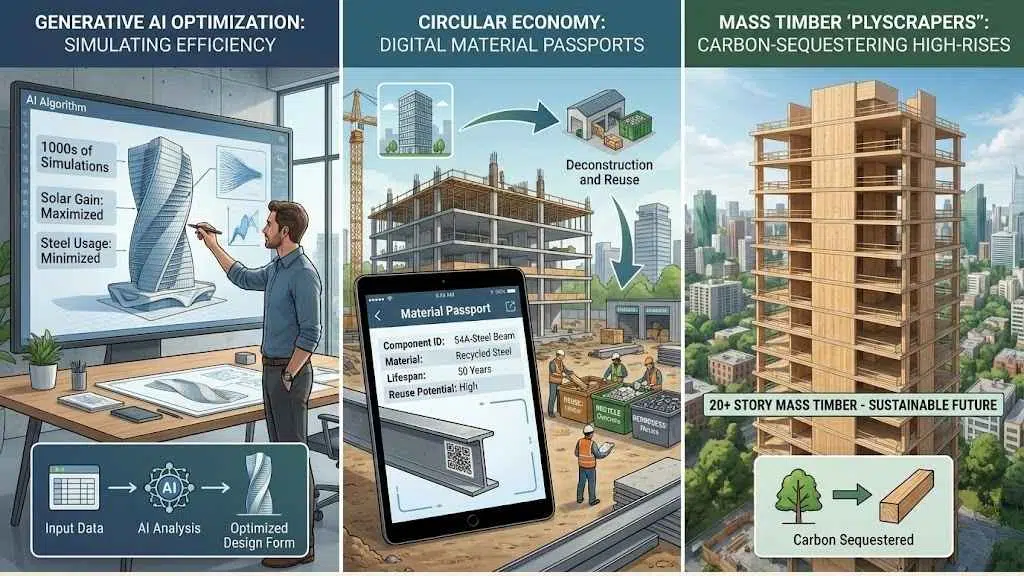
To understand why these firms are winning, we must look at the technologies they utilize:
- Generative AI for Optimization: Firms are now using AI to run thousands of simulations on a building’s shape to find the one that requires the least amount of steel while maximizing solar gain.
- The Circular Economy: Leading firms now provide “Material Passports” for their buildings. These digital records list every component so that when the building is decommissioned in 50 years, the materials can be easily sorted and reused.
- Mass Timber: 2026 is the year of the “Plyscraper.” We are seeing 20+ story buildings made almost entirely of wood, which sequester carbon rather than emitting it.
Final Thoughts
The architecture of 2026 is no longer about human dominance over nature; it is about integration. The five firms listed here—Studio Gang, Perkins&Will, Foster + Partners, Snøhetta, and SUP Atelier—are not just building structures; they are building ecosystems. As we move closer to the 2030 climate deadlines, these innovators are providing the blueprints for a world where our cities can actually help heal the planet.