

On January 27, 2026, Arijit Singh announced that he would no longer take on new playback singing assignments for films, a move that surprised fans and the industry alike. Arijit Singh, one of the most-followed artists on Spotify globally with over 172 million followers, posted a message on social media saying, “I am calling it off,” indicating he would not take new playback singing assignments.
The Arijit Singh exit moment became one of the most discussed in Indian music media and on social platforms, prompting reactions from fans and composers. The announcement marked a decisive shift for an artist who has dominated Bollywood soundtracks for over a decade. With an estimated net worth of around Rs 414 crore, built on hit songs, sold-out concerts, and streaming success, Singh was not stepping away from music.
Why Arijit Singh’s Exit Matters Now
Singh’s announcement did not arrive in isolation. It came at a time when India’s film music ecosystem is quietly recalibrating under the weight of streaming dominance, compressed production timelines, and a narrowing definition of commercial success. Playback singing, once built on long-term creative partnerships, now often functions as a high-volume, low-risk enterprise driven by algorithms and release calendars. Against this backdrop, the Arijit Singh exit reads less like a personal rupture and more like a moment that reveals how the industry itself has changed.
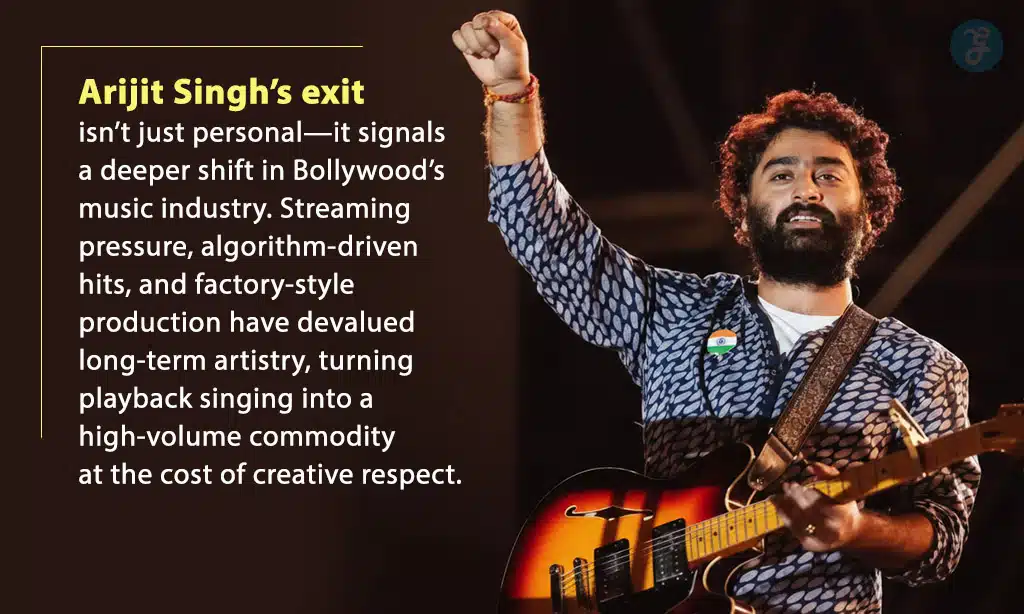
The shock of Arijit Singh’s exit felt like a “Virat Kohli-level” retirement from the world of sound. For over a decade, his voice has been the structural integrity of the Indian film industry, the fail-safe mechanism that could turn a mediocre script into a box-office juggernaut. From his ballads in Border 2 to the upcoming O Romeo, his last playback tracks now serve as ghostly reminders of a monopoly that has officially collapsed. To understand why the “King of Playback” walked away at the absolute zenith of his power, one must look beyond the Instagram post and into the systemic devaluation of artists in the Mumbai “Factory Model.”
Arijit Singh Exit: The Industry Reacts
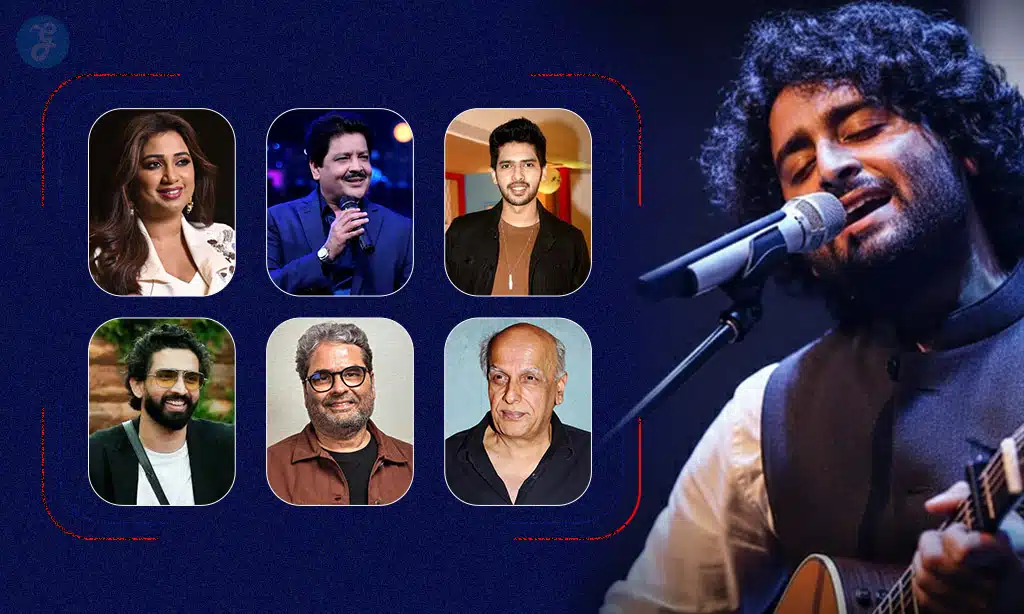
When the “Calling it off” post went live, it wasn’t just the fans who were spiralling; the industry’s inner circle seemed to be collectively holding its breath. Shreya Ghoshal, perhaps his most frequent collaborator, was among the first to break the tension, refusing to call it an “end.” Instead, she hailed it as a “new phase,” noting that a genius of his calibre can’t be boxed into a set formula forever. It felt less like a goodbye and more like Shreya giving him a standing ovation for having the guts to soar higher. Even the veteran Udit Narayan expressed admiration, marvelling at how Arijit saw the absolute peak of fame and money in such a short time and still had the clarity to choose his own path.
The reactions from the younger lot were a mix of heartbreak and deep-seated respect. Armaan Malik shared a poignant note about the “soul knowing when to change direction,” while his brother Amaal Mallik admitted to being “lost” but underscored a grim reality: film music simply won’t be the same without him. Filmmaker Vishal Bhardwaj, who was jamming with Arijit just days prior for the track Ishq Ka Fever in the upcoming O Romeo, called the decision “unfair” and “unacceptable,” pleading with him to take back his “sanyaas.” From Sona Mohapatra cheering for his “brave, disruptive” choice to Mahesh Bhatt recalling the “shy, self-effacing boy” from the Aashiqui 2 days, the consensus was clear: Arijit didn’t just quit a job; he walked out of a noise-filled room to find his own truth.
The Vocal Plugin and the Death of Art
For years, the Hindi film industry has transitioned from organic music composition to what critics call “content generation.” In this factory model, a singer is no longer an artist; they are a vocal plugin. Arijit Singh’s exit is a direct response to a system that prioritises viral 15-second reels over the soul of a song.
The “toxic” practice that reportedly broke the camel’s back is the multi-singer recording trap. Labels often record the same track with five or six different A-list singers, treating them like competing contestants in an untelevised reality show, only to ghost those they don’t select. For an artist of Arijit’s stature, being used as a “safety net” while the industry lacks the courage to commit to a single vision became an intolerable insult to the craft.
In a 2023 interview, Singh lamented the “verbal discussions” that govern the industry. Agreements on pay, rights, and creative control frequently vanish the moment a corporate contract arrives. He famously stated, “I realise my name is not me anymore… it’s a perception.” He wasn’t just tired of singing; he was tired of being a brand used to validate a broken system.
The Rs 414 Crore Fortress (Escape Velocity)
The primary reason most artists endure the “label mafia” is financial necessity. Arijit Singh, however, achieved “escape velocity.” With an estimated net worth of Rs 414 crore, he is no longer an employee of the industry; he is its peer.
The Financial Freedom Table
| Source of Income | Estimated Value / Rate | Impact on Autonomy |
| Est. Annual Earnings | ~Rs 70–75 Crore | Financial immunity; freedom from “per-song” dependencies. |
| Live Concerts | Rs 14 Crore (per premium set) | Direct-to-fan revenue bypassing film producer gatekeepers. |
| Spotify Dominance | 172M+ Followers | Global leverage independent of Bollywood distribution networks. |
| Asset Base | Rs 8 Cr Home + Jiaganj Studio | Secure, self-owned infrastructure for independent production. |
The Copyright (Amendment Act of 2012 was his silent weapon. By securing the right to receive royalties (managed by bodies like ISRA), Arijit ensured that every time his hits played in a mall, a gym, or a radio station, his “Freedom Fund” grew. This steady stream of wealth allowed him to become “un-bullyable.” Unlike a newcomer who must say yes to a toxic contract just to pay rent in Mumbai, Arijit could afford to say no to the biggest banners in the country.
View this post on Instagram
The “Gilded Cage” vs. The Jiaganj Truth
While Bollywood stars are often obsessed with the glitz of suburban Mumbai, Arijit’s soul remained anchored in Jiaganj, Murshidabad. His exit from playback singing is, in many ways, a homecoming.
The contrast between his lifestyle and his peers is stark. While others chase “star-kid” debut parties, Arijit has his children enrolled in a local school in Murshidabad. This is a deliberate rejection of the sheltered, privileged ecosystem of the Mumbai elite. His restaurant, Heshel, serves meals for as little as Rs 40 to the local community, a project he runs not for profit, but as a “detox” from the corporate greed he witnessed in the music industry.
“Mumbai made me who I am, but Jiaganj is who I am.” This sentiment, often shared by his close friend and collaborator Indradip Das Gupta, captures the reality: Arijit didn’t just leave a city; he returned to himself.
The Independent Rebellion (Oriyon Music)
Arijit’s “retirement” is strictly selective. He has retired from being a cog in the Bollywood wheel, but he is accelerating his journey as a creator. Through his label, Oriyon Music, he is building a parallel universe.
The strategy is three-fold:
- The Classical Detox: He has expressed a desire to return to his roots as a “small little learner” of Indian Classical Music, away from the 4/4 beat of commercial pop.
- Ending the Monopoly: By mentoring “sidelined” artists like Soumya Murshidabadi, he is using his capital to give a voice to those who refuse to play the “label politics.”
- Creative Autonomy: Making music that doesn’t need to fit a 2-hour rom-com narrative.
Before vs. After: The Arijit Singh Career Shift
| Aspect | The Bollywood Era (2012–2025) | The Independent Era (2026 Onwards) |
| Primary Goal | Chart-topping film hits | Creative experimentation/Classical roots |
| Decision Maker | Film Producers & Music Labels | Arijit Singh & Oriyon Music |
| Location | Mumbai Recording Studios | Jiaganj Home Studio |
| Revenue Model | One-time fees + Royalties | Direct Streaming + Global Tours |
The ‘Arijit Effect’: Why a Spotify-First Movement is Inevitable
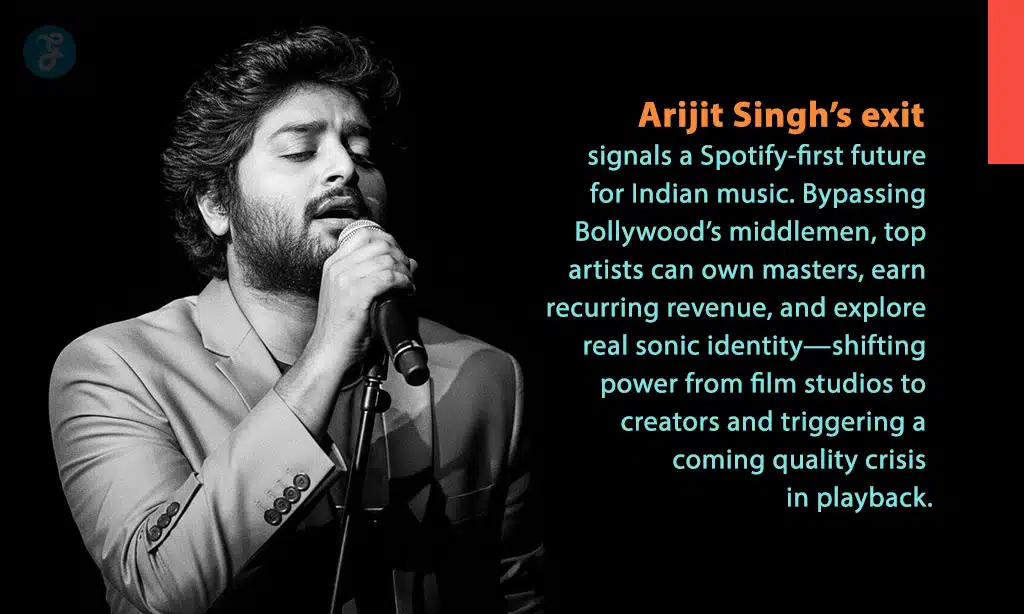
Arijit Singh’s departure isn’t just a personal pivot; it’s the “Beta Test” for the future of the Indian music economy. For decades, Bollywood was the only distributor that mattered; if you weren’t on a film soundtrack, you were invisible. But the Rs 414 crore exit has proven that the umbilical cord can be cut. We are witnessing a “Spotify-first” migration where the industry’s top voices stop auditioning for film directors and start programming directly for their fans.
The Death of the ‘Middleman’ Director: In the traditional playback model, a singer is often at the mercy of a film director’s “vision,” which frequently involves multiple soul-crushing re-recordings and zero creative input. By moving to a Spotify-first model, artists with massive leverage can bypass the “label-producer-director” hierarchy entirely. When you have 172 million+ followers, you don’t need a Rs 200-crore movie banner to make your song a hit. The platform itself has become the primary launchpad.
The Math of Autonomy: 100% vs. 5% The economics of 2026 have finally tipped the scales. In a standard Bollywood contract, the singer gets a flat fee and a tiny, often uncollectible fraction of royalties. On independent platforms, an artist of Arijit’s stature can negotiate direct distribution deals, retaining 80–100% of the master rights.
- The Bollywood Fee: Rs 15 Lakh (one-time payment).
- The Spotify Stream: Millions in recurring, compounding revenue over decades.
For the top 1% of singers, staying tethered to the playback system is no longer a career boost; it’s an “industrial leak” of potential wealth.
The Rise of the ‘Sonic Identity’: Bollywood music has become dangerously homogenised; every track feels engineered for the same 15-second wedding reel. A Spotify-first movement allows for genre-fluidity. We are seeing singers explore Indie-Folk, Electronic, and pure Hindustani Classical… genres that the “content generation” factory usually kills. Arijit’s Oriyon Music is the blueprint: use the capital built from the “Big Machine” to fund “Real Music.”
The Leverage Shift: As top-tier talent exits the playback booth, Bollywood faces a looming “Quality Crisis.” If the best voices are only available on their private channels, film producers lose their most potent marketing tool. This creates a seismic power shift: soon, movies will have to “license” tracks from independent artists on the artist’s terms, rather than the singer begging for a spot on the soundtrack.
The silence Arijit left behind in Mumbai isn’t empty; it’s being filled by the sound of an industry finally realising it holds all the cards.
The Grassroots Blueprint: Beyond the Recording Booth
Arijit Singh’s transition isn’t just about stepping back from playback singing; it’s about redirecting his energy into a grassroots legacy. For years, he has invested in Murshidabad, founding the Dhriti Foundation, financing state-of-the-art hospitals, and establishing nursing colleges. These initiatives are not a hobby, they are high-stakes social infrastructure projects. By walking away from the industrial pace of film music, he is reclaiming roughly 3,000 hours a year, using them to support projects that ensure rural communities have access to healthcare and education.
Singh’s influence in Bengal, through these philanthropic efforts and local projects, demonstrates a different kind of impact, one that extends beyond his music. His work in Jiaganj and surrounding areas shows that an artist’s resonance can exist outside the studio, and that creative autonomy can coexist with meaningful social contribution.
The 2026 Smoke: A Change of Stage?
Of course, you can’t build hospitals and colleges in West Bengal without the local grapevine going into overdrive. Following his heightened focus on community impact, rumours of a 2026 political entry have turned into a full-blown national debate. Is he trading the “label mafia” for the “political battlefield”? While his team keeps a strategic silence, insiders suggest his groundwork is more “civic” than “partisan.” Whether he launches his own platform or remains a shadow philanthropist, the “Arijit Singh Exit” has signalled a shift in power. He has effectively traded his status as a “voice for hire” for a seat at the table where real change happens. If he does enter the arena, he will be the only candidate who doesn’t need a campaign song; he already has a decade’s worth of anthems that have won over the very people he now aims to serve.
The Coda: Silence of the Songbird
Arijit Singh didn’t lose his voice; he found the strength to stop lending it to people he didn’t respect. The silence he has left in mainstream Bollywood is a deafening exposure of an industry that forgot how to value its most precious talent.
The final note of this saga is not a song. It is a quiet evening in Murshidabad, where the world’s most-followed singer rides a scooter to buy groceries, far from red carpets and flashing cameras. Bollywood may no longer have his voice at its disposal, but Arijit has gained freedom; and in that freedom, his artistry continues to shine, on his own terms.





















