Can we be real for a moment? It is late January 2026. By now, the shiny energy of your New Year’s resolutions has likely worn off. The gym bag is gathering dust in the corner. The meditation app is sending you passive-aggressive notifications about your broken “streak.”
If you are feeling the familiar creep of failure, stop. It is not you. It is the outdated tools you are using.
For years, “habit tracking” meant downloading an app that was essentially a digital clipboard. In 2026, AI habit trackers have moved far beyond passive tracking, using adaptive intelligence to understand why habits fail and adjust support in real time to help you stay consistent.
You had to remember to open it, perform the habit, and check a box. The entire mental load was still on your shoulders. If you missed a day, the app punished you by breaking a red chain, effectively demotivating you right back into old patterns.
Fortunately, we aren’t living in 2023 anymore.
The AI maturation of the last few years has fundamentally changed personal development. The best AI-powered habit apps in 2026 don’t just track what you did; they actively help you do it. They have moved from passive observers to active participants in your day. They schedule the time for you, break down overwhelming tasks, and even negotiate with your boss’s calendar to get you a lunch break.
If you want to build sustainable systems this year instead of just fleeting intentions, you need to upgrade your toolkit. Here is a curated look at the 15 best tools redefining habit building right now.
Why We Need AI to “Run” Our Habits
Willpower is a finite resource. By 2:00 PM, your decision-making battery is usually drained. This is where artificial intelligence steps in.
The goal of these apps is to remove friction. They act as an external prefrontal cortex, handling the executive function tasks like planning, scheduling, prioritizing; so you only have to focus on execution. We have categorized these apps by the specific “friction point” they solve, from time management to emotional regulation.
AI Habit Tracker for Time Management & Scheduling
The biggest enemy of a new habit isn’t laziness; it is a lack of protected time. These apps fight tooth and nail against your calendar to ensure you have space to exist.
1. Reclaim.ai
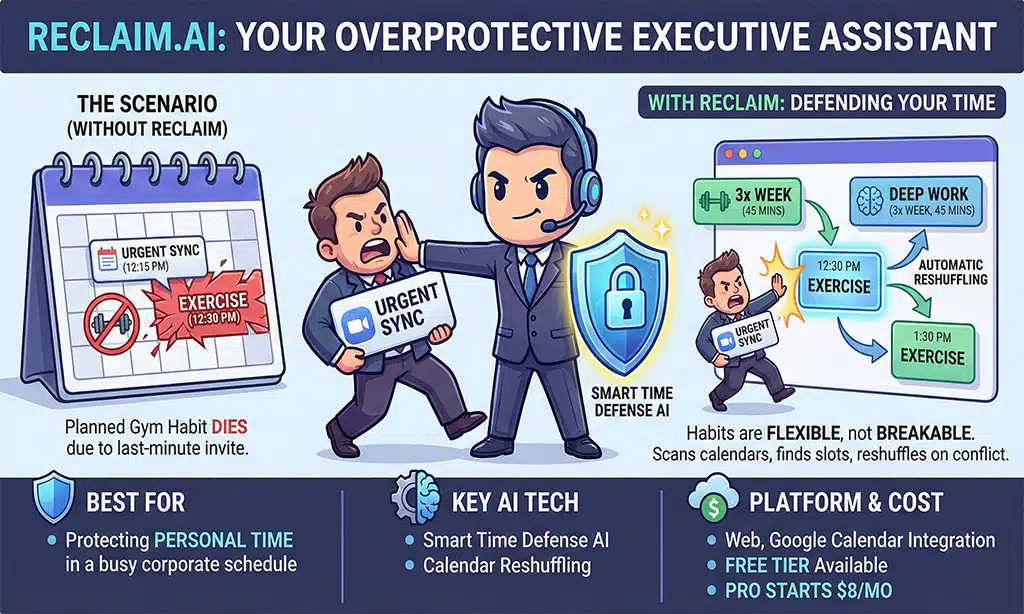
Reclaim acts like an overprotective executive assistant who isn’t afraid to body-block your boss. We all know the scenario: you plan to exercise at 12:30 PM, but an “urgent sync” invite lands on your calendar at 12:15 PM, and the gym habit dies. Reclaim prevents this by “defending” your time.
You don’t schedule a specific slot; you tell Reclaim, “I need 45 minutes for Deep Work three times a week.” Its Smart Time Defense AI scans your work and personal calendars to find the slots. If a conflict arises, it automatically reshuffles the habit to the next best time. It ensures your habits are flexible, not breakable.
- Best For: Protecting personal time in a busy corporate schedule
- Key AI Tech: Smart Time Defense & Calendar Reshuffling
- Platform: Web, Google Calendar Integration
- Cost: Free tier available; Pro starts at $8/mo
2. Motion
If you have ADHD or a chaotic executive schedule, a static to-do list is useless. You don’t need a list; you need to know what to do right now. Motion uses “Algorithmic Prioritization” to solve this.
You dump every task and habit into Motion, and the AI builds your daily schedule minute-by-minute. The real power appears when you fall behind. Instead of shaming you, Motion instantly recalculates your entire day, shuffling tasks to ensure high-priority habits still happen. It is an anti-overwhelm engine.
- Best For: Users with ADHD or chaotic, unpredictable days
- Key AI Tech: Real-time Algorithmic Prioritization
- Platform: iOS, Android, Web, Chrome Extension
- Cost: $19/mo (Individual)
3. Clockwise
It is incredibly difficult to build focus habits when your day is Swiss-cheesed with 30-minute meetings. You cannot get into a flow state in the 15 minutes between Zoom calls.
Clockwise focuses on team-level optimization. Its AI engine negotiates with your colleagues’ calendars to move flexible meetings, grouping them back-to-back. This creates massive blocks of “Focus Time” for your deep work habits. It automates the tedious email tag of rescheduling, opening up the space you need to actually do your job.
- Best For: Teams who need to coordinate schedules
- Key AI Tech: Focus Time Optimization & Meeting Negotiation
- Platform: Web, Slack, Google Calendar
- Cost: Free basic; Teams from $6.75/user/mo
4. BingeTimer
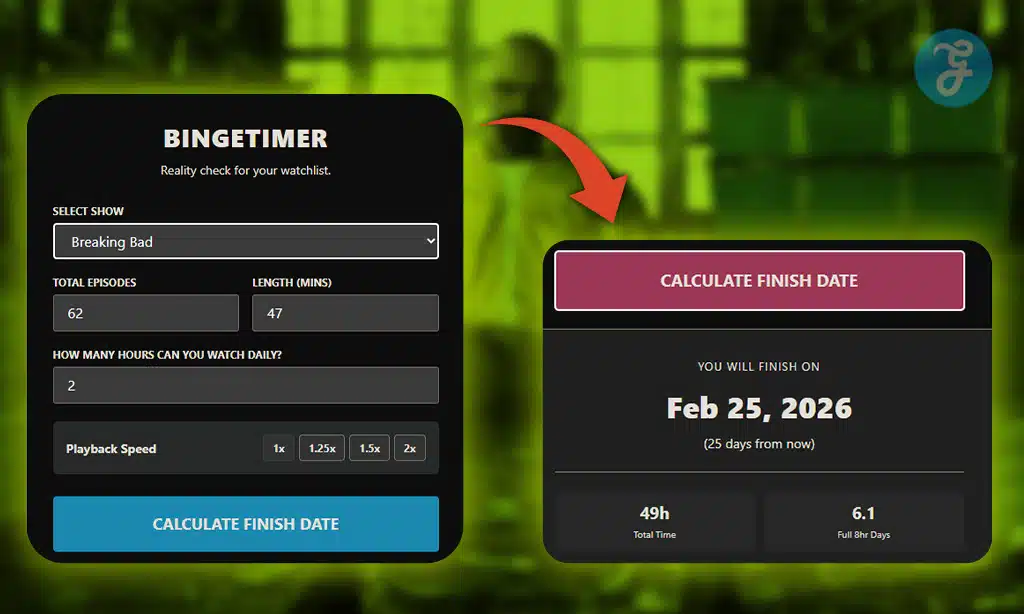
We all say “just one more episode,” and suddenly it is 3:00 AM. BingeTimer serves as a necessary “reality check” for your entertainment habits. It prevents you from accidentally committing to a show that doesn’t fit your life.
This smart calculator forecasts exactly when you will finish a series based on your daily available hours and speed settings. Crucially, it calculates the “Work Equivalent” of a show, telling you, for example, that watching One Piece is equivalent to working a full-time job for 10 weeks. It helps you build the habit of mindful consumption rather than mindless binging.
- Best For: Reality-checking your Netflix/streaming addiction
- Key AI Tech: Algorithmic Watch-Time Forecasting
- Platform: Web
- Cost: Free
AI Habit Tracker for Mental Health & Neurodivergence
Sometimes the barrier isn’t time; it is mental paralysis. These apps lower the cognitive entry point for difficult tasks.
5. Goblin Tools
This is likely the most beloved tool of 2026 for anyone experiencing “task paralysis.” If your habit is “Clean the Kitchen,” your brain might look at that vague, massive task and shut down.
Goblin Tools uses LLMs to perform “The Magic To-Do.” You type in a scary task, hit a button, and the AI breaks it down into tiny steps: pick up trash, put spoons in the dishwasher, and wipe the stove. Suddenly, the impossible becomes manageable. It also features a “Judge” tool to interpret tone in texts, reducing social anxiety.
- Best For: Overcoming procrastination and overwhelm
- Key AI Tech: Large Language Model Task Breaking
- Platform: Web, iOS, Android
- Cost: Free (Web); Small one-time fee for app
6. Liven
Journaling is a fantastic habit, but staring at a blank page when you are anxious is daunting. Liven replaces the standard journal with Livie, a highly sophisticated AI companion.
Livie isn’t a chatbot that offers generic quotes. It remembers your history and helps you process complex feelings in real-time. If you tell Livie you are overwhelmed, it suggests bite-sized “wellbeing tasks” tailored to your current mood, like a 2-minute breathing exercise. It turns emotional regulation into a guided, actionable habit.
- Best For: Emotional processing and anxiety management
- Key AI Tech: Context-Aware Emotional Companion
- Platform: iOS, Android
- Cost: Subscription-based
7. Endel
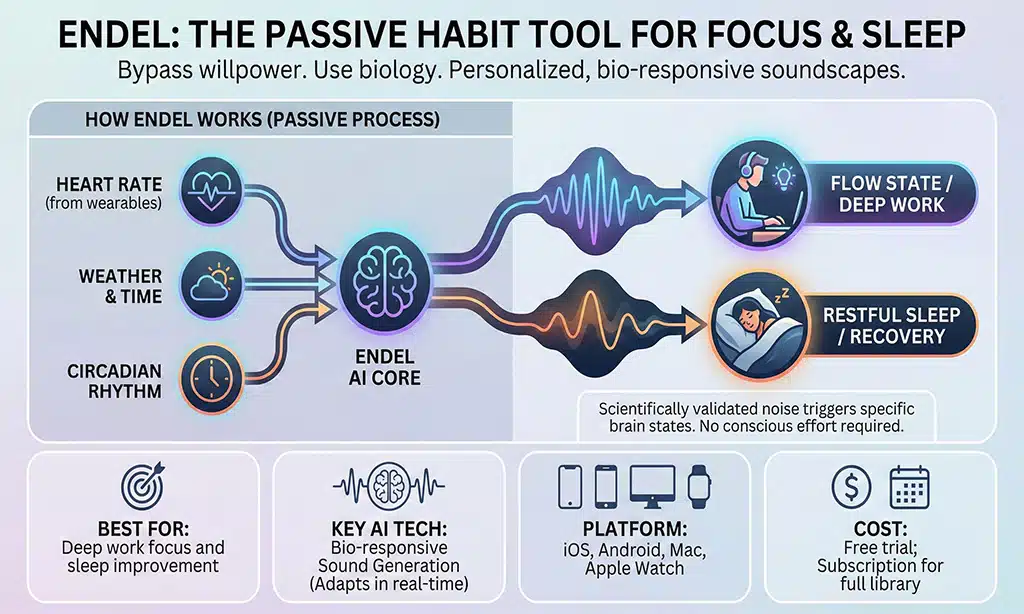
Sometimes the best way to build a habit is to bypass willpower entirely and use biology. Endel is a “passive” habit tool. You just turn it on.
Endel’s AI generates personalized soundscapes that adapt in real time. It uses inputs like your heart rate, the weather, and the time of day to create sound layers that trigger specific brain states. It is scientifically validated noise that guides you into flow or sleep without conscious effort.
- Best For: Deep work focus and sleep improvement
- Key AI Tech: Bio-responsive Sound Generation
- Platform: iOS, Android, Mac, Apple Watch
- Cost: Free trial; Subscription for full library
AI Habit Tracker for Health, Sleep & Nutrition
You cannot build productivity habits on a foundation of exhaustion. These AI-powered habit apps align your routine with your biology.
8. Rise Science
Most sleep trackers just tell you how badly you slept. Rise Science focuses on “Circadian Forecasting.”
It tracks your sleep debt, but its AI uses that data to predict your energy levels for the next day. It tells you exactly when your energy will peak (do hard work then) and when it will dip (do admin then). Rise helps you build the habit of working with your body’s rhythm rather than fighting it.
- Best For: Optimizing energy levels and sleep schedule
- Key AI Tech: Circadian Rhythm Prediction
- Platform: iOS, Android
- Cost: $60/year
9. Ollie
The habit of cooking healthy meals usually dies under the mental load of planning and inventory management. Ollie is an AI supply chain manager for families.
It learns your family’s constraints: allergies, budget, and time. It generates realistic weekly meal plans and auto-generates grocery lists based on what you already have in the pantry. It effectively reduces food waste and the “let’s just order pizza” reflex.
- Best For: Families trying to cook at home more
- Key AI Tech: Constraint-Based Meal Planning
- Platform: iOS, Android, Web
- Cost: Free and Premium tiers
10. Fitia
Tracking nutrition is traditionally high-friction. Weighing food and searching databases is miserable. Fitia uses image recognition to make logging painless.
Its standout feature is proactive suggestion. If you reach dinner time and are short on protein, the AI suggests specific combinations of foods remaining in your kitchen to fill the gap. It turns hitting your macros into a guided process rather than a math problem.
- Best For: Painless calorie and macro tracking
- Key AI Tech: Smart Logging & Nutritional Gap Filling
- Platform: iOS, Android
- Cost: Free basic; Premium for smart features
AI Habit Tracker for Financial Habits
Building wealth isn’t about willpower; it is about automation and, occasionally, being roasted by a robot.
11. Cleo
For those who find banking apps dry, Cleo offers “tough love.” It connects to your accounts and analyzes spending habits.
Its defining feature is “Roast Mode.” You can ask the AI to roast your spending, and it will humorously shame you for dropping $200 on takeout while your savings account is empty. This humorous bullying is surprisingly effective at shocking users into better financial awareness.
- Best For: Gen Z/Millennials needing financial discipline
- Key AI Tech: Transaction Analysis & Conversational AI
- Platform: iOS, Android
- Cost: Free; Plus subscription for credit builder
12. Rocket Money
One of the best financial habits is “financial hygiene” that is knowing what you pay for. Rocket Money’s AI performs “Subscription Recon.”
It scans years of history to find recurring payments you forgot about. It can then cancel them for you or negotiate lower rates on bills like internet or cable. It automates the habit of frugality.
- Best For: Cutting waste and managing subscriptions
- Key AI Tech: Recurring Payment Detection
- Platform: iOS, Android, Web
- Cost: Free to download; takes a percentage of savings negotiated
AI Habit Tracker for Advanced Systems Design
For those who want to design complex behavioral architectures for their life.
13. Emergent
Emergent represents the shift toward “Natural Language System Design.” Instead of fiddling with settings, you just talk to it.
You tell the AI your goal, and it designs a bespoke tracking system for you. It builds a system around your psychology, emphasizing recovery protocols over streaks. It is “vibe coding” for your life.
- Best For: Designing custom productivity systems
- Key AI Tech: Natural Language System Generation
- Platform: Web (Mobile largely in beta)
- Cost: Early access pricing varies
14. Taskade
If your “habit” is actually a massive project like “Write a Book,” you need project management. Taskade allows you to deploy AI Agents.
You can task an AI agent to research topics, outline chapters, and schedule daily writing prompts. It turns a vague goal into a conveyor belt of actionable tasks.
- Best For: Turning big goals into actionable workflows
- Key AI Tech: Autonomous AI Agents
- Platform: All platforms
- Cost: Free and Pro tiers
15. HabitBee
HabitBee brings emotional intelligence to tracking. It combines habit logging with mood logging.
Its AI analyzes correlations, telling you things like, “You are 40% happier on days you swim vs run.” It acts as a chat-based coach, reaching out when your stats drop to investigate why.
- Best For: Understanding the emotional impact of habits
- Key AI Tech: Mood-Correlated Data Analysis
- Platform: iOS, Android
- Cost: Subscription-based
AI Habit Trackers Methodology: How We Selected These Apps
We didn’t just pick the most popular apps on the App Store. To make this list of AI-powered habit apps, each tool had to pass a specific set of criteria focused on “Active Assistance.”
First, the AI had to be functional, not a gimmick. We excluded apps that just use AI to write generic motivational quotes. The AI had to actually do work: schedule a task, calculate a plan, or analyze data.
Second, we looked for “Friction Reduction.” Does using this app take less time than doing the habit manually? If an app required too much data entry, it was cut. The best tools in 2026 are those that work in the background.
Finally, we evaluated “Recovery Protocols.” Old-school apps shame you for missing a day. We prioritized apps that help you get back on track after a failure, as this is the most critical factor in long-term behavior change.
Decoding Your Data: What These Metrics Actually Mean
We are living in the age of data overload, where every app on this list will bombard you with colorful graphs, percentages, and trend lines. But raw data is useless, and often anxiety-inducing, if you don’t know how to translate it into behavior change. A “90% sleep score” or a “4-day streak” are just vanity metrics unless they trigger a specific decision. Instead of obsessing over getting a perfect score, you need to learn to read these numbers as diagnostic signals that tell you exactly which lever to pull in your daily life to get back on track.
| The Metric | What It Actually Means | The Action You Should Take |
| Sleep Debt (Rise) | The running total of hours you’ve missed relative to your biological need over the last 14 days. | Stop trying to “sleep efficiently.” If this number is high (>5h), go to bed 60 minutes earlier tonight to pay it down. |
| Focus Time (Clockwise) | The amount of uninterrupted time (2+ hours) you have available for deep work, not just total free time. | If this is low, you are just “snacking” at work. Decline the next non-urgent meeting to create a protected block. |
| Habit Streak (Various) | A measure of consistency, often gamified to keep you engaged. | Warning: If a broken streak makes you want to quit entirely, switch to tracking “Completion Rate” (e.g., 80%) instead. |
| Spend Velocity (Cleo) | How fast you are burning through your paycheck relative to the days left in the month. | If velocity is “High,” stop all discretionary spending immediately until the next pay cycle begins. |
| Watch Trajectory (BingeTimer) | The estimated calendar date you will finish a show based on current viewing habits. | If the finish date is months away and clashes with a busy season, either drop the show or increase playback speed to 1.25x. |
Common Mistakes to Avoid When Using AI Tools
Even the best AI can’t fix a broken mindset. Here are the traps to avoid.
- Over-Automation: Do not try to automate everything at once. If you download Reclaim, Motion, and Cleo on the same day, you will be overwhelmed by notifications. Pick one friction point to solve first.
- Ignoring the Human Element: AI can schedule your gym time, but it cannot lift the weights for you. Use these tools to handle the logistics, but remember that the actual effort must still come from you.
- The “Set and Forget” Fallacy: AI models need feedback. If Motion schedules a task at a bad time, you need to tell it. If you don’t correct the AI, it will keep making the same mistake. Treat these apps like an intern you are training, not a magic wand.
Quick Picks: The Best AI Habit Trackers by Category
| Category | App Name | Best Use Case |
| Time Management | Reclaim.ai | Protecting personal habits in a busy corporate schedule. |
| Motion | Managing chaotic days for users with ADHD. | |
| BingeTimer | Reality-checking your streaming habits before you binge. | |
| Mental Health | Goblin Tools | Breaking down overwhelming tasks to cure procrastination. |
| Liven | Real-time emotional processing and anxiety relief. | |
| Health & Sleep | Rise Science | Optimizing energy peaks based on circadian rhythms. |
| Ollie | Automating family meal planning and grocery lists. | |
| Financial Habits | Cleo | “Tough love” and roasting to stop overspending. |
| Rocket Money | Canceling forgotten subscriptions and lowering bills. | |
| Advanced Systems | Emergent | Designing bespoke behavioural systems via natural language. |
| Taskade | Managing massive projects (like writing a book) with AI agents. |
Final Thoughts
The era of the “dumb” habit tracker is over. In 2026, we have the luxury of tools that understand our context, our biology, and our schedules.
But remember, the goal of using AI habit trackers aren’t to become a productivity robot. It is to offload the boring, administrative parts of being a human so you can spend more time doing the things that actually matter.
Pick one tool from this list. Download it today. Let the AI handle the friction, and see what happens when you just have to show up.
Disclaimer: This article is for informational purposes only and is not professional advice. Always consult a qualified expert before making major health, financial, or lifestyle decisions.