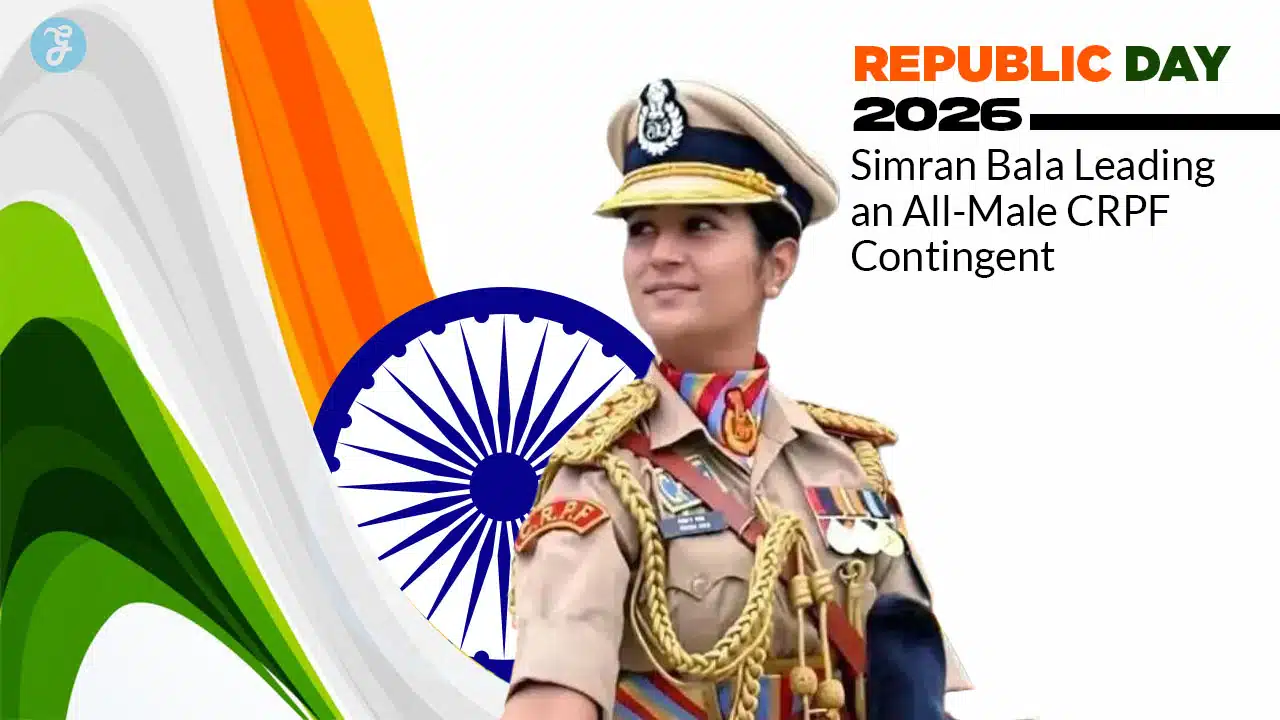
On Republic Day 2026, Assistant Commandant Simran Bala, a 26-year-old officer of the Central Reserve Police Force, becomes the first woman to lead an all-male marching contingent down Kartavya Path in New Delhi. So CRPF’s Simran Bala at Republic Day 2026 exemplifies this historic milestone and the breaking of traditional barriers. The moment marks an unprecedented chapter in the history of India’s largest central armed police force.
This achievement is not just ceremonial pageantry; it represents a symbolic recalibration of long-standing gender norms in uniformed services and signals a narrative shift that reflects broader social and institutional transformations in India. But why does this matter beyond the headline?
CRPF’s Simran Bala at Republic Day 2026: Breaking Tradition, But Not Alone
Traditionally, command roles in uniformed services, especially ones involving male formations at elite public events like the Republic Day parade, have been held by senior male officers. Even where women participated, it was usually in women-only contingents or supporting roles.
Simran Bala’s selection breaks that pattern:
- She will command over 140 male CRPF personnel in a full, all-male march past.
- This is the first time a woman has been appointed to such a visible, traditionally male leadership position in the CRPF.
It is a first not because the skill isn’t there, but because historic norms have kept women out of this spotlight.
Women’s Command Roles in Indian Security Forces – A Snapshot
| Category | Historically Dominant | Recent Milestones |
| Army | Male officers in command & combat | Women in permanent commission, some command roles |
| Air Force | Male pilots & commanders | Women fighter pilots & leadership roles |
| Paramilitary Forces (Incl. CRPF) | Male leadership in ceremonial & tactical units | Women in operational roles; first woman to lead all-male contingent (Simran Bala) |
| Republic Day Parade Leadership | Male officers | Women leading women/mixed contingents; now first leading all-male |
Meritocracy and Institutionality: What This Signals
In interviews and official statements, the CRPF emphasized that Bala’s selection was based on performance during rigorous rehearsals, where her leadership, drill precision, and command presence stood out. This aligns with a narrative increasingly voiced by institutions: merit, not gender, guides high-visibility appointments.
This isn’t lip service. It reflects an institutional evolution:
- The CRPF has already raised women-only battalions and inducted women into operational units.
- Opportunities like Bala’s show that women are no longer confined to symbolic participation but are rising into leadership positions.
This shift mirrors broader trends in India’s security establishment, where women are increasingly entering front-line, combat-linked, and command roles across the Army, Air Force, and paramilitary forces.
Social Symbolism Meets Strategic Reality
For many Indians, Republic Day functions as a tableau of national pride rooted in the idea of unity in diversity. Simran Bala’s role amplifies this message in significant ways.
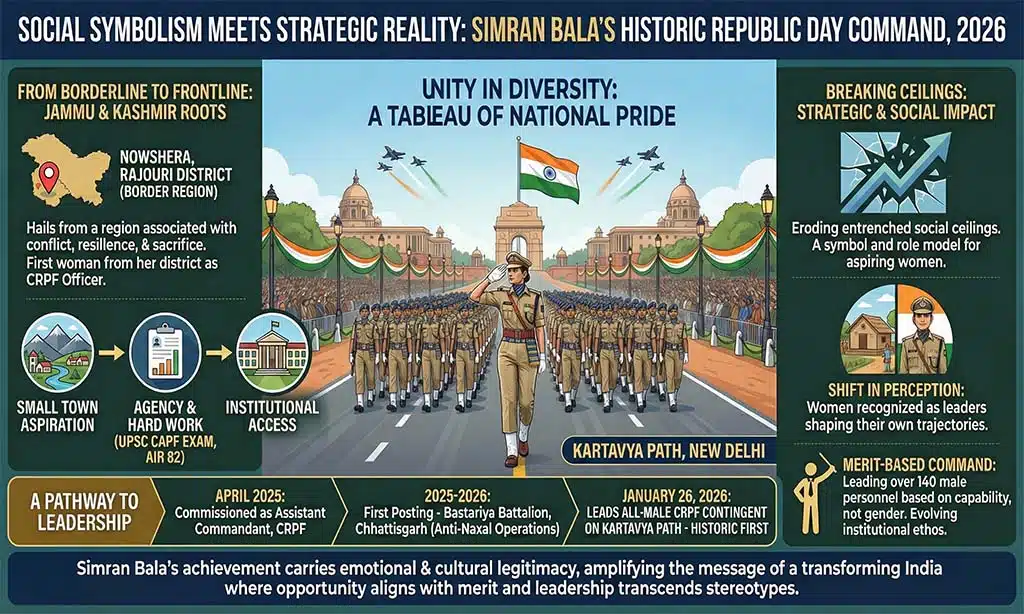
She hails from Nowshera in the Rajouri district of Jammu and Kashmir, a border region long associated with conflict, resilience, and sacrifice. Her journey from a small town to commanding a major ceremonial formation on Kartavya Path reflects themes of aspiration, agency, and institutional access.
In rural and semi-urban India, where ambitious young women often encounter entrenched social ceilings, Bala emerges as both a symbol and a role model. Coming from a region where traditional expectations can be particularly rigid, her achievement carries emotional and cultural legitimacy across communities. It signals a broader shift in perception, one in which long-standing barriers begin to erode and women in uniform are increasingly recognised as leaders shaping their own professional trajectories.
Beyond Optics: Towards Institutional Inclusion
This moment isn’t just optics. Its significance extends into the practical calibration of India’s security apparatus:
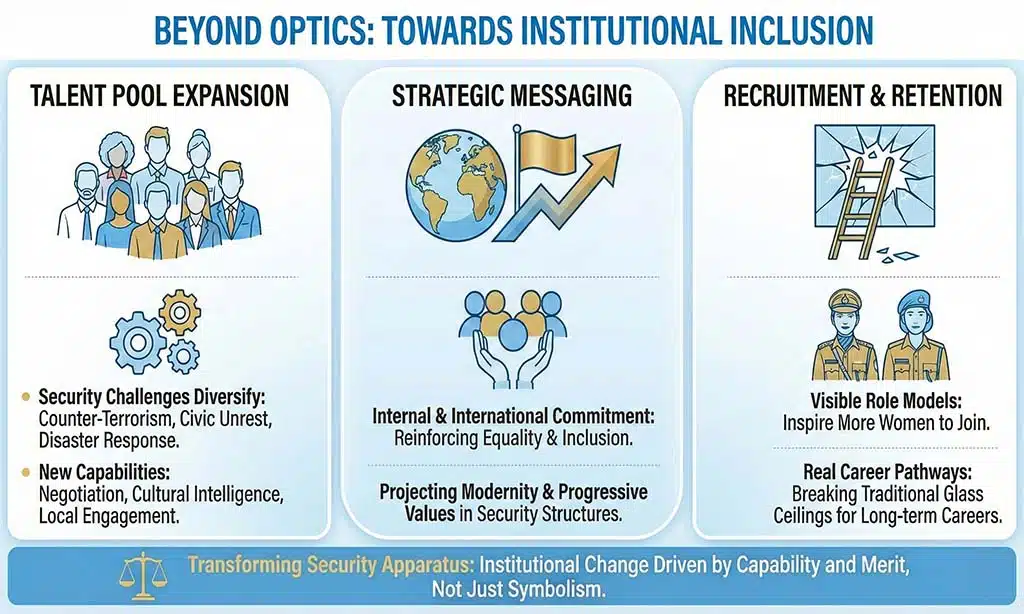
- Talent Pool Expansion: As security challenges diversify from counter-terrorism to civic unrest and disaster response, leadership capability matters as much as brawn. Women officers bring diverse skills in negotiation, cultural intelligence, and local engagement
- Strategic Messaging: Internally and internationally, such leadership roles reinforce India’s commitment to equality and inclusion within its security structures.
- Recruitment and Retention: Visible role models have a real impact on recruitment, more women may join and stay, knowing that traditional glass ceilings can be broken.
Global Perspective: Contextualizing the Milestone
Ceremonial leadership is not just a domestic achievement; it aligns India with global trends in armed forces. Across the world:
- United States Armed Forces: Women have commanded mixed-gender infantry units and ceremonial formations since 2015.
- United Kingdom: Female officers have led segments of the Trooping the Colour parade since the early 2010s.
- Israel Defense Forces (IDF): Women lead mixed-gender combat units and ceremonial formations.
- Scandinavian Forces (Norway, Sweden): Women are fully integrated in combat, operational, and ceremonial leadership roles.
Simran Bala, the first woman to lead an all-men marching contingent on Republic Day 2026, places India in this global trajectory of visible, operationally credible female leadership.
Operational Implications: Leadership Beyond Ceremony
Bala’s role demonstrates that ceremonial excellence mirrors operational competence:
- CRPF leadership appointments are merit-based, reflecting drill precision, coordination, and command presence.
- Women’s integration into operational units is gaining momentum, with female officers now deployed in field, counter-insurgency, and disaster-response operations.
- Her visibility may encourage the expansion of leadership training and career progression opportunities for women, reinforcing meritocracy institution-wide.
Societal and Cultural Impact
Bala’s achievement transcends institutional walls:
- Schools, colleges, and recruitment bodies are likely to cite her milestone as evidence that gender barriers can be dismantled.
- Young women in border and rural districts may now view security service as an attainable aspiration.
- Symbolically, it demonstrates that national strength is not only measured in manpower but also in opportunity and inclusion.
Future Implications: A Path Forward
Normalising Command Parity
Bala’s leadership could catalyse a shift where women regularly command mixed or male formations, not as exceptions, but as institutional norms.
Policy and Structural Shifts
As more women enter operational and front-line roles, the CRPF and other forces may see:
- Expanded tactical and leadership training designed with gender inclusivity.
- Policy reviews for command opportunities in combat and strategic planning.
- Evolving performance metrics that recognize diverse leadership strengths.
Societal and Cultural Ripple Effects
- Schools, colleges, and recruitment bodies can use Bala’s milestone as a case study for gender equity.
- Communities may re-evaluate traditional gender norms, inspired by her visibility.
- Young women across India, especially in border districts, may be motivated to pursue careers in security services.
Significance and Milestones
Significance of Simran Bala’s Appointment
| Dimension | What It Changes | What It Signals |
| Institutional Norms | Women can command all-male contingents | Meritocracy overriding tradition |
| Social Messaging | Visibility of female leadership | Inspires gender equality across sectors |
| Strategic Capability | Expands leadership talent pool | Diverse perspectives strengthen security outcomes |
| Future Pathways | Opens doors in uniformed services | Moves toward structural inclusion |
Global Comparison of Women in Leadership Roles
| Country | Role | Year |
| USA | Commanded mixed-gender infantry units | 2015 |
| UK | Led ceremonial parade segments | 2012 |
| Israel | Led mixed-gender combat units | 2000s |
| India | Simran Bala commands all-male CRPF contingent | 2026 |
A Deeper Look: Women in India’s Paramilitary Forces
While the Army, Navy, and Air Force have long been in the public eye regarding women’s integration, the paramilitary forces, including CRPF, have historically been even more male-dominated. Women first began serving in CRPF battalions in limited numbers during the late 20th century, primarily in support roles such as communications, medical, and administration. The introduction of women in operational battalions marked a major policy evolution, demonstrating that female officers could perform in physically demanding and high-risk environments.
By the early 2010s, women were deployed in crowd control, counter-insurgency, and disaster-response operations, signaling institutional recognition of their capabilities. Bala’s appointment is the culmination of decades of gradual integration. Unlike earlier roles restricted to women-only units, leading an all-male contingent in the Republic Day parade is a public affirmation of operational credibility, combining visibility with authority.
Training and Operational Readiness: What It Takes to Lead
Leading an all-male contingent is not ceremonial window dressing, it demands rigorous preparation. Officers undergo months of drill rehearsals, tactical coordination, and command simulations. For Bala, this meant:
- Commanding over 140 personnel, ensuring synchronized movement and precision.
- Adhering to strict timing and protocol, with every step under scrutiny from top brass.
- Demonstrating authority and composure, especially under public and media attention.
Such preparation mirrors operational leadership on the field, where communication, decisiveness, and trust are essential. By successfully completing this assignment, Bala demonstrates that gender does not limit the ability to lead in high-pressure scenarios, reinforcing CRPF’s merit-based promotion culture.
Global Comparisons: Learning from the World
Across the world, militaries have used visible leadership milestones to signal inclusion. Several examples illustrate parallels with Bala’s achievement:
- Israel Defense Forces: Women routinely command mixed-gender combat units, with ceremonial appointments serving as both a morale booster and public affirmation.
- United States: Female officers now lead infantry companies, armored units, and ceremonial contingents. These roles are milestones that encourage further operational integration.
- United Kingdom: Leading segments of the Trooping the Colour parade are symbolic, yet these officers also occupy high-ranking command positions, demonstrating a link between visibility and operational authority.
- Canada & Scandinavia: Full integration allows women to command units, manage strategic operations, and lead public ceremonial events… ensuring symbolic leadership aligns with operational competence.
Bala’s leadership can be seen as India’s entry into this global pattern of recognizing women in both ceremonial and operational command roles.
Public Perception and Media Impact
Visibility is a powerful tool. Republic Day is broadcast nationally and watched by millions across the country. Bala’s appointment:
- Challenges stereotypes about women in combat and command positions.
- Inspires a new generation of young women to consider careers in uniformed services.
- Sends a strong societal signal that skill and dedication, not gender, determine leadership.
Media coverage, both traditional and social, amplifies this effect. Early reactions to Bala’s selection have been overwhelmingly positive, with many highlighting her as a role model for ambition, resilience, and breaking barriers.
Institutional Messaging: Policy Implications
Bala’s milestone is not just about visibility, it is a policy statement. Institutions like CRPF signal through appointments that:
- Meritocracy is paramount: Selection is based on performance, not traditional gender expectations.
- Operational capability is recognized: Female officers are trusted with high-visibility, high-pressure assignments.
- Pathways are opening: By appointing women to symbolic yet operationally demanding roles, forces encourage more women to aspire to command positions.
This appointment may lead to broader policy reviews:
- Expanding training programs to ensure women have equal access to operational leadership roles.
- Reviewing promotion and command pathways to include frontline and high-visibility roles.
- Establishing mentorship programs where experienced female officers guide juniors, increasing retention and career satisfaction.
Strategic Significance: Beyond Symbolism
Beyond optics, Bala’s leadership reflects a strategic understanding of diversity as a force multiplier:
- Women in command positions bring different perspectives in crisis management, cultural understanding, and engagement in civilian-heavy operations.
- Institutional flexibility in leadership assignments ensures better talent utilization, strengthening operational efficiency.
- Visible female leadership enhances recruitment, ensuring a broader, more capable talent pool for future challenges.
Regional Representation and Inspiration
Bala hails from Nowshera, Rajouri district in Jammu & Kashmir, a region historically associated with conflict. Her ascent is significant for several reasons:
- Demonstrates that talent from remote and border regions can rise to national prominence.
- Serves as a regional inspiration, encouraging youth from similar backgrounds to pursue careers in security services.
- Symbolically, it emphasizes the diverse fabric of India’s armed forces, where meritocracy transcends geography and gender.
Integrating Tradition with Modernity
India’s security apparatus is steeped in tradition. Leading a parade is both ceremonial and a test of discipline. Bala’s appointment shows:
- How traditional ceremonies can be leveraged to communicate institutional change.
- That modern operational competence and gender inclusion can coexist with long-standing cultural rituals.
- By integrating women into high-visibility roles, forces signal an alignment of institutional tradition with progressive social values.
Future Pathways: Beyond Bala
Bala’s appointment opens the door for further developments:
- Women may command mixed and male formations regularly, not as exceptions.
- Policies may evolve to allow more operational leadership roles in combat, intelligence, and tactical units.
- Visibility in public ceremonies can act as a feedback loop, encouraging broader societal acceptance and institutional reinforcement of gender parity.
Her success could inspire regional and national recruitment campaigns, leading to long-term structural changes in India’s security forces.
Final Thought: A Step, Not a Ceiling
Simran Bala, the first woman to lead an all-men marching contingent on Republic Day 2026, represents a milestone, but not the destination. Her achievement reflects a trajectory of inclusion, where capability and leadership are increasingly uncoupled from traditional gender roles. It is both symbolic and substantive, a reminder that national strength is measured not only in force size but in the breadth of opportunities it offers to all citizens.