For decades, the ultimate symbol of suburban luxury was the golf course community. Manicured fairways and exclusive clubhouses defined the aspirational lifestyle. But in recent years, a significant shift has occurred. The golf cart is being traded for the garden hoe, and the fairway is being replaced by rows of organic vegetables.
Welcome to the age of the Agri-hoods—residential developments built around a working farm.
This isn’t just a niche trend for serious homesteaders. It is a booming real estate sector catering to families, retirees, and young professionals who crave connection—to their food, to the land, and to their neighbors. From small pockets of homes in rural areas to massive master-planned communities in the suburbs, agri-hoods are redefining what it means to live “the good life.”
What Is An Agri-hood?
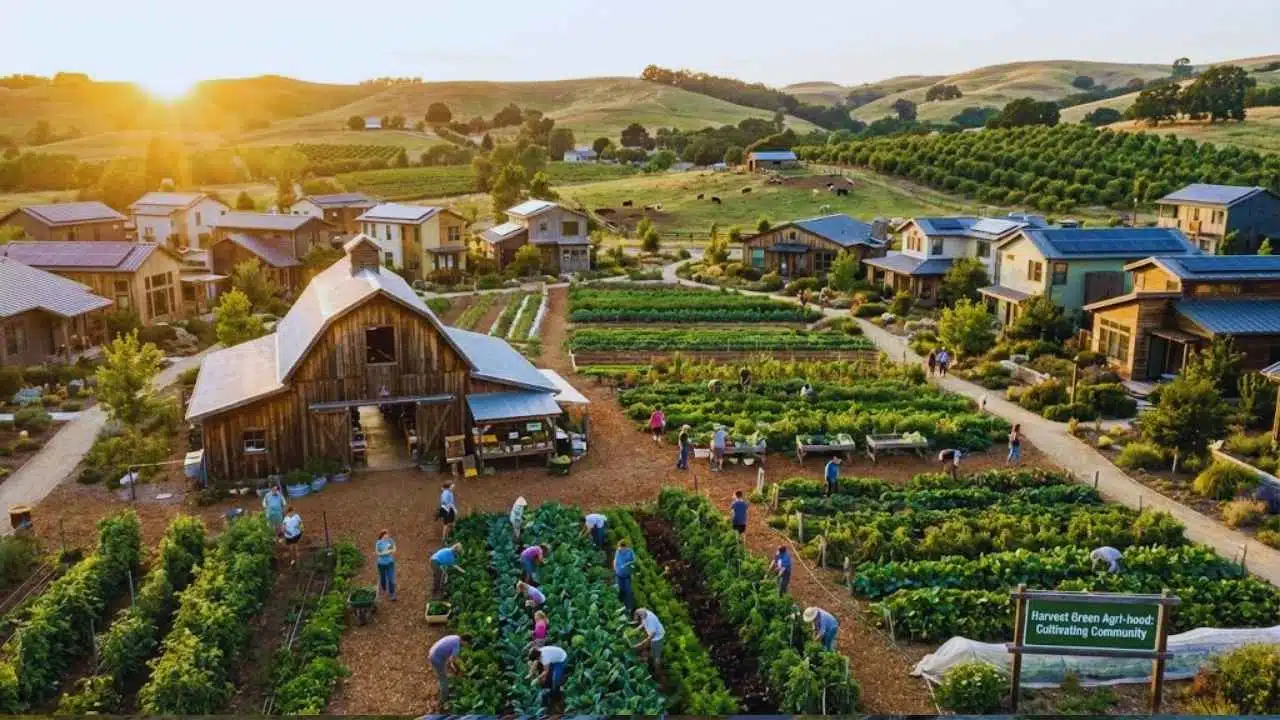
At its core, an agri-hood is a planned community that integrates agriculture into a residential neighborhood. Instead of a tennis court or a swimming pool serving as the central amenity, the focus is a working farm.
While community gardens have existed for decades, agri-hoods take the concept further. In these neighborhoods, the farm is not an afterthought; it is the centerpiece of the development’s design, culture, and often, its economy. Developers deliberately preserve a portion of the land for agricultural production, ensuring that residents have direct access to fresh produce and green space.
The Urban Land Institute (ULI) estimates there are now over 200 agrihoods across the United States, and the number is growing rapidly internationally. They range from urban infill projects with small hydroponic setups to sprawling rural estates with hundreds of acres of crops and livestock.
What is an Agri-hood? An agrihood (short for “agricultural neighborhood”) is a master-planned residential community built with a working farm as its primary focus and amenity. Unlike typical suburbs, agri-hoods provide residents with access to fresh, locally grown food, farm-based education, and open green spaces, fostering a lifestyle centered on wellness and sustainability.
The Working-Farm-First Concept (Not Just “Homes Near Farmland”)
It is important to distinguish a true agri-hood from a standard subdivision that happens to border a cornfield. In a generic subdivision near farmland, the residents have no relationship with the agriculture; in fact, they are often separated from it by fences or buffer zones.
In a true agrihood, the “working-farm-first” concept applies. The farm is an interactive amenity. The rows of crops are often woven between housing clusters, and the barn may double as a community center. The design philosophy treats the farm as a living, breathing asset. This means the layout of the streets, the positioning of the homes, and the pedestrian paths are all oriented to highlight the agriculture, not hide it. The farm is the “anchor tenant” of the neighborhood.
Common Agrihood Models (Working Farm, Community Garden, CSA-Driven, Mixed-Use)
Not all agrihoods look the same. Developers and planners utilize different models depending on the size of the land and the target demographic.
- The Production Farm Model: This is the most robust version. A professional farm manager or a tenant farmer runs a full-scale operation (often 5 to 20+ acres). They grow crops for the residents and potentially for sale to local restaurants or markets. Residents enjoy the view and the food but don’t necessarily do the weeding.
- The CSA-Driven Model: Community Supported Agriculture (CSA) is central here. Residents are automatically enrolled in a subscription service, receiving a weekly box of produce from the onsite farm as part of their HOA fees or as an optional perk.
- The Community Garden Model: These are more “hands-on.” Instead of a single large commercial operation, the land is divided into allotment gardens where residents grow their own food. This is common in urban agrihoods where space is tight.
- The Mixed-Use Village: These are larger developments that combine residential living with commercial enterprises. You might find a farm-to-table restaurant, a coffee shop, and a retail market right on the property, all supplied by the farm next door.
Why Agri-hoods Are Growing Now
The explosion of agrihoods isn’t accidental. It is the result of a convergence of shifting consumer values, economic realities for developers, and a renewed interest in environmental stewardship. As the quintessential “suburban dream” evolves, the agrihood has emerged as the solution to modern housing desires.
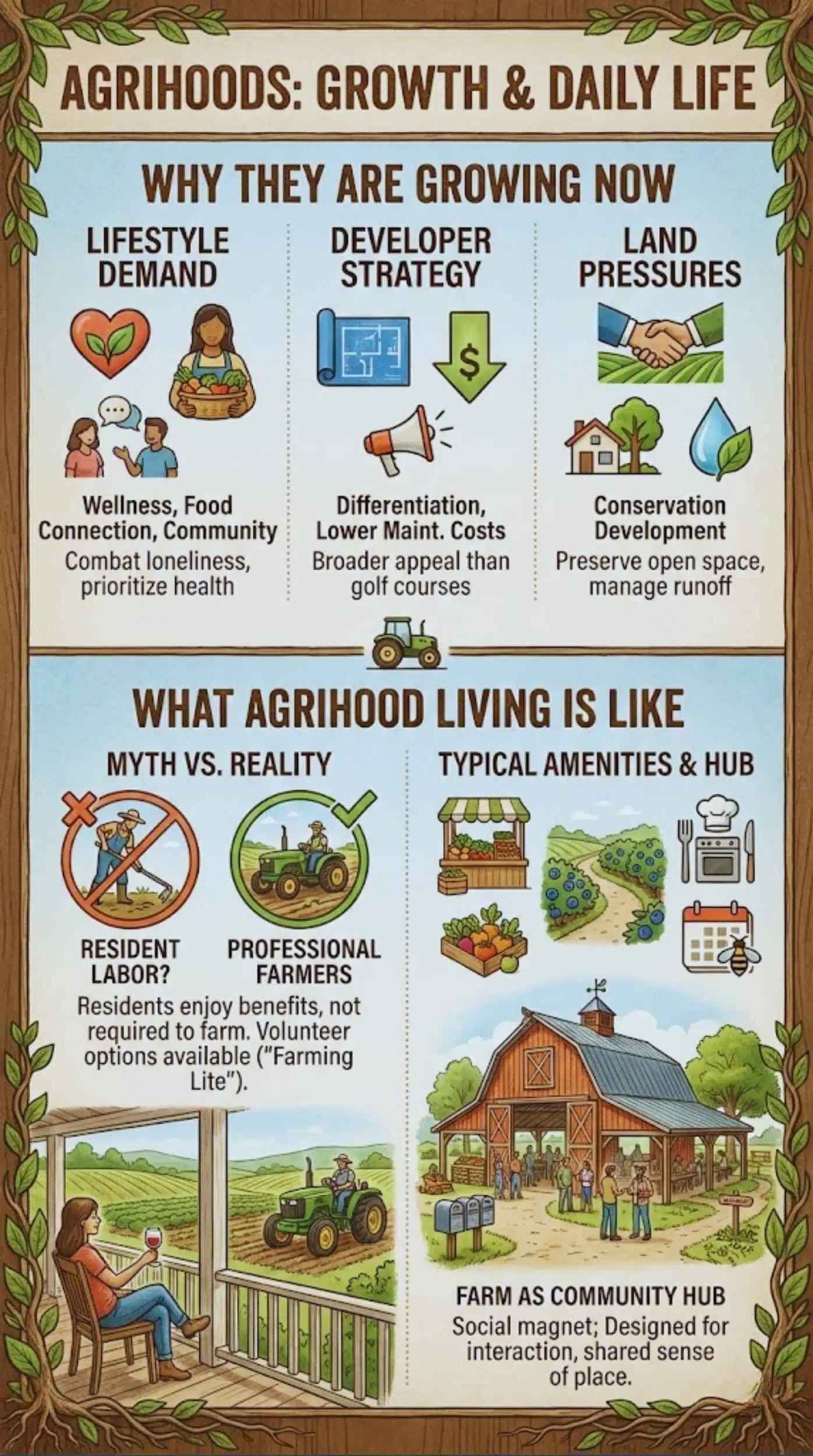
Lifestyle Demand: Wellness, Food Connection, Community
The modern homebuyer is increasingly health-conscious and socially conscious. The “farm-to-table” movement has graduated from restaurants to real estate. People want to know where their food comes from, and there is no better transparency than looking out your kitchen window to see your dinner growing.
Beyond food, there is a deep crisis of loneliness in modern society. Traditional suburbs, with their car-centric designs and private backyards, often isolate neighbors. Agrihoods are designed to force interaction in positive ways. Whether it’s picking up a CSA box at the barn, attending a harvest festival, or volunteering for a “weed and wine” Wednesday, the farm provides a natural gathering point.
Furthermore, the wellness economy is booming. Residents see living near a farm as a way to ensure their families eat fewer processed foods and spend more time outdoors. It is a lifestyle choice that signals a prioritization of health and nature over status and exclusivity.
Developer Strategy: Differentiation Beyond Golf-Course Suburbs
For decades, the golf course was the gold standard for adding value to real estate. However, golf participation has flattened or declined in many demographics, and golf courses are incredibly expensive to maintain (requiring massive amounts of water and chemicals).
For developers, agrihoods offer a compelling alternative strategy:
- Lower Maintenance Costs: While farms require work, they often cost less to install and maintain than an 18-hole championship golf course.
- Broader Appeal: Not everyone plays golf, but everyone eats. A farm appeals to a much wider demographic, including young families, millennials, and active retirees.
- Marketing Power: In a crowded housing market, offering an “eco-friendly” and “sustainable” lifestyle is a powerful differentiator. It allows developers to market a story of heritage and health, which commands a premium price.
Land And Planning Pressures: Preservation + Open Space Value
From a municipal planning perspective, agrihoods are a smart way to handle the tension between housing needs and land conservation. As cities expand outward, they often pave over prime agricultural land.
Agrihoods offer a compromise known as “conservation development.” By clustering homes closer together on a portion of the property, the developer can preserve the remaining land for agriculture. Local governments often look favorably on these projects because they preserve green space, manage stormwater runoff better than concrete-heavy subdivisions, and keep a semblance of the area’s rural character alive. It turns the preservation of open space into an economic asset rather than a liability.
What Agrihood Living Is Actually Like (Day-To-Day Reality)
The marketing brochures for agrihoods feature golden-hour photos of laughing children holding baskets of heirloom tomatoes. But what is the actual day-to-day experience for a resident? It is a blend of standard suburban comfort with a layer of rural activity.
Do Residents Have To Work On The Farm?
This is the most common misconception. In the vast majority of agrihoods, residents are not required to farm.
Most communities employ professional farmers or contract with a local agricultural company to manage the crops. The residents are the beneficiaries, not the laborers. You can sit on your porch with a glass of wine and watch the farmers work without ever getting dirt under your fingernails.
However, volunteer opportunities are almost always available. For those who want to get involved, there are usually scheduled community days, educational workshops, or designated community garden plots. It is “farming lite”—you get the therapeutic benefits of gardening when you feel like it, without the financial risk or back-breaking obligation of running a commercial farm.
Typical Amenities (Farm Stand, Farmers Market, Events, Edible Landscaping)
Living in an agrihood feels different because the amenities are productive.
- The Farm Stand: Most agrihoods have an on-site stand where residents get “first dibs” on fresh eggs, honey, flowers, and vegetables.
- Edible Landscaping: Instead of decorative shrubs, you might find blueberry bushes lining the sidewalks or apple trees in the common parks. Residents are often encouraged to forage these public plants.
- Demonstration Kitchens: Community centers frequently feature large commercial kitchens for cooking classes, canning workshops, or chef-hosted dinners using ingredients grown 500 yards away.
- Educational Programming: Expect a calendar full of events like “Introduction to Beekeeping,” “Composting 101,” or summer camps for kids centered on biology and farming.
The “Farm As Community Hub” Design Principle
In traditional towns, the church or the town square was the anchor. In agrihoods, the farm serves this purpose. The physical layout of the community usually funnels foot traffic toward the farm.
Mailboxes might be clustered near the greenhouse to encourage conversation. Walking trails loop around the perimeter of the fields. The “Hub” is designed to be a third place—neither work nor home—where residents bump into one another naturally. This design principle turns the farm into a social magnet, grounding the community in a shared sense of place.
Benefits Of Agri-hoods (Who They’re Best For)
Agrihoods appeal to a specific psychographic of buyers—those seeking a return to simplicity without sacrificing modern convenience. The benefits are tangible and center on health, social ties, and environment.
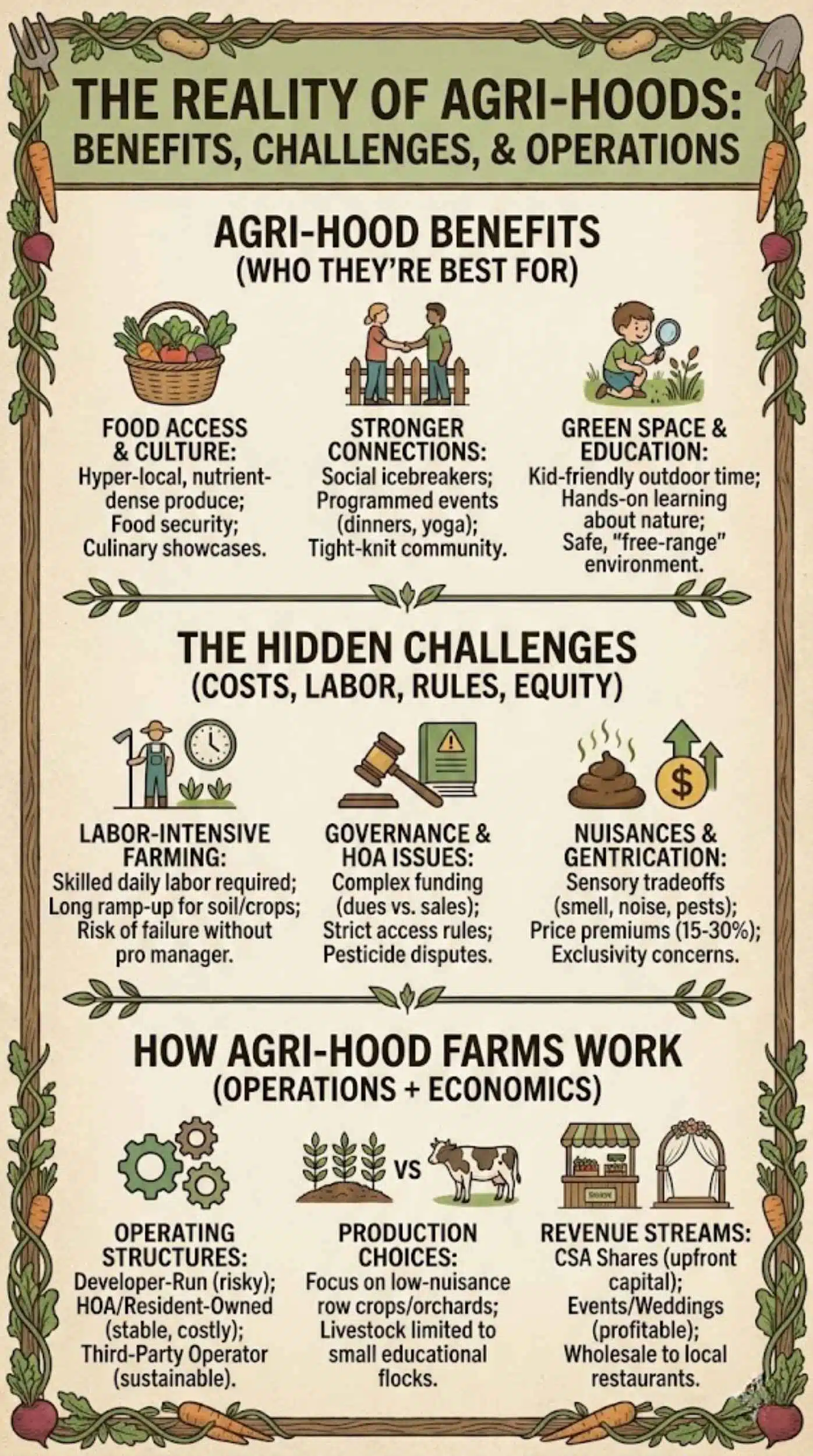
Food Access + Farm-To-Table Culture
The most obvious benefit is food security and quality. In an era of supply chain disruptions and concerns over pesticides and factory farming, having a source of food within walking distance provides immense peace of mind.
Residents often enjoy a “hyper-local” diet. The produce is harvested at peak ripeness, meaning it is more nutrient-dense and flavorful than vegetables that have traveled 1,500 miles on a truck. This fosters a culture where food is celebrated. Potlucks become culinary showcases, and neighbors trade recipes based on what is currently in season. For foodies and home cooks, this environment is paradise.
Stronger Neighbor Connections + Programming
Agrihoods are famously social. The shared interest in the farm creates an instant icebreaker. It is easier to meet a neighbor while picking strawberries or attending a harvest festival than it is in a sterile cul-de-sac.
Developers heavily program these communities. There are often full-time “lifestyle directors” whose job is to organize farm-to-table dinners, sunset yoga in the fields, and pumpkin patches. This programming creates a tight-knit social fabric. For remote workers or transplants moving to a new city, this built-in community is a major selling point.
Green Space, Education, And Kid-Friendly Outdoor Time
For families with children, agrihoods offer an unparalleled educational environment. Kids grow up understanding that carrots come from the dirt, not a plastic bag. They learn about seasons, pollinators, and the water cycle through direct observation.
The abundance of open green space allows for “free-range” parenting. Because the land is preserved for farming and nature trails, there is often less through-traffic and more safe areas for children to explore. It combines the safety of a gated community with the adventure of a rural upbringing.
The Hidden Challenges (Costs, Labor, Rules, And Equity Concerns)
While the agrihood concept is idyllic, the reality involves complex logistics. Farming is a difficult, low-margin business, and mixing it with high-end real estate can create friction.
The Farm Is Labor-Intensive (Staffing Reality + Long Ramp-Up)
A farm is not a park; it cannot simply be mowed once a week. It requires daily, skilled labor. One of the biggest failures in early agrihood attempts was underestimating the cost of professional farming.
If the developer does not hire an experienced farm manager, crops fail, weeds take over, and the “amenity” becomes an eyesore. Furthermore, farms have a long ramp-up period. Soil health takes years to build. Fruit trees take years to bear fruit. Residents moving in during phase one might see a lot of mud and machinery before they see a bountiful harvest, leading to dissatisfaction if expectations aren’t managed.
Governance: HOA Rules, Farm Access, And “Who Pays For What?”
The intersection of HOA (Homeowners Association) politics and farming can be messy.
- Who pays for the farm? Is the farm self-sustaining through produce sales, or do HOA dues subsidize it? If the farm has a bad year (drought, pests), do residents’ fees go up?
- Access Rules: Can residents walk in the rows whenever they want? Usually, no, because of food safety regulations and potential crop damage. This can frustrate residents who feel they “own” the farm.
- Pesticide Disputes: Residents might demand an organic farm, but if a crop disease strikes, the farmer might argue for conventional intervention to save the harvest. These governance issues require clear legal frameworks.
Nuisances And Tradeoffs (Smell, Noise, Pests, Farm Traffic)
Farms are sensory experiences—and not always pleasant ones. Real agriculture involves manure (which smells), roosters (which crow at 5 AM), and tractors (which are loud and kick up dust).
There are also pests. A farm attracts insects, deer, and rodents. While developers try to mitigate this, residents living next to a working farm must have a higher tolerance for nature’s grittier side. A buyer expecting a pristine, sterile environment will be unhappy when the wind shifts during fertilizing season.
Gentrification And Pricing Pressure (Community Benefit vs Exclusivity)
There is a growing critique that agrihoods are a form of “green gentrification.” They often command a price premium of 15% to 30% over comparable standard subdivisions. This pricing creates exclusive enclaves where only the wealthy can afford access to fresh, local food and green space.
While the farm provides food, if that food is sold at boutique prices that only the residents can afford, it fails to address broader food system inequities. The challenge for future agrihoods is to balance premium real estate with genuine community accessibility.
How Agrihood Farms Work (Operations + Economics)
To understand an agrihood, you must follow the money. The success of the community hinges on a sustainable business model for the agriculture.
Common Operating Structures (Developer-Run, Resident-Owned, Third-Party)
- Developer-Run: The developer retains ownership of the farm and employs staff to run it. This is common in the early stages but can be risky if the developer loses interest after selling all the homes.
- HOA/Resident-Owned: The farm is a common area asset, like a pool. The HOA employs the farmer. Residents pay for the farm via dues. This offers stability but increases monthly costs.
- Third-Party Operator: The developer leases the land to an independent farmer for a nominal fee (e.g., $1/year). The farmer runs their own business, selling produce to residents and the public. This is often the most sustainable model, as the farmer is an entrepreneur with “skin in the game.”
Production Choices (Vegetables vs Livestock) And Why It Matters
Most agrihoods focus on row crops (vegetables, flowers, herbs) and orchards. These are visually appealing and generally low-nuisance.
Livestock is trickier. While chickens and goats are popular for “petting zoo” vibes, large-scale livestock (cows, pigs) require significant land and create more waste and smell. Consequently, most agrihoods limit animals to small educational flocks or rotational grazing on the periphery, keeping the intensive vegetable farming closer to the homes.
Revenue Streams (CSA, Farm Stand, Events, Local Wholesale)
A financially healthy agrihood farm rarely relies on just one income source.
- CSA Shares: Pre-sold vegetable subscriptions provide upfront capital for the farmer at the start of the season.
- Events/Weddings: Many agrihoods rent out the “picturesque barn” for weddings. This is often more profitable than the crops themselves and helps subsidize the farming operations.
- Wholesale: Selling excess produce to local restaurants helps the farm brand gain reputation in the wider city.
Real-World Examples (What To Look For In A “True” Agrihood)
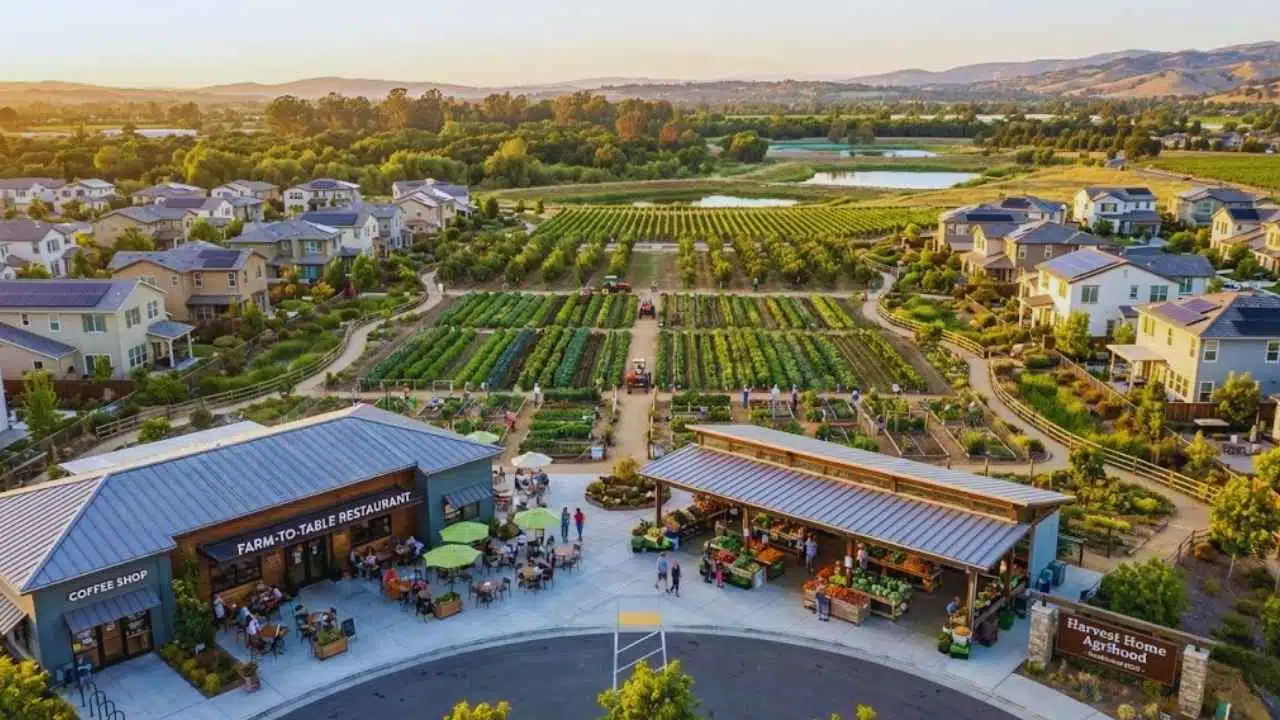
Seeing is believing. Several established communities have set the standard for what a successful agrihood looks like.
Agritopia (Arizona) As A Frequently Cited Case Study
Located in Gilbert, Arizona, Agritopia is the “grandfather” of the modern agrihood movement. Built on the Johnston family’s homestead, it features 450 residential lots surrounding roughly 11 acres of certified organic farmland.
Agritopia succeeds because it feels like a village. It has a coffee shop, a farm-to-table restaurant (Joe’s Farm Grill), and a community garden, all walkable from the homes. The fences are low to encourage chatting, and the farm is visually central. It proves that agriculture can thrive even in a suburban desert environment when integrated with commercial amenities.
Harvest Green (Texas) And The Master-Planned Agrihood Playbook
Harvest Green in Richmond, Texas, represents the “scaled-up” model. It is a 1,300-acre master-planned community. It includes a 12-acre village farm, orchards, and vineyards.
What makes Harvest Green unique is its “Farm Club,” which allows residents to rent plots and learn directly from professional farmers. They also have a massive CSA program. This development shows how the agrihood concept can be applied to mass-market housing, moving beyond boutique projects to mainstream suburbia.
A Quick “Spot The Difference” Checklist
How do you tell a marketing gimmick from a real agrihood? Use this checklist:
- Is the farm central? If the farm is hidden in a back corner or acts as a buffer against a highway, it’s not an agrihood—it’s landscaping.
- Is there dedicated staff? Ask to meet the farmer. If there isn’t a full-time farm manager, the project will likely fail.
- Is food access real? Can you actually buy the food? Some “agrihoods” grow decorative corn that isn’t for eating. Look for a CSA or active farm stand.
- Is the farm protected? Is the agricultural land under a conservation easement? If not, the developer could pave it over for “Phase 2” of housing later.
Buyer’s Guide: Questions To Ask Before You Move Into An Agrihood
Buying a home in an agrihood requires more due diligence than a standard purchase. You are buying into a business ecosystem.
Cost Questions (HOA, Farm Dues, CSA Pricing)
- What does the HOA fee cover? Does it subsidize the farm’s losses? If the tractor breaks, do residents get a special assessment bill?
- Is the CSA included? In some communities, a weekly veggie box is mandatory and included in your dues. In others, it is an extra $500–$800 per season.
- Event Fees: Are the harvest dinners and workshops free for residents, or are they ticketed events open to the public?
Farm Governance Questions (Decision Rights, Pesticide Policy)
- Who controls the farming practices? If you are allergic to certain chemicals, you need to know the farm’s pesticide policy. Is it Certified Organic or just “naturally grown”?
- Can the land be sold? Verify that the farm land is deed-restricted. You don’t want to wake up in five years to find condos being built on the vegetable patch.
Lifestyle Fit Questions (Participation, Volunteer Culture, Privacy)
- What are the expectations for volunteering? Some co-housing style agrihoods require work hours. Most are voluntary. Know the difference.
- How public is the farm? If the farm hosts weddings every weekend or opens a market to the general public, there will be traffic and strangers in your neighborhood. Ensure you are comfortable with this level of activity.
- Privacy: If your home backs up to the farm, realize that workers will be visible early in the morning.
The Future Of Agrihoods (Trends To Watch)
The agrihood model is maturing. We are moving from the “experimental” phase to the “refinement” phase.
Scaling Up: Larger Developments + Conservation Components
Future agrihoods will be bigger. We are seeing developments with 2,000+ homes where the “farm” is actually a 100+ acre conservation area involving forestry and wildlife management alongside crops. This moves the concept toward “nature-hoods,” where the focus is broadly on ecological restoration.
Climate, Water, And Regenerative Claims (What’s Measurable?)
As climate change accelerates, agrihoods will market themselves as resilient communities. Expect to see “Regenerative Agriculture” as a buzzword, focusing on soil health and carbon sequestration. Water management will also be key; agrihoods in drought-prone areas will utilize gray-water recycling systems to irrigate crops, claiming a “net-zero water” footprint.
What Could Make The Model More Accessible
The next frontier is affordability. Currently, most agrihoods are luxury products. However, nonprofits and affordable housing advocates are looking at the model to solve food deserts. We may see “civic agrihoods”—publicly funded housing developments integrated with urban farms—providing healthy food and jobs to lower-income residents, democratizing the benefits of the farm-to-table life.
Final Thoughts
Agri-hoods are more than a real estate trend. At their best, they blend housing with a working farm to create fresher food access, stronger neighbor connections, and a daily lifestyle that feels rooted in place.
But the “farm” part is not decorative. A successful agri-hood needs clear governance, stable funding, qualified farm leadership, and realistic expectations about nuisances like noise, smell, and seasonal variability. When those pieces are missing, the concept can slide into marketing without meaningful community or food impact.
If you’re covering or buying into an agri-hood, focus on proof over promises: who operates the farm, how it’s funded, what residents actually receive (CSA, farm stand, programming), and what rules shape participation and long-term sustainability. The more transparent the operating model, the more likely the community delivers on the farm-centered vision.