In 2026, the traditional “social contract” of international education—pay high fees, get a degree, secure a visa—has fractured. With Western nations implementing strict student visa caps, a new phenomenon is emerging: the “Immersive Degree.” This analysis explores how Virtual Reality (VR) and the E-Learning Revolution are not just upgrading online learning but creating a controversial new “side door” for global mobility, fundamentally altering citizenship pathways for students in the Global South.
Contextual Background
To understand the current seismic shift in 2026, we must look at the regulatory “earthquake” of 2024 and 2025. For decades, the university sector in the UK, Canada, and Australia operated on a tacit agreement: higher education was the primary route to residency. However, this model collapsed under political pressure to reduce net migration.
Canada’s decision to cap international study permits at roughly 485,000 in 2024, followed by further reductions in 2025, sent shockwaves through the market. Similarly, Australia’s replacement of the Global Talent Visa with the stricter National Innovation Visa (NIV) in late 2024, alongside “soft caps” on university enrollments, left millions of aspiring migrants from India, Nigeria, and Southeast Asia stranded.
Faced with a revenue cliff, universities pivoted. They didn’t just return to Zoom; they invested billions in the “Metaverse Campus”—high-fidelity, haptic-enabled VR environments. But the unforeseen consequence of this technological pivot is geopolitical: it has begun to decouple education from location, creating complex new visa categories and loopholes that immigration authorities are struggling to regulate.
The Rise of the “Metaverse Campus”: Beyond Zoom
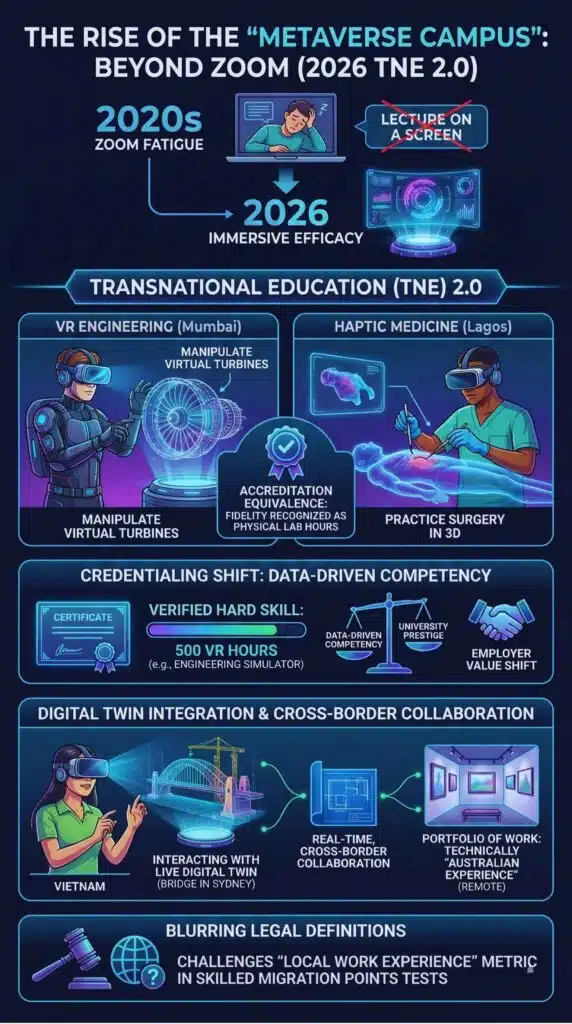
The first major shift of 2026 is technological. The “Zoom fatigue” of the early 2020s has been replaced by immersive efficacy. We are no longer talking about watching a lecture on a screen; we are witnessing the rise of Transnational Education (TNE) 2.0.
Top-tier institutions in the US and Germany now offer “VR Engineering” and “Haptic Medicine” degrees where students in Mumbai or Lagos wear headsets to manipulate virtual turbines or practice surgery in 3D. The fidelity of these simulations has reached a point where accrediting bodies—previously skeptical—are beginning to recognize them as equivalent to physical lab hours.
This creates a critical credentialing shift. If a student in Lagos can prove they have logged 500 hours in a specific VR engineering simulator, they possess a verified hard skill. This data-driven competency is becoming more valuable to employers than the prestige of the university providing it, fundamentally changing who gets hired remotely.
What distinguishes the 2026 landscape is the integration of “Digital Twins” into the curriculum. A student in Vietnam isn’t just looking at a 3D model of a bridge; they are interacting with the live digital twin of a bridge currently being built in Sydney. This real-time, cross-border collaboration allows students to build a portfolio of work that is technically “Australian experience” without ever stepping foot on the continent. This blurs the legal definitions of “local work experience,” a key metric in almost every skilled migration points test.
The “Hybrid Loophole”: A New Path to Residency
The most significant development for global mobility is the emergence of the “Hybrid Visa Pathway.”
With full-term student visas becoming scarce and expensive (Australian visa fees spiked significantly in mid-2025), students are adopting a 2+1 model. They complete two years of their degree in their home country via immersive VR (paying lower “offshore” fees) and transfer to the physical campus only for the final year.
Why this matters for migration:
- Visa Cap Evasion: By entering the country only for the final year, students often bypass the stricter “commencing student” caps which target multi-year entries.
- Post-Study Work Rights: Most jurisdictions, including the UK and Canada, require a minimum duration of onshore study (usually 8 months to 2 years) to qualify for a Graduate Route visa. The “VR start, Physical finish” model is being aggressively marketed by agents as the most cost-effective way to secure these rights without the crushing debt of three years of onshore living costs.
This model effectively democratizes the “brain drain.” Previously, only the wealthy elite of the Global South could afford the three or four years of tuition and living expenses required to study abroad. Now, a much broader middle class can afford the “1 Year Onshore” cost, meaning the pool of potential migrants has paradoxically expanded despite the tighter visa caps. Western governments, aiming to restrict numbers, have inadvertently created a funnel that is wider at the top (offshore enrollment) and harder to block at the bottom (onshore transfer).
The Shift from “Degree-Based” to “Skill-Based” Visas
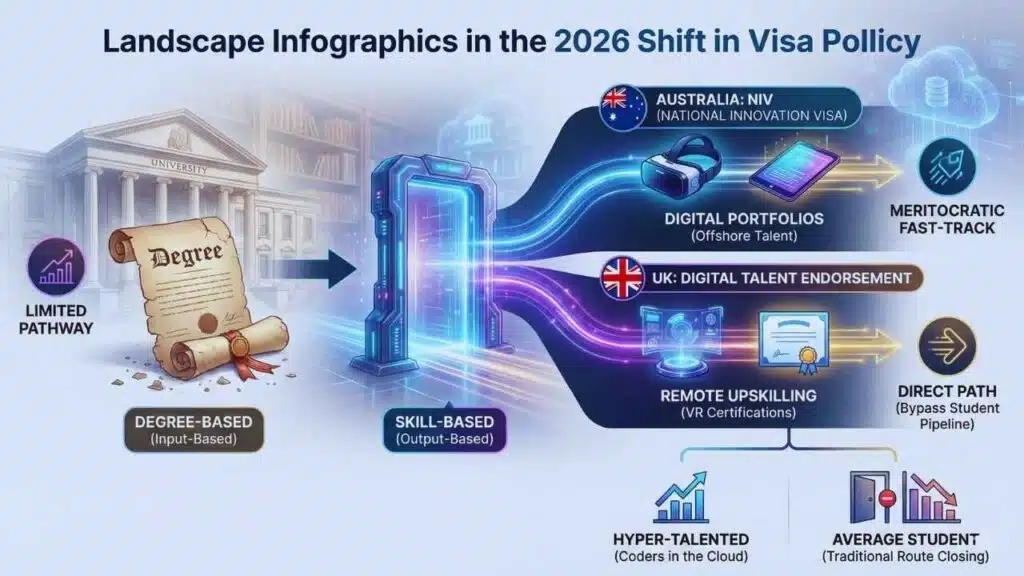
Perhaps the most forward-looking trend in 2026 is the erosion of the university degree as the sole proxy for talent. New visa regimes are prioritizing proven innovation over academic pedigree.
Australia’s National Innovation Visa (NIV):
Replacing the Global Talent Visa, the NIV (fully operational as of 2026) places immense weight on “exceptional talent” in critical sectors. Crucially, it allows for offshore applicants to demonstrate their value through digital portfolios. A VR developer in Vietnam who has built a successful application on a global platform may now have a stronger claim to an NIV than a generic MBA graduate from a Melbourne university.
UK’s Digital Talent Endorsement:
Following the transition from Tech Nation to a new endorsing body in May 2025, the UK’s criteria for digital talent have evolved. There is a growing recognition of “remote upskilling.” We are seeing early signs that high-level certifications obtained via VR—specifically in high-demand fields like cybersecurity and digital twin modelling—are being accepted as evidence of “exceptional promise,” allowing applicants to bypass the traditional student-to-worker pipeline entirely.
This represents a philosophical shift in immigration policy: from “Input-Based” (did you pay for a degree?) to “Output-Based” (can you do the job?). For the Global South, this is a double-edged sword. It offers a meritocratic fast-track for the hyper-talented “coders in the cloud,” but it closes the door on the average student who previously relied on a mediocre degree to secure a waiter’s job and eventually residency.
Economic Impact: Winners and Losers in Emerging Markets
The “Digital Degree” revolution is reshaping the economics of the Global South.
- The Winners: The “Digital Elite” in cities like Bangalore, Ho Chi Minh City, and Nairobi. These students can access world-class Ivy League or Russell Group education via VR for a fraction of the cost, earning degrees that allow them to work for Western firms remotely, earning USD/GBP wages while spending in local currency. They become “Virtual Expats,” living in their home countries but economically tethered to the West.
- The Losers: Students relying on the “Diploma Mill” route. In previous years, students would enroll in low-quality colleges solely to physically enter a country and work low-wage jobs. The VR shift decimates this model. You cannot “work in a warehouse” virtually. The barrier to entry has shifted from money (paying tuition) to cognitive skill (passing rigorous VR assessments).
This shift is devastating for the “migration agency” industry that thrived on processing thousands of low-quality student applications. The new market demands “career consultants” who can navigate complex digital portfolios, not just fill out visa forms.
Data & Visualization
The New Educational Migration Matrix (2026)
A comparison of three distinct pathways for international students.
| Feature | Traditional Onshore Route | The “Hybrid” VR Route (2+1) | Pure Digital/VR Degree |
| Cost (3-Year Degree) | High ($100k – $150k USD) | Medium ($60k – $80k USD) | Low ($20k – $30k USD) |
| Visa Probability | Low to Medium (Subject to strict caps) | High (Bypasses initial entry caps) | Zero (No physical entry) |
| Work Rights | Full Post-Study Work (2-3 Years) | Partial Post-Study Work (1-2 Years) | None (Remote Work Only) |
| Target Demographic | Wealthy elites; Scholarship holders | Middle-class aspirants; “Smart Savers” | Stay-at-home professionals; Caregivers |
| Primary Risk | Visa rejection after paying deposits | Policy change closing the “transfer” window | Lack of credential recognition by local employers |
Key Policy Shifts Impacting Student Mobility (2024-2026)
| Year | Country | Policy Event | Impact on Mobility |
| 2024 | Canada | Implementation of strict Study Permit Caps | -35% drop in Indian student entries; rise of online alternatives. |
| 2024 | Australia | End of Global Talent Visa; Introduction of NIV | Shift from “credentialism” to “proven innovation” and sector-specific skills. |
| 2025 | UK | New Digital Endorsing Body (Post-Tech Nation) | Wider acceptance of non-traditional digital portfolios (including VR work). |
| 2026 | Global | Rise of “accredited” VR Campuses | Recognition of virtual lab hours for Engineering/Medical migration assessments. |
Expert Perspectives
Dr. Aris Vlahos, Senior Analyst at the Institute for Global Mobility:
“We are witnessing the ‘unbundling’ of the student visa. Previously, you bought the education to get the visa. Now, governments are saying: ‘Get the education remotely, prove you are useful, and then we might give you a visa.’ It’s a meritocratic shift, but it disenfranchises those who used education primarily as a migration bridge.”
Sarah Jenkins, Immigration Solicitor, London:
“The 2+1 Hybrid model is currently the ‘Wild West’ of immigration law. Students are banking on the rules remaining static for two years while they study in VR at home. If the UK or Australia suddenly decides that remote study doesn’t count toward the ‘Australian Study Requirement,’ thousands could be left with expensive degrees and no path to residency.”
Future Outlook: The “Digital Nomad” Student
Looking ahead to 2027 and beyond, the integration of VR in education suggests a fragmentation of citizenship. We are moving toward a future of “Cloud Credentials.”
- Prediction: By 2028, we will see the first “Virtual Internships” counting toward skilled migration points. If a student can remotely manage a factory floor in Germany using a digital twin from India, they will accrue “local experience” points without setting foot in Europe.
- Milestone to Watch: Watch for the updating of Washington Accord (Engineering) and General Medical Council guidelines regarding virtual clinical hours. Once these bodies officially sanction VR hours as 1:1 equivalents to physical hours, the floodgates for remote-trained skilled migration will open.
- The Risk: A potential “two-tier” citizenship system where remote workers are granted “Digital Residencies” (taxation rights but no voting/welfare rights), creating a class of global virtual citizens who contribute economically but remain physically excluded.
The revolution is no longer just about how we learn, but where that learning allows us to live. As VR dissolves the walls of the classroom, it is also eroding the borders of the nation-state—one digital degree at a time.