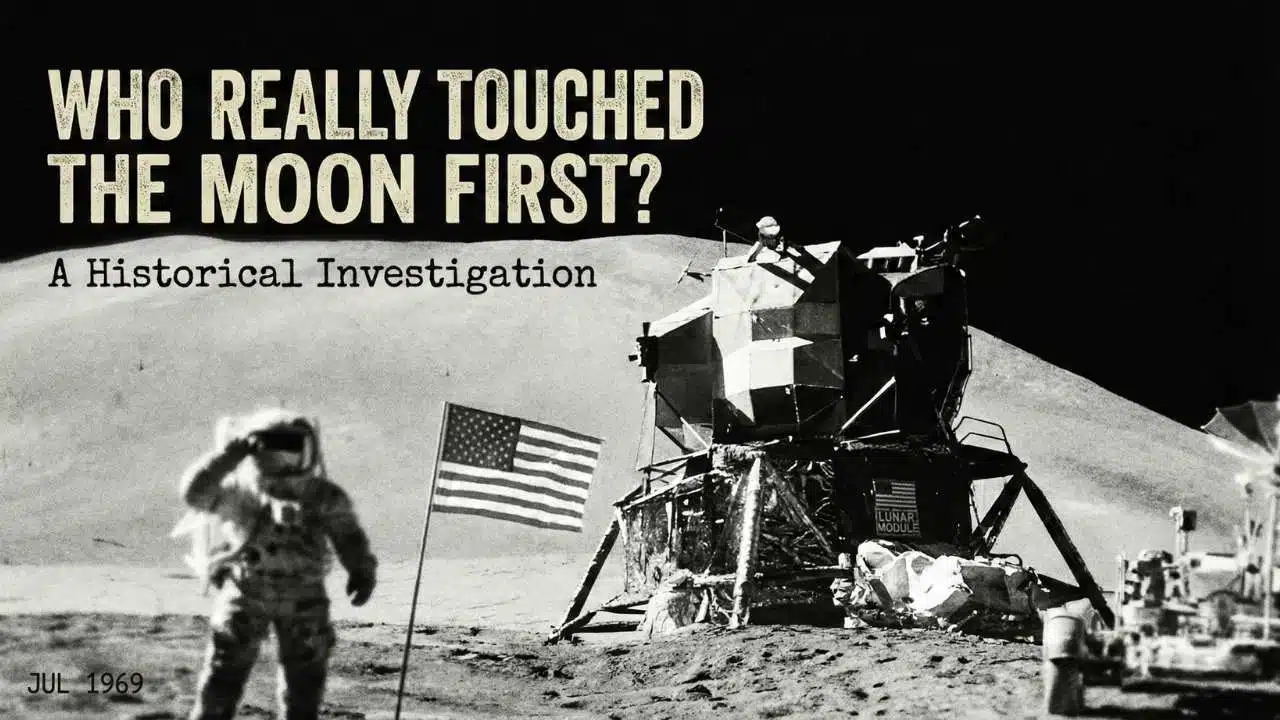
Ever look up at the night sky and wonder about the exact moment humans first stood on that glowing rock? The phrase “Moon Landing First” brings up pride, grainy black-and-white footage, and a bit of mystery. You might ask, “Who really touched the Moon first?”
We all know the big answer: Neil Armstrong took that famous step during Apollo 11. But working in engineering and editing tech stories has taught me that the “how” is often just as wild as the “who.”
Did you know, for instance, that the landing almost didn’t happen because of a computer error code called “1202”? Or that a simple felt-tip pen saved the crew from being stranded in space?
In this post, I’m going to take you through the gritty details of NASA’s Apollo program—from the heart-stopping descent to Tranquility Base to the future missions planning to return. I’ll share the technical secrets and close calls that make this story even better than the movies.
Grab a coffee, and let’s walk through history together.
The Apollo 11 Mission and the First Lunar Landing

I still get chills watching the replays of Apollo 11 soaring from Kennedy Space Center. It wasn’t just a rocket; it was 7.5 million pounds of thrust lifting three hopeful astronauts inside the Saturn V. When their lunar module finally touched down on Mare Tranquillitatis, it changed everything.
The Real Timeline of the Landing
Space history was written in July 1969, but the schedule was tighter than most people realize. The journey to the lunar surface was packed with engineering hurdles that we still study today.
- The Launch: Apollo 11 launched from Kennedy Space Center, Florida, on July 16, 1969, at 13:32 UTC. The Saturn V remains the only launch vehicle to carry humans beyond low Earth orbit.
- The Crew: The team included Neil Armstrong (Commander), Buzz Aldrin (Lunar Module Pilot), and Michael Collins (Command Module Pilot).
- The Separation: The Lunar Module, named Eagle, separated from the Command Module Columbia to begin its descent. Michael Collins stayed behind in lunar orbit, arguably the loneliest man in history for those few hours.
- The “1202” Alarm: During the descent, the Apollo Guidance Computer flashed a “1202” alarm. My engineering friends love this detail—it meant the computer was overloaded with data from a radar switch left in the wrong position. Thankfully, NASA engineers gave the “GO” to proceed anyway.
- The Landing: Eagle touched down at Tranquility Base on July 20, 1969, at 20:17 UTC. Armstrong had to fly manually to avoid a field of boulders, landing with only about 25 to 45 seconds of fuel remaining before a mandatory abort.
- The Arrival Message: Armstrong radioed Houston with the immortal words, “Houston, Tranquility Base here. The Eagle has landed.”
Which Country Landed on the Moon First?
The United States secured this victory with Apollo 11. Neil Armstrong and Buzz Aldrin parked their lunar module in the Sea of Tranquility, a site chosen for its relatively flat surface.
But the race was closer than it appeared. While the Americans were walking on the surface, the Soviet Union was trying to pull off a last-minute win with a robotic probe named Luna 15. The Soviets hoped to scoop up soil samples and return them to Earth before the Apollo crew could get back.
It didn’t work. Luna 15 crashed into Mare Crisium—about 344 miles away from Armstrong and Aldrin—just two hours before the American astronauts lifted off. It was a stark reminder of how difficult space travel really is. Since those days, only the U.S. has landed humans on the Moon, though robotic landers from China, India, and Japan have recently joined the club.
Related Read: NASA’s Artemis II Moon Mission Set for Historic 2026 Crewed Launch
Who Was the First Human to Touch the Moon?

Neil Armstrong holds the title. He didn’t just step out; he had to squeeze through a small hatch in a bulky suit designed to protect him from temperatures swinging between 250°F and -250°F.
The Man and the Moment
Neil Armstrong exited the Eagle at 02:56:15 UTC on July 21, 1969. As an engineer, I appreciate the precision of his movements. He didn’t just jump; he tested his weight on the ladder before committing to the surface.
An estimated 650 million people watched the broadcast. Armstrong’s voice cut through the static with a phrase that defines the 20th century: “That’s one small step for [a] man, one giant leap for mankind.”
He spent about 2 hours and 31 minutes outside. During this Extravehicular Activity (EVA), he collected soil samples and snapped photos. He even walked over to a nearby crater, later called Little West Crater, venturing about 196 feet from the module. That short walk proved that humans could work and move in one-sixth gravity.
What Happened During those First Steps?
I’ve looked at the logs, and the first few minutes were critical. Armstrong reported that the surface was “fine and powdery,” like charcoal dust. Here is what they actually did down there:
- Stability Check: Armstrong found he could move easily, dispelling fears that he might sink into the dust.
- Contingency Sample: He immediately scooped up a small bag of soil and put it in his pocket. This was a safety protocol—if they had to leave suddenly, they wouldn’t return empty-handed.
- The Flag: Planting the U.S. flag was harder than it looked. The soil was hard rock just beneath the dust, so they could only push the pole in about two inches. They had to bank it carefully so it wouldn’t fall over on live TV!
Who Was Buzz Aldrin and What Was His Role on the Moon?

Buzz Aldrin joined Armstrong on the surface about 19 minutes later. While Armstrong was the commander and photographer, Aldrin was the systems specialist. He described the view as “magnificent desolation,” a perfect contrast to the lively blue Earth hanging above them.
The Engineer’s “MacGyver” Moment
Aldrin’s contribution went far beyond walking. He set up the Early Apollo Scientific Experiments Package (EASEP), which included a seismometer to measure moonquakes and a retroreflector array.
Here is a fun fact that gets left out of the history books: Buzz Aldrin saved the mission with a pen.
When the astronauts were preparing to leave, they discovered a broken circuit breaker on the floor. It was the switch needed to arm the ascent engine. Without it, they couldn’t lift off. Aldrin realized his finger was too big to push the mechanism inside the breaker hole, so he used a felt-tip Duro “Rocket” pen to jam the switch forward. It worked, the engine fired, and they came home. That is the kind of practical engineering I love.
Read More: NASA Targets February 2026 for Historic Artemis II Moon Mission
How Many Men Have Walked on the Moon?
Between 1969 and 1972, exactly 12 astronauts walked on the lunar surface. They were all Americans, and they all flew during the Apollo program. Each mission added something new to our understanding of the solar system.

| Mission | Dates | Moonwalkers | Key Discovery/Fact |
|---|---|---|---|
| Apollo 11 | July 1969 | Neil Armstrong, Buzz Aldrin | First landing; deployed laser reflectors. |
| Apollo 12 | Nov 1969 | Pete Conrad, Alan Bean | Landed precisely near the Surveyor 3 probe. |
| Apollo 14 | Feb 1971 | Alan Shepard, Edgar Mitchell | Shepard hit two golf balls on the Moon. |
| Apollo 15 | July 1971 | David Scott, James Irwin | First use of the Lunar Roving Vehicle (Moon Buggy). |
| Apollo 16 | April 1972 | John Young, Charles Duke | Explored the lunar highlands. |
| Apollo 17 | Dec 1972 | Gene Cernan, Harrison Schmitt | Found orange volcanic soil; longest stay. |
Who Was the Last Person to Walk on the Moon?
Eugene “Gene” Cernan was the last human to leave his footprints there during Apollo 17. Before climbing up the ladder on December 14, 1972, he traced his daughter’s initials, TDC, in the dust.
Cernan’s final words were hopeful: “We leave as we came, and, God willing, as we shall return.” It has been over 50 years, but those footprints remain untouched, preserved in the vacuum of space like a museum exhibit waiting for visitors.
Is Harrison Schmitt Still Alive?
Yes, Harrison “Jack” Schmitt is still alive as of early 2026. He is unique on this list because he was the only professional geologist to fly to the Moon. While the other astronauts were test pilots trained to do geology, Schmitt was a scientist first.
His trained eye spotted something incredible at Shorty Crater: orange soil. It turned out to be tiny beads of volcanic glass from an ancient eruption 3.6 billion years ago. That discovery completely changed our understanding of the Moon’s volcanic history. Today, he remains an active voice in space policy, advocating for a return to deep space exploration.
Who Will Be the First Woman on the Moon?
No woman has landed on the Moon yet, but that is about to change. NASA’s Artemis program is training the next generation of explorers with the specific goal of landing the first woman and the first person of color on the lunar surface.
While dates often shift in the aerospace world, the current target for the Artemis III landing is set for mid-2027, following the crewed orbital mission of Artemis II in 2026. Astronauts like Christina Koch (assigned to Artemis II) and Victor Glover are paving the way. Unlike the Apollo era, these missions aim to build a sustained presence, using the Moon as a stepping stone for Mars.
Final Words
We went from dreaming about the Moon to actually touching its dusty ground, thanks to the sheer grit of the Apollo 11 team. Neil Armstrong took that famous small step at Tranquility Base, proving that human curiosity is stronger than gravity.
Looking back at the engineering miracles—from the 1202 alarm to the felt-tip pen fix—reminds me that these weren’t just “missions.” They were lessons in solving impossible problems. Whether you are an engineer like me or just someone who loves the stars, the Apollo legacy belongs to you too.
With the Artemis program gearing up, we are on the verge of seeing new footprints next to the old ones. I can’t wait to see who takes the next giant leap.