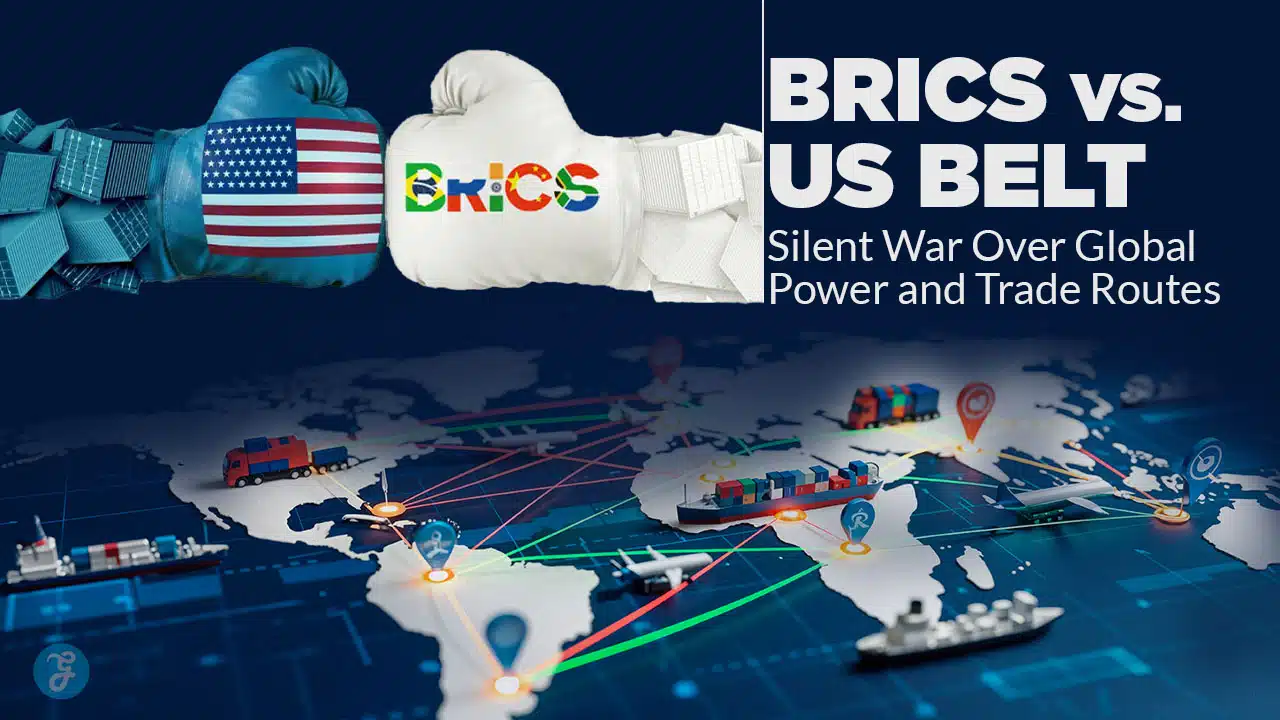
BRICS vs. US Belt is not a phrase you will find in official communiqués or treaty documents. Yet it describes, more accurately than most formal language, the reality shaping global politics today. Beneath the constant noise of elections, wars, and market swings, a quieter struggle is taking place, one that is less visible, but ultimately more consequential. At its core is a contest between two very different ways of organising power in the international system.
On one side is BRICS, an expanding coalition of non-Western economies at different stages of development, trying to convert shared frustration into collective influence and strategic room to manoeuvre. On the other is what can best be described as the “US Belt”: not a bloc in the traditional sense, but a sprawling network of alliances, trade routes, financial plumbing, and security arrangements through which American power continues to travel, often unnoticed, but rarely unfelt.
This is not a return to Cold War binaries. There are no sealed camps or ideological iron curtains dividing the world. Instead, influence now moves through infrastructure, standards, currencies, and supply chains. Power flows along routes rather than borders. And the outcome of this contest will shape not only who leads, but how leadership itself is exercised in a world that no longer fits old templates. At its core, this is a story about global power competition unfolding quietly, through systems and dependencies rather than open confrontation.
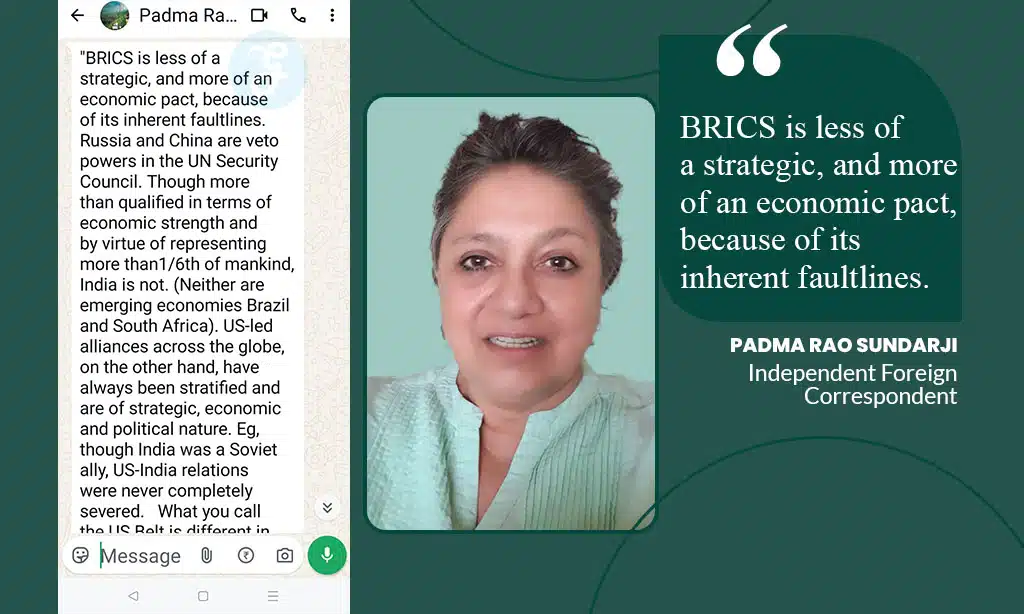
Padma Rao Sundarji, independent foreign correspondent, opines:
“BRICS is less of a strategic pact and more of an economic one, because of its inherent fault lines. Russia and China are veto powers in the UN Security Council. Though more than qualified in terms of economic strength, and by virtue of representing more than one-sixth of mankind, India is not. Neither are emerging economies Brazil and South Africa.
US-led alliances across the globe, on the other hand, have always been stratified and are strategic, economic, and political in nature. For example, though India was a Soviet ally, US-India relations were never completely severed. What you call the US Belt is different in nature.
The United States is the world’s mightiest military superpower. Be it President Trump or any of his predecessors, this fact looms large over any and all US global engagement. One may argue that President Trump is unpredictable. But this US President is merely saying out loud, and sometimes actioning, as in Venezuela… what has always been covert US global policy.
The ideological binary of the Cold War era may be over. But it has been replaced by a free-for-all, multinary race for resources, minerals, rare earths, and domination in space exploration. The bottom line to this new race is that if you can’t dominate; you share the spoils. Even in such a world, and as before, both BRICS and the US Belt will coalesce and disassociate as per the needs of the moment.”
Beyond Labels: What “BRICS vs. US Belt” Really Means
To understand this rivalry, it helps to drop the shorthand. “BRICS vs. US Belt” is not a neat slogan describing two equal camps. BRICS is a formal grouping. It began with Brazil, Russia, India, China, and South Africa. It has since expanded to include countries including Egypt, Ethiopia, Iran, Saudi Arabia, the United Arab Emirates, and Indonesia.
What binds these countries is not ideology, but experience. Each has, in different ways, felt constrained by a global system shaped largely by Western institutions. BRICS does not seek to overthrow that system. Its ambition is more modest, and more pragmatic: to push for space, voice, and influence within it.
The “US Belt,” by contrast, is not an organisation. It has no charter or membership list. It is better understood as a strategic architecture, a set of overlapping economic, military, financial, and technological networks through which the United States projects power. These include NATO, Indo-Pacific partnerships, dollar-based finance, trade rules, sanctions regimes, and supply-chain dependencies.
The difference is crucial. BRICS is a bloc. The US Belt is a system.
Why This Contest Has Intensified Now
Three structural shifts have brought BRICS vs. US Belt into sharper focus.
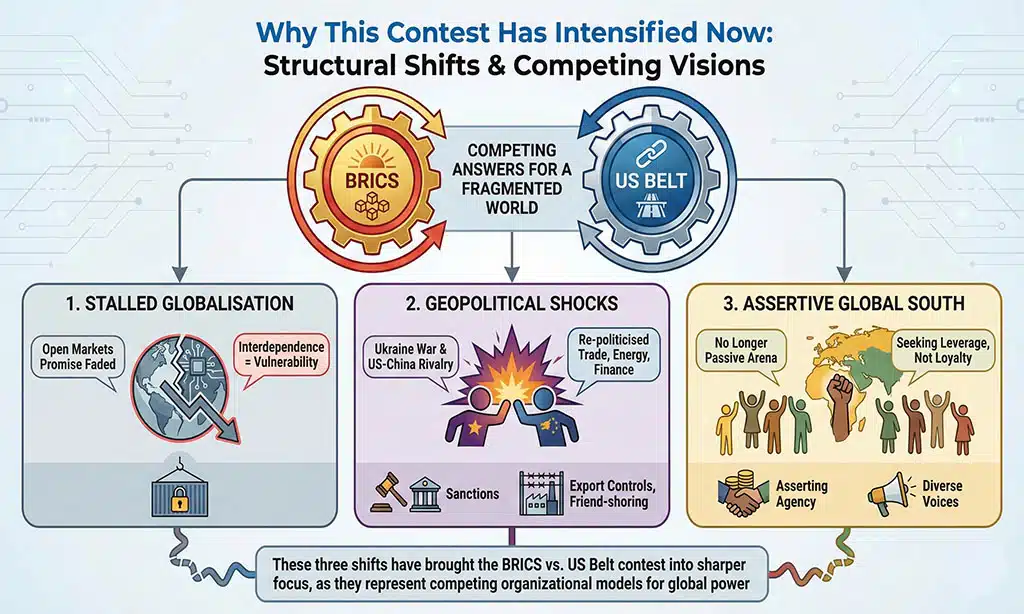
First, globalisation as a universal project has stalled. The promise that open markets would naturally lead to political convergence has faded. Instead, economic interdependence is increasingly viewed as a vulnerability.
Second, geopolitical shocks, from the Ukraine war to US-China rivalry, have re-politicised trade, energy, and finance. Sanctions, export controls, and friend-shoring are now mainstream tools of statecraft.
Third, the Global South is no longer content to remain a passive arena. Countries across Asia, Africa, and the Middle East are asserting agency, seeking leverage rather than loyalty.
In this environment, BRICS and the US Belt represent competing answers to the same question: how should power be organised in a fragmented world?
What BRICS Represents: Ambition, Autonomy, and Its Limits
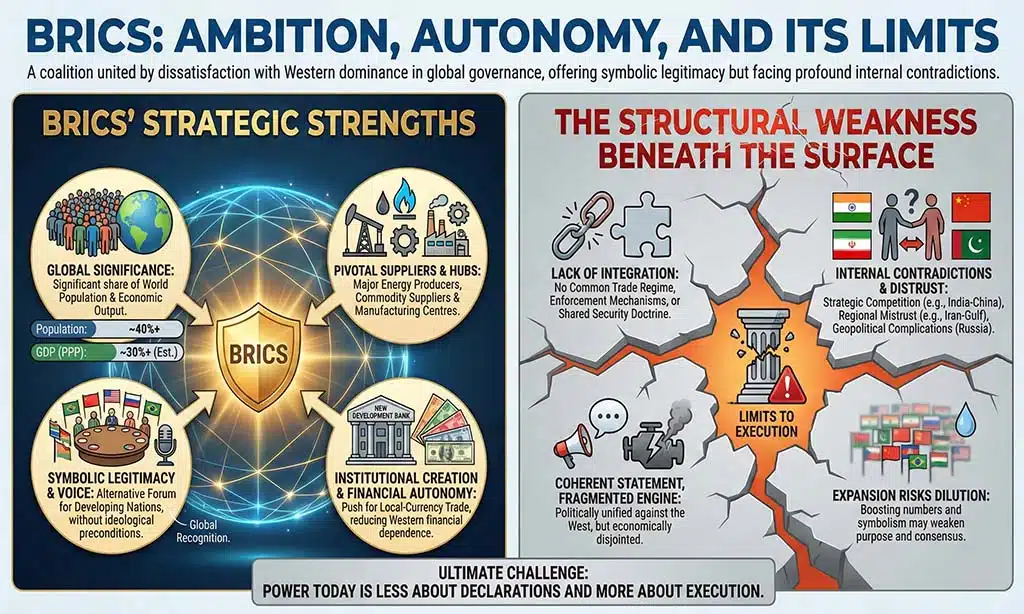
BRICS was never meant to be a mirror image of the G7. Its appeal lies precisely in its looseness. It brings together states with vastly different political systems, cultures, and strategic priorities, united primarily by dissatisfaction with Western dominance in global governance.
BRICS’ Strategic Strengths
At a glance, BRICS is formidable. Its members account for a significant share of global population, energy production, and industrial output. Several are pivotal commodity suppliers. Others are major manufacturing hubs or financial centres.
More importantly, BRICS offers symbolic legitimacy. For many developing countries, it represents recognition, an alternative forum where their voices carry weight without ideological preconditions.
The creation of institutions such as the New Development Bank and the push for local-currency trade reflect a desire to reduce dependence on Western-controlled financial systems. Even when practical impact is limited, the political signal matters.
The Structural Weakness Beneath the Surface
Yet BRICS’ very diversity is also its constraint. Unlike the European Union or even ASEAN, it lacks a common trade regime, enforcement mechanisms, or security doctrine. Internal contradictions are profound: India and China compete strategically; Iran and Gulf states distrust each other; Russia’s geopolitical posture complicates consensus.
BRICS is coherent as a political statement, but fragmented as an economic engine. Expansion, while boosting numbers and symbolism, risks diluting purpose.
This matters because power today is less about declarations and more about execution.
The US Belt: Power Without a Flag
If BRICS seeks visibility, the US Belt thrives on invisibility. It does not announce itself as a bloc because it does not need to. Its strength lies in normalisation, making American-centred systems appear indispensable rather than imposed.
An Architecture of Influence
The US Belt operates across four interconnected domains:
- Trade and Supply Chains: From semiconductor ecosystems to energy markets, the US shapes who trades with whom and under what conditions.
- Security Networks: NATO, bilateral defence treaties, and maritime partnerships secure critical routes and chokepoints.
- Financial Infrastructure: The dollar’s dominance, clearing systems, and sanctions architecture give Washington unmatched leverage.
- Norm-Setting Power: Legal standards, regulatory frameworks, and compliance regimes quietly align global practices with US preferences.
This model does not require ideological alignment. Participation is often driven by necessity, access, or risk avoidance.
Bloc vs. Network: A Structural Comparison
| Dimension | BRICS | US Belt |
| Core Form | Formal bloc | Informal network |
| Power Style | Collective symbolism | Asymmetric leverage |
| Enforcement | Weak | Strong |
| Economic Glue | Political alignment | Market access & finance |
| Strategic Risk | Paralysis | Overreach |
This contrast explains why the rivalry is so asymmetric. BRICS seeks to build alternatives. The US Belt works by making alternatives costly.
The Real Battlefield: Corridors, Not Currencies
Much commentary focuses on BRICS currency ambitions or dollar “de-weaponisation.” This misses the deeper struggle.
The real contest is over corridors… physical and digital pathways that structure global flows:
- Ports and logistics hubs
- Energy pipelines and shipping lanes
- Semiconductor and rare-earth supply chains
- Undersea cables and digital payment systems
Control over corridors translates into control over choices. Countries may resist alignment rhetorically, but dependence quietly shapes behaviour.
In this sense, the US Belt enjoys a first-mover advantage. Many global systems already run through American-linked nodes. BRICS, by contrast, must build from scratch—or repurpose existing routes dominated by others.
Why Most Countries Refuse to Choose Sides
One of the most misunderstood aspects of BRICS vs. US Belt is the assumption of binary alignment. In reality, most states are doing neither.
Middle powers hedge. They join BRICS initiatives while deepening trade with the US. They accept American security guarantees while engaging China economically. This is not indecision, it is strategy.
The emerging order is not divided into camps but layered into overlapping dependencies. Loyalty has been replaced by optionality.
The Limits of Both Models
Neither BRICS nor the US Belt offers a complete solution.
BRICS Risks
- Becoming a rhetorical forum without delivery
- Internal fragmentation undermining credibility
- Excessive dependence on China’s economic gravity
US Belt Risks
- Sanctions fatigue eroding compliance
- Alliance overstretch amid domestic political volatility
- Growing resentment over perceived coercion
Power exercised too visibly invites resistance. Power exercised too diffusely risks incoherence.
What This Means for the Future World Order
The contest between BRICS and the US Belt does not point to a new hegemon. Instead, it signals the end of hegemonic simplicity.
The future is likely to be multiplex: overlapping systems, regional hubs, and issue-specific coalitions. Global order will be managed, not mastered.
BRICS will continue to matter as a platform for political coordination and symbolic challenge. The US Belt will remain dominant where infrastructure, finance, and security converge. Neither will fully displace the other.
The real winners may be those who learn to navigate both.
Power in Practice: How States Are Adjusting to a Fragmented Order
Understanding what this emerging order looks like in theory is only part of the picture. What matters more is how states are already adjusting to it in practice. Across regions, governments are recalibrating foreign policy not around allegiance, but around insulation, seeking to protect room for manoeuvre in a world where alignment increasingly comes with strings attached.
For many countries, the choice is no longer between Washington and an alternative bloc, but between different kinds of dependence. Participation in the US Belt offers access to markets, finance, and security guarantees, but also exposure to sanctions risk and regulatory pressure. Engagement with BRICS, meanwhile, promises political solidarity and symbolic autonomy, yet often lacks the institutional depth required to deliver consistent economic outcomes.
As a result, foreign policy is becoming less ideological and more transactional. States are learning to compartmentalise… working with one power on security, another on trade, and a third on technology or energy. This patchwork approach reflects not confusion, but adaptation. In a system without a single organising centre, flexibility becomes a form of power.
The Middle Powers’ Moment
Nowhere is this shift more visible than among middle powers, countries large enough to matter, but not dominant enough to dictate terms. From Southeast Asia to the Middle East, these states are leveraging competition between systems to extract concessions, diversify partnerships, and hedge against future shocks.
Rather than choosing sides, they are choosing options. Joining BRICS does not preclude deep economic ties with the United States. Hosting American military assets does not prevent engagement with China-led infrastructure projects. The ability to operate across systems has become a strategic asset in its own right.
This behaviour challenges older assumptions about alliance politics. During the Cold War, ambiguity was often punished. Today it is rewarded. Both BRICS and the US Belt court participation, and both are cautious about pushing too hard for exclusivity. The result is a global environment where influence is negotiated continuously, not locked in by treaty.
Economic Fragmentation Without Economic Collapse
One of the most persistent fears surrounding the BRICS vs. US Belt dynamic is that it will lead to outright economic fragmentation… a world split into rival trading blocs, incompatible standards, and closed markets. While fragmentation is real, collapse is not inevitable.
What is emerging instead is a form of selective decoupling. Sensitive sectors… advanced semiconductors, defence technologies, critical minerals… are increasingly shielded. Supply chains are being shortened, duplicated, or politically screened. Yet at the same time, global trade volumes remain substantial, and interdependence persists in less strategic areas.
This partial separation creates inefficiencies, but it also creates redundancy. States are willing to absorb higher costs in exchange for reduced vulnerability. From Washington’s perspective, this strengthens the US Belt by tightening control over strategic nodes. From the BRICS perspective, it reinforces the argument for alternative pathways and greater self-reliance.
Neither side achieves complete insulation. Both accept friction as the price of resilience.
Finance as Leverage, Not Just Currency
Discussions around de-dollarisation often dominate headlines, but the more consequential story lies in financial infrastructure rather than currency substitution. The dollar’s role is not sustained by habit alone; it is reinforced by settlement systems, legal predictability, liquidity, and crisis response capacity.
BRICS initiatives to expand local-currency trade and strengthen institutions like the New Development Bank reflect a recognition of this reality. The goal is not to replace the dollar overnight, but to reduce exposure to a system where access can be restricted for political reasons.
At the same time, the US Belt continues to benefit from inertia. Global finance tends to flow where it feels safest, not where it is most ideologically neutral. This gives the United States enduring leverage, but also imposes responsibility. Overuse of financial coercion risks encouraging exactly the diversification Washington seeks to prevent.
The tension between leverage and legitimacy will shape how financial power is exercised going forward.
Technology and Standards: The Quiet Frontline
If there is one domain where the BRICS vs. US Belt contest is likely to intensify quietly, it is in technology standards. From digital payments to data governance, technical specifications increasingly carry geopolitical weight.
Standards determine compatibility. Compatibility determines dependence. And dependence, in turn, shapes influence.
The US Belt has historically dominated this space through early innovation and institutional reach. BRICS countries, particularly China and India, are now seeking greater say in how future technologies are regulated and deployed. This is less about ideology than about ensuring that emerging systems do not lock in disadvantage.
These battles rarely make headlines, yet their consequences are lasting. Once standards are set, reversing them is costly. In this sense, today’s technical negotiations may matter more than tomorrow’s summits.
Security Without Certainty
Security dynamics further complicate the picture. The US Belt remains unparalleled in its ability to project military power and provide security guarantees. For many states, this remains indispensable. Yet reliance on external protection also carries risk, particularly in a climate of domestic political volatility within major powers.
BRICS, for its part, does not offer a collective security framework, and shows little appetite to create one. This limits its appeal as a comprehensive alternative, but also preserves flexibility. Many BRICS members prefer ambiguity over obligation when it comes to defence.
The result is a world where security arrangements are increasingly decoupled from economic partnerships. This separation allows states to engage across systems, but it also introduces uncertainty. Crisis management becomes harder when alliances overlap and interests diverge.
Narratives, Not Just Networks
While much of the BRICS vs. US Belt competition plays out in material terms, narratives still matter. BRICS positions itself as a corrective… a voice for those historically marginalized in global governance. The US Belt, by contrast, emphasises stability, rules, and continuity.
Neither narrative is universally persuasive. Both resonate differently across regions and political contexts. What matters is not which story prevails globally, but how effectively each is adapted locally.
In this sense, the contest is less about persuasion than relevance. States engage with whichever framework best addresses their immediate priorities, be it development finance, security assurance, or market access.
An Order Defined by Negotiation
Taken together, these trends point toward a world order defined less by hierarchy than by negotiation. Power still matters, but it is exercised through bargaining rather than command. Influence is situational, not absolute.
BRICS and the US Belt are not mirror images, nor are they destined for a decisive showdown. They coexist, overlap, and compete in uneven ways. Their interaction produces friction, but also space… space for states to manoeuvre, adapt, and resist full absorption into any single system.
This does not make the world more stable. But it does make it more fluid.
And it is within this fluidity that the final stakes of the BRICS vs. The US Belt contest becomes clear: not the replacement of one order with another, but the redefinition of how order itself is maintained.
Where This Leaves the World: A War Without Declarations
BRICS vs. US Belt is not a clash of armies or ideologies. It is a silent war over routes, rules, and relevance. It is fought in ports and payment systems, standards committees and supply chains.
In this struggle, power does not announce itself, it embeds itself. And the future global order will be shaped less by who speaks the loudest, and more by who controls the pathways along which the world moves.
What makes this contest especially consequential is that it unfolds without moments of formal rupture. There are no declarations, no treaties torn up on camera, no single event that signals a decisive shift. Instead, change accumulates quietly, through contracts signed, standards adopted, and dependencies accepted one by one. Countries wake up one day to discover that their options have narrowed, not by force, but by design. In this kind of war, influence is measured not by headlines or speeches, but by whose systems become unavoidable… and whose choices slowly disappear.