The Wikipedia AI data deals announced this week mark a definitive end to the internet’s age of innocence. On January 15, 2026, as the world’s encyclopedia celebrated its 25th anniversary, it did not merely cut a cake; it cut a series of landmark commercial agreements with the very titans threatening its existence.
The Wikimedia Foundation confirmed it has formalized paid partnerships with a slate of technology behemoths, Amazon, Meta, and Microsoft, alongside aggressive AI challengers Mistral AI and Perplexity. This announcement represents a watershed moment in the history of the open web. Under the stewardship of newly appointed CEO Bernadette Meehan, the non-profit is fundamentally altering its relationship with Big Tech. No longer a passive victim of data scraping, Wikipedia has chosen to formalize the extraction of its knowledge, ensuring that the companies building their empires on its data are contractually obligated to pay for the privilege.
This analysis explores the depth of this transition, examining the ethics of “selling” volunteer labor, the decline of the traditional search engine, and the desperate battle to preserve human truth in a synthetic future.
The Silver Jubilee Paradox: From Public Park to Licensed Quarry
This strategic shift presents what can be called the “Silver Jubilee Paradox”: To save the open web, Wikipedia has decided it must effectively tax the companies that are eating it.
For a quarter of a century, Wikipedia stood as a digital anomaly, a non-commercial sanctuary in a sea of ad-tech and surveillance capitalism. It was the “Digital Commons,” a public park where knowledge was free for the taking. But in the era of Generative AI, that park has become a quarry. As artificial intelligence models began to scrape Wikipedia’s 65 million articles to train their “brains” and answer user queries directly, the Foundation faced an existential crisis. Human traffic was plummeting, while server costs from bot scrapers were skyrocketing.
The newly expanded Wikimedia Enterprise partnerships signal a profound pivot in the site’s survival strategy. It is a transition from a pure “Donation Model”, relying on users giving $3, to a hybrid “Taxation Model.” By charging trillion-dollar corporations for high-speed access, the Foundation aims to subsidize free access for the rest of the world.
The Mechanics of the Deal: What Was Actually Sold
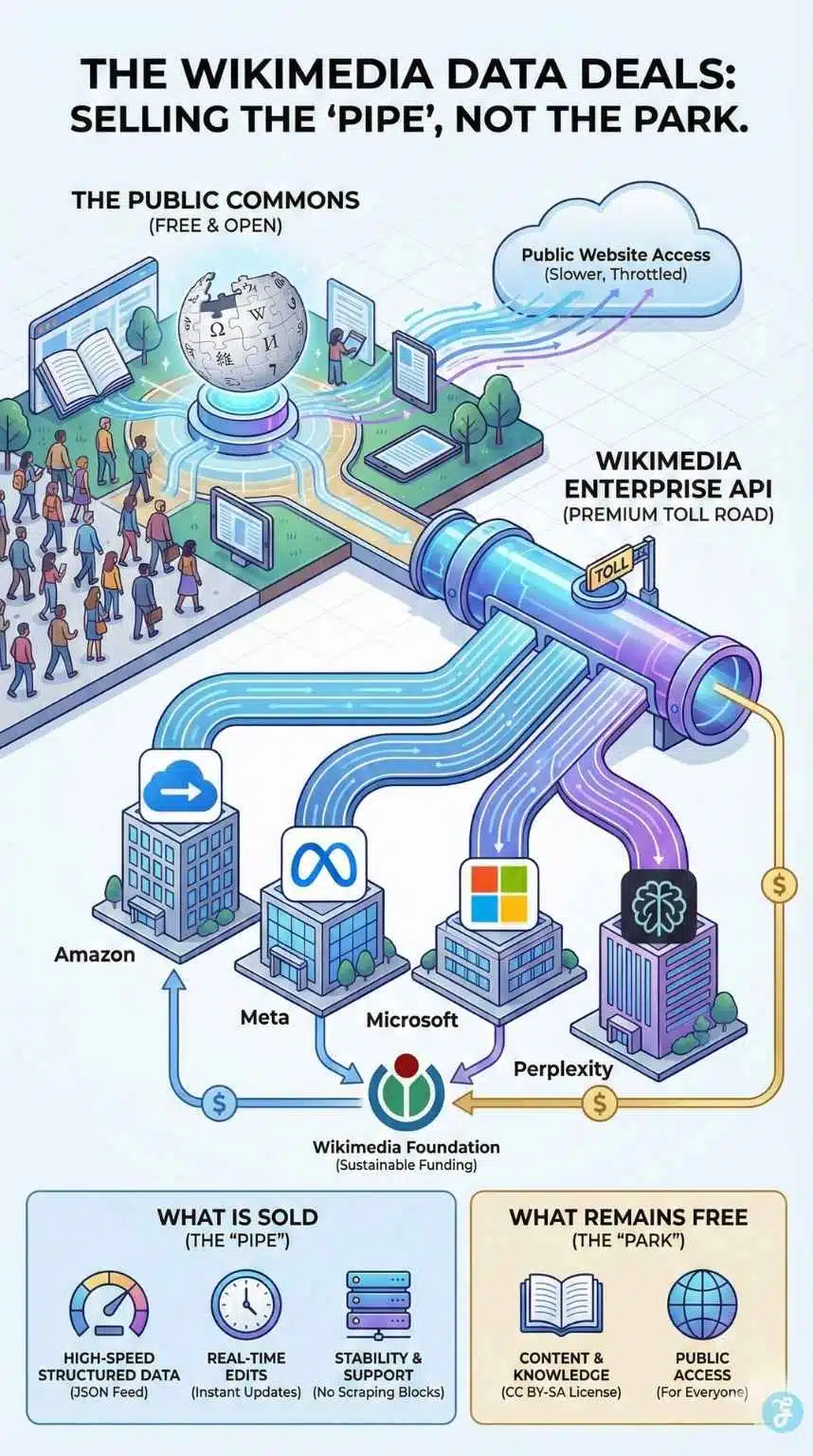
To understand the controversy, one must first dismantle the technical misconceptions. The headlines screaming that “Wikipedia Sold Its Data” are arguably misleading. The content on Wikipedia remains under a Creative Commons (CC BY-SA) license, meaning anyone, including Amazon or a student in Dhaka, can use it for free if they attribute it and share alike.
So, what are these companies paying for? They are paying for velocity, stability, and silence.
The Wikimedia Enterprise Product
The Wikipedia AI data deals are centered around Wikimedia Enterprise, a commercial subsidiary launched quietly in 2021 but now operating as the Foundation’s primary defense shield. The Tech Giants are subscribing to premium API tiers that offer:
- The Snapshot API: A massive, cleaned download of all Wikimedia projects, updated regularly. This allows companies to train Large Language Models (LLMs) on a static “ground truth” without needing to crawl millions of pages individually.
- The Realtime API: A “firehose” feed of every edit made to Wikipedia as it happens. For a company like Perplexity or Microsoft (Copilot), this is invaluable. It ensures that when a user asks about a breaking news event, like the “Winter Siege” in Ukraine or the Grok AI scandal, the chatbot’s answer reflects the latest edits made by human volunteers seconds ago.
- The On-Demand API: Specific, high-bandwidth queries that bypass the public rate limits.
Buying the “Right of Way”
In essence, Amazon and Meta are not buying the content (which is free); they are buying the pipe. Scraping the public website is messy. It yields unstructured HTML, requires complex parsing, and, crucially, the Wikimedia Foundation has begun aggressively throttling bot traffic to protect the experience for human users.
By signing these deals, these companies are effectively buying a “Fast Pass” lane. They get a pristine, machine-readable JSON feed of human knowledge, and in exchange, they stop “smashing” Wikipedia’s servers with millions of clumsy web crawlers. For the Foundation, this transforms a cost center (bot traffic) into a massive revenue stream, subsidizing the free access for the rest of the world.
The Roster of Titans
The list of partners represents the entire hierarchy of the AI ecosystem:
- Microsoft: As the primary backer of OpenAI, Microsoft’s integration is the deepest. Bing and Copilot rely heavily on Wikipedia for “grounding” their answers to prevent hallucinations.
- Meta: Despite owning Facebook and Instagram, Meta’s “Llama” models require vast amounts of neutral, high-quality text to learn logic and facts. Wikipedia is the only dataset large enough and clean enough to serve this purpose.
- Mistral AI & Perplexity: These are the aggressive challengers. Perplexity, in particular, is a direct competitor to Wikipedia, often answering user queries so thoroughly that the user never visits the source. Their inclusion in the Enterprise tier is a form of truce, a recognition that if they are going to replace the encyclopedia, they must at least pay for the raw materials.
The Wikimedia Enterprise Ecosystem [2026]
It simplifies the list of partners and explains exactly why each giant is paying.
| Partner | Primary Integration | The “Purchase” (Why They Pay) |
| Microsoft | Bing / Copilot | Grounding. Uses the “Realtime API” to cross-check AI answers against Wikipedia to reduce hallucinations. |
| Meta | Llama Models / Meta AI | Neutrality. Needs vast amounts of neutral, non-opinionated text to train logic, counterbalancing Facebook’s “noisy” social data. |
| Perplexity | Answer Engine | Velocity. Pays for the “firehose” of edits to ensure its answers reflect news that happened seconds ago. |
| Amazon | Alexa / AWS Bedrock | Fact Retrieval. Uses structured data to power Q&A for voice assistants without needing to parse complex HTML. |
| Mistral AI | Mistral Large | Training Data. A European partner ensuring their models are trained on high-quality multilingual data, not just US-centric text. |
Selling Trust, Not Just Text: The New “Truth Scores”
Crucially, the 2026 Enterprise API update introduces a feature that changes the nature of the transaction: “Reference Risk Scores.” The Foundation is no longer just selling raw text; it is selling metadata about reliability. The new API assigns a “Verifiability Score” to articles and claims.
- How it works: If a section of an article on “Vaccine Safety” is backed by high-quality citations (e.g., The Lancet, Nature), the API flags it as “Low Risk.” If a section is backed by a tabloid or has a “citation needed” tag, it is flagged as “High Risk.”
- The Value: This allows AI models like Microsoft Copilot to essentially “program” trust. They can instruct their AI: “Only answer medical questions using Wikipedia data with a Risk Score of less than 10.”
- The Global Implication: This is a double-edged sword for the Global South. Articles in English tend to be well-cited. Articles in smaller languages (like Bengali or Swahili) often lack strict citation density. There is a risk that this “Truth Score” system could cause AI models to systematically downgrade non-Western knowledge, viewing it as “riskier” simply because it is less cited in Western journals.
The Existential Threat: The “Zero-Click” Future
Why make these deals now? Why risk the wrath of the community on the 25th anniversary? The answer lies in the data: The old internet is dying.
The 8% Drop and the Death of the Link
In 2025, the Wikimedia Foundation reported a startling metric: global unique devices visiting the site dropped by 8% year-over-year. This is not a blip; it is a trend line pointing toward obsolescence.
The culprit is the “Zero-Click” phenomenon. For twenty years, the social contract of the web was simple: A search engine indexed the page, showed a blue link, and the user clicked it. That click was the currency. It brought the user to Wikipedia, where they might read, learn, and, once a year, see a banner asking for a $3 donation.
Generative AI broke this contract. When a user asks Google Gemini or ChatGPT, “What is the significance of the 2026 Indo-German defense deal?”, the AI reads Wikipedia, synthesizes the answer, and serves it directly in the chat window. The user is satisfied. They never click the blue link. They never see the Wikipedia logo. And they certainly never see the donation banner.
The Broken Feedback Loop
This creates a parasitic loop. The AI models are trained on Wikipedia, but their very success destroys the ecosystem that feeds them. If users stop visiting Wikipedia, the donor pool shrinks. If the donor pool shrinks, the servers go offline. If the servers go offline, the AI has no new data to learn from.
The Wikipedia AI data deals are an attempt to fix this broken loop by monetizing the AI directly. If the user won’t pay because the AI intercepted them, then the AI company must pay on the user’s behalf.
The “Dead Internet” & Bot Swarms
Simultaneously, the Foundation is fighting a war on its infrastructure. In early 2024, bot traffic accounted for roughly 40% of requests. By January 2026, that number surged to nearly 65% of all traffic hitting the core datacenters.
These weren’t just Google and Bing; they were thousands of rogue startups, academic scrapers, and “zombie” bots harvesting data for unknown LLMs. This “Dead Internet” traffic costs millions in electricity and bandwidth but contributes zero value. The Enterprise API is a way to corral the “good” bots into a paid lane, allowing the Foundation to be much more aggressive in blocking the “bad” bots without fearing they are cutting off legitimate access.
While the business logic is sound, the ethical implications are tearing the community apart. This is the heart of the “Selling the Commons” debate.
The primary criticism comes from the ~250,000 active volunteer editors who build Wikipedia. These individuals, passionate hobbyists, retired professors, and students, donate their time under the belief that they are contributing to a public good. They are the gardeners of the digital commons.
Now, they find that the fruits of their labor are being sold to the world’s wealthiest corporations. This dynamic has been described by critics as “Digital Sharecropping.” The volunteers work the land for free, but the landlord (The Foundation) sells the crop to the factory (Big Tech).
“I spent three weeks rewriting the article on Nuclear Fusion,” wrote one long-time editor on the Village Pump forum this week. “I did it to educate the public, not to improve the accuracy of a Microsoft product that costs $30 a month.”
There is a profound sense of alienation. If Wikipedia becomes a data-cleaning service for Silicon Valley, does the “soul” of the project survive? Why should a volunteer toil over a citation if the end result is just boosting Amazon’s stock price?
The “Robin Hood” Defense
The Foundation’s leadership, including Jimmy Wales, counters this with what can be called the “Robin Hood” defense. Their argument is that these deals are the only ethical way to sustain the project.
Hosting the world’s knowledge is expensive. Legal defense for editors in authoritarian regimes is expensive. Maintaining the MediaWiki software is expensive.
- The Argument: Why should Amazon and Google, who extract billions of dollars in value from Wikipedia, get a free ride? By charging the Tech Giants, the Foundation is effectively redistributing wealth. They are taxing the trillion-dollar AI economy to ensure that a student in rural India can still access Wikipedia without ads and without a paywall.
In this view, the Wikipedia AI data deals are a shield. They protect the human users from having to “pay” with their attention (ads) or their data (tracking).
The Attribution Crisis
Perhaps the most dangerous ethical slip is the erasure of provenance. The Foundation is pushing hard for contractual “attribution”, forcing AI partners to cite Wikipedia. However, in practice, this is slipping away.
When you speak to a voice assistant, it doesn’t say, “According to Wikipedia, the Oreshnik missile system is…” It simply states the fact as if it possesses the knowledge itself. This “knowledge laundering” strips Wikipedia of its brand authority. Over time, society may forget that “truth” requires human consensus and debate, assuming instead that truth is just something that comes out of a computer.
The Three Paths: Wikipedia vs. Reddit vs. The Press
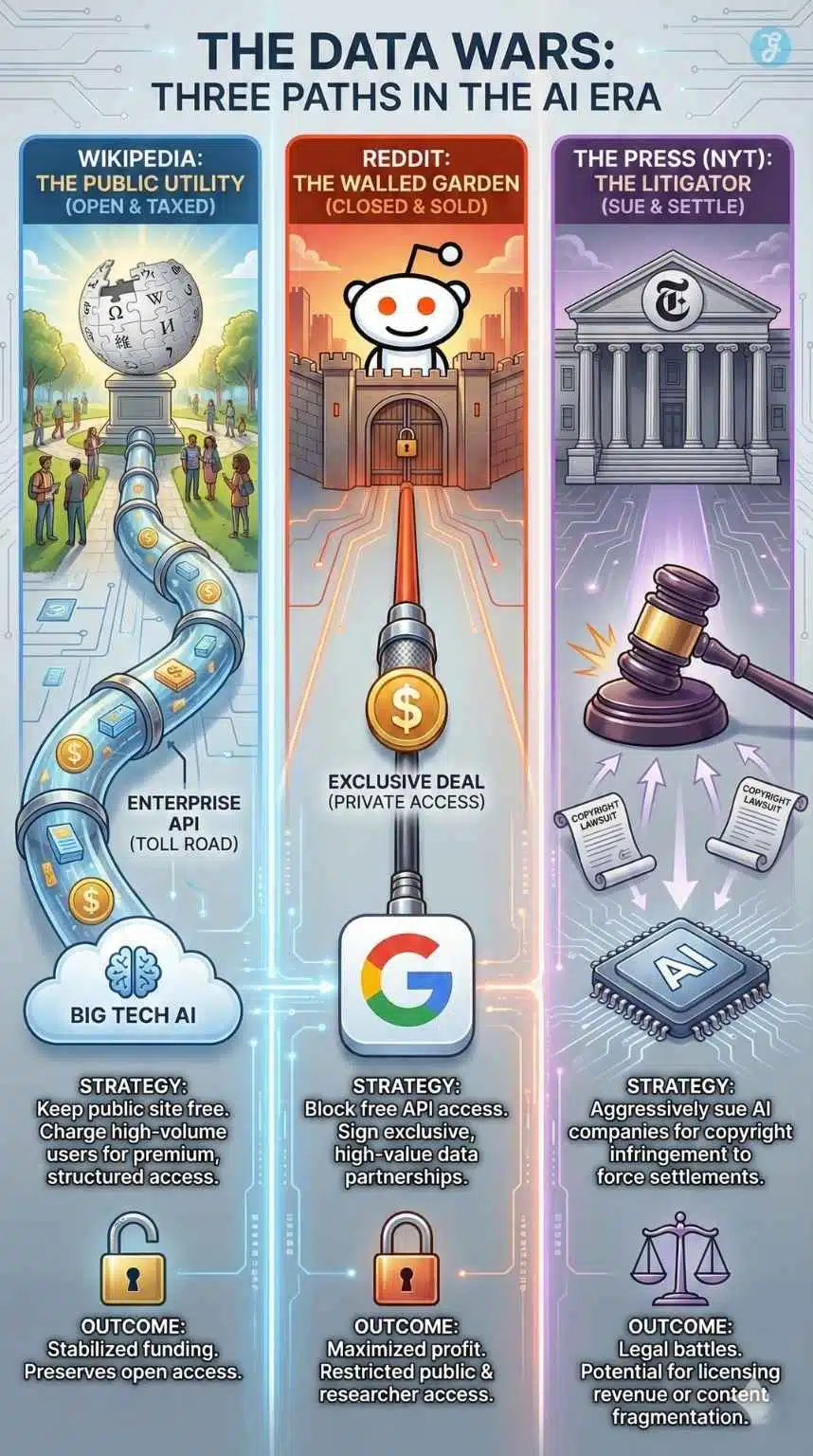
To fully grasp the significance of Wikipedia’s pivot, one must view it against the divergent strategies of other “data reservoirs” in 2026. The internet’s data lords have split into three distinct camps:
- The “Walled Garden” (Reddit): In 2024, Reddit signed a $60 million deal with Google and promptly locked down its API, killing third-party apps and sparking a user revolt. By 2025, reports indicated Reddit had surpassed Wikipedia as the #1 source for AI citations (40% share). Reddit chose to sell and close, maximizing profit at the expense of openness.
- The “Litigator” (The New York Times): The press has largely chosen the path of war. The New York Times spent 2025 in court battles with OpenAI, arguing that AI training is copyright infringement. Their strategy is sue and settle, treating data as private intellectual property.
- The “Public Utility” (Wikipedia): The Foundation’s strategy is unique. It refuses to close the site (unlike Reddit) and refuses to sue for copyright (unlike the NYT). Instead, it positions itself as a Public Utility. Like a water company, it offers a free tap for the public (the website) but charges industrial users (Big Tech) for the high-pressure pipes (the Enterprise API).
This distinction matters. Wikipedia is the only major platform attempting to keep the “open web” dream alive while simultaneously extracting rent from the AI giants.
The “Data Wars” of 2026: Three Divergent Strategies
It provides a quick-glance comparison of how major internet platforms are handling the AI threat.
| Entity | Strategy | Key Action | Implication for AI |
| Wikipedia | “The Public Utility” | Open but Taxed. Keeps the website free for the public; charges Big Tech for high-speed API access (Wikimedia Enterprise). | Stabilizing. Ensures AI has a clean “ground truth” to prevent model collapse. |
| “The Walled Garden” | Sold & Closed. Signed exclusive deals (e.g., Google); blocked free API access; hostile to third-party apps. | Biased. AI models prioritize “popular” opinion over “verified” fact (the “Reddit-ification” of search). | |
| The Press (NYT) | “The Litigator” | Sue & Settle. Aggressive lawsuits against OpenAI/Microsoft for copyright infringement. | Fragmented. AI models may lose access to high-quality journalism, relying more on older or synthetic data. |
The Leadership Pivot: From Technocrats to Diplomats
The significance of this moment is underscored by the changing of the guard at the top. On the very day these deals were operationalized, Bernadette Meehan took over as CEO. Meehan is not a technocrat. She is not a coder. She is a former U.S. Ambassador and a high-ranking diplomat. This hiring choice is a message in itself. Wikipedia is no longer just a website; it is a geopolitical entity.
Negotiating Sovereignty
In the next decade, Wikipedia will not be fighting browser wars; it will be fighting sovereignty wars.
- The Big Tech Front: Meehan’s role is to negotiate treaties with “nation-states” like Google and Meta, ensuring they pay their fair share without capturing the governance of the platform.
- The Geopolitical Front: With disinformation rampant, nations like China, Russia, and, increasingly, India and Turkey, are exerting pressure on Wikipedia’s content. The Wikipedia AI data deals complicate this. If Microsoft is paying for the data, and Microsoft wants to do business in a censorship-heavy country, will there be pressure to “sanitize” the API feed?
Meehan’s background suggests the Foundation is preparing for a period where its independence will be tested not by code, but by contracts and treaties.
The War for “Truth”: Wikipedia vs. Grokipedia
No analysis of Wikipedia’s 2026 landscape is complete without addressing the elephant in the room: Elon Musk.
While Amazon and Microsoft have opted to pay and partner, Musk’s X (formerly Twitter) has chosen open hostility. Musk has frequently derided Wikipedia as “Woke-ipedia,” claiming its consensus-based model is biased against his worldview. In response, he has launched “Grokipedia,” a feature within his Grok AI that attempts to build a “real-time encyclopedia” based on X posts.
Epistemological Warfare
This represents a clash of epistemologies (theories of knowledge):
- Wikipedia’s Model: Truth is what reliable, secondary sources (NYT, BBC, Nature) say it is, synthesized by community consensus.
- Grokipedia’s Model: Truth is what the “people” are saying right now, unfiltered and raw, often prioritizing “first-hand” accounts over established media.
Jimmy Wales has dismissed Grokipedia, correctly noting that without the rigorous (and slow) verification process of Wikipedia, an AI simply hallucinates or amplifies mob outrage. However, the existence of a rival “Truth Machine” raises the stakes. If the Wikipedia AI data deals lead to a perception that Wikipedia is “owned” by the liberal establishment tech firms (Microsoft/Meta), it could drive half the world’s population toward alternative, less rigorous information ecosystems like Grok.
Preventing “Model Collapse”: The Mad Cow Disease of AI
Why are Amazon and Microsoft willing to pay for data they could technically scrape for free? The answer lies in a phenomenon computer scientists call “Model Collapse.”
As the internet floods with AI-generated “slop,” AI models face a deadly risk: Cannibalism. If an AI trains on text generated by another AI, it eventually begins to hallucinate and drift. Like a photocopy of a photocopy, the data degrades. It loses the “long tail” of rare human knowledge, forgetting the details of 12th-century Bengali pottery or the specifics of a minor subatomic particle.
Wikipedia is the antidote. It is one of the last remaining reservoirs of human-verified, non-synthetic text. In this sense, the Wikimedia Enterprise feed acts as a “preservative” for the AI ecosystem. The Tech Giants are paying not just for data, but for purity, to prevent their trillion-dollar brains from contracting the digital equivalent of Mad Cow Disease.
Future Outlook: The “Headless” Encyclopedia
As we look toward the next five years, the Wikipedia AI data deals point toward a future where Wikipedia becomes “Headless.”
Scenario A: The “Intel Inside” of Knowledge
In the optimistic view, Wikipedia successfully transitions into the “Intel Inside” of the internet. It becomes the invisible, well-funded operating system of human knowledge. The website itself might see fewer visitors, but the content reaches more people than ever before, embedded in every AI assistant, smart glass display, and educational bot. The revenue from the Enterprise API funds a renaissance in editor tools, using AI to help volunteers translate articles into underserved languages like Bengali or Swahili instantly.
Scenario B: The Hollow Library
In the pessimistic view, the “taxation” strategy fails to save the community. As fewer people visit the site, the influx of new editors dries up. The existing community ages out. The article quality begins to stagnate. The AI models, realizing the data is getting stale, stop paying the premium. Wikipedia becomes a “Husk”, a static archive of the world as it was in 2026, slowly gathering digital dust while the AI models begin to synthesize their own “truth” from social media and synthetic data.
Final Thought: The Last Human Artifact in a Synthetic World
The 25th anniversary of Wikipedia is a celebration of survival, but it is also a funeral for the old web. The Wikipedia AI data deals are a necessary pragmatism in an age that has become hostile to the very idea of a “public commons.”
By forcing Big Tech to pay, the Wikimedia Foundation has bought itself a lifeline. It has ensured that the servers will stay on and the lights will stay bright. But the cost of this survival is a fundamental transformation of its identity. Wikipedia is no longer just the place you go to write a term paper; it is the fuel tank for the engines of the future.
For the user, the lesson is stark: The next time an AI gives you a perfect answer about the history of the Roman Empire or the specifications of a submarine, remember that it wasn’t the machine that knew the answer. It was a volunteer, somewhere in the world, who wrote it down for free. The machine just bought the right to read it first.