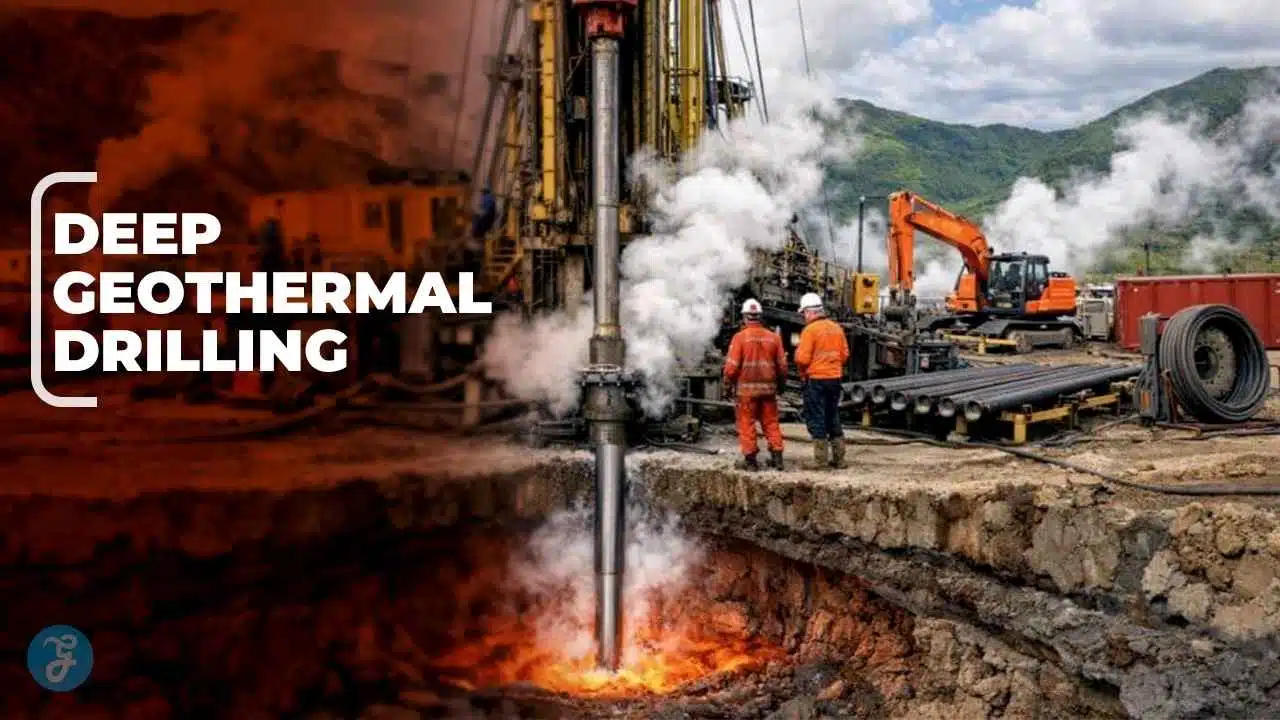
Imagine a world where the very machinery that defined the fossil fuel age, the towering derricks and drill bits, becomes the savior of our climate. For decades, geothermal power was dismissed as a niche resource, limited to volcanic regions like Iceland where hot water naturally bubbles to the surface.
But that era is ending. We are now witnessing the dawn of Next-Generation Geothermal Energy, a technological revolution that promises to turn the entire planet into a power plant. By drilling deep into hot, dry rock rather than hunting for rare aquifers, we can finally harvest the inexhaustible heat beneath our feet anywhere on Earth.
Key Takeaways
- Paradigm Shift: We are moving from “hunting” for rare volcanic heat to “harvesting” heat available anywhere on Earth using Next-Generation Geothermal Energy.
- The Oil Pivot: The fossil fuel industry provides the essential workforce, technology, and supply chain (drilling rigs, fracking, sensors) needed to scale geothermal power.
- Baseload Solution: Unlike wind or solar, advanced geothermal provides 24/7 “always-on” power, acting as a critical stabilizer for the renewable energy grid.
- Technological Leap: Innovations like Enhanced Geothermal Systems (EGS), Closed-Loop (AGS), and Millimeter-Wave drilling are unlocking energy from hot, dry rocks miles beneath the surface.
- Economic Viability: With the “Geothermal Shot” initiative, the industry aims to drop costs to $45/MWh by 2035, making it competitive with traditional fossil fuels.
The Clean Energy Paradox
While solar and wind have dominated the green conversation, they suffer from a fatal flaw: intermittency. The sun sets, and the wind dies down, leaving the grid reliant on batteries or fossil fuels to fill the gaps. Next-Generation Geothermal Energy solves this by providing “baseload” power, electricity that flows consistently, 24 hours a day, 365 days a year.
The irony is palpable. To unlock this clean, infinite energy, we are turning to the perceived “villain” of the climate narrative: Big Oil. It turns out that the engineering miracles developed to squeeze the last drops of oil from shale rock are exactly what we need to crush hot, dry granite miles deep.
By repurposing the oil and gas industry’s workforce and technology, Geothermal 2.0 isn’t just an energy transition; it’s a workforce evolution. We aren’t leaving the drillers behind; we are giving them a new mission, drilling for heat instead of hydrocarbons.
The “Oil & Gas” Connection: A Tech Transfer Story
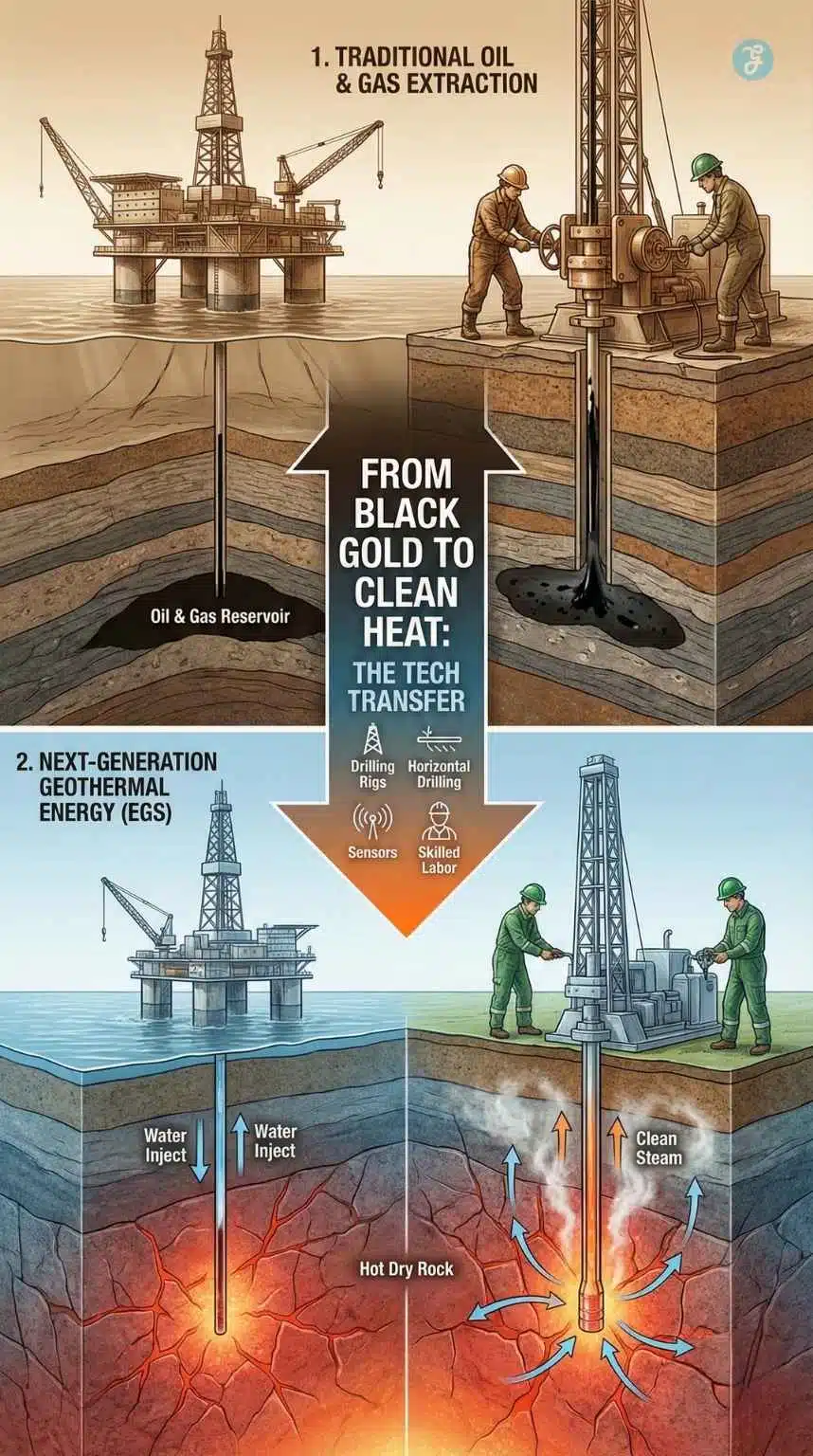
The rapid scaling of Next-Generation Geothermal is driven by the direct adaptation of fossil fuel technologies. This section details how the industry is leveraging existing oil and gas assets—from advanced drilling rigs and seismic mapping to a specialized workforce—to solve the engineering challenges of deep heat extraction without the need for decades of new research.
From Black Gold to Clean Heat
For over a century, the oil and gas (O&G) industry has perfected the art of surviving in hostile environments deep underground. They have mapped the subterranean world better than we have mapped the oceans. This deep institutional knowledge is the cornerstone of the new geothermal wave.
The transition from fossil fuels to geothermal is arguably the most seamless “Green Collar” shift available. A solar technician cannot easily swap jobs with an offshore oil rig worker; the skills are vastly different. However, a drilling engineer on a Texas oil field can walk onto a geothermal site and feel immediately at home. The safety protocols, the rig mechanics, the mud logging, and the geology are strikingly similar.
This “skill bridge” solves a massive political and economic problem: what to do with the millions of workers in the fossil fuel sector as the world decarbonizes? Geothermal 2.0 offers a direct answer. It utilizes the same steel pipes, the same cement casings, and the same sensor technology. We don’t need to invent a new supply chain; we just need to redirect the existing one.
| Job Role | Role in Oil & Gas | Role in Geothermal 2.0 | Transferability |
| Drilling Engineer | Designs wells to extract oil/gas. | Designs wells to extract heat/steam. | High (90%) |
| Geologist | Locates hydrocarbon reservoirs. | Locates subsurface heat anomalies. | High (85%) |
| Roughneck | Operates rig machinery. | Operates rig machinery. | High (100%) |
| Reservoir Engineer | Optimizes oil flow rates. | Optimizes water/heat flow rates. | Medium-High (75%) |
The Shale Boom Legacy
The “Shale Revolution” of the early 2000s changed the global energy map, primarily through two technologies: horizontal drilling and hydraulic fracturing (fracking).
In the past, drillers could only go straight down. If they missed the oil pocket, it was a dry hole. Horizontal drilling allowed them to drill down two miles, turn the drill bit 90 degrees, and drill another two miles sideways through a thin layer of oil-rich rock.
Next-Generation Geothermal applies this exact geometry to heat. Instead of chasing a specific pool of hot water (which is rare), engineers can now drill into hot, dry rock anywhere. By turning the well horizontally, they can expose the water to a much larger surface area of hot rock, maximizing heat transfer. Without the billions of dollars spent perfecting directional drilling for oil, modern geothermal would likely still be a pipe dream.
The Core Technologies of Geothermal 2.0
To understand why this is “2.0,” we have to look at the three specific technologies that are breaking the geographic constraints of traditional geothermal.
1. Enhanced Geothermal Systems (EGS)
EGS is the flagship technology of this new era. In traditional settings, you need three things naturally present: heat, fluid (water), and permeability (cracks in the rock for water to move). Most of the planet has the heat (if you dig deep enough), but lacks the water and the cracks.
EGS engineers nature. They drill into hot, solid rock (usually granite) and inject fluid at high pressure. This isn’t “fracking” in the dirty sense of mixing toxic chemicals to release gas; it is “hydraulic stimulation” used to shear the rock slightly, creating a network of tiny, interconnected fractures.
The Process:
- Injection: Cold water is pumped down an injection well.
- Circulation: The water travels through the man-made fractures in the hot rock, absorbing thermal energy.
- Production: The now-superheated water is drawn up a second well (the production well) to the surface.
- Generation: The heat is transferred to a power plant (often a binary cycle plant) to spin a turbine, and the cooled water is injected back down to start the loop again.
Companies like Fervo Energy have proven this works commercially. By using fiber-optic cables inside the well, a trick learned from the oil industry, they can monitor exactly where the water is flowing and how hot it is getting, allowing for real-time optimization.
2. Advanced Geothermal Systems (AGS) / Closed-Loop
If EGS is about breaking rock, AGS is about plumbing. Often called “Closed-Loop Geothermal,” this method treats the Earth like a giant radiator.
In an AGS system, fluids never touch the rock directly. Instead, a sealed loop of conductive pipes is drilled deep underground. A working fluid circulates inside these pipes, absorbing heat through the pipe walls via conduction, and brings it to the surface.
Why is this revolutionary:
- No Fracking: Since no fluid is injected into the rock, there is zero risk of induced seismicity (earthquakes).
- Water Independence: It doesn’t consume water. The same fluid circulates forever.
- Predictability: It relies on conduction, which is easier to model than the chaotic flow of water through fractured rocks in EGS.
Eavor Technologies is the pioneer here. Their “Eavor-Loop” design resembles a massive underground radiator grid. While the energy output per well is generally lower than EGS, the reliability and ability to place it near cities (where earthquakes are a non-starter) make it highly attractive.
3. Superhot Rock & Energy Drilling
This is the “Moonshot” of the industry. Standard geothermal operates at 150°C–300°C. “Superhot Rock” geothermal aims for temperatures exceeding 400°C (752°F).
At these depths and pressures, water becomes “supercritical”, a weird state where it isn’t quite liquid and isn’t quite gas, but holds an incredible amount of energy. A single superhot well could produce 10 times the energy of a standard well.
The challenge? Physics. Traditional mechanical drill bits grind rock. At 10 miles deep, the rock is so hot that electronics fry and drill bits melt. Enter Quaise Energy, an MIT spin-off. They are developing millimeter-wave drilling technology. Instead of a mechanical bit, they use a device called a gyrotron (borrowed from nuclear fusion research) to shoot high-powered energy beams that vaporize the rock.
This allows them to drill deeper and faster than ever thought possible, potentially unlocking access to heat beneath our feet anywhere on the globe.
The Economic Case: Why Now?
The commercial viability of Next-Generation Geothermal is being accelerated by a convergence of grid instability issues and technological cost reductions. This section examines the economic factors transforming the sector, specifically the rising market value of 24/7 clean energy and the aggressive price targets making it competitive with traditional power sources.
The Value of Baseload Power
The energy grid is a delicate balancing act. Supply must effectively match demand every second. Solar produces too much power at noon and none at night. Wind is unpredictable. To manage this, grid operators usually burn natural gas as a “peaker” source to fill the gaps.
Next-generation geothermal is the only renewable that is dispatchable. You can ramp it up or down to follow demand, just like a gas plant. As we retire coal and nuclear plants, the grid is desperate for a clean, firm power source to keep the lights on when the sun isn’t shining. This “reliability premium” makes geothermal much more valuable than its raw cost per kilowatt-hour suggests.
LCOE Trends and the “Geothermal Shot”
The Levelized Cost of Energy (LCOE) measures the average cost of electricity over the lifetime of a plant. Historically, EGS was expensive, over $200/MWh. However, the U.S. Department of Energy (DOE) launched the “Enhanced Geothermal Shot”, an aggressive initiative to slash the cost of EGS by 90% to $45/MWh by 2035.
Achieving this puts it in direct competition with natural gas. As drilling techniques improve and learning curves kick in (similar to how solar costs plummeted in the 2010s), geothermal is poised to become the cheapest form of firm power available.
| Energy Source | Capacity Factor (Reliability) | LCOE ($/MWh) | Land Use Intensity |
| Solar PV | 20% – 25% | $30 – $45 | High |
| Wind (Onshore) | 30% – 40% | $30 – $50 | High |
| Natural Gas | 50% – 85% | $45 – $75 | Low |
| Geothermal 2.0 (Target) | 90% – 95% | $45 (2035 Goal) | Very Low |
Environmental Impact & Sustainability
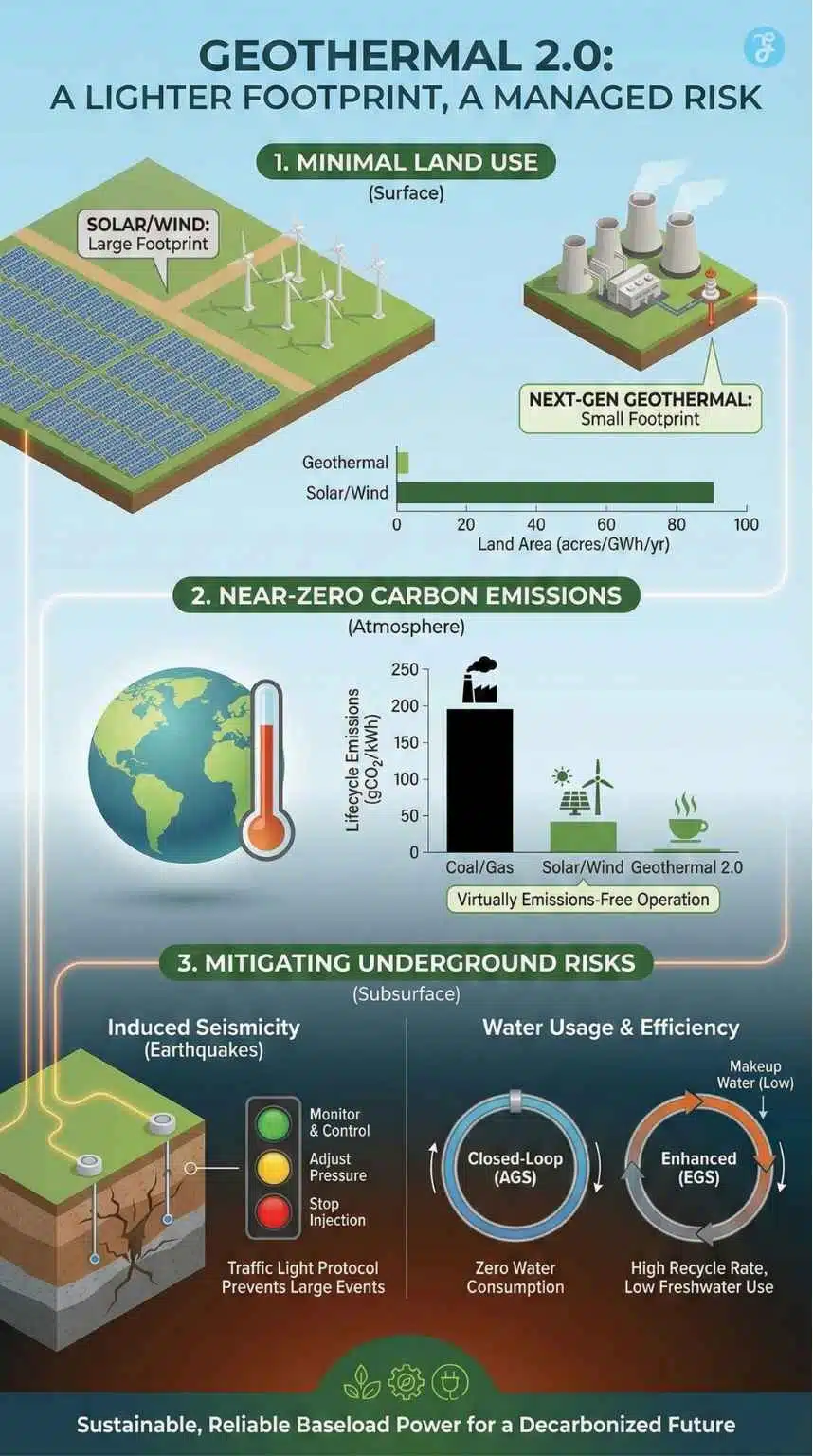
Next-Generation Geothermal offers a distinct sustainability advantage through its minimal surface footprint and low material intensity. This section analyzes its environmental benefits compared to wind and solar, while addressing the industry’s protocols for managing risks such as induced seismicity and water usage.
Land Use and Carbon Footprint
In a crowded world, space matters. Solar farms require thousands of acres to generate the same power as a small geothermal facility. Geothermal power plants have the smallest surface footprint of any energy source. Most of the infrastructure is underground. This makes it ideal for regions where land is expensive or ecologically sensitive.
Furthermore, next-gen geothermal is a critical minerals miser. While EVs and battery storage require massive amounts of lithium, cobalt, and nickel, geothermal plants are mostly made of steel and cement—cheap, abundant materials.
Addressing the Risks
We must address the elephant in the room: Induced Seismicity. Because EGS involves injecting water to fracture rock, it can trigger small earthquakes. This famously shut down a project in Basel, Switzerland, in 2006.
However, the industry has evolved significantly since then.
- Better Mapping: We now identify and avoid major fault lines with high precision.
- Traffic Light Systems: Operators use sensitive seismometers. If tremors reach a minor threshold (Green to Yellow), they dial back injection pressure immediately, preventing larger events (Red).
- Soft Stimulation: Modern EGS uses “shear stimulation” (gentle opening of existing cracks) rather than explosive fracturing.
Data from the Utah FORGE lab has shown that with proper protocols, these risks are manageable and minimal compared to the environmental devastation of fossil fuel extraction.
Major Players and Projects to Watch
The sector is moving from “science projects” to commercial deployment. Here are the entities leading the charge:
- Fervo Energy (USA): The current leader in EGS. Their “Project Red” in Nevada was a watershed moment in 2024, proving they could conduct a 30-day well test at commercial flow rates. They are currently developing the huge Cape Station project in Utah, which aims to deliver 400 MW of continuous clean power, enough for 300,000 homes.
- Eavor Technologies (Canada/Global): Focused on the scalable “Eavor-Loop.” They secured massive funding to build commercial loops in Germany, where the heat will be used not just for electricity, but for district heating (keeping homes warm in winter without gas).
- Utah FORGE (DOE): This is the field laboratory where the magic happens. Funded by the US government, it is an underground playground where researchers from around the world test new drill bits and stimulation techniques without the pressure of commercial profit.
- Google & Microsoft: The tech giants are the biggest customers. To meet their “24/7 Carbon Free” goals, they are signing Power Purchase Agreements (PPAs) with geothermal startups to power their data centers. They realize that wind and solar alone cannot run an AI server farm reliably.
Future Outlook: The Path to 2050
Realizing the global potential of Next-Generation Geothermal requires a strategic transition from successful pilot projects to mass commercial deployment. This section outlines the roadmap to 2050, identifying the critical regulatory reforms and infrastructure integration needed to establish deep earth heat as a cornerstone of the net-zero energy mix.
Scaling Up
The next decade (2026-2036) is the “deployment phase.” The technology works; now it needs to scale. We need to move from drilling 10 geothermal wells a year to drilling 10,000. This requires permitting reform. In many countries, geothermal is regulated like oil and gas, requiring years of environmental reviews. Streamlining these permits (categorizing them as renewable infrastructure) is crucial to unlocking the speed required for climate goals.
Retrofitting the Past
One of the most exciting prospects is repowering coal plants. A coal power plant is essentially a steam turbine connected to a dirty boiler. Geothermal 2.0 proposes replacing the coal boiler with Earth’s heat. We can drill deep geothermal wells on the site of retiring coal plants, using the existing transmission lines and turbines. This saves billions in infrastructure costs and revitalizes coal communities with clean energy jobs.
Final Thought: The Age of Heat Farming
We are witnessing a fundamental shift in our relationship with the Earth. For two centuries, humanity has been in the “Age of Hunting”, scouring the planet for pockets of oil, gas, and coal to burn. It was a finite game with messy consequences.
Next-Generation Geothermal Energy ushers in the “Age of Farming.” We no longer need to hunt for energy; we can harvest it right where we stand. By combining the brute force of the oil rig with the precision of silicon valley tech, we are unlocking a resource that is inexhaustible, clean, and ubiquitous.
The heat beneath our feet has been there for billions of years, waiting. We finally have the tools to reach it.