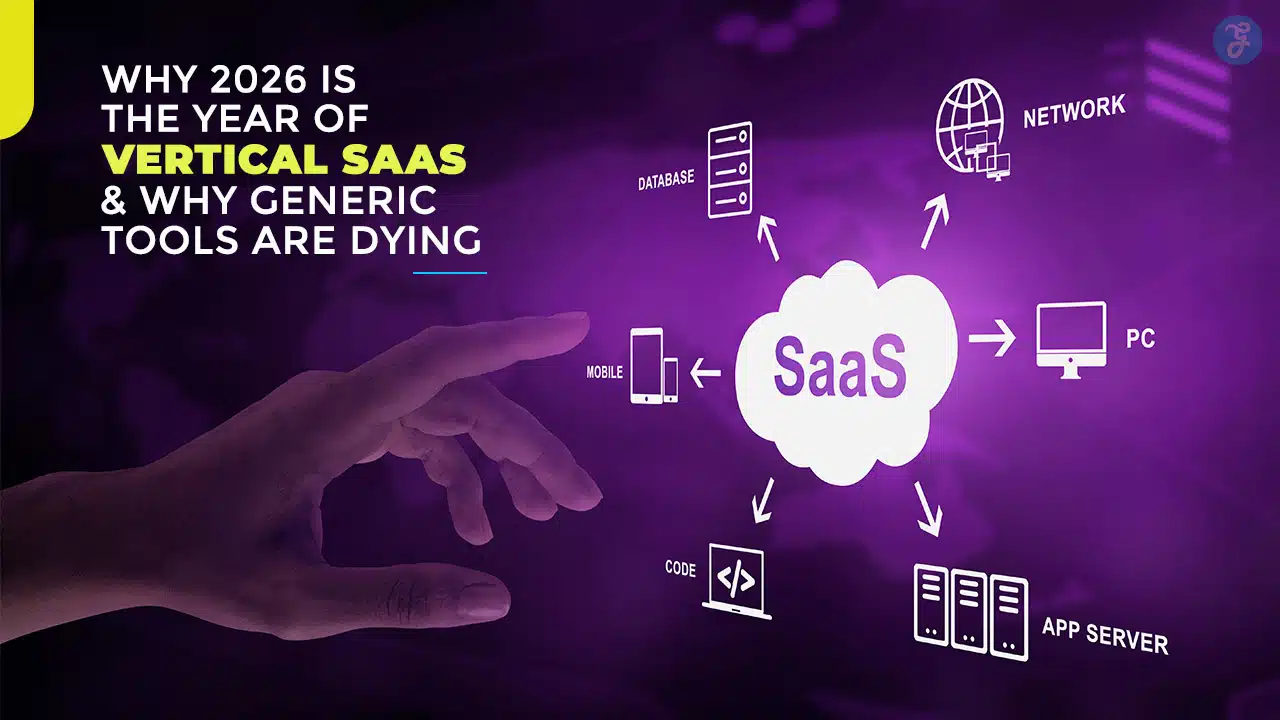
Vertical SaaS in 2026 feels like a quiet takeover. Not the loud kind where one product replaces everything overnight, but the steady kind where industry-specific platforms become the place work actually happens.
For years, teams stacked generic tools for CRM, projects, docs, chat, analytics, and payments. It worked, until it didn’t. The stack became messy. Costs crept up. Data spread across too many apps. Security teams lost visibility. And new AI features started showing up everywhere, even where nobody asked for them.
Now buyers want fewer tools that do more of the real job. That shift is exactly where vertical SaaS shines.
The SaaS Landscape In 2026: Why Buyers Are Rethinking The Stack
Most companies do not suffer from “too little software.” They suffer from too much of it.
Okta’s Businesses at Work research has tracked app adoption for years. In the 2024 report, Okta found the average number of apps per company rose to 93, with large companies averaging 231 apps. That is already a lot to manage, before you add AI tools and new compliance requirements.
At the same time, public cloud spending keeps rising. Gartner forecast worldwide public cloud end-user spending would reach $723.4 billion in 2025, up from $595.7 billion in 2024. More cloud spend usually means more vendors, more integrations, and more risk unless the stack gets simplified.
This is the tension shaping 2026:
-
Businesses want modern, cloud-based systems
-
But they also want fewer tools, fewer logins, and fewer integration headaches
-
And they want AI that saves time, not AI that adds noise
Vertical SaaS is one of the cleanest responses to that tension.
| What’s Changing In 2026 | What Buyers Want Instead | What This Pushes Teams Toward |
|---|---|---|
| App sprawl and overlapping tools | Fewer platforms that cover full workflows | Consolidation around “systems of record” |
| More cloud services, more vendors | Clear ownership of data and access | Identity-first architecture |
| AI features everywhere | Practical automation tied to business outcomes | AI inside the workflow, not bolted on |
What Vertical SaaS Means (And Why It’s Different From “Niche”)
Vertical SaaS is software built for a specific industry and its real workflows, not just a generic tool with custom fields.
Andreessen Horowitz describes vertical SaaS as a category that scales by embedding deeper capabilities, including fintech and AI, to expand revenue and market reach. Gartner uses a related idea at the platform layer with “industry cloud platforms,” which combine software and cloud services for specific vertical needs.
A simple test helps:
If you removed the product, would the business lose an entire workflow (billing, scheduling, claims, compliance, fulfillment), or just a general function (notes, chat, task lists)?
Vertical SaaS tends to own workflows. Horizontal tools tend to support work around the edges.
Typical vertical SaaS characteristics:
-
Industry language and templates built in
-
Compliance and audit needs designed into the product
-
Integrations that match the industry’s common vendors
-
Reporting that matches how that industry measures performance
-
Payments, financing, or other transactions embedded in the flow (in many cases)
| Vertical SaaS Trait | What It Looks Like | Why It Matters |
|---|---|---|
| Workflow ownership | From intake to invoice | Higher stickiness and better ROI proof |
| Built-in compliance | Permissions, logs, policies | Faster procurement and lower risk |
| Data model fits the job | Industry entities are native | Better reporting and automation |
| Embedded monetization | Payments, lending, insurance | Higher revenue per account potential |
Why Vertical SaaS In 2026 Is Taking Off

Vertical SaaS is not new. What’s new is how strongly the market conditions favor it right now.
1) Tool Sprawl Has Turned Into A Cost And Security Problem
When companies run dozens (or hundreds) of apps, every new tool adds:
-
Another login and permission set
-
Another vendor risk review
-
Another integration to build and maintain
-
Another place data can leak
Okta’s reporting highlights how app adoption has been climbing again. In parallel, many IT and security teams are actively trying to shrink the stack instead of growing it.
Vertical platforms often replace multiple point solutions at once because they own the workflow end-to-end.
2) AI Rewards Deep Context More Than Broad Features
Generic tools can add AI assistants quickly. But vertical tools often win because they have:
-
Cleaner domain data
-
Repeatable workflows
-
Specific outcomes to optimize
That matters because AI is most useful when it can act on structured, trusted context.
A16z argues vertical SaaS is scaling again, this time because AI can be built directly into vertical workflows and sold as real productivity.
3) Embedded Finance Expands The Business Model
A major reason vertical SaaS can outgrow “small markets” is monetization beyond subscriptions.
A16z has long argued fintech can scale vertical SaaS by expanding revenue per customer, often cited as 2–5x in the right cases. Stripe’s embedded finance guidance also points to similar upside for platforms that add financial services.
What this looks like in practice:
-
Payments at checkout or invoice
-
Instant payouts
-
Expense cards
-
Financing offers
-
Insurance and protection products
The result is a business model that captures value when customers transact, not only when they log in.
4) Growth Pressure Is Pushing Software Toward “Must-Have,” Not “Nice-To-Have”
A 2025 AlixPartners study (reported by Business Insider) warned many midmarket software companies were being squeezed by AI-native entrants and giants bundling AI features.
In that climate, “generic productivity with small differentiation” is a tough place to live. Vertical SaaS avoids that trap by tying itself to revenue, compliance, and daily operations.
| 2026 Growth Driver | What It Changes | Why Vertical SaaS Benefits |
|---|---|---|
| Consolidation pressure | Buyers cut overlapping tools | Workflow platforms replace point tools |
| AI shift to outcomes | Features alone stop selling | Domain context becomes the advantage |
| Embedded finance maturity | Monetization expands | Revenue tied to transactions |
| Rising cloud spend | More vendor complexity | Industry platforms simplify procurement |
Are Generic Tools Really Dying? The Balanced Answer
“Generic tools are dying” is a catchy headline, but it is not fully true.
Generic tools are still strong when:
-
The workflow is the same across industries (email, chat, calendars)
-
The company needs broad interoperability
-
The tool is a platform layer (cloud, identity, data warehouse)
-
The buyer wants flexibility over depth
Also, some horizontal suites keep getting more powerful. Bundling is real, and buyers sometimes prefer fewer vendors even if the fit is not perfect.
So what is actually happening?
-
Generic tools are getting commoditized for many common tasks
-
Differentiation is moving toward vertical context, outcomes, and ownership of data
-
More “mid-layer” generic apps will struggle unless they become platforms or go vertical
Think of it less as “death” and more as “gravity.” If a tool does not own a workflow or a platform layer, it gets pulled into consolidation.
| Where Generic Tools Still Win | Where They Struggle In 2026 |
|---|---|
| Cross-industry collaboration | Industry-specific compliance workflows |
| Broad integrations and ecosystems | Deep workflow automation without context |
| Commodity categories with price pressure | Mid-layer “nice to have” software |
| Platform infrastructure | Proof of ROI tied to revenue outcomes |
The Vertical SaaS Playbook For 2026: How Winners Are Built
If you are building or investing, the 2026 playbook is clearer than it used to be.
Start With One Painful Workflow, Not A Full “Industry OS” Dream
The fastest path is usually:
-
Pick a workflow people already hate
-
Replace it with software that feels native to the industry
-
Expand into adjacent workflows once you own the data
Earn Trust Early With Compliance And Reliability
In many industries, software adoption is blocked by:
-
Audit requirements
-
Data residency and retention policies
-
Permissioning and role controls
-
Integration with legacy systems
If you treat compliance as an afterthought, growth slows later.
Add AI Where It Removes Real Labor
Good vertical AI in 2026 looks like:
-
Drafting notes, claims, or reports using structured templates
-
Flagging exceptions and compliance risks
-
Auto-categorizing and routing work
-
Summarizing conversations into the system of record
Bad vertical AI looks like a chatbot pasted onto a weak workflow.
Monetize Like A Platform, Not Just A Subscription
Embedded finance is one path, but not the only one.
Vertical SaaS can also monetize through:
-
Usage-based pricing for high-volume workflows
-
Outcome-based pricing in measurable processes
-
Marketplaces (staffing, supplies, services)
-
Data products, when privacy and contracts allow
Toast is a practical example of a workflow-led platform that also tracks metrics like gross payment volume and subscription/fintech gross profit, showing how vertical platforms blend software with payments economics.
| Playbook Step | What To Do | Practical Signal It’s Working |
|---|---|---|
| Own a core workflow | Replace a daily operational process | Users log in because they must |
| Build trust | Compliance + reliability by design | Procurement cycles shorten |
| Use AI for labor removal | Automate repeatable tasks | Time saved is measurable |
| Expand monetization | Add transactions or usage levers | Revenue per account rises |
What To Measure In Vertical SaaS (Beyond MRR)
Vertical SaaS performance is often misunderstood when teams only track SaaS-only metrics.
You still need the basics:
-
Retention (logo and net revenue)
-
Gross margin
-
CAC payback
-
Expansion
But vertical SaaS often adds second engines:
-
Payments volume and take rate
-
Financing attach rate
-
Marketplace GMV
-
Multi-product adoption
This changes how you judge “growth quality.”
A platform with stable subscription growth plus rising transaction adoption can be healthier than one that only adds seats.
Also watch operational readiness:
-
Support load per customer
-
Integration time per account
-
Compliance cost per deal
If those numbers spiral, scale becomes painful.
| Metric Category | What To Track | Why It Matters In 2026 |
|---|---|---|
| Core SaaS health | Retention, payback, margin | Still the foundation |
| Workflow depth | Feature adoption by role | Shows “system of record” strength |
| Transaction engines | Volume, attach rate, take rate | Expands TAM and ARPA |
| Operational scalability | Support, onboarding time | Protects growth efficiency |
Trade-Offs And Risks: Vertical SaaS Isn’t Easy Mode
Vertical SaaS can look like a cheat code. It isn’t.
Here are the common risks in 2026:
Smaller TAM Can Still Be A Real Limit
Some verticals are simply too small or too fragmented. You may need:
-
Multi-product expansion
-
Adjacency moves into related niches
-
Geographic expansion
-
Embedded monetization to raise revenue per customer
Industry Sales Cycles Can Be Weird
Some verticals buy fast (SMBs). Others buy slow (regulated enterprises).
You must match:
-
Pricing model
-
Implementation model
-
Sales motion
Data And AI Can Create New Liability
If you add AI and automation, you also add:
-
Model risk and error risk
-
Privacy and data-use concerns
-
Security expectations that buyers now ask about early
Platform Ambition Can Kill Focus
Trying to become the “everything system” too soon can lead to:
-
Bloated product
-
Weak differentiation
-
Costly implementation
| Risk | What It Looks Like | How Strong Teams Reduce It |
|---|---|---|
| TAM ceiling | Growth stalls after initial niche | Expand adjacencies and monetization |
| Long sales cycles | Deals drag, implementation heavy | Product-led onboarding where possible |
| AI liability | Errors, compliance issues | Guardrails, review loops, audit logs |
| Overbuilding | Too many features too soon | Nail one workflow, then expand |
Buyer’s Checklist: How To Choose Between Vertical And Generic Tools
If you’re buying in 2026, the best question is not “vertical or horizontal.”
The best question is: “Where do we need depth, and where do we need flexibility?”
Use this quick decision guide.
Choose Vertical SaaS When
-
The workflow is core to revenue or compliance
-
Staff need industry-specific screens and language
-
You are tired of stitching together 4–7 tools
-
You need reporting that matches how your industry works
Choose Generic Tools When
-
Your needs are common across industries
-
You want broad integrations and standardization
-
You need flexibility and custom workflows across teams
-
The tool is a platform layer (identity, cloud, data)
Red Flags In 2026 Procurement
-
AI features with no clear workflow fit
-
Vendor promises that depend on “custom services” forever
-
Weak permissioning and audit controls
-
No clear data export or migration path
| Decision Factor | Vertical SaaS Usually Wins If… | Generic Tools Usually Win If… |
|---|---|---|
| Workflow criticality | It’s tied to revenue/compliance | It’s supportive, not core |
| Implementation | There’s a standard industry path | Every team needs unique setups |
| Data model | Industry entities matter | Generic objects are enough |
| Vendor strategy | You want consolidation | You want best-of-breed flexibility |
Final Thoughts
Vertical SaaS in 2026 is winning because it fits how work really happens. It turns software from “yet another tool” into a workflow engine that connects operations, data, and sometimes transactions.
Generic tools are not disappearing. The best ones will keep thriving as platforms, standards, and collaboration layers. But many mid-tier generic apps will face tough questions as buyers consolidate and demand clearer ROI.